

You have hollow bones because they reduce your skeletal weight without sacrificing strength, which is essential for efficient flight. Their thin walls and internal struts provide strong support while minimizing mass, enabling agility and lower energy use during flight.
These bones connect to your respiratory system through air sacs, improving oxygen flow and metabolic efficiency. This adaptation evolved to meet the high demands of flight and varies among bird species.
Exploring further reveals more on their mechanical and metabolic roles.
Importance of Lightweight Skeletons in Flight

Because flight demands immense metabolic energy, birds have evolved lightweight skeletons that minimize their overall body mass. This directly reduces the energy required to generate lift. You’ll notice that the weight of a bird’s skeleton is significant, as it directly correlates with metabolic cost during flight.
When skeletal mass decreases, the overall body weight lessens, requiring less aerodynamic lift and conserving energy. This efficiency is especially important for small birds that rely on rapid wing beats. The presence of hollow bones with internal struts allows birds to maintain strength while significantly reducing skeletal weight.
Furthermore, birds optimize their skeletal strength-to-weight ratios, achieving remarkable stiffness and load-bearing capacity without excess mass. This dual optimization allows them to sustain prolonged flights with reduced energy expenditure.
Internal Structure and Reinforcement of Hollow Bones
Although hollow bones might seem fragile at first glance, their internal structure incorporates sophisticated reinforcements that provide remarkable strength without adding excessive weight.
You’ll find that the outer edges feature a thin cortical layer to minimize weight, while the main bone body retains a thicker cortex for vital support.
Inside, a honeycomb-patterned trabecular system distributes stress efficiently. Moreover, criss-crossing internal struts brace the framework against mechanical stress during flight. These bones also contain pneumatic sacs that reduce weight and improve respiratory efficiency.
Key reinforcements include:
- Cortical layering balances minimal weight with necessary load-bearing capacity.
- Honeycomb trabeculae optimize strength by spreading forces across the internal matrix.
- Internal strut networks create a truss-like lattice that resists bending and torsion.
This precise architecture guarantees your bird’s skeleton is lightweight yet remarkably strong.
Integration of Hollow Bones With the Respiratory System

You’ll find that birds’ hollow bones are directly connected to their respiratory system through an extensive network of air sacs linked to specific skeletal regions.
This setup isn’t just random—it’s actually pretty clever. By maintaining unidirectional airflow through these pneumatic bones, birds can improve oxygen flow significantly, which means gas exchange becomes way more efficient. Fresh air flows unidirectionally over gas exchange surfaces during respiration, ensuring a near-constant supply of oxygen.
When you really think about it, this connection shows how the skeletal and respiratory systems work together as one smooth operation.
It’s a smart design that supports the high metabolism birds need to power flight.
Air Sacs Connection
When air sacs connect to the hollow spaces within bird bones, they form an integrated respiratory system that extends beyond the lungs themselves. This connection creates a continuous network where air sacs invade pneumatized bones, enabling airflow to reach beyond traditional lung tissue.
You should understand that:
- Air sacs systematically pneumatize vertebrae from neck to pelvis, uniting air spaces across the skeleton.
- Bone struts maintain structural integrity despite extensive hollows, supporting the bird’s lightweight yet strong frame.
- This skeletal-respiratory integration allows air sacs to facilitate unidirectional airflow, sustaining oxygen supply even during exhalation.
- Contrary to popular belief, the hollow bones are actually denser than similar-sized animals, indicating that their function is not primarily to reduce weight.
Through this sophisticated linkage, the skeletal system actively participates in respiration, enhancing efficiency and meeting the high metabolic demands of flight.
Oxygen Flow Enhancement
Because birds’ hollow bones integrate directly with their respiratory system, they greatly improve oxygen flow efficiency essential for flight. This integration supports unidirectional airflow, ensuring fresh air continuously passes through lungs during inhalation and exhalation, maximizing oxygen extraction.
The hollow bones act as conduits for air sacs, maintaining steady oxygen delivery to tissues and meeting high metabolic demands. This system eliminates air stagnation, enhancing gas exchange rates via air capillaries and supporting sustained, energy-intensive flight. Additionally, the hollow bones are reinforced internally with struts and cross-bracing, preserving their structural integrity despite their lightness.
| Feature | Benefit |
|---|---|
| Unidirectional airflow | Continuous oxygen supply |
| Hollow bones connected to air sacs | Efficient air distribution |
| Dual-phase oxygen uptake | Maximum oxygen extraction |
| Continuous oxygen delivery | Sustained flight metabolism |
Respiratory System Integration
Although hollow bones might seem like simple structural features, they form an intricate part of the bird’s respiratory system by maintaining permanent connections with air sacs throughout the skeleton. This integration supports continuous oxygen delivery essential for flight.
You’ll find:
- Air sacs permanently invade hollow bones during development, creating air-filled cavities connected to the respiratory system.
- These pneumatic bones link directly to air sacs, enabling unidirectional airflow that improves gas exchange efficiency.
- The interconnected system supplies oxygen during both inhalation and exhalation, meeting the high metabolic demands of flight. Studies using high-resolution CT scans have allowed scientists to quantify the distribution of air and marrow in bird bones, deepening our understanding of this system.
This respiratory-bone integration distinguishes birds from mammals and reptiles, providing superior oxygen extraction and supporting sustained aerobic performance.
Understanding this complex architecture reveals how hollow bones contribute beyond mere weight reduction to respiratory efficiency.
Role of Air Sacs in Bird Skeletons
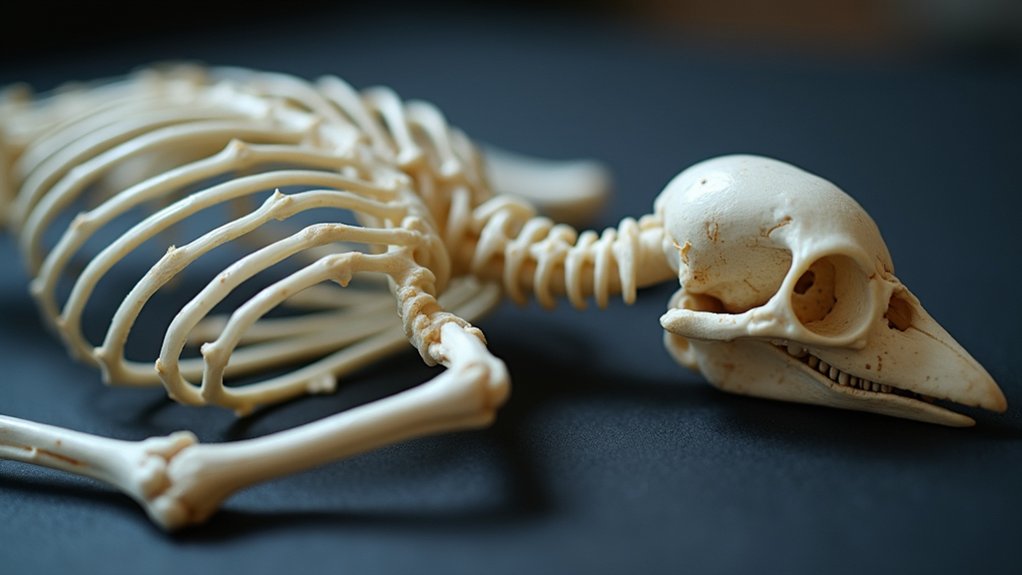
Since air sacs extend directly into the hollow spaces of bird bones during development, they play an essential role in linking respiratory function with the skeletal system.
These delicate, capacious air chambers invade skeletal structures, maintaining permanent attachment to bone hollows throughout the bird’s life.
By pneumatizing bones, air sacs create air-filled cavities that improve oxygen availability beyond the lungs. This extension supports continuous ventilation, facilitating efficient gas exchange even during sustained flight. The unidirectional airflow within air sacs ensures that fresh air continuously passes through the bones, enhancing respiratory efficiency.
Air sacs pneumatize bones, enhancing oxygen flow and enabling efficient gas exchange during prolonged flight.
The thin-walled sacs connect to lungs via ostia, ensuring synchronized airflow throughout respiratory and skeletal components.
Consequently, the integration of air sacs within bones reduces skeletal weight while optimizing respiratory efficiency, demonstrating a crucial physiological adaptation that sustains the avian metabolic demands associated with powered flight.
Evolutionary Origins of Pneumatic Bones
The integration of air sacs into bird bones reflects a complex evolutionary history rooted in the Ornithodira clade, which includes pterosaurs and non-avian dinosaurs. This trait emerged as postcranial skeletal pneumaticity (PSP) when pneumatic lung diverticula invaded the skeleton, enhancing respiratory efficiency.
You can trace this evolutionary innovation through:
- Early sauropodomorphs with pneumatic neck vertebrae, progressing to neosauropods exhibiting extensive vertebral pneumatization.
- Theropods like Aerosteon showing postcranial air sac systems, indicating a shared ancestral respiratory adaptation.
- Developmental patterns in modern birds mirroring ancestral pneumatization sequences, with cranial vertebrae pneumatized early.
This adaptation not only lightened the skeleton but also allowed for a more effective respiratory system by connecting the hollow bones to the air sacs, which significantly improves oxygen intake during flight.
Understanding these origins clarifies how birds inherited a sophisticated air-exchanging lung system, optimizing oxygen uptake and reducing skeletal mass.
Variations in Hollow Bone Structure Across Bird Species
You’ll notice that hollow bone structures vary widely among bird species. This variation is influenced by factors like size, flight capability, and evolutionary history.
For instance, larger birds tend to have more extensive air-filled cavities to reduce their weight.
On the other hand, flightless species keep hollow bones mainly for thermoregulation rather than flying.
Plus, pneumaticity patterns can differ quite a bit even among closely related species. This reflects how they’ve adapted to their specific ecological niches.
Additionally, the degree of hollowness in bird bones is not uniform, with some species like ostriches having denser bones to support their terrestrial lifestyle.
Species-Specific Pneumaticity Patterns
Species-Specific Pneumaticity Patterns
Although hollow bones are a common trait among birds, their distribution and density vary considerably across species. This reflects adaptations to different ecological niches and flight demands. You’ll notice that pneumaticity patterns align closely with a bird’s size, flight style, and habitat requirements.
For instance, large soaring birds like eagles exhibit extensive air-filled bones to reduce weight and improve respiratory efficiency. On the other hand, smaller songbirds have selectively hollow bones to balance agility and oxygen intake. Diving birds, conversely, possess solid bones to aid underwater maneuverability.
Key factors include:
- Body size drives pneumaticity extent, with larger birds increasing air sac networks to offset mass.
- Flight style dictates bone density variations, optimizing strength or lightness as needed.
- Ecological roles influence skeletal adaptations, balancing buoyancy, mobility, and respiratory demands.
Additionally, the integration of the respiratory system with the skeletal system allows air to be stored within bones during breathing, enhancing oxygen absorption during flight and contributing to the bird’s overall respiratory efficiency.
Flightless Birds’ Bone Structure
Bird species adapted to flight demonstrate varied pneumaticity patterns that optimize weight and respiratory efficiency, but you’ll find a stark contrast when examining flightless birds.
Once freed from aerodynamic constraints, flightless birds develop denser, more solid bones to support greater body mass without the need for lightweight skeletons.
For example, penguins and loons have entirely solid bones that aid underwater propulsion by reducing buoyancy, while ostriches and emus retain hollow femurs yet increase trabecular density for improved strength.
Internally, their bone architecture shifts from complex pneumatic networks seen in flyers to denser, weight-bearing structures. This inner structure reveals complex networks beyond a simple hollow tube, which highlights the adaptability of bone to different ecological demands.
These adaptations reflect evolutionary pressures favoring skeletal robustness over flight efficiency, demonstrating how loss of flight prompts rapid remodeling that balances residual pneumaticity with increased bone density to meet terrestrial or aquatic demands.
Size and Air Volume
Skeletal pneumaticity varies considerably with body size, influencing how air fills the hollow spaces within bird bones. Larger birds exhibit increased air volume in their pneumatic bones, with thinner bone walls to compensate for greater mass. This enables agile flight despite their size. In contrast, smaller birds maintain relatively less air volume.
You should note these critical variations:
- Heavy marrow replacement by air spaces scales with body mass, optimizing maneuverability in larger species.
- Diving birds contradict this trend, possessing denser, marrow-filled bones to overcome buoyancy during submersion.
- The humerus shows the greatest variability in pneumatization, reflecting its role in flight mechanics across species.
These adaptations illustrate how size and ecological niche drive the evolution of hollow bone structures in birds. Additionally, bird skeletons weigh about the same as mammal skeletons of the same size due to their thin but denser bone material, which prevents breakage and maintains strength within the bird skeleton.
Comparison of Hollow Bone Function in Flying and Flightless Birds
When comparing hollow bone function, you’ll notice that flying birds utilize a highly specialized respiratory system where air sacs connect to their hollow bones. This setup enables unidirectional airflow that sustains increased oxygen intake during both inhalation and exhalation.
This adaptation supports their heightened metabolic demands and reduces skeletal weight without sacrificing strength, thanks to trabeculae within the bone.
In contrast, flightless birds such as penguins have denser, solid bones that lack pneumatic cavities; this increases skeletal mass to improve underwater maneuverability and eliminates respiratory air sacs in bones.
Consequently, flightless species retain conventional bone marrow for blood cell production, while flying birds sacrifice marrow function in most bones.
These divergent structural and functional adaptations reflect evolutionary trade-offs aligned with each bird’s ecological niche and respiratory requirements.
Mechanical Benefits of Hollow Bones During Flight
Although hollow bones might seem fragile at first glance, they provide an exceptional balance of weight reduction and structural strength essential for flight. You’ll find that their thin walls, combined with dense bone material, reduce skeletal mass without sacrificing durability.
Internally, crisscrossing struts reinforce these bones, preventing breakage and minimizing damage spread during flight stresses.
Consider these mechanical benefits:
- Weight-to-strength optimization: Hollow bones weigh less than mammalian equivalents while maintaining stiffness, enabling swift maneuverability.
- Structural reinforcement: Internal lattice frameworks mirror aircraft design principles, ensuring bone rigidity despite thin walls.
- Aerodynamic efficiency: Lighter skeletons reduce muscular effort required for lift, enhancing acceleration, agility, and endurance during sustained flight.
This intricate design enables birds to withstand intense aerodynamic forces while maintaining remarkable flight performance.
Metabolic Advantages Provided by Hollow Bone Adaptations
Beyond providing mechanical strength and weight efficiency, hollow bones play an essential role in optimizing birds’ metabolic functions during flight. These pneumatic structures connect directly to the respiratory system, allowing continuous airflow through air sacs embedded within bones. This unique adaptation improves oxygen exchange efficiency, bypassing traditional lung-only respiration methods. By maintaining consistent oxygen availability, hollow bones support the extraordinary metabolic demand, 150-300% higher than mammals, required for sustained flight. Furthermore, air-filled cavities facilitate thermoregulation, dissipating metabolic heat generated during intense activity. Additionally, some hollow bird bones contain cross walls for strength, enhancing skeletal durability without adding weight. The reduced skeletal mass minimizes energy expenditure, enabling metabolic resources to prioritize muscle function and endurance. Ultimately, hollow bones integrate respiratory and metabolic functions, ensuring rapid oxygen delivery, stable glucose levels, and efficient heat management to sustain prolonged, high-intensity flight.
Frequently Asked Question
How Do Hollow Bones Heal After Fractures Compared to Solid Bones?
You’ll find hollow bones heal faster than solid bones due to their unique structure and blood supply.
Despite thin, brittle walls and internal struts, fractures in hollow bones stabilize quickly with proper immobilization.
However, their fragility demands specialized fixation methods like tie-in fixators for effective healing.
You must guarantee precise alignment, stabilization, and restricted activity to prevent complications and promote rapid recovery, often achieving healing in under a month.
Do Hollow Bones Affect a Bird’s Buoyancy in Water?
You might be surprised, but hollow bones greatly increase a bird’s buoyancy in water.
These pneumatic bones connect with air sacs, filling the skeleton with air pockets that reduce overall density.
This adaptation helps non-diving birds float effortlessly without using extra energy.
However, diving species evolve denser bones to counteract this buoyancy, allowing them to submerge deeply.
Can Hollow Bones Be Found in Animals Other Than Birds?
Yes, you can find hollow bones in other animals besides birds. For example, extinct pterosaurs had hollow bones that helped them fly, showing convergent evolution with birds.
Theropod dinosaurs, ancestors of birds, also had pneumatic bones aiding mobility and strength.
Some mammals, like humans and crocodiles, have hollow bone areas mainly around sinuses for sound and structure, but their hollowing isn’t as extensive or flight-related as in birds or dinosaurs.
What Role Do Hollow Bones Play in Bird Vocalization?
You’d be amazed to know that the frequency of bird vocalizations directly correlates with air sac pressure inside their hollow bones.
Hollow bones act as extensions of their respiratory system, enabling continuous bidirectional airflow.
This airflow sets syringeal labia vibrating, producing sound. By controlling muscle tension around these structures and regulating air sac pressure, birds modulate pitch and volume with precision.
This allows complex vocalizations essential for communication and species-specific songs.
How Does Diet Influence the Development of Hollow Bones?
Your diet directly shapes hollow bone development by supplying essential calcium and minerals.
Without enough calcium, your pneumatic bones weaken, compromising structural support.
Vitamin D improves calcium absorption, which is essential for maintaining bone density.
An imbalanced calcium-phosphorus ratio disrupts bone remodeling, leading to fragile skeletons.
If you lack these nutrients, your bones won’t properly mineralize, reducing flight capability and affecting egg production.
Balanced nutrition is important for healthy hollow bone formation.
Conclusion
You might not realize it, but a bird’s hollow bones are nature’s clever engineering marvels, designed to keep them effortlessly airborne. These lightweight yet sturdy structures, reinforced internally, seamlessly integrate with their respiratory system to optimize flight efficiency and metabolism.
Whether soaring high or grounded, these adaptations reflect millions of years of evolutionary finesse. They ensure birds remain masters of the sky without unnecessary weight holding them back.