

You’ll notice birds stop chirping shortly after dawn because increasing light and temperature trigger hormonal shifts that redirect their behavior from singing to foraging and predator awareness. Rising daylight signals the end of ideal acoustic conditions, while warmer air degrades sound transmission.
Different species respond distinctly based on breeding status and environmental cues. Predation risk and noise pollution also influence their silence.
Exploring these factors reveals complex adaptations shaping their morning vocal patterns and survival strategies.
Timing of Morning Birdsong Cessation

At dawn, you’ll notice birds typically stop singing as the sun rises, usually between 5 and 7 am depending on the season and location. This time of day marks a critical change when increased light levels prompt birds to cease their morning chorus.
Species like robins, known for early singing, often end their songs shortly after sunrise to prioritize foraging. The intensity and frequency of birdsong peak just before dawn, then taper as daylight strengthens.
During the breeding season, singing serves to attract mates and defend territory, but as nesting concludes, birds reduce vocalizations to avoid predation.
Consequently, by late summer, you’ll observe a significant decline in morning chirping, illustrating how the timing of birdsong cessation aligns closely with biological and environmental cues linked to the breeding cycle.
Environmental Triggers for Silence
When light levels increase and temperatures rise after dawn, birds quickly respond by ceasing their morning songs to shift focus toward foraging. This shift marks the end of the dawn chorus, influenced by several environmental factors.
As light and temperature rise after dawn, birds stop singing to focus on foraging, signaling the dawn chorus’s end.
You’ll notice that the presence of predators or sudden disturbances causes birds to abruptly stop chirping to prioritize safety.
Moreover, as daytime noise pollution intensifies, birds reduce vocal activity to avoid competition with ambient sounds.
The change from calm, cool dawn conditions to warmer, windier atmospheres also degrades song clarity, prompting silence.
These environmental triggers work together to signal birds that the dawn chorus is complete, ensuring they adjust behaviors to optimize survival and feeding rather than maintaining vocal displays.
Role of Sunlight and Temperature
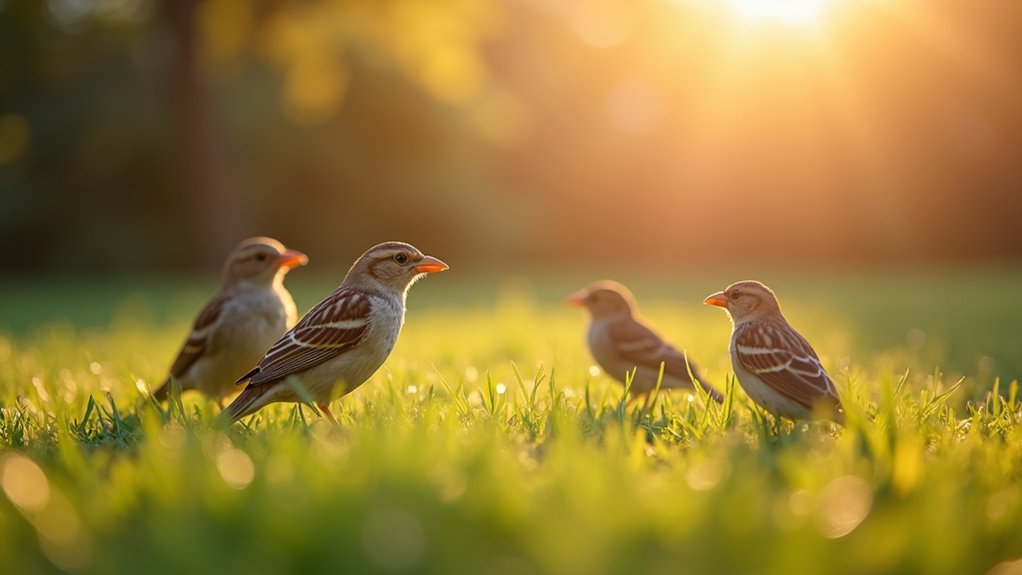
Although birds begin their dawn chorus in low light, they typically stop chirping soon after the sun rises because increased sunlight signals a shift from vocal communication to active foraging.
When the sun rises, the environment warms, causing temperature to rise, which influences bird behavior.
You’ll notice that as temperature increases, birds reduce their vocalizations, focusing energy on feeding and other survival tasks. Moreover, warmer conditions degrade sound transmission, making chirping less effective, so birds naturally cease their songs.
The exact timing varies among species, but most align their singing cessation closely with sunrise. This synchronization guarantees they maximize communication during ideal acoustic conditions and shift smoothly to daytime activities.
Consequently, sunlight and temperature play essential roles in ending the morning chorus.
Impact of Predation Risk on Chirping
Sunlight and temperature influence birds to stop their morning songs, but another significant factor shaping this behavior is predation risk. When you observe male birds, their chirping decreases as daylight makes them more visible to predators.
Here’s why predation risk impacts chirping:
- Increased light heightens predation risk, prompting male birds to cease vocal displays.
- Silence helps avoid attracting predators, especially during vulnerable morning hours.
- Birds shift focus from singing to foraging while minimizing exposure to threats.
- After breeding season, male birds reduce chirping as territorial and mating calls become less necessary.
Understanding this strategic silence helps you appreciate how birds balance communication needs with survival in a predator-rich environment.
Behavioral Differences Among Bird Species

You’ll notice that different bird species start and stop their morning songs at distinct times.
It’s interesting because factors like species-specific rhythms and breeding seasons play key roles here. For example, robins often begin singing earlier in the dawn compared to thrushes.
Thrushes, on the other hand, have their vocal activity peak closer to sunrise. These timing differences actually reflect adaptations to reproductive cycles and environmental cues that influence their daily behavior.
Some birds, like urban-adapted robins, may adjust their singing patterns depending on their environment, highlighting how habitat preferences and adaptability can influence daily vocal routines.
Species-Specific Song Timing
Because bird species have evolved distinct behavioral patterns, their singing schedules vary considerably throughout the morning hours. You’ll notice that each species has a unique timing for their early morning songs, shaped by environmental cues and ecological needs.
Consider these points:
- Robins often start singing up to 45 minutes before sunrise, setting an early morning tone.
- Warblers and thrushes contribute prominently to the dawn chorus, joining as light increases.
- Hole-nesting birds generally cease their songs before dark, contrasting with nocturnal species like owls that vocalize at night.
- Variations in temperature and light influence when species initiate their singing, causing subtle shifts in timing.
Understanding these species-specific song timings clarifies why the morning chorus ebbs and flows differently depending on which birds are present.
Breeding Season Effects
Although bird song patterns vary widely, the breeding season greatly alters singing behaviors across species. During this period, male birds ramp up their vocal activity, singing more frequently and loudly at dawn to attract mates and defend territories.
As nesting progresses and fledglings emerge, many species sharply reduce their singing to minimize predator attention. Some birds even stop singing entirely after securing a mate and territory, illustrating distinct behavioral strategies.
This change typically occurs by late summer, signaling the end of the breeding season when birds prioritize conserving energy and preparing for migration.
Curiously, certain species briefly resume singing in post-breeding phases, either to reestablish territories or ready themselves for migration.
Understanding these seasonal shifts reveals how breeding season demands shape vocal behaviors among diverse bird species.
Influence of Food Availability on Singing
When food sources are limited, birds often prioritize foraging over singing to meet their nutritional needs.
You’ll notice that food availability directly impacts how and when birds sing during the morning. Here’s what you should observe:
- Birds sing loudly at dawn when light is low and food gathering is challenging, using this time for territory claims and mate attraction.
- As sunlight increases, birds shift focus to foraging since food becomes easier to locate.
- During spring, plentiful food encourages more frequent singing, but as the morning progresses, birds reduce singing to feed.
- Limited insects and seeds cause birds to conserve energy by reducing vocalizations, emphasizing foraging instead.
Transition From Breeding to Non-Breeding Season
As morning progresses and food gathering takes precedence, birds gradually reduce their singing, a pattern that becomes even more pronounced as the breeding season ends.
You’ll notice that by late August, many birds stop chirping altogether, marking the completion of nesting and fledging activities.
This change signals a shift from territorial and mating behaviors to survival-focused strategies. During this post-breeding phase, birds prioritize molting, regrowing feathers essential for efficient flight.
They also reduce vocalizations to minimize predation risk while preparing for winter.
You’ll see them either adopt a more solitary lifestyle or join social groups, conserving energy rather than advertising territory.
Understanding this change helps explain why birds stop chirping in the morning as they move from breeding to non-breeding seasons.
This seasonal vocal shift is closely tied to breeding frequency and strategies, which vary widely among bird species and influence their patterns of singing and silence.
Effects of Noise and Light Pollution
Because urban environments expose birds to constant noise and artificial light, their natural singing patterns undergo significant disruption. You’ll notice:
- Noise pollution forces birds to start singing earlier, competing with ambient sounds.
- Light pollution disturbs circadian rhythms, causing birds to chirp at unnatural times or stop at night.
- Increased noise levels make birds sing louder but may lead them to cease chirping earlier as they adapt.
- Chronic noise pollution reduces vocalizations in some species, affecting mating and territorial calls.
These disruptions shift the timing and duration of the dawn chorus. As a result, birds in noisy, artificially lit areas often stop their morning songs sooner than those in quieter, natural settings.
This highlights how noise and light pollution critically alter avian communication.
Physiological Changes Affecting Vocalization
Urban noise and light pollution certainly impact birds’ singing habits, but internal physiological processes play a significant role in regulating vocalization patterns as well.
As the sun rises, increased light triggers hormonal changes that reduce vocalization, shifting birds’ focus toward foraging and predator avoidance.
Morning light sparks hormonal shifts that quiet birds, guiding them from singing to seeking food and safety.
These physiological changes are closely tied to circadian rhythms, prompting birds to cease singing as their biological clocks signal the dawn chorus’s end. Furthermore, temperature shifts alter air density, affecting sound propagation and encouraging birds to stop chirping.
Once birds establish territory and attract mates, their vocalization decreases since reproductive goals are met.
You’ll notice that these internal biological adjustments finely tune the timing and intensity of vocal behavior, ensuring birds optimize energy use and survival as morning shifts into active daylight hours.
How Birds Communicate Without Singing
Though birds often rely on singing to communicate, they also use a range of other methods to convey information effectively.
When birds communicate without singing, they employ diverse strategies to interact and attract a mate:
- Vocal calls signal alarm, location, or social cues within flocks, distinct from melodic songs.
- Visual signals, like feather displays and body posture, help establish dominance or attract a mate through clear, observable gestures.
- Tactile communication, such as preening, reinforces social bonds and cohesion among group members.
- Some species use drumming or tapping sounds. Woodpeckers, for instance, do this to mark territory or attract partners without vocalizing.
In addition to these behaviors, certain birds rely on specialized beak shapes that allow them to produce unique non-vocal sounds for communication, further demonstrating their adaptability in complex social settings.
These alternative communication modes show just how complex bird interactions can be beyond singing. They really highlight how adaptable birds are in social and reproductive contexts.
Frequently Asked Question
Do Birds Stop Chirping Immediately After Sunrise?
No, birds don’t stop chirping immediately after sunrise. You’ll notice many continue singing for a few minutes as light signals shift their behavior.
This gradual decline happens because they’re changing from dawn chorus to daily activities like foraging.
You’ll also see species differences and environmental factors influencing how long birds keep vocalizing.
How Do Juvenile Birds Learn When to Stop Singing?
You’ll notice juvenile birds learn when to stop singing by closely observing adult birds’ behavior and mimicking their vocal patterns.
They pick up on social cues about territory and mate attraction, gradually reducing their calls as daylight intensifies and predators become more active.
Through social interactions with older birds, juveniles understand when silence is safer, especially as nesting season ends.
This helps them avoid drawing unwanted attention in their environment.
Can Weather Changes During the Morning Affect Chirping Duration?
Just as sailors read shifting winds to navigate, you’ll find birds adjust their morning songs with weather changes.
When temperatures climb or humidity rises, their chirping shortens, responding to less favorable conditions.
If wind picks up or rain approaches, they stop earlier, avoiding wasted energy and predation risks.
You can observe how light intensity shifts their behavior from singing to foraging, making weather a key factor in chirping duration.
Do Nocturnal Birds Have Different Morning Chirping Patterns?
Yes, nocturnal birds have different morning chirping patterns compared to diurnal species.
You’ll notice they typically reduce vocal activity at dawn, having been active throughout the night. Their calls are often lower in pitch and more rhythmic, adapted for nocturnal communication.
As daylight increases, they become quieter to rest, whereas diurnal birds ramp up their singing.
Environmental factors like moonlight and temperature can further influence their morning vocal behavior.
How Does Urbanization Influence Birds’ Morning Silence?
You might think birds stop chirping in the morning simply because they’re done communicating, but urbanization plays a bigger role.
In cities, noise pollution and light disruption force birds to alter their singing patterns. They often start earlier but stop sooner to avoid competition with human-made sounds.
Stress and habitat loss also make them more cautious.
Conclusion
You’ve seen how birds stop chirping in the morning due to environmental cues like sunlight, temperature, and predation risk. Their vocal silence isn’t random but a finely tuned response influenced by seasons, pollution, and physiological shifts.
Just as a knight would sheath his sword at dawn, birds pause their songs to conserve energy and communicate differently. Understanding these patterns reveals the intricate balance between nature’s rhythms and avian behavior.