
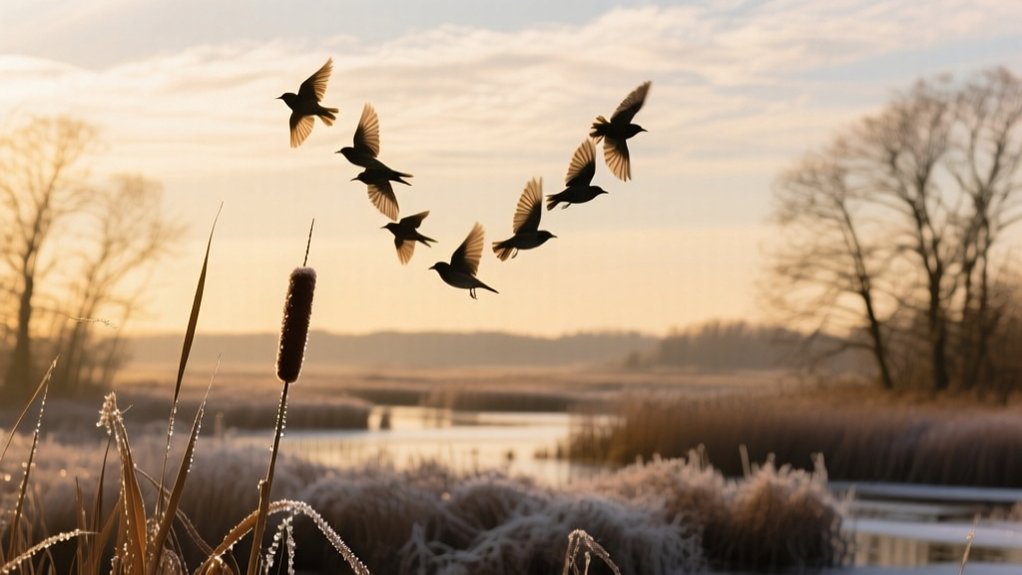
You see birds fly south in winter primarily because colder temperatures reduce their food supply like insects and nectar, making survival tough. Shorter daylight triggers hormonal changes that urge them to migrate, helping them find warmer regions rich in food to fuel their journey and breeding.
Not all species migrate; some stay where resources suffice. This complex behavior involves physiological shifts and navigation skills, ensuring their survival through seasonal challenges. Investigate deeper to understand the full migration story.
The Role of Temperature in Bird Migration
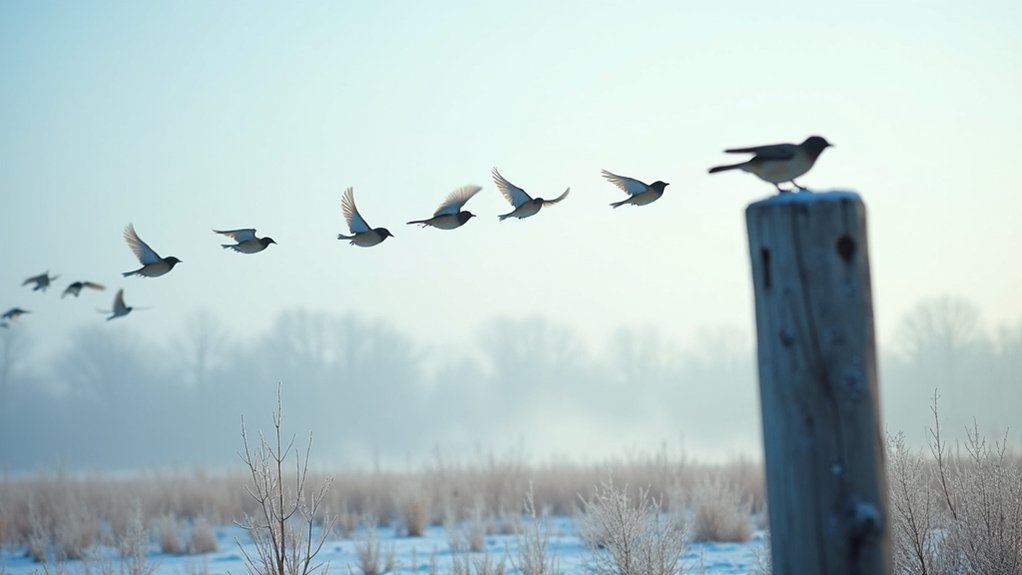
Although you mightn’t immediately notice it, temperature plays an essential role in driving bird migration each winter. As temperatures drop, many bird species experience physiological changes triggered by shorter daylight hours, leading to migratory restlessness known as Zugunruhe. This hormonal shift signals that it’s time to move.
Temperature drops and shorter days trigger birds’ migratory restlessness, signaling it’s time to move.
You’ll see birds migrate primarily because colder climates reduce the availability of insects and nectar, vital food sources for their survival. While some species, like chickadees, can endure low temperatures if food is ample, most birds migrate south to escape harsh winter conditions.
Warmer regions during migration offer increased food access, helping birds maintain energy reserves important for survival and future breeding success.
Therefore, temperature acts as a powerful environmental cue prompting birds to migrate annually.
How Food Availability Influences Migration
Temperature changes set the stage for bird migration, but it’s the search for food that ultimately drives many species to travel south. As daylight shortens, you’ll notice birds responding to reduced food availability, especially those dependent on flying insects and nectar, which nearly vanish in winter.
While some birds, like chickadees, adapt by finding enough food in boreal forests, many must migrate to access richer food sources. You’ll observe that birds time their migration to coincide with periods when northern food supplies dwindle, ensuring survival in warmer regions offering abundant food.
Notably, supplemental food sources, such as bird feeders, have influenced some species’ winter presence. This demonstrates how food availability directly shapes migratory behavior and population dynamics. During unusual circumstances such as avian flu outbreaks, safe practices around feeding wild birds should be followed to protect both bird populations and humans.
Species That Migrate and Those That Don’t
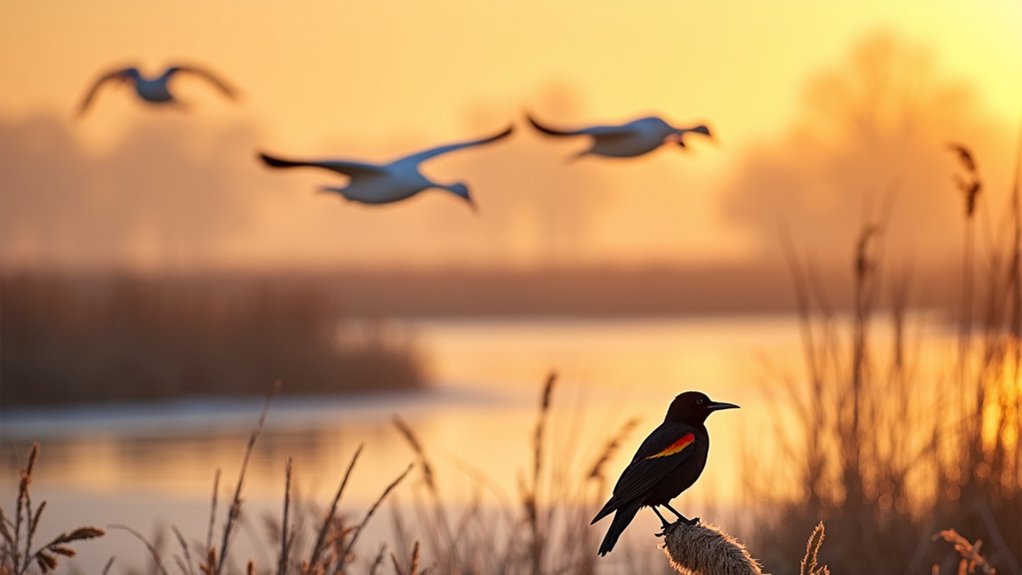
When food becomes scarce and temperatures drop, some bird species choose to migrate while others remain in their habitats year-round. You’ll notice that migratory birds like hummingbirds travel thousands of miles to reach warmer areas rich in food.
As food dwindles and cold sets in, some birds migrate while others stay the course year-round.
In contrast, species such as chickadees find enough resources locally and stay put through winter. You might also observe cardinals and mockingbirds increasingly present during colder months in places like New England, reflecting shifts in food availability and human habitat influence.
Migration patterns vary widely; for example, Red-winged Blackbirds follow predictable schedules, while others adjust based on local conditions.
These behavioral differences highlight how environmental changes and resource access shape which species migrate and which don’t, demonstrating the complexity of migratory birds’ survival strategies.
The Science Behind Migration Timing
Understanding why birds migrate at specific times reveals how finely tuned their behavior is to environmental cues. Migration timing largely depends on changes in daylight length, which alter brain chemistry and hormone levels. These changes trigger migratory urges as days shorten.
You’ll notice species like Red-winged Blackbirds follow predictable schedules, although local weather can shift individual timing. Adult males often migrate before females and juveniles because they leave breeding grounds earlier. Younger birds require more preparation.
This sex- and age-based variation in migration timing is consistent across many species.
Furthermore, annual environmental fluctuations cause shifts in overall migration timing, showing birds’ adaptability. By observing these patterns, you can appreciate the precise biological and behavioral mechanisms that govern when birds start their southward journeys each winter.
Environmental Triggers for Migration
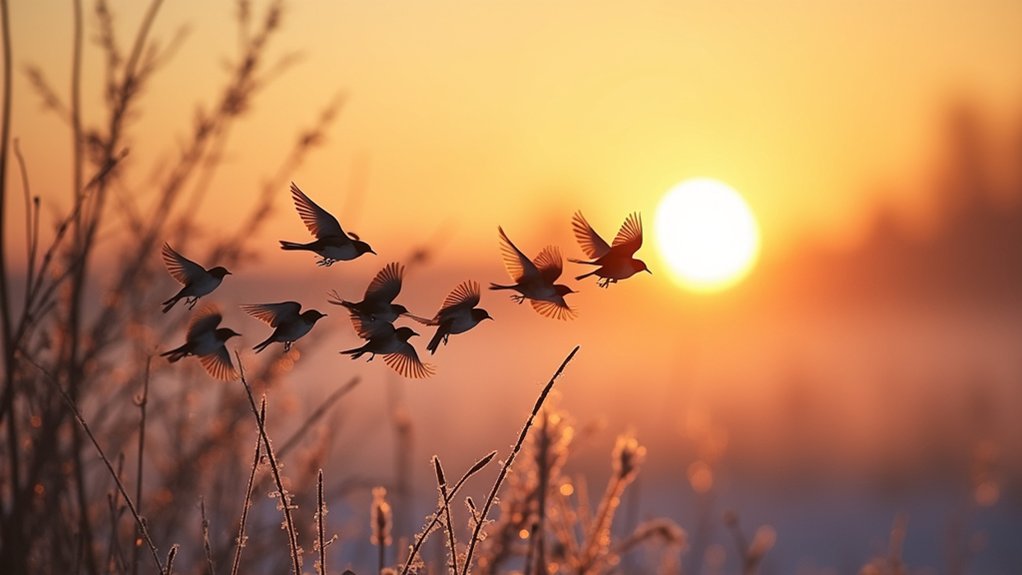
Although multiple factors influence bird migration, changes in environmental conditions act as primary triggers for their seasonal journeys. You’ll notice that shortening daylight alters birds’ brain chemistry and hormone levels, prompting migratory behaviors.
As days grow shorter and temperatures drop, food sources like flying insects and nectar become scarce, pushing birds to seek regions with abundant resources. Temperature fluctuations and seasonal shifts further influence the timing and routes each species takes.
While migration patterns are generally predictable, local weather variations can adjust when birds depart. By observing these environmental cues, you can understand how birds finely tune their migration to optimize survival, ensuring they leave when food dwindles and conditions become unfavorable, guiding their remarkable journey southward for the winter months.
Additionally, artificial lighting can disrupt natural cues for migration, just as it does with nocturnal singing, highlighting how human activity can impact the timing and patterns of bird movements.
Understanding Migratory Restlessness (Zugunruhe)
As daylight shortens, many birds exhibit a behavior known as Zugunruhe, or migratory restlessness. This behavior is marked by increased movement and activity that signals their preparation to commence migration.
You’ll notice this behavior particularly in captive birds, where Zugunruhe manifests as heightened nocturnal activity triggered by reduced daylight. This shift corresponds with changes in brain chemistry and hormone production that initiate migratory instincts.
Zugunruhe intensity varies among species and depends on factors like food availability and environmental conditions.
By observing Zugunruhe, researchers gain valuable insights into the physiological and behavioral changes birds undergo before migration.
Understanding this phenomenon helps you appreciate how deeply ingrained and finely tuned these internal migratory cues are, prompting birds to set off on their seasonal journeys.
Navigation Techniques Used by Migratory Birds
When migratory birds commence their long journeys, they rely on an intricate combination of natural cues to navigate accurately.
These cues allow birds to fly south with remarkable precision, even on unfamiliar routes.
Birds navigate southward with astonishing accuracy, even when venturing along unfamiliar paths.
You can observe three primary navigation techniques:
- Celestial navigation: Birds utilize the sun’s position during the day and star patterns at night to maintain direction.
- Magnetic orientation: They sense Earth’s magnetic field, enabling them to adjust their paths without visual landmarks.
- Visual landmarks: Mountains, rivers, and coastlines act as natural guides, helping birds stay on course.
Some species also employ olfactory cues, showing diverse adaptations.
Even first-year birds navigate independently, demonstrating innate abilities.
Understanding these techniques reveals the extraordinary complexity behind why birds plunge south in winter.
Common Migration Routes and Destinations
Because migratory birds depend on reliable routes to reach suitable wintering habitats, they follow established pathways shaped by geography and environmental conditions.
For example, many North American species like the Red-winged Blackbird travel south via the Atlantic Flyway, stopping at key sites along the eastern U.S. coast to rest and refuel.
On the west coast, the Pacific Flyway guides species such as the Western Sandpiper along the shoreline to avoid harsh winters.
Remarkably, the Arctic Tern migrates over 71,000 kilometers annually between the Arctic and Antarctic, demonstrating extreme endurance.
You’ll notice that food availability and weather influence these patterns, causing slight yearly variations.
Additionally, many migratory birds take advantage of rising warm air currents during their journeys to conserve energy and maintain efficient flight.
Challenges and Hazards During Migration
You face a grueling journey. Long flights impose severe physical and mental strain, which means you need to keep your energy up constantly.
On top of that, environmental factors like storms and predators make things even riskier.
And it’s not just nature causing trouble—human-made obstacles like buildings and towers add to the hazards.
All these challenges together really shape your chances of survival during migration, so you have to navigate carefully through these dangerous conditions.
If a bird doesn’t make it, scavengers and decomposition quickly recycle its remains back into the ecosystem.
Physical and Mental Strain
Although migration is essential for survival, it imposes intense physical and mental strain on birds. They endure long flights spanning thousands of miles, pushing their energy reserves to the limit. Freezing temperatures along the route add to their challenge, demanding extra metabolic effort to maintain body heat.
Mentally, young birds face the formidable task of traversing unfamiliar terrain without guidance, increasing stress and risk of disorientation.
You can appreciate this strain by considering:
- Exhaustion from continuous flight drains their physical stamina, risking organ failure.
- Navigational errors in adverse conditions heighten vulnerability and delay arrival.
- Stopovers for rest expose birds to predation and starvation threats.
These factors combine, making migration a perilous endeavor requiring remarkable endurance and resilience.
Environmental and Human Threats
When birds commence on their lengthy migrations, they encounter numerous environmental and human-induced hazards that threaten their survival. Freezing temperatures can sap their energy and impair navigation, increasing mortality rates.
Bad weather leads to disorientation, forcing birds off course and exposing them to further risks.
You’ll notice that tall buildings and communication towers pose deadly obstacles; many birds collide with these structures, especially during nocturnal flights when urban light pollution confuses their migratory cues.
As you observe, predation intensifies since fatigued birds focus on finding food and shelter, making them vulnerable.
These combined environmental stressors and human-made barriers considerably challenge migrating birds, demanding remarkable endurance and adaptability to complete their journeys south safely.
The Impact of Human Activity on Bird Migration
Because human activities have significantly reshaped natural environments, their impact on bird migration is profound and multifaceted.
You’ve likely noticed some bird species staying year-round in altered habitats due to urban development and agriculture expanding their ranges.
Food availability from feeders and invasive plants also encourages birds to skip migration, especially in areas like New England.
However, light pollution disorients many migrating birds, causing fatal collisions with buildings and towers.
Climate change further disrupts migration timing and routes by affecting food and habitat conditions.
As you observe these changes, consider the emotional weight of:
- Birds losing traditional migratory paths.
- The silent deaths from man-made obstacles.
- Conservation efforts working to restore balance.
Understanding these impacts reveals how your actions influence bird species’ survival during migration.
Even small changes to bird habitats can have significant consequences for migratory species, emphasizing the importance of habitat conservation for their survival.
How Birds Prepare for Their Journey
As the days get shorter, you might start to notice birds becoming a bit restless. This behavior is called Zugunruhe, and it’s a sign that they’re going through some important physiological changes like molting and building up fat to get ready for their big journey.
They’re pretty smart about this—they efficiently turn the food they eat into energy reserves that will help them fly long distances without needing to stop too often.
At the same time, their natural navigation skills get sharper, allowing them to use things like the stars and Earth’s magnetic fields to find their way with amazing precision.
Physiological Changes Before Migration
Although you mightn’t notice, birds undergo remarkable physiological transformations triggered by shortening daylight in late summer and early fall. These changes affect their brain chemistry and hormone production, preparing them to withstand freezing temperatures and endure long flights.
You can observe three key adaptations: Birds increase fat storage dramatically, sometimes doubling their weight, to fuel sustained energy needs. Hormonal shifts optimize metabolism, enabling efficient energy conversion vital for survival during migration.
Behavioral shifts, like migratory restlessness called Zugunruhe, signal readiness for departure. Additionally, many birds adjust plumage and body condition to improve flight performance and resilience.
These finely tuned physiological changes guarantee birds are primed to face the challenges of migration, highlighting nature’s precise orchestration behind this incredible seasonal journey.
Fueling Up With Food
The physiological changes birds undergo before migration set the stage for one of their most crucial behaviors: increasing food intake to build fat reserves.
As daylight shortens, you’d observe birds feeding intensively, especially species relying on flying insects or nectar, which become scarce in freezing temperatures. This fat storage acts as essential energy for their long flights.
While some birds, like chickadees, manage to survive harsh winters by finding seeds or insects, many must migrate south where food is more abundant during winter.
You’d also notice migratory restlessness, or Zugunruhe, coinciding with their growing appetite, an instinctive drive to fuel up.
This preparation guarantees birds have sufficient energy to endure the demanding journey and the challenges posed by cold, freezing conditions ahead.
Navigational Instinct Development
When daylight shortens, birds’ brains trigger hormonal changes that prepare them for migration by sharpening their navigational instincts.
You can observe how young birds, migrating alone for the first time, develop essential navigational skills to locate unfamiliar winter habitats.
They rely on multiple natural cues to guide their journey.
Consider these remarkable navigation methods:
- Using the sun, stars, and Earth’s magnetic field to orient themselves precisely.
- Recognizing natural landmarks and the setting sun’s position to maintain course.
- Employing a keen sense of smell, as seen in species like homing pigeons, to navigate complex routes.
These physiological and sensory adaptations guarantee birds commence successful migrations, displaying innate navigational skills honed through both instinct and environmental interaction.
The Role of Daylight in Migration Behavior
As daylight shortens, birds undergo hormonal shifts that trigger their migratory instincts, preparing them to head south for the winter.
You’ll notice increased restlessness, or Zugunruhe, especially in captive birds, reflecting their innate urge to migrate as daylight decreases.
This shortening daylight acts as a critical environmental cue, synchronizing migration timing across species to align departures with ideal food availability and favorable weather.
While local factors may cause individual variations, the overarching influence of daylight remains consistent.
Despite individual differences, daylight consistently guides birds’ migratory timing across species.
Species dependent on seasonal food sources, like flying insects, particularly rely on these daylight cues to time their migration, ensuring survival during scarce winter months.
Understanding how daylight drives these physiological and behavioral changes reveals the intricate connection between environmental signals and migratory behavior.
Unlike some reptiles and mammals, birds never give live birth, instead relying on egg laying—a reproductive strategy that helps keep them lightweight for migration and flight.
Conservation Efforts Supporting Migrating Birds
You can really help migrating birds by restoring native habitats. These areas offer the food and shelter birds need during their long journeys.
Plus, cutting down on light pollution in cities makes a big difference. It helps keep birds from getting confused and crashing into buildings at night.
Another way to support birds on their migration is to learn about and protect flight adaptations that make their journeys possible, such as feathers for lift and efficient respiratory systems.
Habitat Restoration Initiatives
Although migrating birds face numerous challenges during their journeys, habitat restoration initiatives play an important role in supporting their survival by enhancing food availability and shelter.
As freezing temperatures limit resources, restoring wetlands, grasslands, and native forests guarantees these birds find crucial nourishment and refuge during stopovers and wintering.
You can witness the impact through:
- Planting native vegetation that provides natural food sources and protective cover.
- Creating wildlife corridors that offer safe passage and reduce migration hazards.
- Engaging communities in removing invasive species and monitoring bird populations to improve habitat quality.
These scientifically guided efforts not only buffer against harsh climatic conditions but also sustain migratory bird populations, allowing you to observe their remarkable journeys with greater success.
Reducing Light Pollution
When migrating birds navigate through urban landscapes, artificial lighting can disorient them, leading to fatal collisions with buildings and towers.
Reducing light pollution during peak migration nights helps prevent this confusion, especially when freezing temperatures increase birds’ vulnerability.
By turning off unnecessary lights, cities create safer pathways, greatly decreasing mortality rates.
Studies reveal that even minor adjustments in urban lighting reduce bird fatalities during migration seasons.
You can support these efforts by advocating for bird-friendly lighting and participating in community initiatives.
Collaborative policies between local governments and conservation groups are essential to minimize light pollution and protect migratory habitats.
These targeted actions help migrating birds survive harsh conditions, allowing them to complete their journey south safely despite environmental challenges like freezing temperatures.
Frequently Asked Question
Do All Birds Fly South or Only Specific Species?
Not all birds fly south; only specific species do.
You’ll notice that birds relying on insects or nectar, like hummingbirds, migrate to find food during winter.
However, species such as chickadees, cardinals, and mockingbirds can endure cold temperatures and find sufficient resources locally.
Migration patterns vary with environmental factors and habitat availability, so some birds adapt and stay, while others follow predictable routes south to survive harsh conditions.
How Long Do Birds Stay in Their Wintering Grounds?
You’ll find that birds stay in their wintering grounds anywhere from a few weeks to several months. This duration depends on species, local temperatures, and food availability.
Hormonal changes, triggered by increasing daylight and warming temperatures, signal them when it’s time to leave.
Juvenile birds often linger longer than adults, needing extra time to build strength for the return migration, which typically begins from late winter to early spring.
Can Birds Fly South Alone or Only in Flocks?
You’ll see some birds soaring solo, steering by instinct and observation, while others travel in flocks, sharing safety and conserving energy.
First-year birds often fly alone, relying on innate skills, whereas species like geese prefer group travel.
Males usually migrate before females and juveniles, showing sex and age influence migration style.
Do Young Birds Know How to Migrate Instinctively?
Yes, young birds do know how to migrate instinctively.
You’ll find that they rely on innate behaviors triggered by environmental cues like shortening daylight and temperature changes.
Even without prior experience, their brains adjust hormone levels, motivating them to travel south.
You can observe them using celestial cues, Earth’s magnetic field, and the sun for navigation.
This shows a natural, inherited ability that guides their first solo migrations with remarkable precision.
How Do Birds Find Their Way Back Home After Winter?
You rely on multiple natural cues to find your way home after winter.
You use the sun’s position during the day, the stars at night, and Earth’s magnetic field as a compass.
Landmarks like rivers and mountains guide your path visually.
Some species even use their sense of smell for orientation.
Despite never migrating before, young birds instinctively navigate these cues to return precisely to their breeding grounds each year.
Conclusion
Now that you understand why birds fly south in winter, you see how temperature, food availability, and daylight all play crucial roles in triggering this incredible journey. These creatures prepare meticulously, guided by environmental cues, to survive harsh conditions.
While human activity can throw a wrench in their plans, ongoing conservation efforts help keep their migratory paths clear. It’s clear that regarding migration, birds truly put all their eggs in one basket to guarantee survival.