

You’re actually looking at modern birds as direct descendants of theropod dinosaurs, a reptilian lineage from over 300 million years ago. Birds share many anatomical features with reptiles, like skeletal structures, scales on their legs, and egg-laying biology.
Genetic analyses confirm birds fall within the reptile family tree, showing close ties to crocodilians. Fossils such as Archaeopteryx display evolutionary traits between birds and reptiles. Exploring these connections further reveals how feathers evolved and flight adaptations emerged from reptilian origins.
Evolutionary Origins of Birds and Reptiles
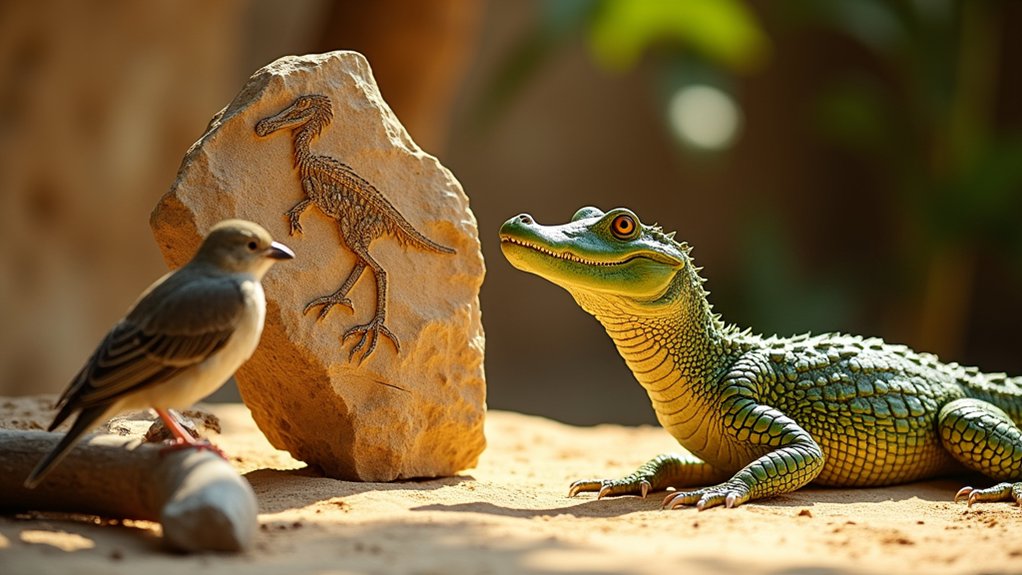
Although birds and reptiles may appear distinct today, they share a common ancestor that lived over 300 million years ago, making their evolutionary origins deeply intertwined.
Birds and reptiles share a common ancestor from over 300 million years ago, linking their evolution closely.
You can trace the earliest reptiles back to approximately 315 million years ago, with dinosaurs emerging around 245 million years ago as reptilian descendants.
Modern birds evolved directly from a lineage that survived into the Late Cretaceous period, long after non-avian dinosaurs went extinct 65 million years ago.
Both groups share key anatomical traits like scales, egg-laying reproduction, and a breastbone structure adapted in birds for flight muscles.
Genetically, birds nest within reptiles, with crocodilians closer to birds than to other reptiles.
Phylogenetic classification confirms birds as reptiles, reflecting their shared evolutionary history rather than superficial differences.
Additionally, birds inherited theropod dinosaur features such as hollow bones and air sacs that enhanced respiration and reduced weight for flight.
Theropod Dinosaurs as Bird Ancestors
When you examine the evolutionary lineage of birds, you’ll find that they belong to the theropod group of dinosaurs, which particularly included species like T. rex.
Small bipedal theropods, such as troodontids and dromaeosaurs, are the closest non-avian relatives of birds.
Birds evolved from the Paraves clade during the Jurassic Period, highlighting a gradual shift over millions of years.
This lineage shows progressive digit loss, first the fifth, then the fourth, refining the hand structure towards modern avian forms.
Fossils like Archaeopteryx and feathered non-avian theropods provide concrete evidence of this evolutionary bridge.
The discovery of Archaeopteryx in the early 1860s was crucial, as it showcased features intermediate between birds and reptiles, such as feathers alongside teeth and a long bony tail, marking it as a key intermediate fossil.
Theropods’ bipedalism and skeletal traits set the foundation for avian flight evolution, demonstrating birds’ direct descent from these dinosaurs rather than an independent origin within reptiles.
Shared Anatomical Features Between Birds and Reptiles
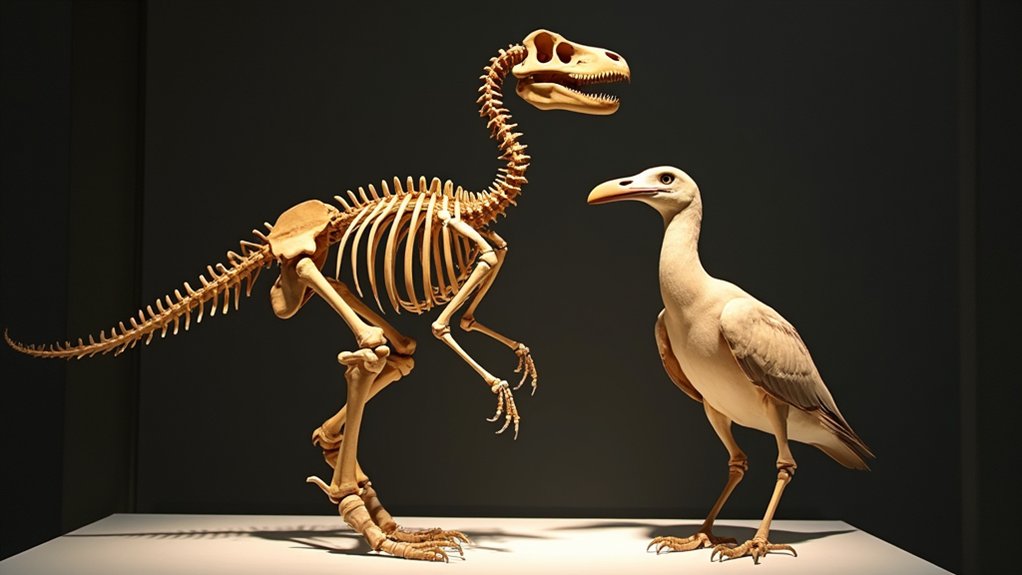
Because birds and reptiles share a common ancestor, you can observe numerous anatomical features that highlight their evolutionary connection.
Their skeletal structures reveal this link: both exhibit similar bone composition. Birds retain a three-fingered hand structure and fused leg and arm bones derived from reptilian blueprints.
Feathers in birds represent modified scales, and scales persist on their legs and feet, underscoring this heritage.
Respiratory systems also reflect this connection. Birds have advanced air sacs evolving from the basic reptilian lung design, allowing efficient oxygen intake during flight. Unlike typical reptiles, birds possess lungs that allow for unidirectional airflow, enhancing respiratory efficiency.
Moreover, both groups produce amniotic eggs, with birds’ hard shells and reptiles’ softer coverings showing variations of a shared reproductive strategy.
Internally, heart and brain structures display modifications from reptilian ancestors, maintaining fundamental anatomical and physiological traits you can trace through evolution.
Genetic Evidence Linking Birds and Reptiles
Anatomical similarities between birds and reptiles provide visible proof of their shared heritage, but genetic data offer even more definitive evidence. By examining DNA and protein structures, scientists have established a clear evolutionary link.
- Birds are genetically encompassed within reptiles, showing closer relations to crocodilians than to turtles or lizards.
- Comparative studies of 248 genes reveal shared sequences, confirming a common ancestor despite millions of years of divergence.
- Molecular analyses find similar egg proteins, receptors, and developmental pathways, underscoring inherited biological mechanisms.
- Mitochondrial DNA sequencing pinpoints lineage separation timing and affirms birds’ origin from reptilian ancestors, supported by shared traits like modified scale genes and reproductive genetics. A 2014 study found that chickens’ genetic material is 97% similar to that of Tyrannosaurus rex, highlighting a significant genetic overlap and direct lineage.
Together, these genetic insights provide precise, measurable evidence connecting birds firmly within the reptile clade.
Fossil Discoveries Supporting the Bird-Reptile Connection
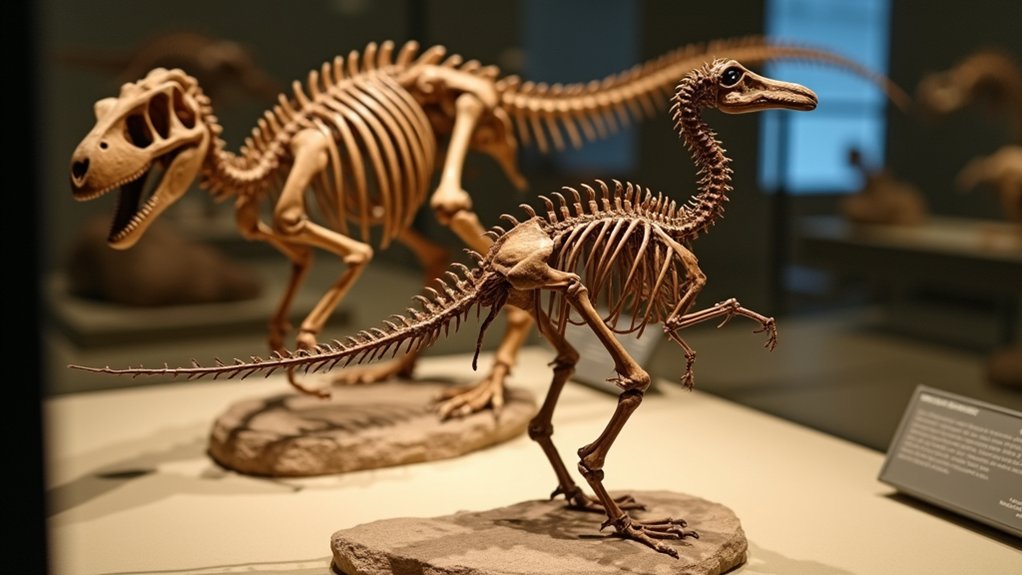
You’ll find that the uncovering of Archaeopteryx in the Late Jurassic offers an essential snapshot of evolution.
It showcases both avian feathers and reptilian skeletal traits. This intermediate fossil reveals how feathers first appeared in dinosaur lineages, bridging the gap between non-avian theropods and modern birds.
The Solnhofen limestone, where these fossils were found, provided ideal preservation conditions that allowed such detailed anatomical features to be studied.
Archaeopteryx Transitional Fossil
When you examine the Archaeopteryx fossils uncovered in the Solnhofen limestone deposits, you find a remarkable blend of reptilian and avian traits that highlight its role as a developmental form.
This Jurassic creature displays sharp teeth and a long bony tail, yet supports flight with feathered wings and a robust furcula. Its anatomy bridges dinosaurs and modern birds, revealing evolutionary experimentation.
- Retains reptilian features: teeth, claws on wings, and long tail with chevrons
- Exhibits avian traits: aerodynamic feathers, wishbone for flight muscles, and bird-like pubis
- Demonstrates flight ability through wing bone geometry matching short-flapping birds. Studies indicate it was capable of short bursts of powered flight.
- Represents an evolutionary link from small meat-eating dinosaurs to early birds, about 147 million years ago
Archaeopteryx provides a pivotal fossil snapshot in bird evolution.
Feathered Dinosaur Evidence
Although the feathered dinosaur fossils excavated from the Liaoning Formation and other sites may seem surprising, they provide compelling evidence linking birds and theropod dinosaurs. You can observe beta-proteins in Sinosauropteryx feathers that chemically match those in modern birds, indicating shared ancestral genes. Velociraptor fossils reveal quill knobs on the ulna, confirming attachment points for large feathers similar to birds. Behavioral evidence, such as oviraptorids brooding their eggs with folded forearms, parallels avian reproductive care. Fossil feathers display diverse functions like insulation, display, and thermoregulation, seen in iridescent patterns on herbivorous theropods. These revelations form a continuous evolutionary narrative, showing how feather complexity and functionality evolved progressively, reinforcing the close relationship between non-avian dinosaurs and birds. This evidence supports the understanding that birds are classified as reptiles, specifically linking them to the archosaur group of reptiles.
Feather Evolution From Reptilian Scales
Because feathers and reptilian scales share a keratin-based structure and developmental pathways, their evolutionary relationship provides essential insight into the origin of avian integument. You’ll find that:
- Both develop from placodes, which are skin thickenings regulated by *EDA* gene mutations, showing a shared developmental mechanism.
- Molecular evidence reveals avian scales genetically resemble feathers more than reptilian scales, suggesting a secondary evolution from feathers.
- Fossil records document simple filamentous feathers in theropod dinosaurs, indicating feathers evolved before birds. This supports the common ancestry of birds and reptiles dating back to the Mesozoic era.
- Despite morphological differences, feathers and scales use similar keratin proteins, reflecting conserved biochemical pathways.
Understanding these points clarifies how feathers likely evolved from reptilian scales through modifications in gene expression and skin development, bridging the gap between reptiles and birds.
Behavioral Similarities in Nesting and Parental Care
Feathers evolved from reptilian scales not only reflect morphological and genetic links but also parallel behavioral traits in reproduction. Both birds and reptiles lay eggs in selected nest sites, exhibiting plasticity in nest depth based on environmental moisture. For example, some ground-nesting reptiles can assess soil moisture and adjust nest depth accordingly, demonstrating phenotypic plasticity in response to environmental changes.
Feathers evolved from reptilian scales, mirroring reproductive behaviors like nest site selection and moisture-based nest depth adjustments.
For instance, monitor lizards burrow nests up to 4 meters deep, adjusting depth during dry periods. This behavior is mirrored in some ground-nesting birds. Incubation periods adapt to temperature variations, with embryos accelerating development in colder climates.
Parental care strategies, though variable, share ancestral roots. Maternal behaviors such as nest site selection respond flexibly to environmental cues.
These shared reproductive and nesting behaviors underscore a conserved evolutionary framework, revealing how both taxa maintain adaptive responses shaped by millions of years of divergent evolution in reproductive biology and environmental interaction.
Adaptations for Flight Derived From Reptilian Traits
When you examine the evolutionary journey from reptiles to birds, you’ll notice that many flight adaptations stem directly from reptilian traits. These inherited features underwent significant modifications to facilitate flight.
- Feathers evolved from reptilian scales, initially serving insulation and communication before adapting asymmetrically for aerodynamic efficiency. Fossil discoveries such as Archaeopteryx highlight the transitional nature of these features in early avian evolution, emphasizing the importance of fossil evidence.
- Skeletal structures became lighter through bone fusion and thinning, with a pronounced keel on the sternum enhancing wing muscle attachment.
- Forelimbs transformed into wings, supported by neural innovations that decoupled limb coordination from terrestrial locomotion patterns.
- Behavioral adaptations like wing-assisted incline running provided incremental power increases, precursing powered flight.
Together, these adaptations illustrate how reptilian characteristics laid the foundation for avian flight’s complex mechanics and metabolic demands.
Frequently Asked Question
How Do Birds Regulate Their Body Temperature Compared to Reptiles?
You regulate your body temperature as a bird by generating internal heat through high metabolic rates, keeping your temperature constant between 41-43°C regardless of the environment.
Unlike reptiles, who depend on external heat sources and behavioral adjustments like sunbathing or seeking shade, you maintain thermal stability via metabolic heat and feather adjustments.
You fluff feathers for insulation in cold and compress them to avoid overheating, actively controlling temperature through physiological and behavioral means.
What Reptiles Are Most Closely Related to Modern Birds?
Imagine tracing your family tree back to a hidden branch; crocodilians, like crocodiles and alligators, are the closest living reptiles to modern birds.
You’ll find they share a common ancestor in the Archosaurs, reflected in skeletal and genetic similarities.
DNA studies reveal crocodilians nest closer to birds than turtles or lizards, making them the closest reptilian relatives.
Observing their physiology and genetics offers a clear evolutionary link you can study in detail.
How Do Bird Eggs Differ Chemically From Reptile Eggs?
You’ll find that bird eggs have hard, calcified shells with over 90% mineral content, mainly calcite, while reptile eggs tend to have softer, leathery shells with just 15-30% minerals.
Bird eggshells contain complex proteins regulating crystal formation, whereas reptile eggs show higher proline levels.
Furthermore, bird eggs feature a thick cuticle and lower pore density, optimizing water and gas exchange differently than the more permeable, softer reptile eggshells.
Are There Any Reptiles Today That Still Have Feathers?
You know what they say: “Don’t judge a book by its cover.”
Today, no reptiles outside birds have feathers.
Modern reptiles like crocodilians, turtles, and squamates retain scales, not feathers. Birds are the only extant feathered reptiles, evolving feathers from theropod dinosaurs.
While some extinct reptiles had feather-like structures, living non-avian reptiles lack these features.
How Does Bird Respiration Differ From Reptilian Breathing Systems?
You’ll notice bird respiration uses a unidirectional airflow with nine air sacs aiding continuous air movement through lungs, unlike reptiles’ primarily bidirectional tidal ventilation.
Birds’ lungs contain air capillaries with efficient counter-current gas exchange, while reptiles rely on alveoli-type sacs.
Birds lack a diaphragm and depend on air sac expansion for ventilation, contrasting reptiles’ rib muscle-driven breathing.
These adaptations let birds extract oxygen effectively, supporting high-altitude flight better than reptiles.
Conclusion
You can’t deny that birds are fundamentally living reptiles, evolved through millions of years from theropod dinosaurs. Their shared anatomy, genetics, and fossil records paint a clear picture of this incredible lineage.
Feathers, once just reptilian scales, became the ultimate flight adaptation. Even their nesting behaviors echo reptilian origins.
Understanding this connection isn’t just fascinating; it’s like unearthing the secret code of evolution itself, revealing how nature’s masterpiece took flight.