

You won’t find dodo birds alive today. They went extinct by the late 1600s, primarily because of humans. When sailors arrived in Mauritius, they hunted dodos extensively and destroyed their forest habitats.
Introduced animals also preyed on their eggs and young, making recovery impossible. Dodos’ ground nesting and limited reproduction made their decline even worse.
Their extinction disrupted local ecosystems. But if you investigate further, you’ll uncover how their biology and ecological role continue to teach us valuable lessons.
Early Encounters With the Dodo

Although the exact date remains disputed, Dutch sailors first recorded encountering the dodo on Mauritius in 1598 during the Second Dutch Expedition to Indonesia led by Vice Admiral Wybrand van Warwijck.
Some historical accounts suggest Portuguese sailors may have encountered dodos as early as 1507, but clear documentation begins with the Dutch around 1600.
Portuguese sailors possibly saw dodos by 1507, but definitive records start with the Dutch near 1600.
Early Dutch reports named the bird “Walghvoghel,” meaning “tasteless bird,” reflecting subjective assessments.
You’ll find that the dodo exhibited little fear toward humans, making it easy to capture, although it defended itself fiercely when threatened. The dodo became a symbol of extinction and obsolescence in popular culture, highlighting its eventual fate as a species that disappeared due to human impact (symbol of extinction).
Rapid hunting for meat and eggs by European sailors quickly reduced its population.
Early specimens were observed in India and Mauritius, with only a few surviving examples documented, such as the Oxford Dodo cataloged in 1656.
Physical Traits of the Dodo Bird
When examining the physical traits of the dodo bird, you’ll notice its size, plumage, and anatomical features reveal adaptations shaped by its isolated environment.
The dodo stood about 62.6 to 75 cm tall and weighed roughly 10.6 to 17.5 kg, similar to a large turkey. Its feathers were blue-gray or gray-brown, with a distinctive white tuft on the rear.
Despite having wings, these were small and nonfunctional for flight, resembling penguin wings. The bill was large, curved, and robust, serving defensive purposes.
Legs were stout and muscular with four-toed feet, enabling an upright posture and strong grip. The dodo was flightless due to the absence of natural predators and laid one egg per year, likely due to its stress-free environment (flightless and reproduction).
Plumage featured pennaceous feathers grouped distinctly in threes. Wings had a visible sternum attachment but no flight capability. Legs bore thick black claws and a rear thumb-like toe.
The Dodo’s Habitat on Mauritius

Understanding the dodo’s physical adaptations offers insight into how it thrived within its native environment on Mauritius.
You’ll find that the dodo primarily inhabited forested areas rather than coastal zones, favoring scrub forests, grasslands, and terrestrial biomes rich in specific vegetation vital for its survival. The forest environment provided shelter and food sources for the dodo.
Mauritius, an isolated volcanic island east of Madagascar, provided a unique ecosystem where the dodo evolved without significant predators, leading to flight muscle reduction.
You need to reflect on environmental challenges like seasonal cyclones and historical mega-droughts that influenced dodo growth cycles and mortality rates.
The species played a keystone ecological role by dispersing seeds of native plants, including the dodo tree, highlighting its critical dependency on Mauritius’s forest habitat and the cascading effects its extinction caused within this isolated island ecosystem.
Diet and Feeding Habits of Dodos
The dodo’s diet primarily consisted of a diverse range of plant-based foods, supplemented by occasional animal matter, reflecting its adaptation to the island’s varied ecosystems.
You’d find these birds searching on the forest floor and along shorelines, using their hooked beak to extract nuts, fruits, and roots. Their feeding habits also included swallowing gastroliths to aid digestion. Significantly, their diet adapted seasonally to environmental changes.
The dodo foraged forest floors and shorelines, using a hooked beak and gastroliths to digest seasonal foods.
Key components of their diet included fruits such as mangoes and palm fruit, alongside roots, bulbs, and bark. They also ate animal matter like crabs, shellfish, and occasionally fish from shorelines. The dodo’s plant-based diet was crucial for its survival in the tropical climate of Mauritius.
Plus, they fattened up during rainy periods to prepare for dry-season scarcity.
These habits reveal the dodo’s ecological role as a versatile ground forager on Mauritius.
Evolution of Flightlessness in Dodos
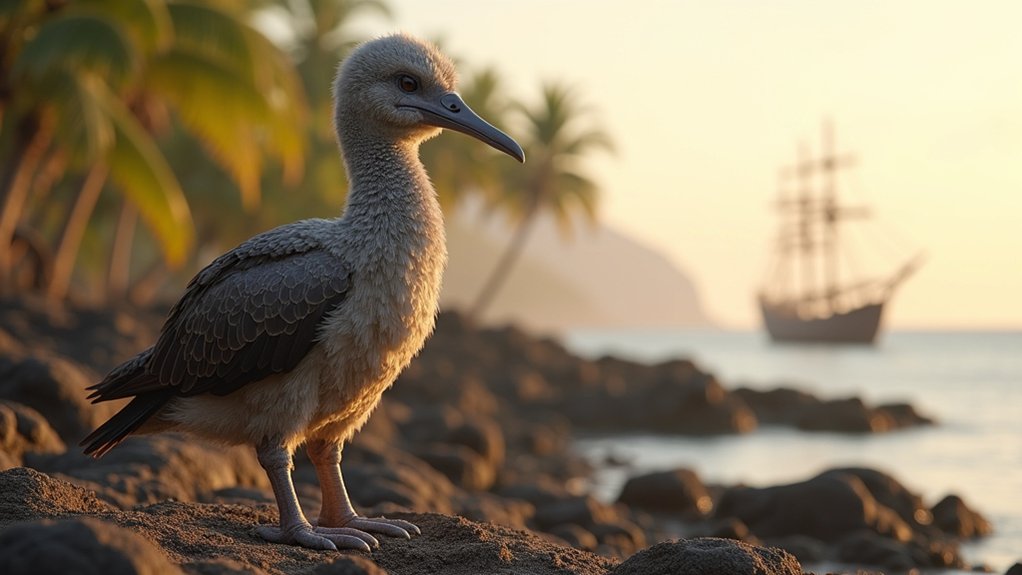
Although dodos evolved from flying pigeons that settled on Mauritius about eight million years ago, they gradually lost their ability to fly due to unique environmental pressures. The island’s absence of predators and abundant food removed the need for flight, favoring energy allocation to other traits.
Morphologically, dodos increased in body size while wing length decreased proportionally. Specialized adaptations like stronger legs and modified bone structures improved terrestrial mobility. This evolutionary shift occurred over millions of years, with no intermediate fossils found.
| Aspect | Adaptation Detail |
|---|---|
| Body Size | Increased for energy storage |
| Wing Structure | Reduced wingspan and smaller sternum |
| Locomotion | Improved leg strength and altered femur |
These changes illustrate the dodo’s evolution to a ground-dwelling, flightless bird optimized for island life.
Human Impact on Dodo Populations
When humans arrived on Mauritius in the late 16th century, their activities rapidly disrupted dodo habitats through deforestation and land conversion for agriculture. You’ll find that this habitat destruction severely reduced the dodo’s nesting and foraging areas, directly impacting their survival. The dodo’s flightless nature and lack of natural predators before human arrival made it especially vulnerable to these new threats.
Furthermore, overhunting by sailors seeking food further decimated populations, as dodos were large, flightless, and easy prey. The combined pressures of habitat loss and exploitation accelerated their decline beyond natural recovery.
Key human impacts include:
- Extensive forest clearing for settlements and crops, eliminating critical habitat
- Systematic hunting intensified with settler population growth, targeting dodos as a food source
- Limited island size constrained refuge availability, increasing vulnerability to human activities
These factors critically contributed to the dodo’s extinction by the late 1600s.
Role of Introduced Predators in Decline
Since invasive predators arrived on Mauritius alongside human colonizers, they played a critical role in accelerating the dodo’s decline.
Pigs, introduced around 1507 and 1598, preyed heavily on dodo eggs and competed for food, rapidly expanding without natural checks. The dodo’s ground nesting behavior made its eggs especially vulnerable to these predators.
Pigs introduced in the early 1500s decimated dodo eggs and competed fiercely for resources.
Macaques also targeted eggs and competed for fruit, leveraging their intelligence to adapt quickly.
Feral cats and dogs hunted young, flightless dodos, eliminating their escape options. Furthermore, rats threatened eggs, intensifying predation pressure alongside indigenous predators.
Goats contributed indirectly by overgrazing, degrading forest habitat and reducing food availability.
This combination of direct predation and habitat degradation created unsustainable conditions, overwhelming the dodo’s survival capacity.
The cumulative impact from multiple introduced species surpassed human hunting effects, playing a decisive role in the dodo’s extinction.
Dodo Nesting and Reproduction Challenges
Understanding the dodo’s nesting and reproductive strategies reveals key challenges that hindered its population resilience.
You’ll find that the dodo’s ground-based nests, built in secluded lowland forests and coastal areas, lacked vertical protection from predators. Its reproductive output was severely limited by producing only one large egg per year, with an incubation period of 46 days.
Both parents shared care responsibilities, yet this extended investment constrained breeding frequency.
Key challenges include:
- Single-egg clutch size restricted population growth and recovery rates
- Ground nesting exposed eggs and chicks to predation, especially from introduced species
- Absence of evolved anti-predator defenses increased vulnerability during the prolonged incubation and rearing periods
These factors combined to create a reproductive bottleneck that critically impaired the dodo’s ability to sustain its population.
Timeline of the Dodo’s Extinction
You’ll find that the last confirmed sighting of the dodo happened in 1662.
But interestingly, reports kept popping up here and there until the late 1600s.
The dodo’s numbers dropped really fast because of a few reasons—its habitat was being destroyed, it was hunted a lot, and new predators introduced to the island really messed with the ecosystem.
The dodo, a large flightless bird native to Mauritius, was driven to extinction by 1681 due to these combined pressures on its population, making it a classic example of human-induced extinction.
Last Confirmed Sightings
Although the dodo had become extremely rare by the mid-17th century, the last confirmed sighting was recorded in 1662 by Dutch sailor Volkert Evertsz on Amber Island off Mauritius.
Evertsz, a shipwreck survivor from the Dutch vessel Arnhem, encountered dodos while searching for food with other stranded sailors. This 1662 record remains the most widely accepted last confirmed observation of the species.
Key points to understand include:
- Previous confirmed sighting occurred 24 years earlier in 1638, indicating rarity by 1662.
- Later sightings, such as those in 1674 and 1681, remain disputed or secondary with limited evidence.
- Statistical analyses estimate extinction between 1680 and 1690, suggesting unconfirmed persistence after 1662.
- The dodo’s vulnerability was largely due to its fearlessness of humans and predation by invasive species introduced by sailors.
These details frame the last concrete evidence of dodo existence, which is essential for understanding their extinction timeline.
Decline and Extinction
Since humans first encountered the dodo in the early 16th century, the species faced a rapid decline driven by multiple factors.
Portuguese sailors uncovered dodos around 1507, with Dutch soldiers following in 1600. The birds, evolving without predators on Mauritius, showed no fear, making them easy targets.
Over-harvesting for fresh meat, combined with habitat loss due to deforestation, devastated populations. Moreover, invasive species like pigs, rats, and monkeys consumed eggs and competed for resources. This ecological disruption accelerated decline, marking the beginning of an ecological crisis for the dodo.
Within less than 80 years after Dutch arrival, the dodo population dwindled drastically. The last confirmed dodo was killed in 1681, and by the 1700s, the species was extinct.
This extinction represents one of the earliest documented cases of human-driven species loss.
Misconceptions About Dodo Intelligence
When examining the intelligence of dodo birds, it’s important to dispel the long-standing myth that they were inherently unintelligent.
Scientific studies reveal that the dodo’s brain size was proportionate to its body, comparable to its closest living relative, the pigeon, suggesting similar cognitive abilities.
Advanced CT scans and 3-D reconstructions show dodos had enlarged olfactory bulbs, enhancing their sense of smell. This is unusual for birds but critical for their ground-dwelling foraging behavior and was revealed through high-resolution CT scanning techniques.
Consider these points:
- Brain-to-body size ratio aligns with moderate intelligence seen in pigeons
- Enlarged olfactory bulbs indicate specialized sensory adaptation, not cognitive deficiency
- Negative stereotypes stem from cultural misconceptions, not scientific evidence
Thus, dodos weren’t “brainless” but adapted to their environment with specific sensory skills.
Ecological Importance of the Dodo
Because dodos played a crucial role in seed dispersal, their extinction drastically altered the reproductive cycles of native plant species on Mauritius. As ground-dwelling frugivores related to pigeons, dodos consumed diverse fruits, facilitating seed distribution across island habitats.
This dispersal was essential for plant reproduction and maintaining forest composition, especially in drier coastal areas. Without dodos, many native plants face extinction risks due to disrupted seed dispersal mechanisms. The dodo’s extinction was largely driven by overhunting and invasive species introduction, which compounded the ecological consequences.
Their large biomass and nesting behaviors also contributed to nutrient cycling and predator-prey dynamics, influencing ecosystem balance. The loss of this keystone species triggered cascading ecological effects, including altered vegetation structure and weakened ecosystem stability.
Understanding the dodo’s ecological role highlights the fragility of island ecosystems and the profound consequences human-driven extinctions impose on biodiversity and ecosystem function.
Current Status and Legacy of the Dodo
Although the dodo has been extinct for over 350 years, its legacy continues to influence scientific research, cultural narratives, and conservation efforts. You’ll find the dodo remains a potent symbol of extinction and human environmental impact.
Current scientific advances even aim to revive it using genetic techniques involving its closest relative, the Nicobar pigeon. Colossal Biosciences has successfully grown primordial germ cells from rock doves and is now working with Nicobar pigeons to edit genes for dodo resurrection. Here’s what you should know:
- Cultural significance: The dodo appears in literature and idiomatic expressions, embodying extinction awareness.
- De-extinction projects: Breakthroughs in primordial germ cell cultivation offer potential resurrection within 5-7 years.
- Conservation implications: Efforts raise debates on resource allocation between de-extinction and protecting endangered species. The protocols developed could also aid in conserving endangered birds like the Mauritian pink pigeon, highlighting broader avian conservation.
Understanding the dodo’s past and future challenges helps you appreciate its role in ecological restoration and ethical conservation discussions.
Frequently Asked Question
Are There Any Efforts to Genetically Clone or Revive the Dodo Bird?
Yes, scientists are actively working to revive the dodo using genetic techniques.
They’ve sequenced ancient dodo DNA and use the Nicobar pigeon’s genome as a scaffold.
By editing genes in pigeon primordial germ cells and injecting them into genetically modified chicken embryos, they aim to produce dodo-like birds.
However, challenges like incomplete genomes and uncertain behavioral outcomes mean you won’t see fully revived dodos anytime soon.
What Cultural Symbols or References Are Inspired by the Dodo?
You might think the dodo’s extinction limits its cultural impact, but it actually inspires many symbols.
You’ll find the dodo in Mauritius’ coat of arms, currency, and national seal, representing humility and heritage.
It’s prominent in literature, especially in Lewis Carroll’s works, and widely used in commercial merchandise.
The dodo also symbolizes biodiversity loss and conservation, reminding you of human environmental responsibility and the fragility of isolated ecosystems.
How Accurate Are Modern Depictions of Dodos in Media and Art?
You’ll find modern depictions of dodos are more accurate than earlier ones but still imperfect.
They rely heavily on recent scientific studies, 3D skeletal scans, and muscle analyses, which reveal a sleeker, less bulky bird weighing 10–14 kg.
Artists now favor darker grey or blackish plumage over lighter tones.
However, since only two authentic skeletons exist and historical records are limited, some reconstructions remain speculative despite improved evidence.
Did the Dodo Have Any Natural Predators Before Humans Arrived?
No, the dodo didn’t have any natural predators before humans arrived. Mauritius, where it lived, was isolated with no predatory species present.
This lack of threats allowed the dodo to evolve without fear, becoming flightless and large.
Because you’re aware of this, you can understand why the dodo lacked defensive behaviors and why its population quickly collapsed once humans and introduced predators appeared.
What Role Did the Dodo Play in the Ecosystem Beyond Seed Dispersal?
You’ll find that the dodo played a critical role beyond seed dispersal by shaping vegetation through selective feeding on fruits, nuts, and roots.
Its foraging influenced plant community composition and nutrient cycling, contributing to energy flow within the island’s terrestrial food web.
Furthermore, its occasional consumption of crabs and shellfish impacted coastal ecosystems.
Conclusion
You won’t spot a dodo at your local birdwatching spot. These famously flightless birds vanished from Mauritius in the late 1600s, thanks to human arrival and invasive species.
Despite their reputation as clumsy, they were perfectly adapted to their island life. Today, they exist only in fossils and museums, a cautionary emblem of extinction.
So, no, the dodo isn’t lurking behind your couch. It’s a scientific relic reminding you how fragile ecosystems really are.