
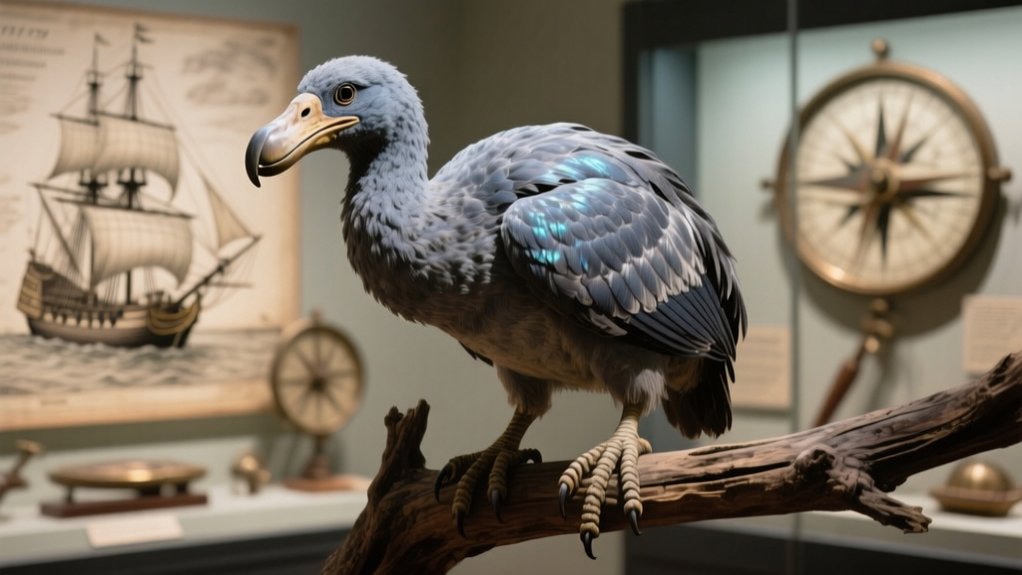
You won’t find dodo birds alive today. They went extinct in the late 1600s. Humans hunted them heavily after settling Mauritius. Invasive species like pigs and rats also destroyed their eggs.
These combined pressures wiped out the dodo, a flightless bird distinctively adapted to an island without predators. Their extinction is a sobering example of how human impact can disrupt ecosystems.
Keep exploring to uncover how this bird’s story shapes conservation lessons still relevant now.
Early Encounters With the Dodo

Although the dodo had never been seen by Europeans before the late 16th century, Dutch Vice Admiral Wybrand van Warwijck recorded the first written mention during the 1598 Second Dutch Expedition to Indonesia.
You’d find these flightless birds exclusively on Mauritius, a forested island in the Indian Ocean, untouched by humans until the early 1500s.
Early sailors noted how tame the dodos appeared, showing no fear and often staying still when approached. This lack of natural predators made them naive to threats, which made capturing them easy.
Though the original Dutch report, “Waarachtige Beschryving,” documenting these observations was lost, its English translation survived, laying the groundwork for all future natural history research on the dodo. The dodo became a symbol of extinction and obsolescence in popular culture, highlighting its lasting impact beyond scientific circles.
These initial encounters provided valuable insight into a unique species that soon became part of European knowledge.
The Origin of the Name “Dodo”
When you look into where the name “dodo” comes from, you’ll come across a few different ideas. People think it might’ve roots in Portuguese or Dutch.
The earliest records show the name popping up in English around the 1620s, and it probably came from Dutch sailors.
One popular theory is that it comes from the Portuguese word “doudo,” which means foolish—kind of how sailors saw the bird. Makes sense, right?
The dodo was a massive, flightless bird native to Mauritius island.
Name Etymology Theories
Since the dodo’s uncovering, scholars have proposed several theories to explain where its name came from, each drawing from different linguistic and cultural contexts.
You’ll find these main theories stand out:
- Portuguese “doudo” theory suggests adventurers called it “fool” or “silly,” reflecting unfamiliarity.
- Dutch “dodaars” feather tuft theory links the name to the bird’s distinctive rear feather knot.
- Dutch “fat-asses” theory interprets “dodaars” as a humorous nod to the bird’s plump body.
- Onomatopoeia theory speculates the name mimics the bird’s calls, though it’s less supported. The dodo’s name also reflects its cultural significance as a symbol of Mauritian heritage.
Each theory offers a unique lens into how early visitors perceived this extinct species, blending language and observation in naming.
Early Documented Usage
The various theories about the dodo’s name set the stage for understanding its early recorded use. You’ll find the first documented mention of “dodo” in 1598, when Dutch sailors, including vice-admiral Wybrand Van Warwijck, arrived at Mauritius and recorded the term in their journals.
Before that, Dutch voyagers used the name “walgyogel,” but it was soon replaced by “dodo.” This designation marked the initial written recognition of the species, highlighting its unique presence.
By September 1598, the name appeared consistently in Dutch expedition records, establishing a foundation for the bird’s identity. Excavations in 2005 at Mare Aux Songes revealed dodo bird remains, providing physical evidence that complements these early records.
These early accounts combined with artistic depictions helped standardize how people understood and referred to this now-extinct species.
Portuguese Linguistic Roots
Although the exact origins of the dodo’s name remain debated, most scholars agree it comes from the Portuguese word “doudo” (modern “doido”), meaning fool or simpleton. Portuguese sailors first encountered the bird during their early 16th-century investigation of Mauritius and used this derogatory term due to the bird’s awkward behavior. Over time, the name stuck and spread among European explorers.
Here’s what you should know:
- “Doudo” was a Portuguese adjective/noun describing foolishness.
- Alternative theories suggest Dutch origins or onomatopoeia, but “doudo” is widely accepted.
- Portuguese writings lack direct references to the bird, yet the term persisted.
- By the 17th century, numerous names existed, but the Portuguese root remained influential.
- The dodo’s significance is underscored by its comprehensive coverage in historical and cultural sources, reflecting its lasting cultural significance.
Physical Features of the Dodo Bird
You’ll find the dodo bird’s physical features strikingly unique, combining a plump, heavyset body with distinct adaptations that set it apart from modern birds. Standing about 3 feet tall and weighing up to 50 pounds, males were larger than females.
Its gray-brown plumage included a tuft of curly feathers on the rear. The tiny wings were too small for flight but helped with balance. Its large hooked beak served as a defensive weapon, while strong legs enabled swift movement on land. The dodo was flightless due to the absence of natural predators and laid one egg per year, likely due to its stress-free environment.
| Feature | Description |
|---|---|
| Size & Weight | 3 ft tall, 20-50 lbs |
| Plumage | Gray-brown with white tuft |
| Wings | Tiny, flightless, balance aid |
| Beak & Legs | Hooked beak, strong legs |
The Dodo’s Habitat on Mauritius

Mauritius, an isolated island in the Indian Ocean about 500 miles east of Madagascar, served as the exclusive home for the dodo bird. This island’s dense forests created the perfect environment for the dodo, a ground-nesting bird adapted to a predator-free habitat.
When exploring the dodo’s habitat, consider these key points:
- The island spans 720 square miles and was formed by volcanic activity 8 million years ago, providing unique evolutionary conditions.
- Dense forests were the primary habitat, but dodos occasionally ventured near shorelines.
- The Mare aux Songes marsh in the southwest yielded over 700 dodo bones, highlighting a critical habitat zone.
- Environmental challenges like cyclones and droughts impacted vegetation and food sources, shaping dodo survival and behavior.
- The dodo’s lack of natural predators on Mauritius contributed to its fearless behavior and inability to adapt to new threats.
Understanding this habitat helps you see why the dodo thrived before humans arrived.
Seasonal Effects on Dodo Food Supply
When heavy cyclones strike between November and March, they drastically reduce the vegetation that dodos rely on for food. These storms damage and destroy fruit trees, cutting off critical food sources and causing predictable seasonal shortages.
You’d notice dodos faced repeated nutritional stress, confirmed by growth arrest lines in their bones, markers of tough times. To cope, dodos evolved to hatch chicks in August, giving juveniles time to mature before cyclone season’s harsh conditions. This timing allowed the young birds to grow rapidly to full size, increasing their chances of survival during harsh weather.
Despite this adaptation, their specialized diet left little room to switch foods during scarcity. Prolonged droughts and deforestation worsened these seasonal gaps, accelerating population decline. The dodo’s role as a seed disperser was also compromised, affecting the regeneration of native plants and further diminishing their food supply.
Diet and Feeding Habits of the Dodo
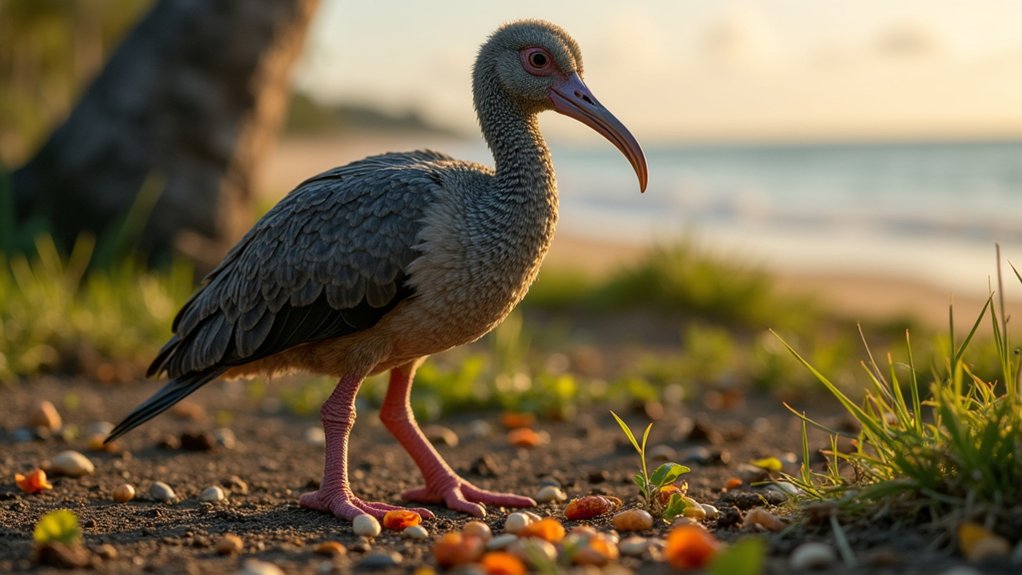
Anyone curious about the dodo’s eating habits will find a fascinating mix of plant-based and occasional animal foods shaped by its island environment. You’ll learn that this flightless bird primarily foraged on the forest floor, relying on fallen fruits, nuts, seeds, roots, and bulbs.
The dodo’s diet was a unique blend of forest floor fruits, nuts, seeds, and occasional animal foods.
Occasionally, it consumed small marine animals like crabs and shellfish near shorelines. To process tough foods, dodos swallowed stones, aiding digestion in their gizzards.
Here’s a quick summary of their diet and feeding habits:
- Mainly frugivorous, eating tambalacoque and palm fruits, plus nuts and seeds.
- Opportunistic omnivores, consuming crabs, shellfish, and possibly fish.
- Used gizzard stones to mechanically break down food.
- Foraged exclusively on the ground due to flightlessness and body size.
This generalist approach helped them thrive in Mauritius’s unique ecosystem.
Lack of Natural Predators and Its Impact
Because the dodo evolved on an island free from natural predators, it developed unique traits that left it vulnerable when new threats arrived.
You’d notice the dodo’s flightless body and large size made it an easy target, as it never needed to escape predators from the air or ground.
Its trusting nature meant it didn’t recognize danger from unfamiliar threats, often approaching humans without fear.
You’d see that the dodo’s reproductive strategy, producing only one egg annually, limited its ability to bounce back from population losses. The bird also built its nests on the ground, which made its eggs highly susceptible to predation by introduced animals like dogs and cats ground-nesting habits.
Without defensive behaviors or wariness, the dodo lacked the instincts to avoid predation.
This lack of natural enemies shaped a bird that was unprepared for introduced predators, ultimately contributing to its rapid decline once new threats reached Mauritius.
Human Impact on Dodo Populations
When humans settled on Mauritius, they really changed the dodo’s environment. They cleared forests and hunted the birds for food, which had a big impact.
On top of that, invasive species like pigs and rats came into the picture. These animals threatened dodo eggs and juveniles, making it even harder for the species to survive.
The dodo’s lack of natural predators before human arrival made it especially vulnerable to these new threats.
All of these human actions combined pushed the dodo toward a rapid and irreversible decline.
Human Settlement Effects
Although human settlement on Mauritius brought progress, it drastically impacted the dodo population by destroying their natural habitat and introducing invasive species. As a result, the dodos faced severe challenges that hastened their decline.
Here’s what happened:
- Forests were cleared for agriculture and urban growth, shrinking the dodos’ food sources and nesting areas.
- Settlers introduced animals like pigs, rats, and macaques that competed for food and preyed on dodo eggs and chicks.
- Expanding settlements displaced dodos from their remaining habitats, increasing environmental pressure.
- These combined habitat losses and invasive predators made survival and reproduction nearly impossible.
- Additionally, dodos were hunted by sailors and settlers, providing an easy source of fresh meat during voyages, which further reduced their population hunting impact.
You can see how human settlement directly triggered ecological changes that left the dodo vulnerable and isolated.
Hunting and Overharvesting
As soon as Portuguese sailors found dodos around 1507, they began hunting the birds for fresh meat on their long voyages. The dodos, having no natural predators and showing no fear of humans, made easy targets.
Hundreds of European ships, including Dutch soldiers who arrived around 1600, intensified hunting efforts. Initially, this was sporadic, but after the Dutch settled permanently in 1644, hunting became systematic and aimed at total eradication.
Besides food, dodos were captured for trade and scientific collections, spreading specimens across Europe and Asia. This relentless overharvesting, combined with the birds’ evolutionary vulnerability, caused their numbers to plummet.
Invasive Species Impact
Because invasive species introduced by humans drastically altered Mauritius’s ecosystem, they played a vital role in the decline of dodo populations.
You should understand that these species, such as monkeys, pigs, deer, and rats, disrupted the dodo’s environment in multiple ways.
Here’s how they impacted dodos: First, they out-competed dodos for food by consuming the vegetation and seeds essential to dodo survival.
Then, macaques and other mammals preyed heavily on dodo eggs and chicks, blocking reproduction.
Dodos, having evolved without predators, lacked defenses against these new threats.
Plus, human-driven deforestation reduced dodo habitats, worsening food scarcity.
This combination of predation, competition, and habitat loss led to an ecological collapse, making dodo extinction inevitable within decades after human arrival.
Today, the last dodo died in Mauritius over 300 years ago, marking it as a powerful symbol of human-caused extinction.
Role of Introduced Animals in Dodo Decline
When European settlers brought cats, rats, and pigs to Mauritius, they unintentionally set in motion a chain of events that would devastate the dodo population. These invasive animals preyed on dodo eggs and chicks, outcompeted adults for scarce food, and altered habitats through rooting and foraging. Habitat restoration efforts could benefit other endangered species in Mauritius, highlighting the importance of ecosystem recovery.
| Introduced Animal | Impact on Dodo Population |
|---|---|
| Cats | Predated adult dodos and chicks |
| Rats | Raided nests, consumed eggs |
| Pigs | Destroyed habitat, competed for food |
These combined pressures caused a rapid decline by increasing juvenile mortality and reducing suitable living conditions. Even today, controlling invasive species remains critical to restoring Mauritius’ native ecosystem and could be key if ever considering dodo reintroduction.
Hunting Practices by Early Sailors
When early sailors landed on Mauritius, they quickly noticed that dodos were an easy target for fresh meat. The birds were tame and couldn’t fly, so hunting them was pretty straightforward. You didn’t need much skill or fancy tools to catch one.
Even though sailors hunted dodos often, their hunting wasn’t the main reason these birds went extinct, which is something a lot of people mightn’t realize. The rapid decline of the dodo was primarily due to introduced animals like dogs, cats, rats, and pigs that destroyed their habitats and ate their eggs.
Early Sailor Hunting Impact
Although the dodo’s lack of fear made it an easy target, early sailors didn’t just stumble upon these birds. They systematically hunted them to sustain long ocean voyages. You should know their organized hunting drastically reduced dodo numbers in less than a century.
Here’s how they impacted the population:
- Sailors killed about 50 large birds daily, half being dodos, during focused expeditions.
- Hunting parties operated in teams, capturing dozens of dodos in trips lasting from three to ten days.
- The birds’ flightlessness and lack of fear made them easy to catch without resistance.
- Captured dodos were salted and preserved on board, ensuring a steady food supply.
In addition to hunting, the introduction of invasive animals such as rats, cats, and pigs further threatened dodo populations by preying on their eggs and competing for resources.
This relentless, well-organized hunting led to the rapid decline and eventual extinction of dodos by the late 1600s.
Fresh Meat Resource
You’ll find that fresh meat was an essential resource for early sailors enduring long ocean voyages, where shipboard rations were often meager and monotonous.
Island stops offered a crucial chance to replenish supplies, with dodos providing nearly half of the daily bird-hunting yield, about 50 large birds each day.
These birds were easy to catch, as their fearlessness and limited escape abilities made hunting efficient. Historical accounts describe the dodo’s lack of fear toward humans, which contributed to their vulnerability.
While sailors had mixed opinions on dodo meat quality, they prized gizzards as the most delicious part, influencing selective butchering practices.
This focus on prime cuts, combined with sailors’ preference for parrots and pigeons, shaped hunting patterns.
Fresh meat not only relieved dietary monotony but also directly supported the endurance of extended sea voyages, making dodo hunting a critical survival strategy for early mariners.
Timeline of Dodo Extinction
Since the dodo’s revelation in the early 1500s, its journey toward extinction unfolded over less than a century.
You’ll find this timeline highlights key events:
- 1507-1598: Portuguese and later Dutch sailors encounter dodos on Mauritius, where they thrived without fear of humans.
- 1598-1638: Dutch settlement introduces invasive species like rats and pigs, destroying dodo nests and habitats.
- 1638-1662: Dodo sightings dwindle; invasive species consume eggs, and competition for food rises; last reliable sighting in 1662. The combination of these factors created an ecological crisis for the dodo.
- 1662-1681: Few confirmed observations remain; the last known dodo is killed in 1681, marking its extinction.
This rapid decline resulted from habitat destruction, introduced predators, and human exploitation, sealing the dodo’s fate within a century.
How the Dodo’s Extinction Was Confirmed
The timeline of the dodo’s extinction provides a framework, but confirming exactly when the bird disappeared requires examining historical records, scientific analyses, and physical evidence.
Determining the dodo’s extinction date involves careful study of history, science, and physical proof.
You’ll find that the last widely accepted sighting was in 1662, though some archives suggest live dodos existed until 1689.
Scientific models estimate extinction around 1690 to 1693, with some debate pushing possible dates to 1715. The introduction of invasive species such as cats and dogs by Dutch settlers played a critical role in accelerating their extinction.
Physical evidence, like limited skeletal remains and the Oxford Dodo specimen shot by humans, confirms the bird was hunted to extinction.
The IUCN officially recognizes 1662 as the extinction date, treating later reports as misidentifications.
Together, these lines of evidence establish that the dodo vanished by the early 18th century, marking it as the first human-driven extinction witnessed in recorded history.
The Legacy of the Dodo Bird Today
Although the dodo vanished centuries ago, its legacy continues to shape how we perceive extinction and conservation today. You’ll find its impact in several key areas:
- Conservation Awareness: The dodo’s extinction serves as a cautionary tale, guiding modern efforts to protect endangered species and habitats.
- Cultural Icon: Phrases like “dead as a dodo” keep its memory alive. Literature and media use it as a symbol of obsolescence.
- Human-Caused Extinction Symbol: It’s one of the first well-documented examples showing how human activity leads to species loss. This frames today’s environmental challenges.
- Scientific Value: Ongoing research into its fossils helps you understand ecology, evolution, and the importance of detailed historical records.
Frequently Asked Question
Could the Dodo Bird Be Revived Through Cloning or Genetic Engineering?
You can’t revive the dodo through traditional cloning because of avian egg limitations, but genetic engineering offers hope.
Scientists use gene editing on primordial germ cells from the dodo’s closest relatives and then insert them into chicken embryos acting as surrogates.
This process might produce a hybrid dodo within 5 to 7 years.
While it won’t be an exact clone, this approach could bring back a version of the extinct bird.
What Modern Animals Are Closest Relatives to the Dodo Bird?
Think of the dodo’s family tree like a puzzle, with the Nicobar pigeon as its closest living piece.
You’ll also find the Victoria crowned pigeon nearby, acting as the dodo’s second-closest modern relative. Both birds share genetic ties and behaviors with the dodo.
The extinct Rodrigues solitaire was another close cousin, now gone but essential for understanding the dodo’s evolutionary roots within the pigeon family.
How Did the Dodo Bird Contribute to the Ecosystem of Mauritius?
You’d see the dodo bird played an essential role in Mauritius’s ecosystem by dispersing seeds of native plants, especially the dodo tree.
Its fruit-eating habits spread seeds through droppings, maintaining forest diversity.
As a large, flightless herbivore, it accessed and processed plant resources others couldn’t, supporting food webs.
When dodos disappeared, seed dispersal faltered, causing forest and biodiversity decline, showing how important they were for ecological balance.
Are There Any Undiscovered Dodo Fossils Outside Mauritius?
You won’t find any undiscovered dodo fossils outside Mauritius because all known remains come exclusively from that island.
Scientists have searched nearby regions like Madagascar and other islands but uncovered no evidence of dodo bones.
The species evolved in isolation on Mauritius, and its flightless nature meant it never expanded its range.
What Cultural Symbolism or Myths Arose From the Dodo Bird?
You’ll find the dodo symbolizes extinction and human impact, often linked to loss and vulnerability, with the phrase “dead as a dodo” reflecting this.
Myths portray it as slow and foolish, but recent research shows it was actually swift and fierce when threatened.
Spiritually, it represents innocence, creativity, and divine presence.
Its cultural image persists in art and literature, shaping how you and others perceive nature’s fragility and the consequences of human actions.
Conclusion
Though the dodo bird no longer walks the Earth, its story sticks with you like a shadow at dusk. It’s a reminder of how fragile life can be.
You won’t find dodos alive today, but their legacy lives on. They teach us about the impact of human actions on nature.
By understanding their history and extinction, you can appreciate why it’s important to protect endangered species. Otherwise, they too might become just a memory in time.