
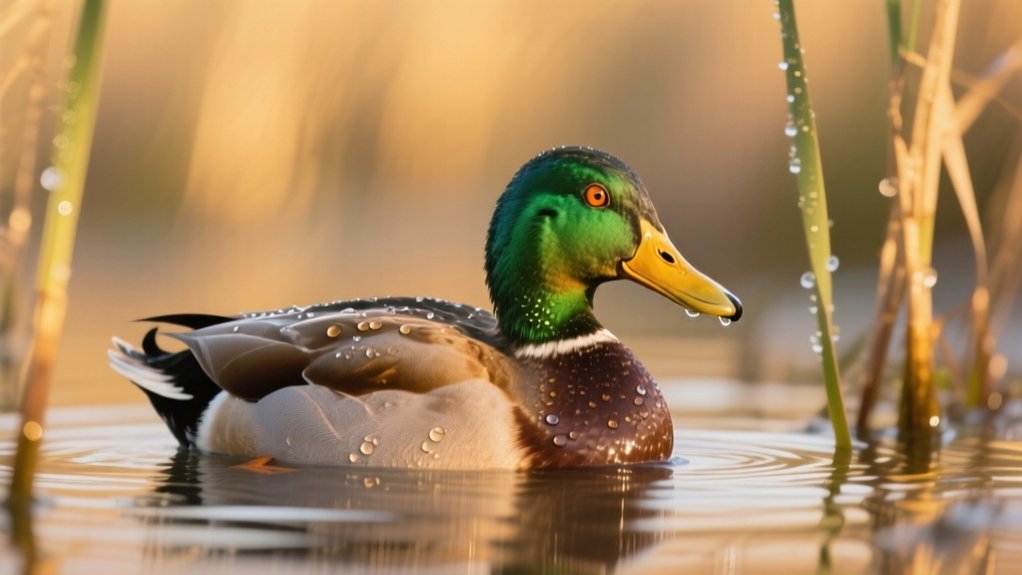
You might wonder if ducks are birds or mammals, but science clearly classifies them as birds within the class Aves. Ducks have feathers, lay eggs, and possess lightweight, hollow bones. These traits are absent in mammals.
Their unique respiratory system uses air sacs for efficient oxygen exchange during flight. They also have specific reproductive anatomy for egg-laying, unlike mammals that birth live young.
Understanding these details reveals why ducks belong to the bird lineage. Exploring further shows fascinating adaptations unique to them.
Taxonomic Classification of Ducks

Although ducks might seem simple at first glance, their taxonomic classification reveals a detailed hierarchy that places them firmly within the animal kingdom.
You’ll find ducks in Kingdom Animalia as multicellular, heterotrophic eukaryotes. They belong to Phylum Chordata, characterized by a notochord and dorsal nerve cord during development. Their Class is Aves, confirming their status as birds.
Within Order Anseriformes, ducks share lineage with geese and swans. Ducks fall under Family Anatidae, a group of waterfowl. They inhabit a wide range of aquatic environments, including marshes, rivers, and lakes, which influences their adaptive traits.
The genus Anas includes common dabbling ducks like the mallard (Anas platyrhynchos). Ducks are further divided into subfamilies and tribes. Anatinae includes true ducks like dabblers and diving ducks.
This structured classification is consistent across major taxonomic databases, underscoring ducks’ precise placement within avian biology.
Defining Characteristics of Birds and Mammals
You can tell birds apart from mammals by looking at their coverings—birds have feathers, while mammals have fur or hair.
Feathers are made of keratin, just like hair, but they’re unique to birds and serve different functions. Unlike mammals, birds’ reproductive process always involves egg-laying, which is a defining feature of the avian class.
When it comes to reproduction, birds lay eggs that have hard shells, which is quite different from most mammals that give birth to live young.
Mammals also nurse their babies with milk from mammary glands, something birds don’t do.
There are also differences inside their bodies.
Birds have lightweight, hollow bones that help them fly, and their lungs are designed for one-way airflow, making breathing very efficient.
Their hollow bones contain a crisscrossed matrix that provides strength without adding weight.
Mammals, on the other hand, have denser bones and use a tidal system for breathing, where air moves in and out the same way.
These features really highlight how birds and mammals have adapted differently over time.
Feathers Versus Fur
Three fundamental structural differences separate feathers from fur, defining key distinctions between birds and mammals.
Feathers are complex keratin structures composed of a central rachis with interlocking barbs and barbules. These create aerodynamic, waterproof surfaces essential for flight and insulation.
In contrast, mammalian fur consists of simpler keratin filaments lacking interlocking vanes. It provides insulation through dense packing rather than branched microstructures.
Feathers grow in distinct tracts called pterylae, whereas fur generally covers skin more uniformly.
Functionally, feathers offer multilayered insulation by trapping air and shedding water efficiently. This is critical for endothermy and buoyancy in birds like ducks.
Fur absorbs water more readily and relies on length, density, and underfur for insulation. It lacks the aerodynamic and waterproof capabilities inherent to feathers.
Unlike fur, feathers are a defining feature of birds, serving purposes beyond insulation and enabling powered flight, waterproofing, communication, and camouflage.
Reproductive Differences
When examining reproductive differences between birds and mammals, internal organ structures reveal key distinctions.
Male birds have paired testes near the kidneys that enlarge during mating, unlike mammals whose testes are external.
Female birds retain only the left ovary and possess an elongated oviduct specialized for egg formation, expanding dramatically in breeding seasons.
Most birds lack a true intromittent organ; only about 3% have a functional phallus, particularly waterfowl, including ducks, which exhibit species-specific penis morphology.
Non-waterfowl birds rely on a cloacal protrusion for sperm transfer, functionally analogous to mammalian penises but structurally distinct.
Sexual dimorphism arises post-hatching with female reproductive structures regressing, while males develop prominent phalluses in species that possess them. These relative weights of ovaries and oviducts are notably greater in sexually mature female birds compared to immature females, reflecting reproductive readiness.
These reproductive traits underscore fundamental avian-mammalian differences in anatomy and functional reproduction.
Skeletal and Respiratory Traits
Understanding reproductive distinctions between birds and mammals provides context for exploring their contrasting skeletal and respiratory systems.
Ducks, like all birds, have thin yet stiff and dense bones with pneumatic (hollow) structures. This enhances strength while reducing weight, which is important for flight. Some of these bones are specifically pneumonised, enhancing flight capability.
Their vertebrae fuse into rigid structures: the notarium in the thoracic region and the synsacrum in the lumbar and sacral areas. These fused bones support stability. The sternum anchors muscles vital for wing movement and respiration.
This skeletal-respiratory integration includes air sacs invading bones, optimizing oxygen exchange during flight. This is unlike mammals whose bones lack pneumaticity.
Limb proportions in ducks show adaptations for swimming and walking, with variations in tibiotarsal curvature and stiffness.
These traits firmly align ducks with avian skeletal and respiratory design, distinguishing them from mammalian anatomy.
Feathered Anatomy of Ducks
Feathers form the vital structural and functional interface between ducks and their environment. They combine lightweight strength with waterproofing and insulation. Their plumage, made of beta-keratin, features a central shaft with interlocking barbules creating a flexible, water-resistant surface. The hollow base part of the feather called the calamus anchors the feather securely within the skin follicle.
Beneath contour feathers lies an ultra-dense down layer that traps air for thermal insulation. This is essential in cold aquatic habitats. Contour feathers overlap tightly, shedding water and supporting buoyancy, aided by oils from preening.
Understanding feather types and microstructures reveals how ducks thrive in diverse environments.
| Feature | Function |
|---|---|
| Beta-keratin | Provides rigidity with low weight |
| Barbules & Hooklets | Create waterproof, wind-resistant surface |
| Down Feathers | Trap air for thermal insulation |
| Preening Oils | Improve water repellency |
Skeletal and Muscular Adaptations in Ducks
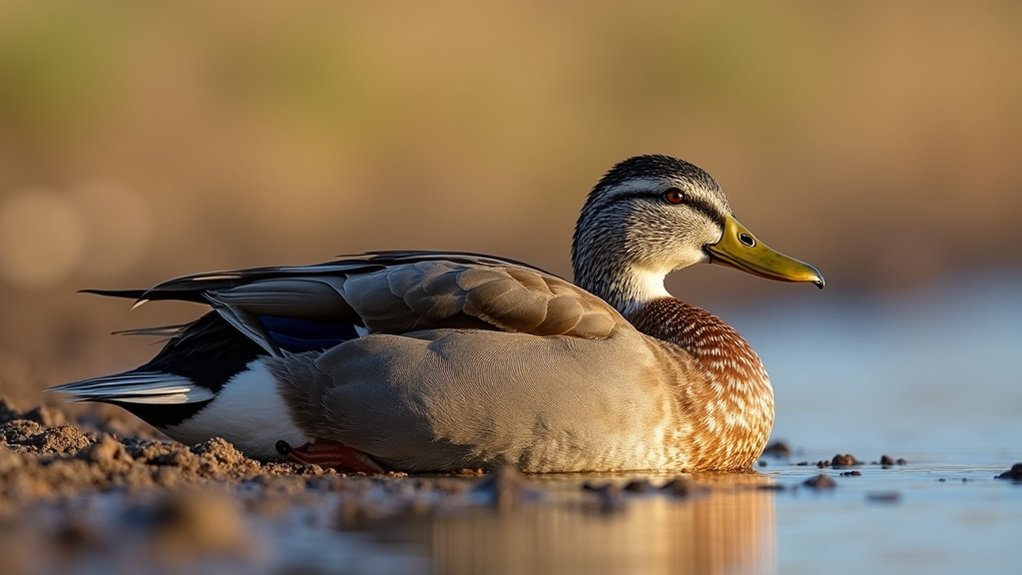
Several key skeletal and muscular adaptations enable ducks to excel in both flight and aquatic environments. Their lightweight pneumatic bones minimize weight without sacrificing strength, while the keeled sternum anchors powerful flight muscles like the pectoralis and supracoracoideus.
Ducks combine lightweight bones and a keeled sternum to power efficient flight and swimming.
You’ll notice elongated tibiotarsal bones, which provide strong swimming propulsion, contrasting with relatively shorter femurs. The fused caudal vertebrae form a pygostyle that stabilizes tail feathers, aiding navigation.
Robust tibial outer diameters in Mallards support powerful takeoffs. Lighter bones in Green-Winged Teals improve agility in wetlands. Intermediate bone strength in Tufted Ducks balances diving demands.
Humerus length and pneumaticity allow precise wing articulation. Sexual dimorphism affects bone geometry, influencing locomotion. Additionally, the uncinate processes on ribs strengthen the rib cage, enhancing respiratory efficiency during flight.
These adaptations optimize ducks’ dual lifestyle across air and water.
Respiratory System Unique to Birds
You’ll notice that ducks rely on air sacs to move air efficiently through their lungs, unlike mammals.
This means air flows in one direction, which is pretty cool because it allows continuous oxygen exchange. Air passes through tiny tubes called parabronchi during both inhaling and exhaling. One key benefit of this system is that ducks maintain consistently high oxygen levels in their lungs, which is especially important during flight.
Because of this setup, gas exchange is optimized, which helps meet the high energy needs ducks have when they’re flying. The presence of neopulmonic parabronchi in ducks supports this efficient bidirectional flow in parts of their lungs, further enhancing respiratory performance.
Air Sacs Function
Although air sacs don’t engage directly in gas exchange, they play an essential role as ventilatory bellows that drive air through the rigid lungs of birds.
These thin-walled, highly compliant structures enable continuous airflow without lung expansion or contraction.
You’ll find about nine air sacs organized into cranial and caudal groups, connected to the lungs via ostia.
Their function includes facilitating large volume changes during respiration through elastin-rich connective tissue.
They store fresh and deoxygenated air in posterior and anterior sacs, respectively.
Air sacs also pneumatize bones to reduce skeletal mass for flight adaptation.
Being poorly vascularized confirms they’ve no direct role in gas exchange.
They drive airflow by coordinated movements of the sternum, ribs, and abdominal muscles.
This specialized system supports the avian respiratory efficiency unique to ducks and other birds, allowing them to extract around 25% more oxygen than mammals.
Unidirectional Airflow Mechanism
Building on how air sacs facilitate airflow without lung expansion, the unidirectional airflow mechanism in birds guarantees continuous, one-way movement of air through their lungs.
You’ll find that primary bronchi route air past rigid lungs to posterior regions, then dorsal and ventrobronchi loop air through parabronchi. These are narrow tubes where air flows from caudal to cranial. This system allows nearly complete air replacement in the lungs with each breath, ensuring a highly efficient gas exchange process near-complete air replacement.
This design, combined with aerodynamic valving, steers airflow without mechanical valves by exploiting flow-dependent resistance and vortex dynamics.
| Component | Function |
|---|---|
| Primary bronchi | Conduct air past lungs to rear |
| Parabronchi | Maintain unidirectional air flow |
| Aerodynamic valving | Control flow direction via resistance |
This system guarantees efficient ventilation despite lung rigidity and varying breathing patterns.
Efficient Gas Exchange
When you examine bird respiration, you find a distinctly efficient gas exchange system that surpasses mammalian designs.
Birds utilize a rigid lung paired with an extensive air sac system that ventilates without lung expansion. This allows continuous, unidirectional airflow through parabronchial air capillaries, maximizing oxygen diffusion. Air sacs provide a continuous flow of oxygen-rich air that is essential for this process.
The cross-current arrangement between air and blood flow maintains a high oxygen gradient, enhancing extraction efficiency. This system supports the metabolic demands of flight and altitude adaptation.
Rigid lungs prevent mechanical stress on exchange surfaces. Air sacs act as reservoirs, not exchange sites. Continuous airflow guarantees fresh air at all times.
Cross-current exchange maximizes oxygen uptake. Thin blood-gas barriers accelerate diffusion. This design optimizes oxygen extraction beyond mammalian alveolar lungs.
Reproductive Methods of Ducks
If you examine duck reproduction, you’ll find their mating involves rapid and specialized genital mechanics unlike most birds.
Male ducks possess a corkscrew-shaped phallus that everts swiftly within one-third of a second, depositing sperm along its spiraled surface. The phallus connects to the cloaca, guaranteeing sperm reaches the female’s reproductive tract. Interestingly, duck erections are supported by lymph, not blood, allowing for rapid and efficient copulation.
Male ducks rapidly evert a spiraled phallus to ensure sperm reaches the female’s reproductive tract efficiently.
Females counter this with a labyrinthine vaginal tract spiraling opposite to the male’s phallus, incorporating blind sacs that physically impede unwanted penetration. This coevolution reflects a sexual arms race, where only males with sufficiently shaped phalluses achieve full eversion and successful insemination.
Females exert cryptic choice via muscular control and sperm storage tubules, selectively facilitating fertilization.
Mating involves brief cloacal contact, requiring precise alignment between male phallus and female tract to guarantee sperm reaches near the ovary for fertilization.
Egg Laying Versus Live Birth

Although both egg laying and live birth serve reproductive purposes, ducks exclusively reproduce by laying eggs, a defining avian trait contrasting sharply with mammalian live birth. This mode of reproduction involves external development, where embryos grow inside eggs outside the mother’s body. The female duck’s ovary produces only one mature ovum on the left side, which becomes the yolk of the egg.
Mammals, however, typically nourish embryos internally and give birth to live young.
Key distinctions include:
- Duck eggs contain nutrient-rich yolk supporting embryonic growth externally.
- Eggshells provide protection and gas exchange through pores.
- Eggs are produced approximately every 24 to 26 hours.
- Incubation relies on maternal body heat transferred via a brood patch.
- Embryos develop fully within eggs before hatching.
This reproductive strategy confirms ducks’ classification as birds, lacking mammalian traits like internal gestation and live birth.
Duckling Development and Parental Care
You’ll notice that after the hen carefully incubates the eggs, the ducklings hatch precocially. That means they’re ready to walk and feed themselves within just a few hours.
The mother then leads the brood to watery habitats where the ducklings start foraging for invertebrates. They rely on their innate motor skills to find food, rather than being fed by the hen.
Meanwhile, the mother focuses on protecting them by keeping the brood together and guarding against predators during this vulnerable early stage.
Egg Incubation Process
The egg incubation process in ducks begins once the hen completes laying her clutch, which commonly consists of 8 to 13 eggs. She then starts full-time incubation, maintaining ideal conditions to synchronize hatching.
As you manage incubation, focus on precise temperature and humidity control to support embryo development. It is also important to ensure proper ventilation in the incubator to provide fresh air circulation for the developing embryos.
Incubation typically lasts 28 days for mallard-type ducks; Muscovy ducks require about 35 days. Keep temperature steady around 99.5°F (37.5°C) and humidity at 45–55% initially. Increase humidity to 65–70% from day 25 to soften shells for hatching.
Turn eggs regularly, hourly if possible, to prevent membrane adhesion and guarantee even growth. Cease turning near day 25 to enter lockdown, maintaining stable conditions until ducklings pip and hatch.
Duckling Self-Feeding Behavior
Once ducklings hatch, they promptly begin feeding themselves, exhibiting precocial behavior that enables immediate foraging. You’ll notice they follow their mother closely, mimicking her pecking and probing to find invertebrates, plants, and seeds. Though the mother guides them to safe, food-rich areas, ducklings independently consume food to meet their high metabolic demands essential for growth. The mother duck also provides warmth and protection during this vulnerable stage, ensuring the ducklings stay safe as they learn to feed themselves.
| Behavior | Role of Mother | Duckling Action |
|---|---|---|
| Foraging Initiation | Leads to feeding sites | Begins pecking immediately |
| Food Acquisition | Demonstrates feeding | Self-feeds on insects, plants |
| Protection | Guides and alerts | Follows closely |
| Growth Support | Guarantees safety | Preens, thermoregulates |
This early independence is critical for survival and development without direct food provisioning by the mother.
Parental Protection Strategies
Although ducklings quickly start feeding themselves, they remain highly vulnerable and depend heavily on parental protection strategies to survive early development.
Mother ducks provide critical brooding to maintain duckling body temperature and shield them from weather extremes. They emit alarm calls to warn of predators and use distraction tactics to divert threats. Brooding also protects from extreme weather like rain, hail, snow, and sunlight.
Males may assist in guarding territory, though involvement varies by species. Parents also defend feeding areas and guide ducklings to suitable habitats.
Maternal brooding guarantees thermoregulation and protection from precipitation and predators.
Alarm calls trigger duckling evasive behaviors, including freezing or scattering.
Male drakes sometimes guard broods and defend territory, especially in southern species.
Females aggressively defend brood feeding and loafing zones from intruders.
Parental investment differs with species, adapted to habitat and duckling capabilities.
Feeding Structures and Behaviors in Ducks
When you observe ducks feeding, you’ll notice their bills vary in size and shape, each distinctly adapted to their dietary needs.
Northern shovelers have broad, sieve-like bills for straining tiny aquatic invertebrates, while wood ducks feature shorter, narrower bills ideal for grasping acorns and seeds.
Inside, lamellae act like serrated teeth, manipulating food efficiently.
Ducks lack a true crop but use an expandable esophagus to store food temporarily, which you might see as chest swelling.
Food passes through this muscular tube to the glandular proventriculus, where enzymes and hydrochloric acid begin digestion.
Then, the gizzard mechanically grinds food with grit, aided by keratinized lining to prevent damage.
The size of the gizzard can change depending on the hardness of the food being consumed, allowing for better mechanical digestion.
This coordinated system guarantees ducks process diverse diets effectively and adaptively.
Aquatic Habitats and Ecological Roles
Because ducks rely heavily on aquatic environments for survival, understanding the types of habitats they occupy is essential. You’ll find ducks inhabiting freshwater ponds, marshes, rivers, and coastal estuaries, with some species adapting to urban shorelines.
Ducks thrive in diverse aquatic habitats, from freshwater wetlands to urban shorelines.
Their habitats provide critical resources like submerged vegetation and shoreline cover needed for nesting and foraging. Riparian zones, in particular, support a higher diversity of nesting birds than upland areas, making them vital for duck populations (riparian zones support diversity).
Key habitat and ecological characteristics include:
- Occupation of both freshwater and saltwater systems, including riparian zones.
- Dependence on aquatic vegetation and woody shoreline plants for shelter and food base.
- Use of tree cavities and reed beds for nesting by specific species.
- Adaptations like webbed feet and diving reflexes for efficient aquatic locomotion.
- Ecological roles as consumers, seed dispersers, nutrient cyclers, and prey within wetland food webs.
Vocalizations and Communication in Ducks
You’ll find that ducks produce a diverse array of vocalizations. For example, Pekin ducks can make up to 19 distinct call types, each connected to different social and environmental situations.
These sounds come from the syrinx, which is basically their vocal organ. Inside, vibrating membranes create changes in frequency and loudness that shape the unique sound of each call.
When you understand these vocal patterns, you start to see how ducks use their calls for things like mating, sounding alarms, and coordinating their groups.
It’s pretty fascinating how their communication fits into their complex social lives.
Duck Vocal Types
Ducks produce a diverse array of vocalizations that serve critical roles in communication across species and contexts.
You’ll find their call repertoires vary widely, with domestic Pekin ducks exhibiting up to 16 distinct call types, including AM calls, honks, and pip-harmonics.
Sex differences are pronounced; for instance, female mallards emit loud rhythmic quacks, while males produce softer rasps and whistles.
Vocal types also differ by ecology: dabbling ducks use louder calls than plunging ducks, which favor subtle whistles.
Dabbling ducks are known for their loud and frequent vocalizations, which help them communicate effectively in their shallow water habitats.
Acoustic properties like frequency modulation help distinguish calls.
Pekin ducks’ vocalizations cluster into six major acoustic groups.
Female mallards produce iconic multi-note quacks, and males use “dweek” whistles.
Dabbling ducks’ calls are louder for wetland visibility.
Whistling ducks use far-carrying multi-note whistles.
Muscovy ducks rely on hisses and trills, not quacks.
Communication Functions
Understanding the variety of vocal types sets the stage for examining how ducks use these sounds within their social and environmental contexts.
You’ll notice that sharper, louder quacks warn of predator threats, prompting ducklings to regroup, while rapid staccato quacking signals agitation or alarm.
During mating, both sexes use head bobbing and specific vocalizations like rapid quacks or neck-stretch calls to communicate breeding interest. Ducks also use body language such as head bobbing to express emotions like happiness or displeasure in these interactions.
Territorial dominance involves hostile pumping displays with “took” calls and head bobbing to assert hierarchy and defend space.
Maternal communication relies on soft clucks for calm and high-pitched peeps from ducklings to indicate hunger or distress.
Social bonding uses varied quacks to maintain pair bonds and flock cohesion.
These vocal patterns allow ducks to efficiently navigate survival, reproduction, and social organization.
Sound Production Mechanisms
Several specialized anatomical features enable ducks to produce their distinctive vocalizations. You’ll find that sound generation occurs in the syrinx, located at the tracheobronchial junction, unlike mammals’ larynx.
Ducks possess two independent bronchial sound generators, allowing complex vocal control.
Males feature a left-sided tracheal bulla acting as a Helmholtz resonator, amplifying low-frequency calls. The vocal tract’s configuration further filters and tunes sounds, shaping call quality.
Syrinx tissues self-oscillate as airflow passes, creating sound. The fundamental frequency depends on the tension of syrinx labia and membranes. Interclavicular air sac pressure modulates amplitude and pitch.
Male-specific tracheal bulla improves resonance and loudness. Vocal tract structures adjust harmonics and spectral output.
This system enables the rich, species-specific calls essential for duck communication. The shape and size of the syrinx influence the variety of vocalizations a duck can produce, from raspy quacks to high-pitched whistles.
Migratory Patterns of Waterfowl
Although waterfowl migration patterns vary by species and region, you’ll find that most North American ducks follow one of four principal flyways: Atlantic, Mississippi, Central, and Pacific.
Species like Mallards and Northern Pintails primarily use the Midcontinent flyways, with increasing Pacific Flyway use recently.
Their migrations run north to south, linking boreal breeding sites to southern wintering areas, with strong fidelity to traditional routes.
You’ll notice migration timing spans early September to late May, shifting earlier for some species due to climate change.
Weather severity and habitat availability heavily influence departure decisions, balancing metabolic costs and forage access.
Research shows that winter distributions for most duck species have shifted north, reflecting changes in migration patterns over decades northward shift.
Consequently, warming trends cause northward shifts and shortened distances.
Stopover sites concentrate in wetland-rich regions, creating critical refueling bottlenecks essential for sustaining migration energy demands.
Common Misconceptions About Duck Classification
When you hear ducks described as mammals or fish, it’s usually due to common misunderstandings about their biology and classification. Ducks are birds (class Aves), not mammals or fish, despite traits like warm-bloodedness or aquatic habitats.
Here are key points to clarify:
Essential facts to distinguish ducks correctly within the animal kingdom and avoid common classification errors.
Ducks’ down feathers aren’t mammalian fur but specialized feathers unique to birds. Egg-laying and aquatic lifestyles don’t reclassify ducks as fish; they belong to Anseriformes within birds. Domestic ducks come in various breeds like Pekin and Muscovy, which are classified into common ducks, Muscovy ducks, and sterile hybrids classifications.
Not all waterfowl labeled “ducks” are true ducks; taxonomy distinguishes geese, swans, and diverse duck subgroups. Domestic ducks derive from wild species, maintaining avian classification despite selective breeding.
Mammalian features like hair or mammary glands are absent in ducks, reaffirming their bird status.
Understanding these facts helps you accurately plunge ducks in the animal kingdom.
Differences Between Endothermy in Birds and Mammals
Understanding the differences between endothermy in birds and mammals reveals distinct physiological and biochemical adaptations tailored to their evolutionary paths.
Birds maintain a basal metabolic rate about 40% higher and body temperatures 1–3°C above similar-sized mammals, demanding improved heat production and ventilation via their unidirectional lung–air sac system. This higher metabolic intensity may be supported by differences in cellular machinery, such as mitochondrial numbers and enzyme concentrations.
Mammals rely on tidal lung ventilation and brown adipose tissue (BAT) for primary non-shivering thermogenesis (NST), while birds lack BAT and use skeletal muscle NST mediated by SERCA pumps.
Both groups’ NST involves Ca²⁺ regulation, with sarcolipin variants modulating SERCA activity.
Respiratory adaptations differ structurally but fulfill high oxygen demands essential for tachymetabolic endothermy.
These divergent systems reflect evolutionary pressures such as miniaturization in birds and nocturnality or parental care in mammals, shaping their distinct, yet convergent, endothermic strategies.
Scientific Consensus on Duck Classification
Since ducks share defining characteristics and genetic markers with other members of the order Anseriformes, scientists classify them unequivocally as birds within the class Aves. Taxonomic placement relies on multiple lines of evidence confirming ducks as avian species, not mammals.
You can understand their classification through these key points:
- Ducks belong to family Anatidae, alongside geese and swans, all waterfowl within Anseriformes.
- They exhibit avian physical traits such as webbed feet, feathered bodies, and scutellate leg scales.
- Reproduction occurs via egg-laying, a hallmark of birds, with species-specific mating behaviors.
- Genetic analyses, including mitochondrial DNA sequencing, place ducks firmly in avian lineages.
- Behavioral ecology divides ducks into dabbling, diving, and perching groups, reflecting avian specialization.
- Ducks serve as indicators of wetland health, highlighting their ecological importance as part of avian ecosystems indicators of wetland health.
This consensus confirms ducks as true birds by modern scientific standards.
Frequently Asked Question
How Do Ducks Regulate Their Body Temperature in Cold Water?
You regulate your body temperature in cold water through counter-current heat exchange in your legs, which transfers warmth from arteries to veins, conserving heat.
Your waterproof, oil-coated feathers and insulating down trap air, minimizing heat loss.
You vasoconstrict blood flow to extremities and increase metabolism to produce more heat.
Behaviorally, you tuck legs and select sheltered spots to reduce exposure, ensuring your core temperature stays stable even in near-freezing water.
What Are the Main Predators of Ducks in the Wild?
You might think ducks live safely in the wild, but their main predators are relentless.
Mammals like red foxes, coyotes, and raccoons actively hunt adult ducks, eggs, and ducklings.
Birds of prey such as hawks, eagles, and owls strike swiftly from above.
Corvids and snakes raid nests, while large fish and turtles ambush ducklings in water.
In urban areas, domestic cats and dogs increase the risk, making survival a constant battle.
How Long Do Ducks Typically Live in Natural Habitats?
Ducks typically live 5 to 12 years in natural habitats, though this varies by species and environment.
You’ll find mallards usually survive around 5 to 10 years, while species like Eurasian Teal and Wigeon can live up to 20 or even 30 years under ideal conditions.
High mortality from predation, disease, and habitat loss usually limits lifespan.
Early survival rates are low; only about 10% of ducklings reach breeding age.
Can Ducks Recognize Individual Humans or Other Animals?
Yes, ducks can recognize individual humans and other animals. They use visual cues like facial features and auditory signals such as voice tone to distinguish familiar individuals.
If you regularly care for ducks, they’ll often approach and follow you, showing preference over strangers.
This recognition stems from strong memory capabilities and social bonding, especially when imprinting occurs early. It reinforces trust and reduces stress in interactions with known caretakers.
What Role Do Ducks Play in Controlling Aquatic Insect Populations?
Ducks play an essential role in controlling aquatic insect populations by actively foraging on aquatic invertebrates such as mosquito larvae, caddisfly, and dragonfly larvae.
You’ll find dabbling ducks feeding in upper water columns, while diving ducks target deeper zones.
Their rooting behavior extracts soil-dwelling grubs, reducing pest populations.
This predation supports wetland ecosystem health by balancing insect densities and contributes to nutrient cycling, benefiting both natural habitats and managed landscapes.
Conclusion
So, are ducks birds or mammals? Given their feathered anatomy, avian respiratory system, and migratory behavior, it’s clear ducks belong to the class Aves.
You won’t find mammary glands or fur here, key mammalian traits. Understanding these taxonomic distinctions helps you appreciate the evolutionary adaptations that define ducks.
Next time you see a duck, remember its biology is a precise example of avian specialization, not mammalian characteristics. Why settle for confusion when science offers clarity?