
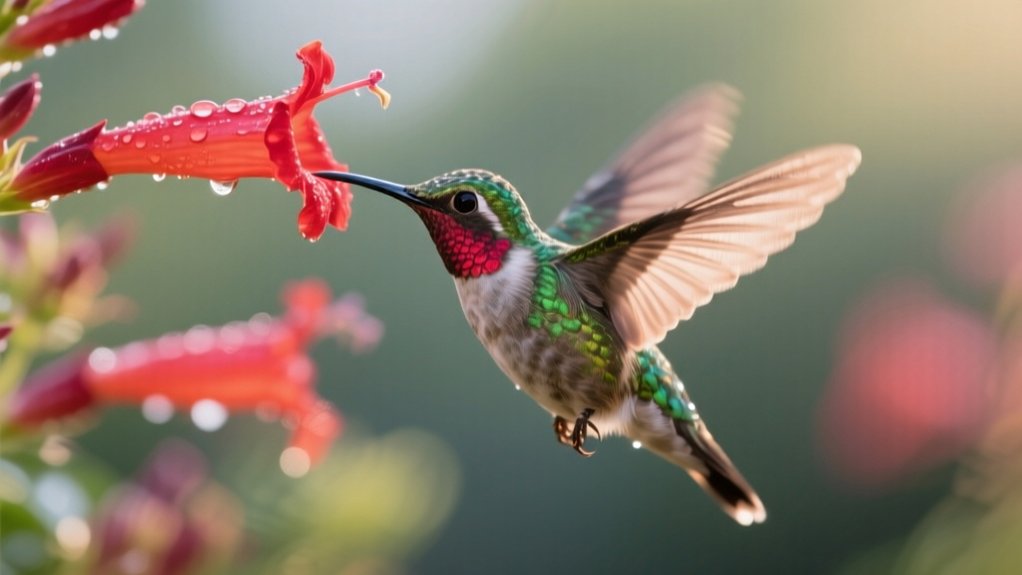
You’ll find that hummingbirds are the only birds capable of sustained, precise backward flight, thanks to their unique wing structure and powerful rotator cuff muscles. Their wings move in a figure-eight pattern, generating lift both forwards and backwards, which other birds can’t sustain.
While some species can briefly fly backward defensively, only hummingbirds use it routinely to improve feeding efficiency and maneuvering. Exploring how their anatomy and behavior support this will deepen your understanding of their flight mastery.
Unique Flight Abilities of Hummingbirds
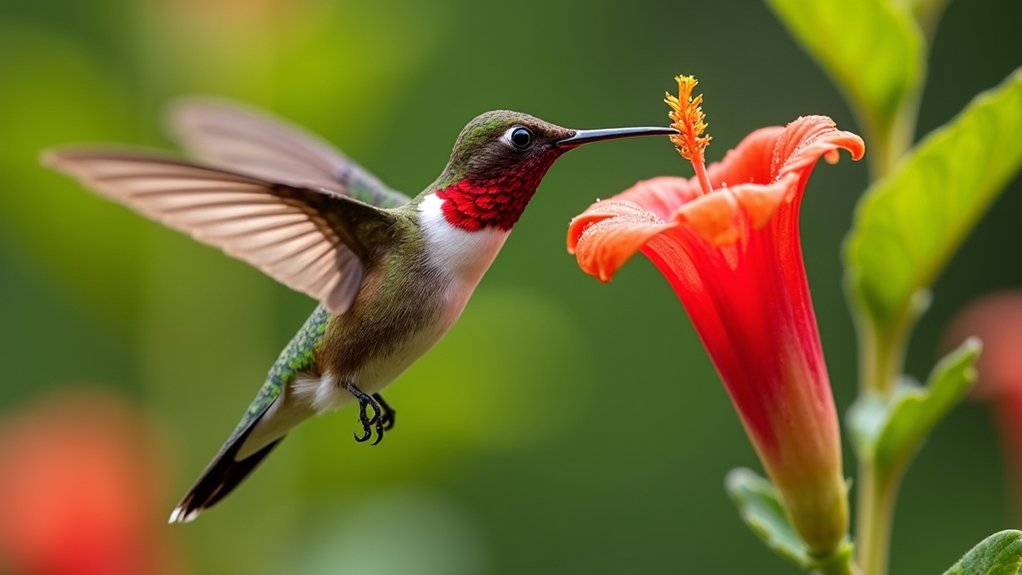
Although most birds can’t sustain backward flight, hummingbirds have evolved a unique wing structure and rotator cuff joint that let them move their wings in multiple directions. This anatomical adaptation enables hummingbirds to fly backwards with precision, unlike other birds that can only briefly reverse direction as a defensive tactic.
When hummingbirds fly, they flap their wings in a figure-eight pattern, generating lift on both the forward and backward strokes. This precise wing movement allows them to hover steadily and even fly upside down, showcasing exceptional aerial maneuverability.
Their ability to fly backwards is critical for efficient feeding, as it lets them quickly navigate between flowers.
Flying backwards enables hummingbirds to swiftly move between flowers for efficient feeding.
Understanding these unique flight abilities highlights why hummingbirds stand out as the only birds capable of sustained backward flight.
Anatomy Behind Backward Flight
The unique flight abilities of hummingbirds stem directly from their specialized anatomy. Their distinctive wing structure includes a rotator cuff joint that functions like a ball and socket, enabling multi-directional wing rotation essential for backward flight.
This joint allows their wings to move in a precise figure-eight pattern, generating lift during both forward and backward strokes. Furthermore, their powerful pectoral muscles, comprising about 30% of body weight, support rapid wing beats exceeding 50 per second. This stabilizes flight and facilitates complex maneuvers.
Key anatomical features include:
- Rotator cuff joint allowing extensive wing rotation
- Figure-eight wing movement producing lift for backward flight
- Enlarged pectoral muscles driving rapid, controlled flapping
These adaptations collectively enable hummingbirds to execute backward flight with unmatched agility among birds.
How Hummingbird Wings Differ From Other Birds

When you compare hummingbird wings to those of other birds, you’ll notice their ball-and-socket joint allows an extraordinary range of motion, enabling multi-directional wing rotation. This unique structure lets hummingbirds fly backwards by generating lift on both wing strokes using a figure-eight pattern.
Their rapid wing beats, over 50 per second, and specialized pectoral muscles, comprising 30% of their body weight, provide precise control and agility unmatched by other birds.
| Feature | Hummingbird Wings | Typical Bird Wings |
|---|---|---|
| Joint Type | Ball-and-socket (multi-directional) | Hinge (limited rotation) |
| Wing Movement | Figure-eight pattern | Up-and-down flapping |
| Muscle Mass | ~30% of body weight | Less developed pectoral muscles |
This anatomy enables hummingbird wings to fly backwards with exceptional efficiency.
The Role of Rotator Cuff in Flight Maneuverability
You know, the hummingbird’s rotator cuff is pretty special. It’s designed in a way that lets their wings move in all sorts of directions with amazing precision.
Because of this unique joint, they’ve better control over their flight. This means they can rotate their wings in complex ways, which is super important for things like hovering and even flying backwards.
When you really think about it, understanding how this works helps explain just how hummingbirds pull off such incredible aerial maneuvers.
Rotator Cuff Anatomy
A hummingbird’s rotator cuff functions as a specialized ball and socket joint, enabling remarkable multi-directional wing movement essential for its aerial agility.
This unique anatomy distinguishes hummingbirds from most bird species by facilitating complex wing rotations necessary for flying backwards.
The rotator cuff’s design allows precise control over wing orientation, critical for maneuvering during feeding and rapid directional shifts.
Key features of the hummingbird’s rotator cuff include:
- Enabling a figure-eight wing motion that generates lift in both forward and backward flight.
- Supporting powerful pectoral muscles constituting about 30% of body weight for sustained high-frequency flapping.
- Providing structural flexibility that improves backward flight capabilities, rare among bird species.
Understanding this anatomy clarifies why hummingbirds excel in aerial dexterity unmatched in the avian world.
Multi-Directional Wing Movement
Although most birds rely on simpler wing joints, hummingbirds utilize a distinctive rotator cuff that grants exceptional multi-directional wing movement. This ball-and-socket joint enables you to observe their unique figure-eight wing strokes, allowing backward and hovering flight.
Ever seen a hummingbird darting flower to flower? Their rotator cuff’s flexibility helps them collect nectar efficiently by permitting rapid directional changes and precise positioning.
| Wing Movement Type | Function | Benefit to Feeding |
|---|---|---|
| Forward Stroke | Generates lift | Enables forward flight |
| Backward Stroke | Maintains lift | Enables backward flight |
| Hovering | Sustained lift | Stabilizes near flowers |
| Vertical Movement | Up/down adjustments | Accesses varied flower heights |
| Rotation | Wing rotation flexibility | Maneuvers precisely around flowers |
This multi-directional wing movement is essential for their high-energy foraging lifestyle.
Enhanced Flight Control
Because hummingbirds possess a specialized rotator cuff, a ball-and-socket joint within their wing structure, they achieve unparalleled flight maneuverability.
This unique joint grants their wings extensive multi-directional movement, allowing for precise control during complex aerial maneuvers.
You’ll notice that hummingbirds exploit this anatomy to perform rapid directional changes essential for efficient feeding and energy conservation.
Their wings move in a figure-eight pattern, generating lift during both forward and backward flight, a feat other birds can’t replicate due to less flexible wing joints.
The rotator cuff’s role is critical, as it supports the fine adjustments required for hovering and backward flight.
Key aspects of improved flight control include:
- Extensive wing rotation enabled by the rotator cuff
- Rapid directional changes for energy-efficient feeding
- Figure-eight wing motion generating lift in multiple directions
Feeding Strategies Enabled by Backward Flight
You rely on the hummingbird’s backward flight to efficiently extract nectar without losing momentum, which helps maximize energy intake.
This precise maneuvering really improves their foraging mobility, allowing them to quickly shift between flowers, especially in dense environments.
By combining backward flight with hovering, you can see how hummingbirds optimize nectar access while conserving energy.
It’s pretty fascinating how these tiny birds manage such smooth and energy-efficient movements!
Efficient Nectar Access
When hummingbirds move backwards, they gain remarkable efficiency in accessing nectar without repositioning their bodies or wasting feeding time. This backward flight lets you approach flowers precisely, maintaining stability and minimizing energy lost to unnecessary movements.
Their figure-eight wing motion supports this unique maneuver, enabling seamless shifts between blooms while sustaining the high metabolic demands of their feeding.
Consider how backward flight benefits your nectar gathering:
- Enables quick, controlled retreat from flowers without turning around
- Maintains ideal hovering posture for sustained feeding
- Helps avoid obstacles and predators while keeping access to nectar
This flight precision maximizes energy intake during frequent feeding sessions, making backward flight indispensable for your survival and efficient foraging.
Enhanced Foraging Mobility
Building on the precision hummingbirds achieve while accessing nectar, their ability to fly backwards greatly improves foraging mobility. You’ll notice this skill allows them to swiftly shift between flowers, optimizing nectar intake to support their high metabolism.
Their unique wing structure facilitates complex maneuvers, enabling precise hovering and rapid directional changes to escape predators and maximize feeding efficiency.
| Aspect | Impact on Hummingbird Behavior |
|---|---|
| Backward Flight | Enables quick repositioning |
| Wing Structure | Supports agile aerial control |
| High Metabolism | Necessitates frequent feeding |
| Predator Evasion | Maintains access to food sources |
| Energy Optimization | Boosts survival in diverse habitats |
This synergy of traits guarantees hummingbirds maintain energy balance essential for survival.
Additionally, their figure-eight wing motion is fundamental in generating the continuous lift and thrust necessary for backward flight.
Other Birds Capable of Brief Backward Movement
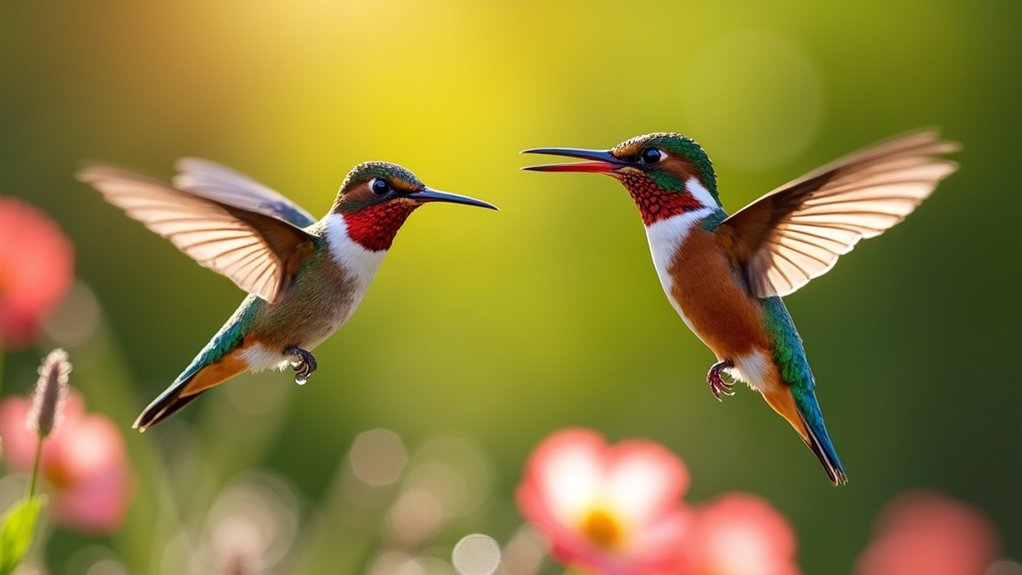
Several bird species, including warblers, egrets, and herons, can perform brief backward flights, usually as a rapid defensive tactic to escape predators.
Unlike hummingbirds, these species lack the specialized wing anatomy that enables sustained backward flight.
Their backward movement is brief, reactive, and less controlled, serving primarily as an evasive maneuver rather than a habitual flight pattern.
When you observe these birds, note that their backward flight lasts only moments during predator evasion.
The wing structure doesn’t support prolonged or efficient backward motion.
This behavior is situational and not used for foraging or routine flight.
Understanding these distinctions clarifies why hummingbirds distinctly achieve sustained backward flight, while others rely on brief, defensive backward bursts.
Comparison Between Hummingbirds and Hummingbird Moths
The striking similarity between hummingbirds and hummingbird moths often leads to confusion, but their flight capabilities and anatomical features reveal clear differences.
Hummingbirds, measuring 3 to 5 inches, possess a distinctive wing structure that enables sustained backward flight, a capability hummingbird moths lack. Moths, smaller at 1 to 3 inches, can only briefly fly backwards.
Both species hover to feed on nectar, yet their body designs differ greatly. Hummingbirds’ wing morphology supports complex aerial maneuvers, while moths rely on rapid, straightforward flight.
Despite behavioral and visual resemblances, you can distinguish moths by their reduced size and distinct body features.
Understanding these differences clarifies why hummingbirds distinctly sustain backward flight among birds, whereas hummingbird moths mimic this motion only transiently.
Hummingbird Habitat and Distribution Overview
Although hummingbirds are native exclusively to the Americas, you can find them across a wide range of habitats, from mountainous regions and dense rainforests to arid deserts and urban gardens.
They rely heavily on environments rich in flowering plants, which supply the nectar essential for their high-energy demands.
Urban settings can support hummingbirds if sufficient floral resources exist. However, outside their native range, such as in the UK, sightings are rare and often mistaken for hummingbird hawkmoths.
Captive maintenance remains difficult, with only a few institutions successfully housing them.
Key habitat characteristics include:
- Availability of abundant flowering plants for nectar feeding
- Diverse ecological zones ranging from high altitudes to lowland deserts
- Adaptability to urban gardens with suitable floral resources
Understanding their habitat preferences is fundamental for appreciating their distribution patterns.
Challenges of Observing Hummingbirds Outside the Americas
Because hummingbirds are native exclusively to the Americas, you won’t find them naturally occurring in Europe, Asia, or other continents. This makes direct observation outside their native range exceptionally rare.
Hummingbirds are native only to the Americas, making sightings outside this region extremely rare.
Their unique backward flight and other aerial maneuvers remain unseen in the wild beyond these regions.
When you attempt to observe hummingbird-like behavior outside the Americas, be aware of common misidentifications, such as the Hummingbird hawkmoth in the UK, which often confuses birdwatchers.
Furthermore, hummingbirds thrive in specific ecosystems like rainforests and deserts that aren’t widely replicated elsewhere, further limiting natural sightings.
Captive hummingbirds are scarce due to husbandry challenges, with only a handful of British zoos housing them.
This reduces your chances to observe these birds in controlled environments.
The Importance of Backward Flight in Hummingbird Survival
You’ll notice that hummingbirds’ ability to fly backward really boosts their feeding efficiency. It lets them position themselves precisely at flowers without having to waste energy turning their whole body around.
This skill is super important because it supports their high metabolic demands.
Because they can move quickly and efficiently between nectar sources, they save a lot of energy.
When you think about it, this flight adaptation shows us how hummingbirds balance their energy intake and expenditure, which is absolutely critical for their survival.
Feeding Efficiency Advantage
When hummingbirds fly backwards, they optimize their feeding efficiency by maintaining momentum and positioning themselves precisely at flowers. This unique ability allows you to access nectar swiftly, reducing the time spent on each bloom and improving foraging success.
Backward flight complements your hovering by enabling subtle positional adjustments to reach flowers at various angles and heights. Furthermore, you can combine feeding with quick evasive maneuvers, enhancing survival during foraging.
Key advantages include:
- Sustaining momentum for rapid shifts between flowers
- Precise positioning to maximize nectar extraction
- Simultaneous evasion of predators without interrupting feeding
Your figure-eight wing motion and specialized wing anatomy make these complex maneuvers possible, supporting your energetic demands with optimized feeding efficiency.
Energy Management Strategy
Mastering backward flight doesn’t just improve your feeding efficiency; it plays an important role in managing your energy balance. By flying backwards, you minimize unnecessary movements, conserving precious energy needed to sustain your high metabolic rate.
This precise control allows you to quickly switch between flowers, optimizing nectar intake without wasting energy on inefficient maneuvers. Your backward flight complements hovering, maintaining a stable position vital for efficient nectar extraction while preventing metabolic depletion.
Furthermore, this skill enables you to evade predators and environmental threats without interrupting feeding, enhancing survival odds. Since nectar is your primary energy source, the ability to precisely control flight direction directly supports your foraging success and energy management.
This ensures you meet the demanding energetic needs required for daily survival and reproduction.
Insights From Wildlife Photography and Videography
Although hummingbirds’ rapid movements challenge human perception, wildlife photography and videography capture their exceptional flight capabilities with remarkable clarity.
These visual media reveal how hummingbirds utilize their unique wing structure and rotator cuff joint to perform sustained backward flight, an ability unmatched by other birds.
By examining high-speed footage, you can observe their precise hovering, sideways, and even inverted maneuvers, especially during feeding.
High-speed footage reveals hummingbirds’ precise hovering and agile maneuvers during feeding.
This documentation not only highlights their agility but also supports ecological studies by illustrating their role as pollinators.
High-speed videography shows shifts between flowers, emphasizing backward flight in feeding.
Photographs capture multi-directional wing strokes and hovering stability.
Documentaries educate on hummingbirds’ ecological significance and unique biomechanics.
These insights deepen your understanding of their flight mechanics and natural behavior.
Frequently Asked Question
How Fast Can Hummingbirds Fly Backwards?
You can picture a hummingbird darting backwards like a tiny helicopter retreating swiftly.
They can fly backward at speeds up to 30 miles per hour, thanks to their unique wing structure that generates lift on both the upstroke and downstroke.
This specialized motion allows precise control and rapid directional changes, essential for accessing nectar.
Their high metabolism demands this agility, enabling them to quickly adjust flight paths while foraging efficiently.
Do Hummingbirds Migrate While Flying Backwards?
No, hummingbirds don’t migrate while flying backwards. During migration, you’ll see them rely on forward flight to cover long distances efficiently, sometimes up to 3,000 miles.
Their backward flight mainly happens during feeding when maneuvering around flowers, not migration.
This forward-focused flight conserves energy and maximizes speed, essential for their arduous journeys between breeding and wintering grounds.
Can Juvenile Hummingbirds Fly Backwards Immediately?
No, juvenile hummingbirds can’t fly backwards immediately after fledging. Their wing muscles and coordination aren’t fully developed yet, so their backward flight attempts are often clumsy and brief.
You’ll notice they gradually improve by watching adults and practicing over several weeks.
This skill is essential for efficient foraging and navigation, but it takes time for juveniles to build the muscle strength and control needed for sustained backward flight.
How Do Hummingbirds Avoid Predators While Flying Backwards?
Think of hummingbirds as aerial ninjas, using their backward flight as a stealthy retreat.
You’ll notice their rotator cuff joints let their wings pivot precisely, enabling quick, agile reversals.
While flying backwards, you can see they keep a sharp eye on predators, maintaining situational awareness.
Their high metabolism fuels these rapid maneuvers, and they avoid scented feeders signaling danger, further reducing predation risk during these evasive flights.
Are There Cultural Significances of Hummingbird Backward Flight?
Yes, you’ll find that many cultures assign deep significance to hummingbirds’ backward flight. It symbolizes resilience and adaptability, showing you how to navigate challenges by reflecting on past experiences.
In Native American and South American myths, this flight represents transformation and spiritual messages.
Hawaiian culture links it to love and flexibility.
Understanding these meanings helps you appreciate how hummingbirds inspire cultural expressions emphasizing agility, beauty, and life’s fluidity.
Conclusion
You might think hummingbirds hold the exclusive title for flying backward, and for good reason. Their unique wing anatomy and powerful rotator cuff make this feat possible. Yet, nature rarely limits such marvels to one species alone.
While hummingbirds master backward flight to feed and survive, other birds show glimpses of similar maneuvers. So, as you watch these tiny acrobats, remember: their backward flight isn’t just motion—it’s evolution’s elegant dance in the air.