
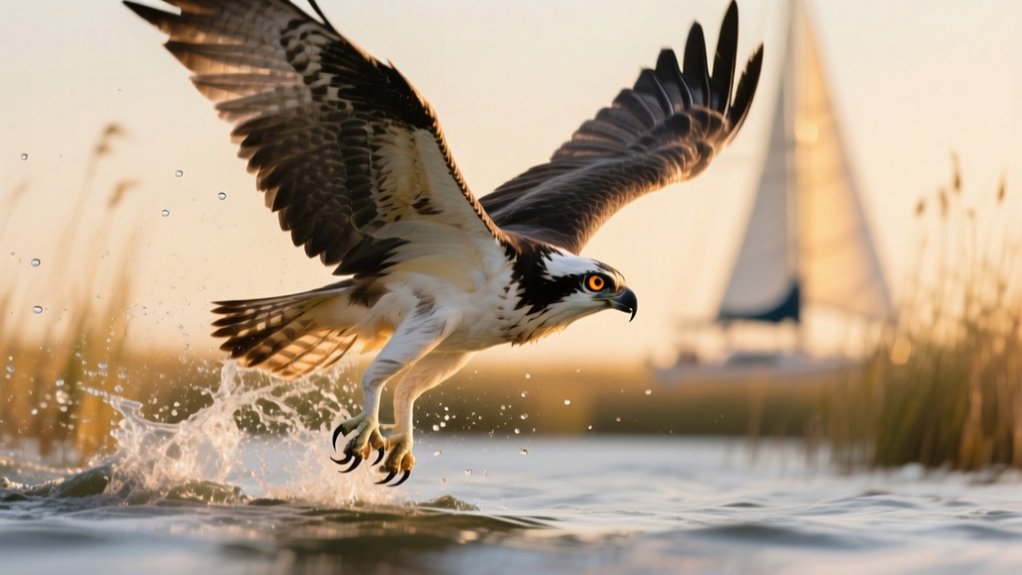
If you’re wondering, “Seahawks” isn’t a distinct bird species but a regional nickname commonly used for ospreys. These birds are skilled fish-eating raptors with white underparts and a dark eye stripe.
They nest near water and plunge expertly for fish, playing a crucial role in coastal ecosystems. The term “seahawk” reflects both ecological and cultural significance, especially in the Pacific Northwest.
Exploring their traits and distinctions reveals a fascinating connection between nature and local identity.
The Origin of the Term “seahawk
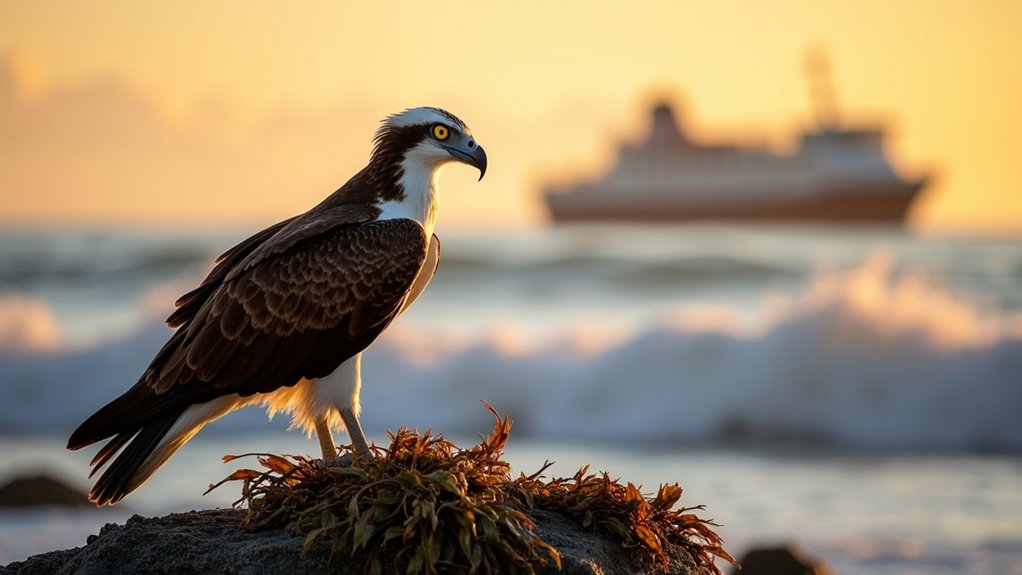
Although the term “seahawk” doesn’t denote an officially recognized bird species, you’ve likely encountered it as a popular nickname for ospreys and skuas, both fish-eating birds known for their specialized hunting abilities.
The origin of the term “seahawk” stems from regional vernacular, where ospreys, also called “fish hawks” in parts of North Florida and South Georgia, are frequently associated with maritime environments. This nickname emphasizes their proficiency in catching fish directly from water surfaces.
Moreover, the term gained cultural prominence when the Seattle NFL team adopted “Seahawks” from over 20,000 fan submissions in 1976, reflecting the Pacific Northwest’s maritime heritage.
Despite its informal nature, “seahawk” effectively captures the ecological and cultural significance linked to ospreys in coastal regions.
Identifying the Osprey: Characteristics and Habits
Ospreys possess distinct physical traits and behaviors that make them identifiable among raptors. You’ll notice their white underparts sharply contrast with brown wings and back, complemented by a distinctive dark eye stripe. These characteristics set ospreys apart visually.
Known as sea hawks, they exhibit specialized hunting techniques, diving from the air to catch fish with their reversible outer toes and barbed pads on their feet, adaptations essential for gripping slippery prey.
You’ll find ospreys nesting in tall trees, poles, or man-made structures near water, highlighting their adaptability. Their global distribution, excluding Antarctica, further attests to this.
Observing these features and behaviors helps you accurately identify ospreys and understand why the term sea hawks fittingly describes their ecological niche and lifestyle.
Regional Names for the Osprey
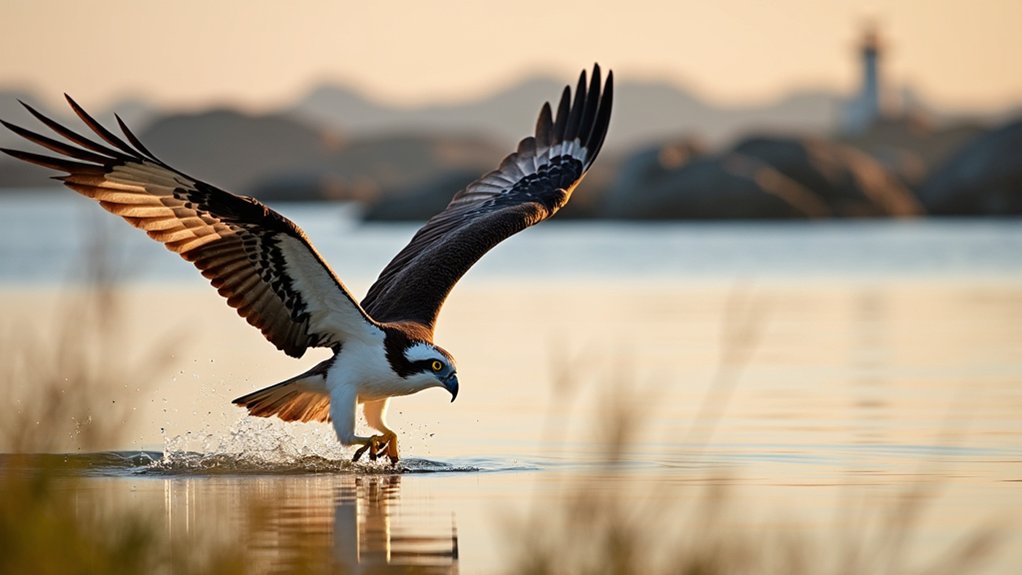
When you investigate different regions, you’ll find that the osprey goes by various local names reflecting its distinctive fishing behavior. Commonly, the term “sea hawk” serves as a widely recognized nickname for ospreys, emphasizing their affinity for coastal and aquatic environments.
In North Florida and South Georgia, these birds are often called “fish hawks,” a regional name for ospreys that directly highlights their primary diet of fish. Such terminology varies globally, influenced by local ecology and cultural perceptions.
This variation in regional names for ospreys enriches community engagement and fosters a deeper understanding of their ecological role. Recognizing these diverse appellations allows you to appreciate how human observation shapes the identity of this remarkable raptor across different habitats.
Differences Between Seahawks and Other Birds of Prey
When you compare seahawks—mostly ospreys—to other birds of prey, you’ll notice some distinct physical traits. For example, ospreys have a dark eye stripe and narrow wings, which set them apart visually.
Their hunting technique is pretty specialized too. They focus on catching fish with sharp talons, which is quite different from eagles or hawks that go after a broader range of prey.
You’ll also see differences in where they live and travel. Ospreys tend to nest close to water, while birds like skuas are known for migrating extensively across polar regions.
Additionally, ospreys are part of the Anseriformes order, which is characterized by adaptations to aquatic habitats and includes various species such as ducks and geese.
Physical Traits Comparison
Distinct physical traits help differentiate the so-called “seahawks” from other birds of prey, providing a clear basis for identification. Ospreys, often nicknamed seahawks, possess a striking white head with dark eye patches and a wingspan reaching up to six feet, which sets them apart from similar raptors.
In contrast, the Augur Hawk, Seattle Seahawks’ mascot, features a darker, more uniformly colored plumage adapted to arid African mountains, differing in both habitat and coloration.
While ospreys have slender bodies optimized for fishing, Augur Hawks exhibit robust builds suitable for terrestrial hunting.
These physical traits are essential in distinguishing ospreys from other raptors like the Augur Hawk, emphasizing that “seahawks” is a colloquial term rather than a distinct species.
Understanding these differences helps you accurately identify these birds based on morphology and ecological niches.
Hunting Techniques Contrast
Although often called “seahawks,” ospreys exhibit a distinctive hunting technique that sets them apart from many other birds of prey. You’ll notice ospreys specialize in fishing, using their exceptional eyesight to spot fish from high above water.
Unlike typical raptors that hunt on land or scavenge, ospreys hover stationary before diving feet-first into the water with remarkable precision. Their feet are uniquely adapted with spiky pads and a reversible outer toe, enabling a firm grip on slippery prey during the plunge.
This contrasts sharply with birds like skuas, which rely on aggressive scavenging rather than active fishing.
When you observe osprey hunting, you see a precise, specialized strategy focused exclusively on securing fish, highlighting their distinct ecological niche among birds of prey.
Habitat and Range Differences
Because “seahawk” is an informal term rather than a specific species, understanding habitat and range differences requires focusing on the birds commonly associated with this nickname.
Ospreys, often called “seahawks,” inhabit regions near water bodies across every continent except Antarctica. Their habitat is closely tied to aquatic environments for fishing.
In contrast, skuas, another bird sometimes labeled as “sea hawks,” are migratory and range extensively from the North Pole to the South Pole. They adapt to diverse habitats along their migratory journey.
Augur Hawks, linked to the Seattle Seahawks mascot, primarily occupy arid mountain habitats in Africa and don’t naturally occur in North American regions like Puget Sound.
Ocean birds such as ospreys and skuas have developed specialized adaptations to thrive in their respective marine or migratory environments, including salt glands and waterproof feathers. Recognizing these distinctions helps clarify how “seahawk” varies regionally, reflecting differences in habitat and geographic range from North to South.
The Role of Ospreys in Coastal Ecosystems
You’ll notice that ospreys feed almost exclusively on fish, which makes them key players in controlling aquatic populations.
Their large nests, usually built close to water, actually create little habitats that support a variety of coastal species.
Osprey Feeding Behavior
Ospreys play an essential role in coastal ecosystems through their specialized feeding behavior, primarily targeting fish with remarkable hunting precision.
You’ll observe that ospreys employ a unique diving technique, plunging feet-first into water to grasp prey with their sharp talons. This feeding behavior enables them to efficiently capture fish near water surfaces, which sustains their high energy needs.
By preying selectively on abundant fish species, ospreys help regulate local populations, maintaining ecological balance within coastal ecosystems.
Their presence signals a healthy aquatic environment, reflecting water quality and fish availability.
Understanding osprey feeding behavior provides valuable insights into coastal ecosystem dynamics and highlights their significance as apex predators in these habitats.
Ospreys also demonstrate specialized beak shapes that make them highly effective at handling slippery fish, further showcasing their adaptation to a piscivorous diet.
Nesting Habits and Locations
When selecting nesting sites, these raptors choose high locations such as dead trees, tall poles, and cliffs, typically near water where they hunt. Ospreys construct large nests from sticks, often exceeding three feet in height, which they reuse and expand annually.
Their nesting habits favor locations offering clear water views to spot prey efficiently while reducing predator risks. You’ll often find Ospreys near human-made structures like docks and power lines, which provide raised, safe nesting locations.
These strategic nesting choices play an essential role in coastal ecosystems by indicating healthy fish populations and supporting biodiversity.
Understanding Ospreys’ nesting habits and locations helps you appreciate their importance in maintaining ecological balance along shorelines.
Impact on Fish Populations
Predators at the top of the coastal food chain, sea hawks play an essential role in regulating fish populations and sustaining ecosystem health.
As apex predators, Ospreys primarily feed on fish, using precise plunging techniques to capture prey. This selective predation targets weaker or diseased fish, promoting genetic robustness within fish populations.
By controlling fish abundance, Ospreys prevent overpopulation that could disrupt aquatic environments. Their presence signals a healthy ecosystem with sufficient fish stocks to support breeding and survival.
Furthermore, Ospreys contribute to nutrient cycling through their coastal nesting habits, enriching soils and fostering plant growth that benefits diverse wildlife.
Understanding the impact of Ospreys on fish populations highlights their critical role in maintaining balanced, thriving coastal ecosystems.
Historical Use of the Name “seahawk
Although the term “seahawk” does not correspond to a specific bird species, it has historically served as a popular nickname for fish-eating birds such as ospreys and skuas. You’ll find historical references to “Seahawks” in Seattle’s sports culture dating back to a hockey team (1934-1940) and a Miami football team in the 1940s.
When the NFL franchise was established in 1976, the name “Seattle Seahawks” was chosen from over 20,000 fan submissions, reflecting the region’s maritime culture. NFL Commissioner Pete Rozelle endorsed this selection, anchoring the name firmly in Seattle’s identity.
| Year | Usage Context |
|---|---|
| 1934-1940 | Seattle hockey team |
| 1940s | Miami football team |
| 1976 | NFL Seattle Seahawks |
| Pre-1976 | Local traditions |
| Present-day | Maritime culture |
How Ospreys Hunt and Feed
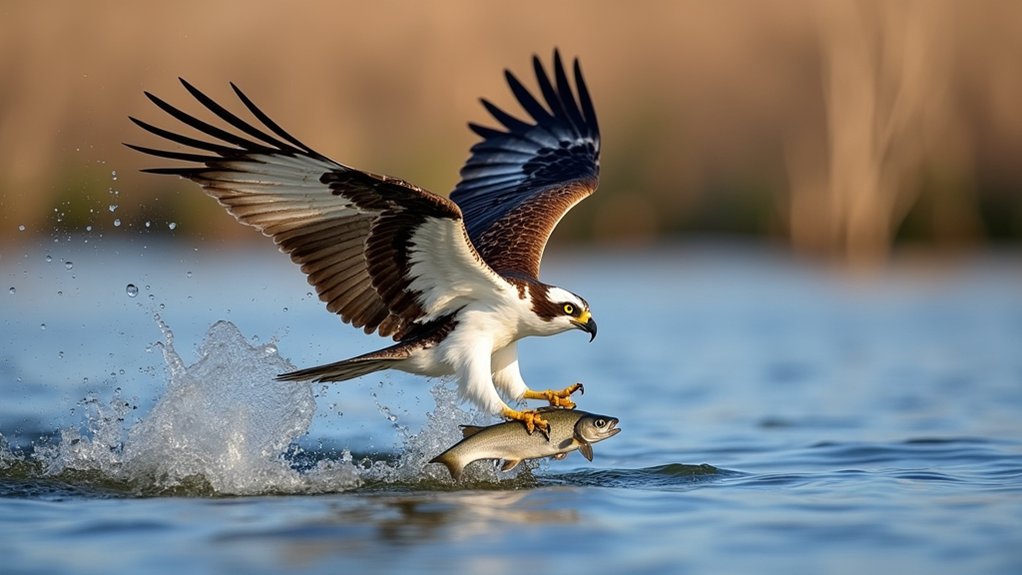
Ospreys rely on exceptional eyesight to locate fish from high above water, scanning vast areas with remarkable precision.
When hunting, you’ll notice they plunge feet-first, using their long, curved talons to grasp slippery prey effectively.
Sometimes, they submerge their entire body to secure fish.
Primarily solitary hunters, ospreys occasionally cooperate by driving fish toward shallower waters, increasing their catch success.
Their hunting strategy hinges on swift, accurate plunges and powerful grips, essential for capturing agile fish.
Ospreys depend on swift plunges and strong grips to catch their agile aquatic prey.
These raptors target freshwater or coastal fish populations, adapting to local prey availability.
Their specialized hunting techniques highlight their role as efficient piscivores, relying on precise visual cues and physical adaptations to capture and feed on fish, ensuring survival near aquatic habitats.
Like many other birds, ospreys benefit from air sacs in birds, which help provide efficient oxygen exchange to support their energy-intensive hunting flights.
The Osprey’s Nesting Behavior
After mastering the art of hunting fish with remarkable precision, these birds focus on securing safe nesting sites to raise their young.
Ospreys select high locations such as dead trees, poles, or man-made structures to avoid ground predators. Their nests, often exceeding three feet in diameter, are constructed from sticks, grass, and various materials.
You’ll notice that ospreys demonstrate strong site fidelity, returning to the same nesting sites year after year. Each breeding season, they refurbish and expand their nests, reinforcing their commitment to these locations.
Typically, nesting sites are situated near water bodies, ensuring easy access to their primary food source. This behavior not only protects their offspring but also helps maintain stable local populations through consistent use of established nests.
Like many colonial birds, ospreys may choose rookery locations that offer both safety and proximity to abundant food sources, further boosting breeding success and chick survival.
The Cultural Impact of the Seahawk Nickname
The nickname “seahawk” captures the osprey’s identity as a skilled maritime predator and plays a significant role in regional culture.
The seahawk nickname embodies the osprey’s maritime prowess and resonates deeply within regional heritage.
You’ll notice the Seahawks’ logo draws from Northwest Coast Art, symbolizing indigenous heritage and strengthening ties to local maritime culture.
This artistic connection reflects the osprey’s ecological role, reinforcing the nickname’s authenticity.
When you engage with the term “seahawk,” you’re also tapping into a broader community pride rooted in the Pacific Northwest’s natural environment.
The nickname encourages awareness of local wildlife while uniting fans and residents around a shared cultural identity.
Consequently, the seahawk serves as both an ecological emblem and a cultural icon, bridging nature, tradition, and community in a scientifically grounded yet socially meaningful way.
The Seattle Seahawks and Their Connection to the Bird
You’ll find that the Seattle Seahawks name actually came from a fan contest. It reflects more of a regional maritime vibe rather than being tied to any specific bird species.
Now, their live mascot, Taima, is pretty interesting. Taima is an Augur Hawk, not an osprey. That’s because there are legal restrictions on using native ospreys as mascots.
And if you look at the team’s logo, you’ll notice it’s inspired by Kwakwaka’wakw ceremonial art. It connects visually to the bird’s symbolism but doesn’t actually depict a real osprey.
Team Name Origins
Although the name “Seahawks” might suggest a direct link to a specific bird species, it actually originated from a fan contest that received over 20,000 submissions before the 1976 NFL season. The term “Seahawks” doesn’t correspond to a single bird species but reflects the region’s maritime culture and the fierce nature of hawks.
NFL commissioner Pete Rozelle supported this distinctive choice, which echoes local high school and college traditions, fostering community pride.
| Aspect | Details |
|---|---|
| Origin | Fan contest (20,000+ submissions) |
| Bird Association | No specific species; broadly “hawk” |
| Cultural Link | Maritime culture of Seattle region |
| Historical Usage | Previous Seattle hockey and Miami football teams |
| Community Impact | Embodies local pride and identity |
Mascot and Logo
Understanding the origins of the Seahawks’ name provides context for their mascot and logo, which embody both cultural significance and biological symbolism.
The team’s live mascot, Taima, is an Augur Hawk, chosen over native ospreys due to legal restrictions. This selection highlights the distinction between the mascot and the actual osprey species often nicknamed “sea hawk.”
The Seahawks’ logo, crafted by Marvin Oliver in 1976, draws from Northwest Coast Art, symbolizing Native tribes rather than depicting an osprey or any real bird. Its design and colors reflect the Pacific Northwest’s natural environment and cultural heritage.
Consequently, the mascot and logo represent a fusion of indigenous artistry and regional identity, rather than a direct biological connection to the osprey species.
Legal Considerations in Using Ospreys for Mascots
Since ospreys are protected under the Migratory Bird Treaty Act, using them as mascots involves strict legal constraints. You need to understand these legal factors when evaluating native ospreys for commercial purposes.
The law prohibits taking, killing, or possessing native ospreys without permits, making their use as mascots illegal in the United States.
Using native ospreys as mascots is illegal without permits under U.S. federal law.
To comply, organizations often select non-native species, such as the Augur Hawk, which is legally permissible.
Key points to evaluate:
- Native ospreys are protected by federal law, restricting commercial use.
- Permits are required to possess or display ospreys, rarely granted for mascots.
- Captive-bred non-native birds avoid these restrictions.
- Choosing non-native species enables legal compliance while maintaining avian symbolism.
Thus, legal frameworks strictly regulate the use of ospreys in commercial mascot roles.
Differences Between Ospreys and Augur Hawks
When selecting a bird mascot, distinguishing between ospreys and Augur Hawks matters due to their distinct ecological and morphological traits.
Ospreys, prevalent in North America and other continents except Antarctica, specialize in fishing. They dive to catch prey with talons near water bodies. They exhibit white underparts and a dark eye stripe.
Conversely, Augur Hawks inhabit arid mountainous regions in Africa, including Ethiopia and Kenya. Their brown and white plumage is adapted for camouflage. They hunt small mammals and birds, soaring high rather than diving for fish.
Nesting differences also arise: ospreys build large nests near water, often reused annually, while Augur Hawks construct smaller nests on trees or cliffs away from aquatic zones.
Understanding these distinctions clarifies why the term “seahawk” aligns more accurately with ospreys than Augur Hawks.
The Significance of the Seahawk in Local Communities
You know, the seahawk—often connected to ospreys—is more than just a bird. It really plays an important role in shaping community identity and pride, especially in places like the Pacific Northwest.
When people watch and talk about these birds, it’s not just about nature; it’s about connecting with cultural traditions and raising environmental awareness.
This kind of interaction really strengthens local bonds. It shows how wildlife symbolism can bring people together, helping everyone understand the environment better while building a sense of community.
Community Identity and Pride
Community identity thrives through symbols that encapsulate shared heritage and values, and the Seattle Seahawks exemplify this by embodying the region’s maritime culture and indigenous heritage.
You’ll find that the Seahawks foster community pride by linking local wildlife, especially ospreys, commonly called sea hawks, to regional traditions. This connection strengthens your sense of belonging and unity.
Consider these points about how the Seahawks symbolize community identity and pride:
- The team name was selected through a fan-driven contest, reflecting active community participation.
- The logo draws from Native American art, honoring indigenous heritage.
- Seahawks represent teamwork and sportsmanship shared by Seattle residents.
- The name highlights the coastal ecosystem, particularly ospreys, reinforcing environmental and cultural ties.
This precise integration of local elements elevates your community’s collective identity and pride.
Cultural and Environmental Connections
Building on the Seahawks’ role in fostering local identity, the term “seahawk” carries significant cultural and environmental meaning within coastal communities.
You’ll find that ospreys, often called seahawks or fish hawks, symbolize strength and resilience, reflecting their cultural significance. Their diet, primarily fish, positions them as crucial indicators of ecosystem health, linking marine and avian life.
When you engage in birdwatching or community observation, you contribute to conservation efforts by raising awareness of habitat preservation.
Furthermore, regional terminology variations highlight diverse cultural connections to these birds. Recognizing the seahawk’s presence helps you understand local environmental impacts, emphasizing the importance of protecting natural habitats.
Consequently, the seahawk embodies a nexus of cultural identity and ecosystem stewardship in coastal areas.
Additionally, understanding bird vocalizations such as the distinctive “caw caw” of crows can deepen appreciation of avian communication and its role within local environments.
Ospreys and Their Migration Patterns
Although ospreys breed across every continent except Antarctica, they undertake extensive migrations to optimize survival and reproduction.
You’ll find that ospreys migrate between breeding sites and wintering grounds, often covering thousands of miles. Their migration varies by population, influenced by climate and food availability.
Here’s what you need to know about ospreys and their migration patterns:
- North American ospreys typically journey to Central and South America during winter.
- Some individuals travel over 3,000 miles between continents.
- Ospreys use thermal updrafts to soar efficiently, conserving energy on long flights.
- Migration intensity ranges from sedentary to strongly migratory depending on local conditions.
Understanding these patterns helps clarify how ospreys adapt across diverse continents through seasonal migration.
Observing Ospreys in the Wild
Tracking ospreys during their migration offers valuable insights, but observing them in their natural habitats reveals their hunting techniques and nesting behaviors firsthand.
When observing ospreys, you’ll notice their preference for nesting in raised sites like dead trees or poles. These are often situated away from feeding areas to minimize disturbances.
These skilled hunters plunge with remarkable precision to catch fish, their primary prey. Although ospreys can be found across diverse regions, including areas near the North Pole, their presence diminishes in extreme northern latitudes.
Ospreys dive with precision to catch fish, thriving across many regions but less common in extreme northern latitudes.
By carefully observing ospreys in the wild, you gain a better understanding of their role in aquatic ecosystems and fish population dynamics.
This direct observation enriches your appreciation of these remarkable birds, sometimes called “sea hawks” or “fish hawks,” depending on the region.
Frequently Asked Question
Can Seahawks Live Inland Away From Water?
Yes, seahawks, or ospreys, can live inland away from the ocean as long as you provide access to suitable freshwater habitats like lakes or rivers.
They rely on fishing, so proximity to water rich in fish is essential.
You’ll find them nesting near these freshwater sources, and they’re capable of traveling significant distances to hunt.
Their adaptability allows them to thrive in diverse environments, including inland areas during breeding seasons.
What Is the Average Lifespan of an Osprey?
You can expect an osprey’s average lifespan in the wild to be around 7 to 10 years, though some reach up to 15 years under ideal conditions.
Young ospreys face high mortality, with only about half surviving their first year.
In captivity, they can live longer, sometimes up to 25 years, due to fewer threats.
Their lifespan depends heavily on food availability, habitat quality, and environmental factors influencing survival.
Do Seahawks Mate for Life?
Yes, seahawks, or ospreys, typically mate for life.
You’ll notice they form strong pair bonds, often returning to the same nesting site annually.
During breeding seasons, they engage in courtship displays and collaborate on nest building, which reinforces their partnership.
If one mate dies, the survivor might find a new partner or remain single temporarily.
This lifelong commitment improves reproductive success and stabilizes their population.
How Do Seahawks Communicate With Each Other?
You’ll notice seahawks exchange a symphony of whistles, chirps, and calls, gently whispering warnings or serenading mates.
Their body language like soaring, diving, and subtle posturing adds nuance to their conversations.
When hunting, they use calls to coordinate, increasing their success rate.
Nesting pairs engage in vocal duets, reinforcing bonds and sharing duties.
These intricate communications reveal a sophisticated social dance beneath their fierce, wild exterior.
Are Seahawks Protected by Wildlife Conservation Laws?
Yes, seahawks, or ospreys, are protected by wildlife conservation laws like the Migratory Bird Treaty Act in the U.S.
You must understand that these laws prohibit harming, capturing, or trading them.
Conservation efforts focus on preserving their breeding habitats and migratory routes.
When you encounter these birds, know they’re safeguarded to maintain stable populations.
This reflects ongoing ecological importance and legal protection measures designed to guarantee their survival.
Conclusion
Just as a lighthouse guides sailors through fog, the term “seahawk” illuminates the osprey’s true nature: an agile, skilled hunter of the skies and seas. You might think it’s just a nickname, but it’s a bridge between human understanding and nature’s precision.
Recognizing the osprey as more than a symbol helps you appreciate its essential role in coastal ecosystems. It reminds you that names carry the weight of both identity and ecological significance.