
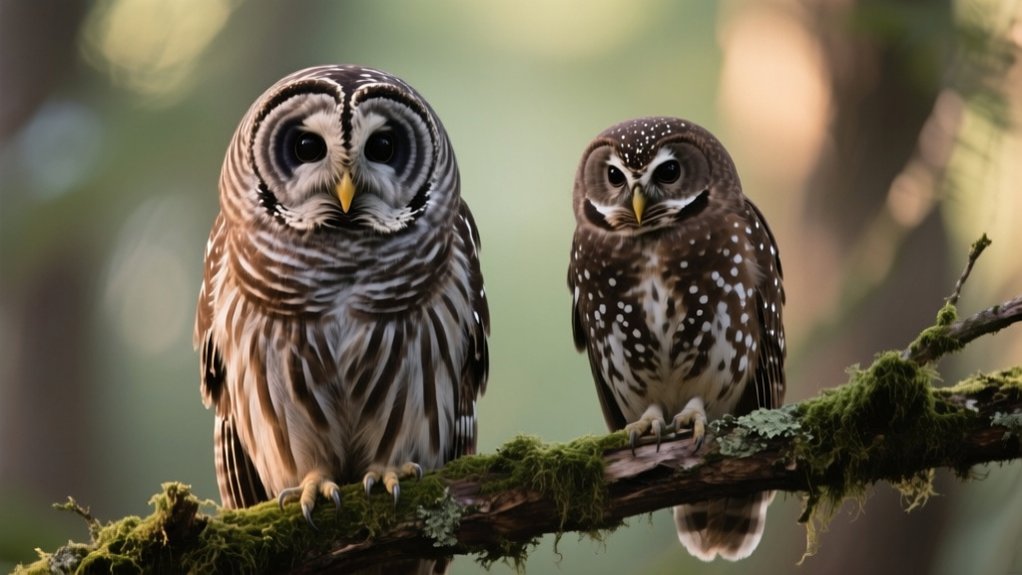
When identifying barred owls versus spotted owls, you’ll notice barred owls are larger with orange-yellow bills, round heads, and horizontal streaks. Spotted owls have flattened heads, yellow-green bills, and spotted breast feathers.
Barred owls prefer diverse, younger forests and have a broader diet, making them more adaptable. On the other hand, spotted owls rely on old-growth coniferous habitats and specialized prey.
Their overlapping ranges increase competition, which threatens spotted owl populations. Understanding these distinctions is key to effective birding and conservation efforts.
Investigating their vocalizations and behaviors reveals even more differences.
Key Takeaways
- Barred Owls have yellow-orange bills and black talons, while Spotted Owls feature yellow-green bills and pale talons.
- Barred Owls have round heads with dark eyes; Spotted Owls have flattened heads and light brown eyes.
- Barred Owls display horizontal streaks on their plumage; Spotted Owls have spotted breast feathers.
- Barred Owls are larger, more aggressive, and more adaptable to various habitats than the specialized Spotted Owls.
- Spotted Owls rely on mature coniferous forests, whereas Barred Owls inhabit a broader range including younger forests.
Physical Features and Identification
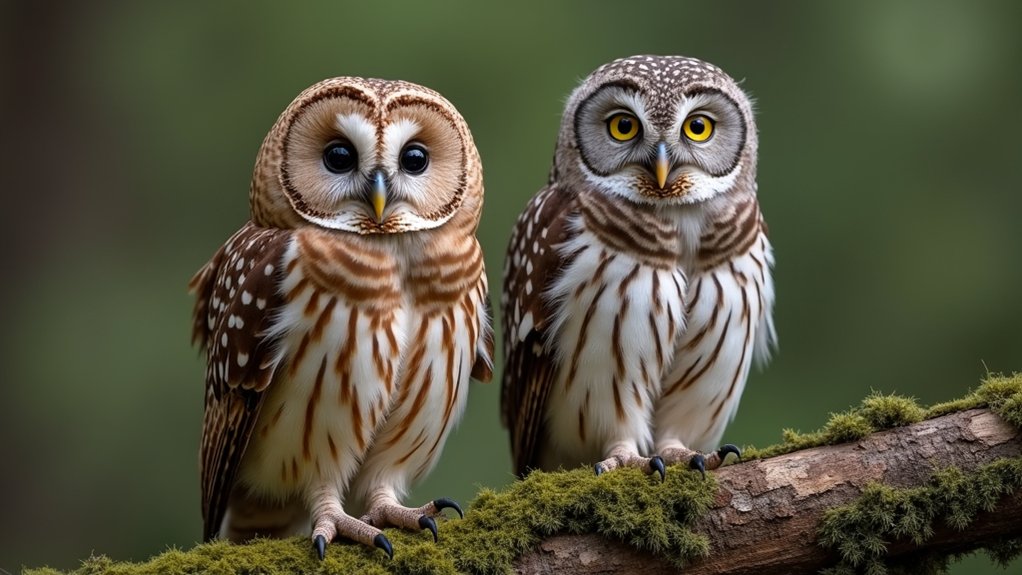
Although both Barred Owls and Northern Spotted Owls share similar habitats, you can distinguish them by key physical features: Barred Owls have a yellow-orange bill and black talons, contrasting with the Northern Spotted Owls’ yellow-green bill and pale talons.
Barred Owls and Northern Spotted Owls differ in bill and talon colors, aiding clear identification.
Their facial profiles also aid in identification. Barred Owls possess round heads with dark eyes, while Northern Spotted Owls feature a more flattened head and light brown eyes.
Plumage patterns differ distinctly; Barred Owls display horizontal streaks, whereas Northern Spotted Owls have spotted breast feathers.
Size and behavior matter too, as Barred Owls are generally larger and more aggressive.
When considering barred owl removal, accurately identifying these physical features guarantees you protect Northern Spotted Owls, which are often the conservation priority in overlapping territories.
Habitat and Geographic Range
You’ll notice that Barred Owls originally occupied the eastern U.S., but over time, they’ve expanded westward into a variety of forest habitats, including younger stands.
On the other hand, Northern Spotted Owls depend heavily on mature coniferous forests in the Pacific Northwest. Unfortunately, their range is now shrinking.
This westward expansion by Barred Owls is directly impacting the Spotted Owls’ habitat, which ramps up competition and puts their survival at risk.
Native Range Comparison
When comparing the native ranges of Barred Owls and Northern Spotted Owls, you’ll notice that Barred Owls originally inhabited the eastern United States. Since the mid-20th century, they have expanded westward into Northern California and the Pacific Northwest. This range expansion has led to significant overlap with the Northern Spotted Owl’s specialized old-growth forest habitat.
Barred Owls occupy a broader variety of forests, including younger and mixed types. In contrast, Northern Spotted Owls remain largely confined to mature coniferous forests in Washington, Oregon, and California.
| Characteristic | Barred Owls | Northern Spotted Owls |
|---|---|---|
| Original Range | Eastern U.S. | Pacific Northwest |
| Current Range | Expanded westward, overlap zone | Pacific Northwest |
| Habitat Types | Mixed, younger, mature forests | Old-growth coniferous forests |
| Range Expansion Period | Since mid-20th century | Stable |
| Impact on Spotted Owl | Competition, habitat overlap | Declining due to competition |
Habitat Preferences
Because Barred Owls have adapted to a wide range of habitats, including younger forests and urban areas, they occupy a broader geographic range extending from the eastern U.S. into northern regions of the country and southern Canada.
In contrast, the spotted owl depends on deep, mature old-growth forests primarily in the Pacific Northwest.
Understanding habitat preferences clarifies owl population dynamics:
- Barred owls inhabit diverse forest types and urban environments, increasing their distribution.
- Spotted owls require dense, old-growth forests for nesting and foraging.
- The barred owl’s flexible habitat use allows exploration westward, overlapping spotted owl ranges.
- Habitat specialization limits spotted owl adaptability, influencing their population stability.
Recognizing these distinctions helps explain the competitive interactions and conservation challenges between barred and spotted owls.
Range Expansion Effects
Although the Barred Owl originally inhabited the eastern United States, it has expanded its range westward into northern California and the Pacific Northwest since the mid-20th century. This expansion increasingly overlaps with the Northern Spotted Owl’s habitat.
This range expansion, driven by habitat changes from human activities, has intensified habitat competition. Barred Owls adapt to younger forests, while Spotted Owls require mature, old-growth stands. This causes significant territorial overlap.
The barred owl’s encroachment has led to a drastic decline in spotted owl territories, threatening their survival due to competition for food and nesting.
| Species | Habitat Type | Territory Decline (%) |
|---|---|---|
| Spotted Owl | Old-growth Forest | >90% |
| Barred Owl | Younger Forests | N/A |
| Competition | Food & Nesting | Severe |
Vocalizations and Behavior
How do the vocalizations and behaviors of Barred Owls and Northern Spotted Owls differ in ways that impact their interactions?
You’ll notice distinct vocalizations: Barred Owls produce a repetitive “Who cooks for you? Who cooks for you all?” call, while Spotted Owls emit a softer, four-note sequence.
Their behavior also diverges markedly: Barred Owls display aggressive territorial behavior, often displacing Spotted Owls. They breed more rapidly, enabling faster territory expansion.
Both are nocturnal, but Barred Owls show more opportunistic behavior in prey selection.
Interbreeding poses genetic dilution risks, complicating conservation due to differing vocal and behavioral traits.
Understanding these differences helps you assess their ecological impact and conservation challenges.
Diet and Hunting Strategies
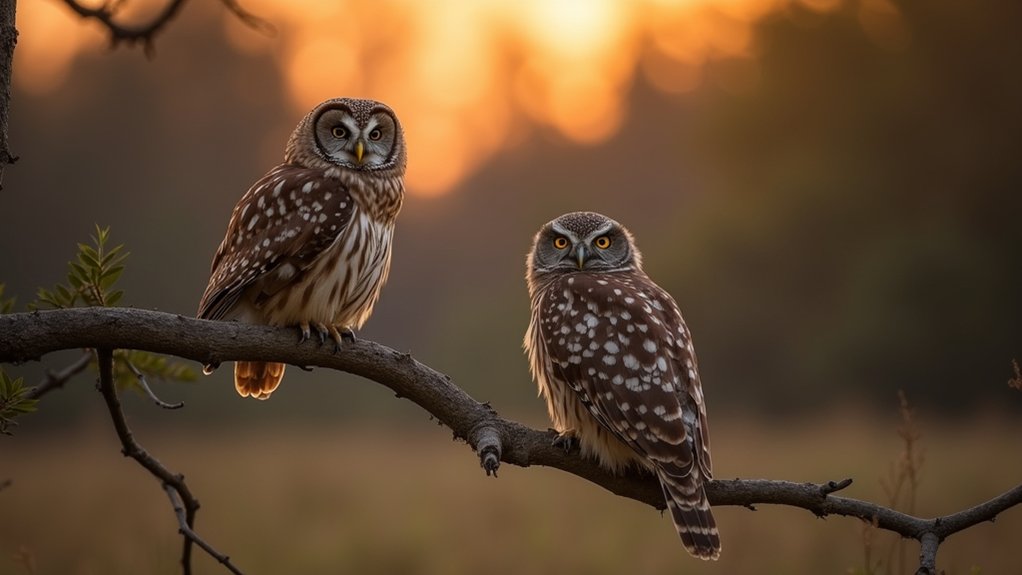
You’ll notice Barred Owls go after a wide variety of prey, from small mammals to reptiles.
They really adapt their hunting techniques depending on the habitat they’re in.
On the other hand, Northern Spotted Owls focus more narrowly—they specialize in hunting mid-sized nocturnal mammals, especially northern flying squirrels, and they do this mostly in mature forest environments.
When you look at these prey preferences and hunting methods, it becomes clear how dietary specialization plays a role in their ecological competition.
Prey Preferences
When comparing the prey preferences of Barred Owls and Northern Spotted Owls, you’ll notice significant differences rooted in their hunting strategies and dietary specialization.
The Barred Owl’s prey preferences reflect its opportunistic hunting habits, consuming diverse taxa, while the Northern Spotted Owl exhibits specialization in mid-sized nocturnal mammals.
- Barred Owl’s diet includes insects, rodents, crayfish, snakes, small birds, and reptiles.
- Northern Spotted Owl primarily targets northern flying squirrels, emphasizing habitat-linked prey reliance.
- Barred Owls show greater dietary flexibility as generalist predators.
- Northern Spotted Owls depend on specific prey availability in old-growth forests.
Understanding these distinctions clarifies how Barred Owls’ aggressive hunting habits influence prey competition and Northern Spotted Owl population dynamics.
Hunting Techniques
Although both Barred Owls and Northern Spotted Owls hunt primarily at night, their techniques differ markedly due to their ecological adaptations.
Barred Owls employ versatile hunting techniques, gliding silently through diverse habitats and relying on acute hearing to detect a wide range of prey, including insects, rodents, reptiles, and crayfish.
In contrast, the Spotted Owl adopts a more specialized strategy, often perching silently to visually scan for mid-sized nocturnal mammals, primarily northern flying squirrels. This perch-and-wait method reflects the Spotted Owl’s reliance on mature forest environments and specific prey.
Barred Owls’ generalist approach gives them a competitive advantage, as they exploit multiple food sources across habitats.
Meanwhile, Spotted Owls’ hunting techniques are tightly linked to their specialized diet and habitat constraints, influencing their ecological niche and survival strategies.
Population Trends and Competition
Since barred owls breed faster and disperse farther than spotted owls, they’ve rapidly expanded their population and range. This has allowed them to outcompete spotted owls in several regions. As a result, spotted owl territories have plummeted from over 100 to fewer than 10.
Barred owls’ rapid breeding and dispersal have drastically reduced spotted owl territories from over 100 to under 10.
Key population trends and competition factors include:
- Barred owls’ broader diet and habitat adaptability give them a competitive edge over the specialized spotted owls.
- Increased barred owl presence correlates strongly with the decline of spotted owl populations.
- Barred owls compete directly for essential resources such as nesting sites and prey.
- The 2011 Recovery Plan highlights competition with barred owls as a primary threat to spotted owl survival.
Understanding these dynamics is vital for analyzing population trends and the ongoing interspecies competition.
Conservation Challenges and Efforts
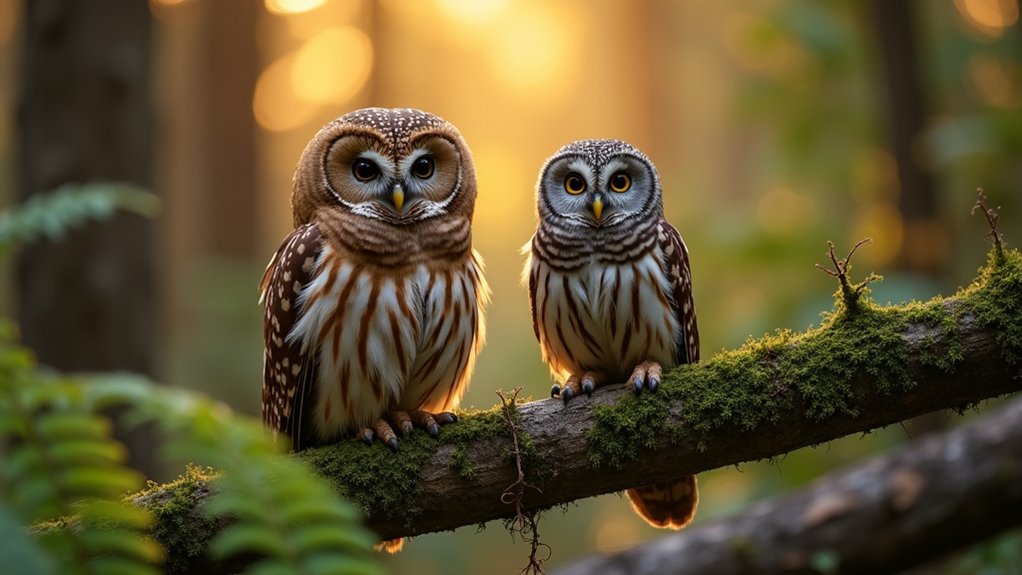
Because the Northern Spotted Owl faces severe threats from habitat loss and Barred Owl competition, conservation efforts have become both urgent and complex.
You must understand that the spotted owl, listed as a threatened species since 1990, has declined by over 65% due to these pressures.
The U.S. Fish and Wildlife Service proposed managing barred owl populations through removal tactics, including potentially culling up to 470,000 barred owls over 30 years, aiming to stabilize spotted owl numbers.
Initial studies showed barred owl removal improved spotted owl survival, supporting this controversial approach.
However, ethical concerns arise regarding barred owl mortality and ecosystem impacts.
As you engage with conservation, balancing spotted owl protection with moral and ecological implications remains a critical challenge for effective species management.
Frequently Asked Question
Can Barred Owls Hybridize With Northern Spotted Owls?
Yes, barred owls can hybridize with northern spotted owls. When these two species interbreed, their offspring display mixed morphological and behavioral traits.
You should know this hybridization complicates conservation efforts by diluting the genetic integrity of the threatened northern spotted owl. As barred owls expand their territories, the frequency of such hybrid events may increase, affecting population dynamics.
Understanding these hybrids is crucial for effective wildlife management and preserving species-specific characteristics.
How Do Barred Owls Affect Local Ecosystems Beyond Competition?
You should understand that barred owls impact local ecosystems by altering prey populations through their broad diet, which includes small mammals and invertebrates.
Their aggressive hunting can destabilize food webs, reducing native species abundance.
Furthermore, their rapid breeding and territorial expansion disrupt established predator-prey dynamics.
You’ll also see genetic mixing with native species, further complicating conservation efforts.
These factors collectively reshape ecological balances beyond mere competition.
What Is the Lifespan Difference Between Barred and Spotted Owls?
You might think barred owls live much longer than spotted owls, but the difference isn’t huge.
Barred owls typically live up to 10 years in the wild, sometimes reaching 20 in captivity.
Northern spotted owls usually live around 7 to 10 years. Lifespan varies with habitat quality, prey availability, and threats like habitat loss.
Are There Any Cultural Significances Tied to Either Owl Species?
You’ll find that the Northern Spotted Owl holds significant cultural importance, especially among Pacific Northwest tribes.
It’s revered as a spiritual guide and forest protector.
In contrast, the Barred Owl is often anthropomorphized in folklore as mischievous and adaptable.
Recognizing these cultural roles helps you appreciate how conservation efforts for the Spotted Owl intertwine with indigenous heritage, while the Barred Owl’s narrative highlights ecological adaptability in changing environments.
How Do Climate Changes Impact Barred and Spotted Owls Differently?
You see the old forest as a fragile clockwork, ticking slower under climate stress. Climate change shrinks the Northern Spotted Owl’s old-growth haven, disrupting its prey’s cycle and survival.
Meanwhile, the Barred Owl adapts like a versatile key fitting new environmental locks, expanding its range and outcompeting the Spotted Owl.
You’ll notice Barred Owls breed faster, gaining an edge as warming alters habitats and resources, shifting the ecological balance decisively.
Conclusion
Understanding the differences between barred owls and spotted owls is essential, especially as barred owls have expanded into over 70% of the spotted owl’s historic range. This overlap intensifies competition, threatening spotted owl populations.
By recognizing their distinct physical traits, calls, and behaviors, you can better contribute to monitoring efforts. Staying informed helps support targeted conservation strategies aimed at preserving the spotted owl amid increasing ecological pressures from its barred counterpart.