
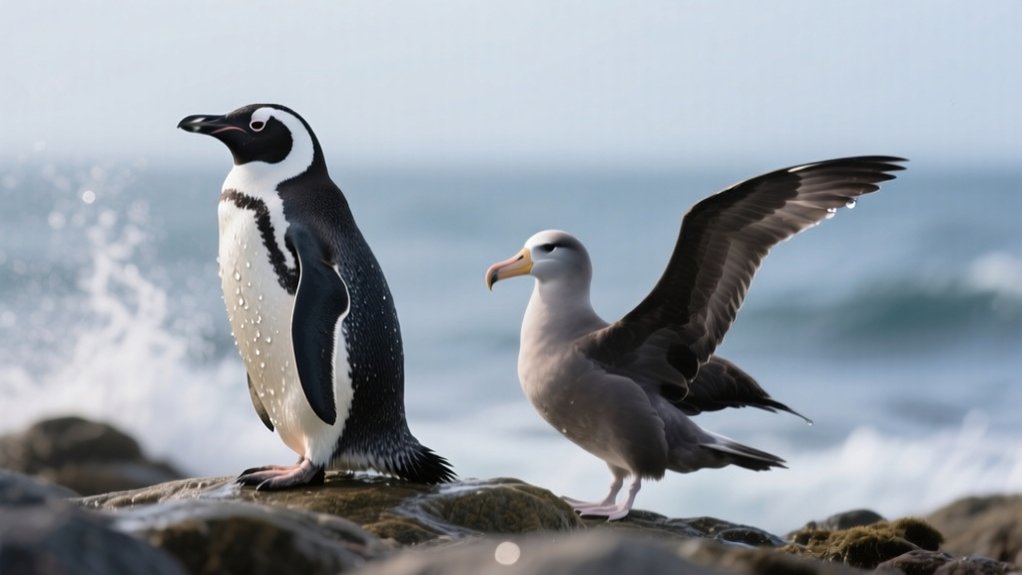
You can’t assume all birds can fly because flightlessness evolved over 150 times independently, often where predators are scarce, like islands. Flightless birds have smaller wings, reduced or absent keel bones, and stronger legs for ground living.
Losing flight conserves energy and suits environments with abundant resources and fewer mammalian competitors. However, flight remains essential for most birds’ survival, offering mobility and escape from predators.
Exploring these adaptations reveals why flight varies so widely among birds.
Evolutionary Reasons Behind Flightlessness

Although flight is a defining characteristic of birds, flightlessness has evolved independently over 150 times across various lineages, revealing a complex evolutionary pattern driven by ecological and genetic factors.
Flightlessness in birds emerged independently over 150 times, highlighting complex ecological and genetic evolutionary dynamics.
You’ll find that flightless birds didn’t descend from a single ancestor but evolved from flying ancestors multiple times.
This repeated loss occurs primarily when predation pressures decrease, especially on islands where mammals are absent. In such safe, resource-rich environments, natural selection favors energy conservation by reducing flight capability.
Genetic and fossil evidence confirms that flightless species like ratites and moas evolved from volant ancestors. Recent studies also show that the ancestors of ratites could fly before evolving flightlessness on their respective continents.
Moreover, after mass extinctions, birds occupied new ecological niches, sometimes growing larger and losing flight.
Consequently, flightlessness reflects adaptive responses to specific ecological contexts rather than a single evolutionary event.
Anatomical Differences Between Flighted and Flightless Birds
You’ll notice that flightless birds have much smaller wings, which makes sense since they don’t need to fly.
Their keel bones—the part of the breastbone that anchors strong flight muscles in birds that do fly—are either much smaller or completely missing. This changes how the muscles attach and affects the shape of their chest.
On top of that, their legs and bodies have adapted to make up for the loss of flight, helping them move efficiently on land or in the water. The skeletal modifications often occur early in the evolution of flightlessness, affecting wings, tails, and body mass.
Wing Size Reduction
When comparing flighted birds to their flightless counterparts, you’ll notice that wing size reduction stands out as a key anatomical difference. Flightless birds like emus, ostriches, and moa exhibit markedly smaller wings, with moa showing nearly wingless forms.
In emus, this reduction results from delayed cellular proliferation in forelimb progenitors, driven by decreased Fgf signaling. This limits wing bud growth and yields stunted adult wings. Despite normal early limb patterning, slowed growth reduces cell numbers contributing to the wing.
Remarkably, different species use distinct genetic pathways, such as cilia-related genes in Galapagos cormorants, to achieve similar wing miniaturization. Genomic analyses reveal that while protein-coding genes vary widely, flightless birds share similar regulatory pathways influencing flight loss.
This consistent reduction in wing size correlates with their inability to generate adequate lift, underpinning flight loss in these lineages.
Keel Bone Changes
Because the keel bone serves as the primary attachment site for major flight muscles, its size and development directly influence a bird’s flight capability.
In flying birds, you’ll find a large, well-developed keel that provides extensive surface area for powerful pectoralis and supracoracoideus muscles. These muscles generate the wing downstroke and upstroke necessary for flight.
Conversely, many flightless birds, such as ratites, exhibit a reduced or absent keel, reflecting diminished flight muscle mass and power.
However, some flightless species like penguins retain an enlarged keel adapted for strong pectoral muscles used in swimming rather than flying.
This anatomical difference highlights how keel bone morphology correlates with locomotive function, indicating evolutionary adaptations to flight or alternative movement strategies without aerial capability. The keeled sternum provides attachment for these essential flight muscles, emphasizing its critical role in avian locomotion.
Leg and Body Adaptations
The keel bone’s development reflects how birds allocate muscle mass for flight or alternative locomotion, but examining leg and body adaptations reveals further anatomical distinctions between flighted and flightless species.
Flightless birds have longer, denser leg bones and more robust musculature, optimizing terrestrial or aquatic locomotion. Their pelvic and spinal fusion into a synsacrum supports greater leg power. In contrast, flighted birds prioritize lighter, pneumatic skeletons with stronger flight muscles. Moreover, the integration of whole-body systems highlights how locomotor functions adapt as a cohesive unit rather than isolated parts, emphasizing the importance of holistic locomotor integration.
Flightless species show proportionally larger tarsometatarsus and tibiotarsus bones for stability. Hindlimb muscles are hypertrophied in flightless birds, supporting running or digging. Reduced fibula and fused pelvic bones improve leg strength in large flightless birds.
Foot morphology shifts from grasping to propulsion, with larger toes and claws. Penguins’ wings adapt as flippers; kiwis have strong feet for digging.
Ecological Niches That Favor Losing Flight
If you examine island ecosystems carefully, you’ll find conditions that consistently favor birds losing their ability to fly. On small, isolated islands, the absence of native mammalian predators and raptors reduces the need for rapid aerial escape, leading to energy-saving adaptations like smaller flight muscles and longer legs suited for terrestrial movement. These predator-poor environments promote “island tameness” and relaxed vigilance, further diminishing flight necessity. Moreover, abundant ground-level resources make flight metabolically inefficient; birds often reallocate energy from wing muscles to robust legs and digestive systems to exploit terrestrial foraging niches. Human activities have drastically altered these ecosystems, causing many flightless birds to go extinct after the arrival of humans and their predators, highlighting their increased vulnerability. The extinction of island endemics such as the dodo bird shows how rapidly human arrival and introduced species can disrupt these specialized evolutionary pathways. Ecological release from mammal competitors enables birds to occupy herbivore, omnivore, and predator roles on land, sometimes increasing body size, which further impairs flight. Together, these ecological factors drive repeated, independent evolution of flightlessness in island bird species.
Notable Examples of Flightless Bird Species

Flightless birds demonstrate remarkable adaptations that suit diverse ecological niches across the globe.
You’ll find species with specialized morphologies that compensate for the loss of flight by enhancing terrestrial or aquatic abilities. Many of these birds have developed strong legs with claws for movement and defense, similar to domestic chickens.
Consider these examples:
Ostrich: Largest bird, runs up to 70 km/h with powerful legs, reduced wings for balance. It belongs to the order Struthioniformes, which includes most flightless birds.
Emperor penguin: Uses flipper-like wings for underwater propulsion in Antarctic waters.
Kiwi: Possesses nostrils at bill tip for olfactory foraging; nearly absent flight muscles.
Kakapo: Flightless parrot with strong legs for climbing, wings used only for balance.
Flightless cormorant: Reduced wings prevent flight but enable efficient pursuit submersion in Galápagos.
These adaptations illustrate how flightlessness aligns with environmental demands and survival strategies.
Conservation Challenges for Flightless Birds
While these birds have evolved unique adaptations to thrive without flight, their specialized traits often make them vulnerable to environmental changes and human impacts.
You should recognize that invasive predators like rats and stoats severely threaten flightless birds, particularly ground-nesting species, by preying on eggs and chicks.
Habitat loss and fragmentation due to agriculture and urban development confine populations to suboptimal areas, reducing genetic diversity and increasing extinction risks.
Since flightless birds can’t disperse easily, they struggle to escape threats or recolonize habitats, making small populations especially susceptible to disease and climate extremes. Research shows that many flightless birds survive only in remote, less impacted refuges, highlighting the importance of preserving these habitats.
Conservation efforts rely heavily on predator control, captive breeding, and translocations to predator-free refuges.
However, ongoing human pressures, including habitat degradation and illegal hunting, complicate these interventions and demand sustained, targeted management to guarantee survival.
Why Most Birds Retain the Ability to Fly

Because flight offers unparalleled advantages in mobility and survival, most birds have retained this capability throughout evolution.
You can see flight’s evolutionary success in how birds exploit diverse habitats, escape predators, and access food sources unreachable to ground-bound animals. Structural and physiological adaptations optimize this ability, making flight both efficient and powerful. Birds’ unique air sacs enable a continuous flow of oxygen through the lungs, enhancing their stamina for long-distance flight.
Flight grants access to varied terrain and expanded resources. Migration enables seasonal exploitation of global ecosystems. The evolution of birds from theropod dinosaurs introduced new predation pressures, which in turn drove adaptations in prey species such as insects, exemplifying a long-standing aerial arms race.
Hollow bones and strong muscles reduce weight while sustaining flight. Feathers provide lift and aerodynamic contouring essential for control. Improved cerebellum supports balance and coordinated wing strokes.
Understanding these factors clarifies why flight remains a dominant trait for most birds, supporting survival and evolutionary fitness across environments.
Frequently Asked Question
How Do Flightless Birds Communicate Without Flying Displays?
You’ll find flightless birds rely on deep, low-frequency calls for long-distance communication and use distinct vocalizations for contact, alarm, and courtship.
They also employ visual signals like feather puffing, head bobbing, and colorful plumage displays on the ground.
Furthermore, tactile behaviors such as allopreening strengthen bonds, while chemical cues from preen glands convey identity and reproductive status.
These birds integrate multimodal signals to compensate for absent aerial displays.
What Do Flightless Birds Eat Compared to Flying Birds?
You’ll find flightless birds primarily consume ground-based vegetation, insects, and small animals that don’t require the high-energy intake flying birds need.
Unlike flying birds, which rely on high-lipid diets to fuel sustained flight, flightless species adapt to stationary or limited-range environments.
They focus on plants and prey accessible on land. Their diets support energy conservation, allowing larger body masses and lower metabolic rates without the demands of continuous flight muscle activity.
Can Flightless Birds Learn to Fly in Captivity?
You can’t expect flightless birds to learn to fly in captivity because their anatomy and genetics prevent it.
Their flight muscles are reduced, wings are structurally altered, and regulatory DNA changes fix these traits.
Even with training, they lack the physical capacity and evolutionary adaptations necessary for powered flight.
Captivity doesn’t reverse these irreversible changes, so flightless birds remain grounded regardless of environment or effort.
How Do Flightless Birds Navigate Long Distances Without Flight?
You navigate long distances without flight by relying on magnetoreception to sense Earth’s magnetic field, using celestial cues like the sun and stars for orientation.
You also depend on landmarks, olfactory signals, and acoustic information to maintain direction on land or water.
Behavioral strategies include walking, running, or swimming along resource corridors and stepping-stone habitats.
Your innate genetic programs and social learning further refine your routes, ensuring precise navigation despite lacking flight.
Are Flightless Birds More Intelligent Than Flying Birds?
You might imagine flightless birds as grounded scholars, yet they aren’t more intelligent than flying birds.
Research shows no significant brain size or neuron density differences between them.
Intelligence in birds, like corvids and parrots, hinges on neuron packing and brain structure rather than flight ability.
Flightless birds maintain comparable cognitive capacities but don’t surpass their flying counterparts in intelligence based on current neurological data.
Conclusion
You might think all birds should fly since flight offers escape and mobility, but that’s not always the case. Flightlessness evolved because, in certain environments, conserving energy or adapting to ground-based niches provides survival advantages.
Anatomical changes support these lifestyles, making flight unnecessary or even disadvantageous. Understanding these evolutionary trade-offs clarifies why not all birds fly, highlighting the diverse strategies life employs to plunge under varying ecological pressures.