
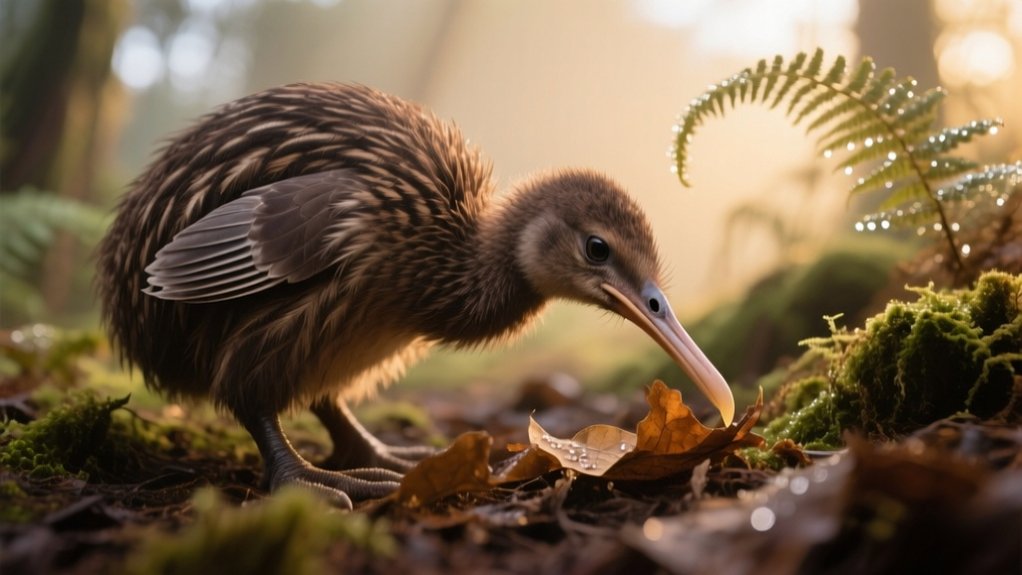
You might wonder if kiwi birds can fly, but the truth is they evolved as flightless birds adapted to ground living. Their dense bones, small wings, and specialized anatomy make flying impossible.
Meanwhile, their strong legs and keen senses support foraging and survival on land. Flightlessness conserves energy and allows kiwis to lay large eggs and incubate them efficiently.
Exploring their unique biology and environmental challenges reveals why these birds are truly grounded in their evolution.
Flightless Anatomy of Kiwi Birds
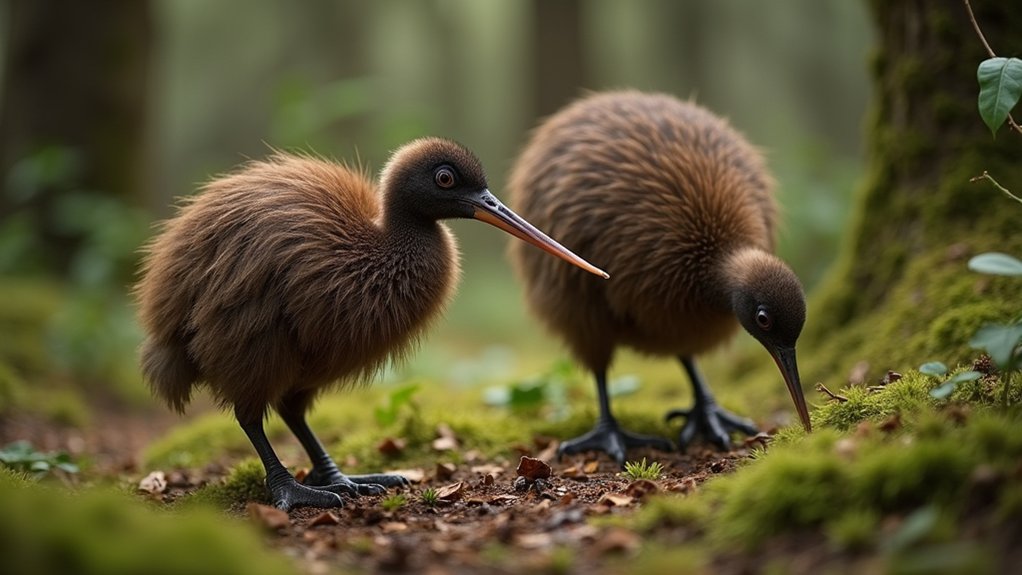
Although kiwi birds share some general avian characteristics, their flightless anatomy reveals distinct adaptations that prioritize terrestrial living and reproduction over aerial mobility.
Their vertebral column bends downward, unlike the straight spines of ostriches or turkeys, and the free caudal vertebrae form a rigid tail used as resting support.
The pelvis and synsacrum curve downward, facilitating egg maintenance in gravid females.
Unlike flying birds, kiwi bones contain marrow rather than hollow air sacs, resulting in a dense, heavy skeleton unsuitable for flight.
The sternum lacks a keel, reflecting reduced flight muscles, while wings are vestigial and serve balance rather than propulsion.
Feathers are hair-like, lacking barbules and preen glands, and sensory adaptations include a tactile bill and reduced visual acuity, all reinforcing their ground-dwelling lifestyle.
Additionally, kiwi birds have small wings that are not designed for flight, emphasizing their adaptation to a flightless existence.
Evolutionary Background of Kiwi Flightlessness
You’ll find that kiwi ancestors originally had flight capabilities.
But over millions of years, evolutionary pressures within New Zealand’s isolated island ecosystem promoted the loss of flight.
There’s still some debate about whether flightlessness evolved rapidly after their arrival or if it happened through gradual adaptation influenced by the absence of mammalian predators.
Recent genomic studies reveal that flightlessness in kiwi and other birds evolved independently through similar regulatory pathways.
Understanding these factors helps clarify how kiwi birds became distinctly adapted ground dwellers.
Flightless Ancestor Debate
When examining the evolutionary background of kiwi flightlessness, recent DNA analyses have reshaped our understanding by linking kiwis most closely to Madagascar’s extinct elephant bird rather than Australian flightless birds as once thought. This connection challenges earlier theories and necessitates reconsideration of kiwi evolution.
Key points include:
- Kiwi and elephant bird share a common flight-capable ancestor about 50 million years ago.
- Kiwi reached New Zealand independently after the island’s formation, not via continental drift. This new research suggests that ancestors of kiwis were originally flight-capable and migrated between continents.
- Flightlessness evolved as an energy-saving adaptation in predator-free environments.
- Plunge of kiwi species occurred through geographic and reproductive isolation over millions of years.
This evidence underscores kiwi’s unique evolutionary path distinct from Australian flightless birds.
Island Ecosystem Influence
Because New Zealand’s island ecosystem developed in isolation for millions of years, it created unique evolutionary conditions that profoundly influenced kiwi flightlessness.
Geographic isolation, with mountains and rivers acting as barriers, genetically separated kiwi populations, preventing interbreeding and promoting divergence.
The absence of native land mammals eliminated the need for flight as an escape mechanism, enabling kiwis to adopt ground-dwelling habits without predation risks.
This predator-free environment relaxed evolutionary pressures maintaining flight, allowing skeletal and feather adaptations for flying to diminish.
Kiwis replaced mammalian ecological roles, evolving heavy bones and specialized foraging behaviors suited to ground vegetation and invertebrates. Additionally, kiwi possess a highly developed sense of smell, which compensates for their limited color vision and supports their nocturnal, ground-based lifestyle.
Their reliance on olfaction and nocturnal activity further supported terrestrial living.
Consequently, New Zealand’s distinct island ecosystem shaped kiwi evolution, favoring flightlessness as an energy-efficient and survival-enhancing strategy over millions of years.
Physical Adaptations Supporting Ground Life
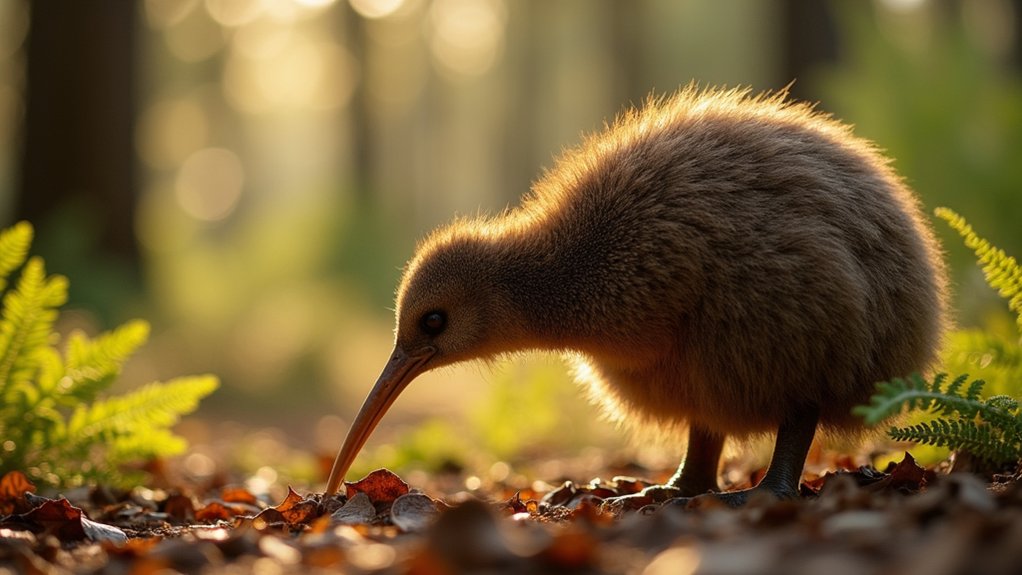
Although kiwi birds share ancestry with flying species, their physical adaptations have evolved distinctly to support a fully terrestrial lifestyle. You’ll notice their strong, muscular legs are designed for rapid ground movement rather than flight.
Their wings are vestigial, hidden beneath feathers, lacking the muscle anchoring keel found in flying birds. Their dense, marrow-filled bones provide structural support for life on land.
Specifically, you can observe:
- Short, stout legs with powerful feet for running and defense
- Rudimentary wings with tiny claws, indicating flightlessness
- Heavy, solid bones optimized for terrestrial biomechanics
- Two-layered feathers offering waterproofing and camouflage
Additionally, kiwi birds have nostrils at the tip of their long beak which enhances their ability to locate food by smell while foraging.
These adaptations collectively guarantee kiwi birds thrive without flying, efficiently maneuvering their forest floor habitat.
Sensory Capabilities Beyond Sight
While kiwi birds have limited vision, they compensate with highly specialized sensory capabilities that extend beyond sight. Their nostrils sit at the beak’s tip, allowing them to detect scents in soil during foraging, with sensitivity to a few parts per million. Enlarged brain regions process olfactory data, reflecting a primary reliance on smell for nocturnal navigation. Kiwi also rely on their whiskers for navigation in the dark, similar to those of mammals.
Tactile sensing is similarly advanced: specialized sensory pits along the beak detect prey vibrations, and long whiskers gather environmental information. Corresponding brain areas devoted to tactile input are significantly expanded.
Visual centers and optic nerves are reduced, consistent with minimal vision use.
This sensory configuration parallels nocturnal mammals, showing convergent evolution. Together, these adaptations enable kiwis to effectively investigate and locate food on the forest floor without relying on sight.
Impact of Flightlessness on Kiwi Survival
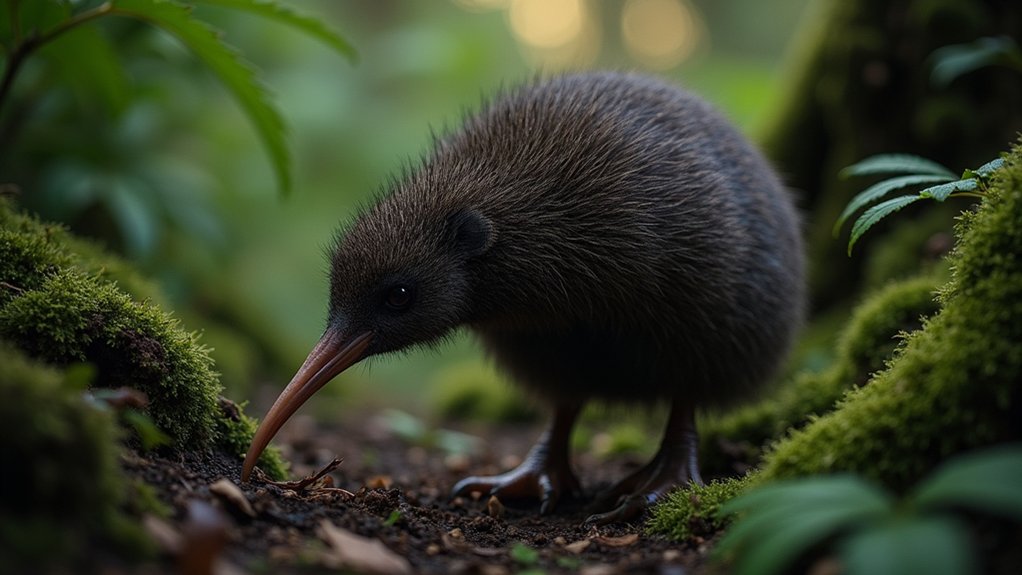
You have to come to terms with the fact that kiwi flightlessness makes them more vulnerable to introduced predators like stoats and dogs, which leads to high mortality rates.
But here’s the interesting part: being flightless actually helps them conserve energy and supports a larger body mass and bigger eggs.
Historically, this was a real advantage because it improved their chances of survival in environments without predators.
Their unique adaptations, such as vestigial wings and specialized nostrils for foraging, contribute to their distinct survival strategy.
Predator Vulnerability Risks
Because kiwi birds lack flight capability, they face heightened vulnerability to introduced mammalian predators that exploit their ground-dwelling habits.
You’ll find their risk factors include:
- Stoats cause about 50% of chick deaths, targeting individuals until they reach 1.2 kg, when they develop better defenses.
- Dogs pose the greatest danger to adults, as kiwi can’t escape attacks by flying.
- Cats and ferrets also prey heavily on chicks and adults, with ferrets being particularly adept hunters.
- Physical traits such as small wings and lack of a breastbone increase kiwi susceptibility to crushing injuries and eliminate aerial escape options. Kiwis have vestigial wings that are small and hidden beneath their feathers, making flight impossible.
Without intensive predator control, fewer than 5% of kiwi chicks survive to adulthood, underscoring the critical impact of flightlessness on their survival.
Energy Conservation Benefits
Although kiwis can’t take to the air, this flightlessness grants them significant energy conservation advantages essential for survival. You’ll notice kiwis have low basal metabolic rates, directly linked to their reduced pectoral muscle mass and small vestigial wings, minimizing unnecessary energy use.
By forgoing flight, kiwis allocate energy toward strong leg muscles that support efficient ground locomotion. This adaptation suits their nocturnal, ground-based foraging, which relies on olfactory and tactile senses rather than energy-intensive visual hunting. Their unique sensory beak with sensory pits enhances their ability to detect prey underground, complementing their energy-efficient lifestyle.
Moreover, flightlessness allows kiwis to carry and incubate disproportionately large eggs without the burden of flight constraints, improving reproductive investment. Their small body size and reduced metabolic demands facilitate survival in food-limited environments, demonstrating how flightlessness boosts energy efficiency crucial for enduring New Zealand’s unique ecosystems.
Conservation Challenges for Kiwi Populations
Since introduced predators have drastically altered New Zealand’s ecosystem, kiwi populations face considerable conservation challenges that threaten their survival.
You must understand that:
- Invasive species like rats, stoats, and possums cause high chick mortality, with unmanaged survival rates below 10%.
- Habitat loss and fragmentation, due to over 90% lowland forest clearance, reduce shelter, food, and mating opportunities.
- Population isolation increases inbreeding risk, limiting genetic diversity and resilience to disease and environmental stressors.
- Active management, including predator control, translocations, and captive breeding, markedly improves survival and population growth. Recent efforts have seen a record year with 324 birds translocated during the 2026 kiwi-handling season, the highest number in the organization’s history.
Unique Reproductive and Biological Traits of Kiwis
Understanding kiwi conservation involves more than protecting habitats and controlling predators; it also requires a grasp of their distinctive reproductive biology.
Female kiwis lay exceptionally large eggs, about 15% of their body weight. This means they need a 2-3 day fasting period and triple their food intake for 30 days prior.
Incubation spans 63-92 days, with males primarily responsible, though some species share duties. Kiwis form long-term monogamous pairs lasting up to 20 years, breeding from June to March. Their diet includes invertebrates, seeds, and grubs, which supports their extensive energy needs during breeding.
Most species produce a single egg per season, but some lay multiple clutches. Their dual-ovary anatomy is rare among birds.
Newly hatched chicks rely on yolk reserves for independent survival, an evolutionary adaptation to a predator-free environment that enables early mobility.
These specialized traits are essential for kiwi survival and inform effective conservation strategies.
Frequently Asked Question
How Do Kiwis Communicate With Each Other?
You’ll find kiwis communicate primarily through various vocalizations like whistles, grunts, and hisses. Mated pairs duet by call-and-reply or overlapping calls, strengthening bonds and coordinating territory defense.
Their calls convey presence, gender, and territorial claims up to 1.5 km away.
Besides sound, they use scent marking and body language to signal reproductive status and intentions.
This multi-modal communication helps maintain pair bonds, navigate territory, and avoid conflicts effectively.
What Do Kiwi Birds Eat in the Wild?
You’ll find that kiwi birds primarily eat earthworms, beetle larvae, and snails during their nocturnal foraging.
They also consume native berries, seeds, leaves, and fungi seasonally.
Occasionally, they catch freshwater crayfish, eels, and amphibians.
Using their sensitive beak, kiwis explore soil and leaf litter to locate prey, relying on diet diversity that varies with habitat and seasonal availability to meet nutritional needs and support breeding success.
How Long Do Kiwi Birds Live on Average?
Kiwi birds live on average between 10 to 15 years in the wild, though some can reach around 20 years, especially great spotted kiwis.
In captivity, their lifespan extends to 12-18 years, with records up to 33 years and rare cases nearing 40.
Factors like predation, disease, and habitat quality affect longevity.
Conservation efforts help improve survival, but only about 5% of chicks typically reach adulthood due to high mortality rates.
Are Kiwis Active During the Day or Night?
You might expect kiwis to be daytime creatures, but they’re actually nocturnal, becoming active after dark. They forage and patrol their territory at night, taking advantage of underground invertebrates surfacing post-sunset.
Their small eyes and improved sense of smell and touch adapt them perfectly for nighttime activity.
During the day, they rest in burrows or dense vegetation, conserving energy. This nocturnal lifestyle reduces competition and predation risks in New Zealand’s ecosystem.
Can Kiwi Birds Swim or Climb Trees?
You won’t find kiwi birds swimming well; their heavy, marrow-filled bones and ground-adapted physiology limit aquatic movement.
While they can navigate uneven forest floors, climbing trees isn’t within their capabilities either. Their powerful legs help them run and dig but aren’t suited for climbing.
Instead, kiwis focus on terrestrial foraging, using their specialized beaks and sensory adaptations to detect prey underground, relying heavily on smell and touch rather than climbing or swimming skills.
Conclusion
You now see that kiwi birds, like a sturdy ship anchored firmly to the ocean floor, can’t take flight due to their unique anatomy and evolutionary path. Their strong legs, diminished wings, and keen senses suit a ground-based life perfectly.
Understanding these adaptations helps you appreciate their survival challenges and conservation needs. By recognizing their distinct biology, you’re better equipped to support efforts that protect these remarkable, flightless birds.