
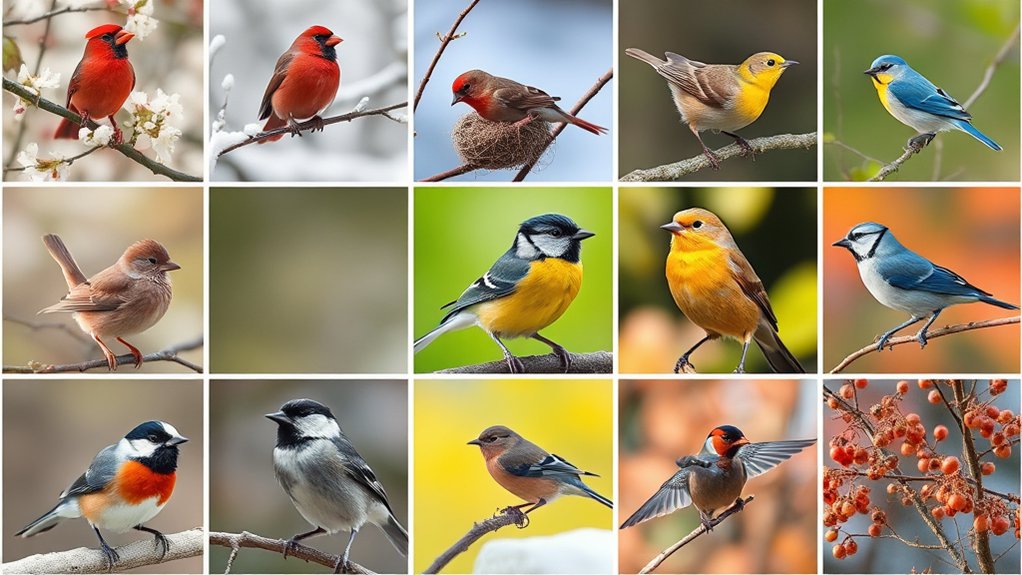
If you watch common backyard birds, you’ll notice they have distinct annual cycles shaped by breeding, migration, and food needs. In spring, males arrive early to claim territories with songs, while females build nests and raise protein-hungry young.
As seasons change, many birds switch diets from insects to berries, even caching food for winter. They also migrate using sun and magnetic cues, facing hazards along the way. Keep exploring, and you’ll uncover plenty more about their fascinating behaviors.
Typical Annual Behaviors of Common Backyard Birds
Although you might only notice them flitting about, common backyard birds like chickadees and blue jays engage in remarkable behaviors throughout the year to survive and reproduce.
During the breeding season, male gray catbirds arrive in late April, establishing territories with their song while females build nests using twigs and even colorful plastic.
As summer ends, many birds shift their diets from insects to berries, prepping for migration by accumulating essential fat reserves.
Chickadees, for instance, cache up to 10,000 food items to endure winter’s scarcity.
Migratory behavior involves traveling to warmer climates like Florida or Cuba, where birds find familiar habitats rich in food and shelter.
Their return in spring depends on the energy stored during winter, ensuring successful breeding and continuation of their species.
How Food Needs Influence Bird Behavior Throughout the Year
Because food availability changes with the seasons, birds adjust their behaviors to meet their nutritional needs. You’ll notice many species, like chickadees and blue jays, actively cache seeds and nuts in autumn to secure food during scarce winter months.
Throughout the annual cycle of migratory birds, foraging for food shifts dramatically. They switch from insect diets in summer to fruit in fall, building fat reserves essential for migration.
Migratory birds shift from eating insects in summer to fruits in fall, storing fat for their journey.
As winter sets in, birds rely heavily on the quality of their habitat to maintain health. Poor food access causes weight loss and delayed migration.
Migration itself is largely driven by food needs, as birds move to areas with better resources to survive and prepare for breeding.
Understanding these patterns helps you appreciate how food shapes bird behavior year-round.
Nesting and Raising Young: Breeding Season in Common Birds
When the breeding season arrives, male birds like the gray catbird stake out territories and sing to attract mates, often arriving before females do.
These migratory species return to familiar breeding grounds where females begin nesting, using twigs, grasses, and sometimes colorful items to build camouflaged nests.
Once eggs hatch, the helpless nestlings demand a high-protein diet, so parents bring insects and nutrient-rich food to support rapid growth.
The timing of breeding aligns with longer days and abundant food, ensuring young have the best chance to thrive.
If conditions remain favorable, some birds can raise multiple broods in a single season, boosting their populations.
Understanding these behaviors helps you appreciate the intricate cycle common birds follow during breeding and raising young.
Territorial and Social Behaviors of Backyard Birds
After the breeding season, backyard birds shift their focus from raising young to defending their territories and interacting with neighbors.
You’ll notice wrens and chickadees showing strong territorial behavior, using aggressive displays and vocalizations to protect their nesting areas from rivals.
Mobbing behavior is common too. Sparrows and jays work together to drive off predators threatening their territory or young.
During the breeding season, males establish and defend territories through songs and visual displays to attract mates.
Social interactions don’t stop after breeding; chickadees often form loose flocks in winter, helping each other find food.
Territorial disputes happen not only between species but also among individuals of the same species, revealing complex social structures you can observe right in your backyard.
Food Caching and Survival Strategies in Birds
Although food is plentiful during warmer months, many backyard birds prepare for winter by caching supplies to survive scarcity.
You’ll notice northern chickadees hiding up to 10,000 food items, relying on a winter-growth hippocampus to remember these hidden stashes.
Blue jays also engage in food caching, burying peanuts in soil or trees near their wintering grounds.
Blue jays cleverly bury peanuts in soil or trees close to their winter homes.
Chickadees cleverly stash mealworms, ensuring a steady food supply when insects become scarce.
You can help by preserving leaf litter, which sparrows and others use to forage for seeds and insects.
These survival strategies are essential for enduring seasonal food shortages.
Migration Patterns of 10 Popular Bird Species
You’ll notice that many birds follow specific seasonal routes. This happens because changes in daylight and temperature signal them to start their journey.
They navigate using some pretty amazing tools—the sun, stars, and even Earth’s magnetic field. Along the way, they face all sorts of challenges like rough weather and predators.
Seasonal Migration Routes
When you observe the seasonal migration routes of popular bird species, you’ll notice a fascinating variety in their travel distances and destinations. Each migratory bird’s annual cycle reflects its unique needs.
For example, the American Robin undertakes a long migration away from North America to Central America, seeking warmer climates and food. The Ruby-throated Hummingbird also makes a remarkable journey of up to 2,000 miles between these regions.
In contrast, the Eastern Phoebe travels shorter distances within the U.S. and into Mexico. The Barn Swallow covers over 6,000 miles, flying all the way to South America.
Meanwhile, the Northern Cardinal usually stays put year-round, moving locally only when food is scarce.
These varied routes show how birds need to adapt their travel to survive changing seasons.
Timing Triggers Explained
Understanding the migration routes of birds raises an important question: what signals prompt these creatures to start their journeys? For many species, changes in daylight trigger hormonal shifts that kickstart migration.
The Red-winged Blackbird, for example, responds to day length variations. Timing also depends on food availability; the American Robin heads north when earthworms and berries appear with warming weather.
Weather patterns influence species like the Eastern Phoebe, which returns as temperatures rise. The Barn Swallow’s timing aligns with insect emergence, prompting flock departures from Central and South America around March.
Moreover, genetic factors shape migration timing in species like the Indigo Bunting, where adult males often leave earlier than females and juveniles to establish territories.
You see, migration timing is a complex mix of environmental and biological cues.
Navigation And Challenges
Although migration poses many challenges, birds use impressive navigation skills to complete their journeys. Migrating birds like the Arctic Tern rely on celestial navigation and Earth’s magnetic field to follow precise routes year after year.
Even first-year birds, such as juvenile Common Loons, navigate independently using innate abilities.
You should know that tall buildings and communication towers create serious hazards, causing many collisions during migration.
Satellite tracking highlights critical stopover sites where birds rest, underscoring the need to conserve these habitats.
However, climate change adds new challenges by altering these sites and shifting migratory timing.
As you observe these incredible travelers, remember their navigation is a finely tuned survival skill threatened by modern obstacles and environmental shifts.
How Birds Navigate and Find Their Way During Migration
When birds migrate, they rely on the Earth’s magnetic field to guide them across vast distances.
You’ll notice they also use celestial cues from the sun and stars to stay on course. Plus, familiar landmarks and even their sense of smell help them pinpoint their exact location during the journey.
So, it’s like they’ve this incredible built-in GPS that uses a mix of natural signals to find their way.
And that’s what makes bird migration such a fascinating and impressive feat!
Magnetic Field Navigation
If you’ve ever wondered how birds manage to travel thousands of miles during migration without getting lost, their secret lies in Earth’s magnetic fields.
Birds use specialized magnetoreceptors in their eyes to sense the direction and strength of these fields, helping with navigation even in low light.
This ability lets them maintain orientation during nighttime migration, reducing predation risks.
Curiously, first-year migratory birds rely on innate navigation skills to find their way, despite lacking experience.
Some species, like homing pigeons, combine magnetic sensing with their sense of smell to improve accuracy.
Celestial Cue Utilization
Since birds can’t rely solely on magnetic fields, they also use celestial cues like the sun by day and stars by night to find their way during migration. You’ll notice that bird migration getting accurate depends heavily on these natural guides.
Celestial cues help birds adjust flight paths, especially when the migration forecast calls for long journeys. Young birds inherit innate routes but refine them by observing these cues.
| Celestial Cue | Time | Role in Navigation |
|---|---|---|
| Sun Position | Day | Determines direction and timing |
| Star Patterns | Night | Provides orientation points |
| Polarized Light | Twilight | Offers additional angle cues |
Using these cues, birds master their migration, relying on nature’s wayfinding signals rather than just magnetic fields.
Landmark and Olfactory Guidance
Birds don’t rely solely on celestial cues like the sun and stars to find their way during migration. They combine landmarks and their sense of smell to navigate and guarantee a successful migration back home.
Here’s how they do it:
- Visual landmarks like mountains and coastlines guide their path, helping them recognize familiar routes.
- Their ability to detect subtle shifts in the Earth’s magnetic field offers precise navigation, even in low light.
- Some species, such as homing pigeons, use olfactory cues, recognizing scents to orient themselves.
- These methods help birds find enough food along the way and stay on track without prior experience.
Preparing for and Surviving Overwintering: Bird Strategies
When winter approaches, many species take proactive steps to secure their survival through clever strategies like food caching and migration. You’ll notice birds preparing for and surviving overwintering by storing food to guarantee a steady food supply during scarce months.
Chickadees, for example, can cache up to 10,000 seeds and insects, relying on their enhanced memory. Others, like catbirds, migrate to warmer climates, avoiding harsh conditions entirely.
| Bird Species | Overwintering Strategy |
|---|---|
| Chickadee | Food caching, memory boost |
| Blue Jay | Burying peanuts in trees |
| Catbird | Migration to warmer regions |
Major Hazards Birds Face During Migration and How They Cope
Surviving the winter months often means commencing on long and demanding migrations, which bring their own set of challenges.
During migration, birds face several hazards that test their endurance and adaptability. You can understand these critical threats and how birds cope:
- Physical stress and lack of food require strategic stopovers to refuel.
- Adverse weather conditions make navigation and flight more difficult.
- Predation risks increase, but many birds migrate at night to avoid hunters.
- Collisions with communication towers and tall buildings pose deadly risks.
Conservation efforts help mitigate these hazards by planting native vegetation and reducing light pollution, creating safer stopover habitats.
Resources to Learn More About Bird Behavior and Migration
Although understanding bird behavior and migration can seem complex, numerous resources make it easier for you to learn and engage. The Cornell Lab of Ornithology offers excellent materials, including articles, videos, and webinars focused on avian ecology across the year.
You can also explore “Songbird Journeys” by Miyoko Chu to dive deep into bird migration patterns. For real-time tracking, the BirdCast Dashboard helps you monitor migration events in your area.
Don’t miss the free “All About Birds” website, a valuable resource covering species behaviors and conservation efforts.
Frequently Asked Questions
How Do Environmental Changes Affect Bird Annual Behavior Cycles?
Environmental changes disrupt your seasonal patterns, causing habitat loss and affecting food availability.
When rainfall shifts or droughts hit, the habitats you rely on shrink, making it harder to find enough food.
These changes throw off your breeding and migration timing, leading to mismatched food supplies when you need them most.
As a result, your survival and reproductive success can decline, forcing you to adapt quickly or face increased risks during your annual cycles.
What Role Do Hormones Play in Regulating Bird Behavior Yearly?
Hormonal influences play a key role in regulating your yearly bird behavior by syncing breeding timing and seasonal changes.
As day length shifts, your pineal gland signals hormone production, triggering breeding activities like courtship and nesting.
When migration season approaches, hormonal changes stir restlessness, prepping you for travel.
After breeding, declining reproductive hormones make way for thyroid and gonadal hormones to start molting, helping you renew feathers.
Hormones keep your annual cycles on track.
How Do Urban Environments Impact Bird Migration and Breeding?
Urban environments impact bird migration and breeding by forcing you to adapt urban nesting strategies due to habitat fragmentation effects.
You’ll notice food availability shifts that challenge breeding success and timing.
Fragmented habitats reduce safe stopover sites during migration, stressing energy reserves.
Artificial lighting and noise further disrupt your communication and navigation.
Increased predators and non-native species complicate survival.
You’ve got to be flexible to thrive in such altered surroundings.
Are There Differences in Behavior Cycles Between Male and Female Birds?
Imagine a stage where male birds perform vibrant courtship displays like dazzling dancers to win hearts.
You’ll notice males often arrive early, flaunting bright plumage and staking territories.
Females, more subtle, focus on nesting preferences and invest deeply in parental care, building nests and nurturing chicks.
These differences shape their behavior cycles, with males leading the show and females ensuring the next generation thrives behind the scenes.
How Do Climate Change and Global Warming Alter Bird Behavior Annually?
Climate change and global warming shift your migration patterns and breeding timings, often causing you to arrive earlier in spring.
These changes affect food availability, sometimes creating mismatches between when you breed and when food is plentiful.
Warmer winters might improve your survival, but altered rainfall can either boost or reduce the resources you rely on.
Conclusion
You might be surprised to learn that some backyard birds travel over 2,000 miles during migration each year! Understanding their annual behaviors, from feeding and nesting to charting long journeys, helps you appreciate the incredible challenges they face.
By observing these patterns, you can support local bird populations and enjoy their fascinating habits all year long. Keep watching, and you’ll discover just how resilient and resourceful these common birds truly are!