
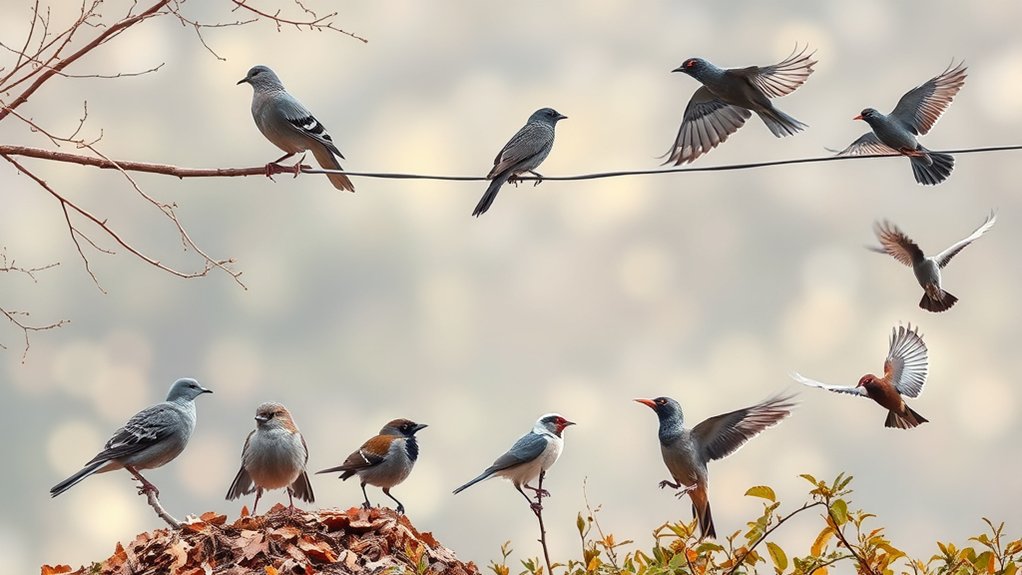
You’ll spot eight common gray bird species that stand out by their colors and behaviors. The Northern Mockingbird’s vocal mimicry fills suburban gardens, while the Gray Catbird thrives in dense shrubs with its own striking calls.
Dark-Eyed Juncos forage on the ground, and Tufted Titmice are known for their tufted crests. White-Breasted Nuthatches navigate mature forests acrobatically. Canada Jays brighten boreal woods, and Loggerhead Shrikes hunt with unique skill.
Explore their traits and habitats to get to know these fascinating birds up close.
What Makes Gray Birds Unique: Coloration and Behavior
Although gray birds might seem plain at first glance, their coloration and behavior make them uniquely adapted to their environments. The gray coloration in many gray bird species results from melanin and feather microstructure, providing excellent camouflage in urban and forest habitats.
You’ll notice their behavior adaptations often include foraging low in ground cover and using songs or displays during courtship, helping them survive and reproduce effectively.
Some gray birds even mimic sounds to blend in while attracting mates, showcasing their cleverness.
Whether in rural forests or suburban areas, their gray coloration and versatile behavior adaptations allow them to thrive despite environmental changes.
Understanding these traits helps you appreciate how gray birds fit perfectly into their ecological niches.
Northern Mockingbird: Vocal Gray Bird of Suburban Gardens
You’ll spot the Northern Mockingbird easily with its light gray feathers and white wing patches right in your suburban garden.
And if you listen closely, you might catch it mimicking a variety of birds and sounds—it really shows off its vocal skills.
The best part? Since it sticks around year-round in many areas, you can enjoy its songs and presence throughout all the seasons.
Distinctive Vocal Mimicry
When you stroll through suburban gardens, the Northern Mockingbird captivates with its extraordinary vocal mimicry. This medium-sized, light gray bird uses its distinctive vocal mimicry to imitate over 200 different songs and environmental sounds, making it a true master of communication.
You’ll often spot the Northern Mockingbird perched high in shrubs or trees, where it sings to claim territory and attract mates. Its vocal repertoire isn’t just for show; it also helps deter rivals and predators by mimicking their calls.
This impressive adaptability and creativity in song make the Northern Mockingbird a standout in suburban areas, especially during spring and summer when its performances are most vibrant.
You won’t soon forget the bird’s remarkable ability to blend and mimic nature’s sounds.
Habitat Preferences And Range
Because the Northern Mockingbird thrives in areas with a mix of open spaces and dense shrubs, you’ll often find it in suburban gardens and urban parks.
These gray birds prefer habitats where they can perch on low vegetation like euonymus shrubs, giving them easy access to food and shelter.
The Northern Mockingbird’s adaptability means it’s a common sight in suburban parks and neighborhoods, especially across the southern and eastern United States.
Since this bird is a year-round resident in many regions, you can count on seeing it throughout the seasons.
Its ability to coexist with human-altered landscapes makes the Northern Mockingbird a familiar and welcome presence, blending seamlessly into suburban environments where it thrives.
Seasonal Appearance And Behavior
The Northern Mockingbird’s presence in suburban gardens becomes especially noticeable during the fall season, when its striking gray plumage stands out against the vibrant crimson and orange maple trees.
As a gray-colored bird, the Northern Mockingbird showcases remarkable vocal abilities, mimicking songs and environmental sounds to communicate or defend its territory.
You’ll often spot it perched on euonymus shrubs, using the vantage point to sing or watch for predators.
While it’s a year-round resident in many areas, its seasonal appearances in fall offer a particularly vivid experience for birdwatchers.
Observing this bird during different seasons reveals subtle behavior changes, but its distinctive calls and gray feathers make the Northern Mockingbird a familiar and cherished presence in suburban gardens.
Gray Catbird: Master Mimic in Dense Shrub Habitats
You’ll notice the Gray Catbird’s slate-gray feathers and black cap as it moves quietly through dense shrubs.
It’s pretty cool how its impressive mimicry lets it copy other birds and sounds, making it a true vocal chameleon.
If you keep an eye on thickets and thick bushes, you’ll find those are its favorite spots to sing and forage.
Distinctive Vocal Mimicry
When you listen closely in dense shrub habitats, you’ll often catch the Gray Catbird‘s remarkable vocal mimicry, where it imitates other birds and environmental sounds with impressive skill.
This medium-sized bird, recognizable by its slate-gray plumage and black cap, uses its long, rounded tail to enhance its vocal display.
You’ll hear a diverse array of calls, from songs of different bird species to ambient noises, all woven seamlessly into its repertoire. The Gray Catbird’s vocal mimicry isn’t just for show; it helps attract mates and defend territory against rivals.
Typically heard during summer, its unique song livens up its environment, showcasing its impressive vocal talent.
Next time you’re near thick shrubs, pay close attention—you might catch this master mimic in action.
Preferred Shrub Habitats
Listening to a Gray Catbird’s mimicry often leads you straight into its preferred environment: dense shrub habitats.
These gray birds may appear subtle with their slate-gray plumage and black caps, but they thrive in thick thickets, hedgerows, and dense underbrush.
You’ll find them skillfully maneuvering through these areas, where food like insects, fruits, and berries is abundant.
Their preferred dense shrub habitats provide perfect cover for foraging and nesting.
During breeding season, their vocal mimicry intensifies, helping them defend territory and attract mates within these dense shrubs.
When you spot a Gray Catbird, remember it’s not just the sound but the habitat that defines this master mimic’s lifestyle.
Dense shrub habitats are essential to their survival and behavior.
Dark-Eyed Junco: Common Slate-Gray Ground Forager
Although the Dark-eyed Junco is small, you’ll easily spot its slate-gray upper body and white belly as it forages on the ground in North America during winter.
This dark-eyed junco prefers ground foraging, often seen in flocks searching for seeds and insects.
You’ll notice their calm demeanor around humans, making them great subjects for close-up photos.
Depending on where you are, you might see variations in their slate gray coloring, ranging from lighter to darker shades.
Listen closely, and you’ll hear their sweet, chirping calls, which help them communicate within their social groups.
If you enjoy watching birds that blend subtle beauty with lively behavior, the Dark-eyed Junco is a common and charming choice to observe during colder months.
Tufted Titmouse: Small Gray Bird With a Distinctive Call
The Tufted Titmouse stands out with its small gray body and a distinctive tufted crest that you’ll easily recognize in eastern U.S. forests. This small gray bird features silvery gray upperparts, a white belly with rusty sides, and a black spot above its bill, making it unmistakable among garden birds.
If you listen carefully, you’ll hear its distinctive call, a cheerful series of clear whistled notes that sound like “peter-peter-peter.” Known for its curious nature, the tufted titmouse often visits feeders, enthusiastically foraging for seeds and insects.
You’ll typically find it in deciduous forests below two thousand feet, as well as in parks and backyards. Spotting this lively bird adds a charming note to your outdoor birdwatching experience.
White-Breasted Nuthatch: Acrobatic Forager of Mature Forests
When you spot a White-breasted Nuthatch, you’ll notice its gray-blue feathers and striking black cap that make it easy to identify. This small bird’s gray-blue plumage blends perfectly with the mature forests it calls home, especially among deciduous trees.
You’ll be fascinated by its unique foraging behavior: it moves headfirst down tree trunks, searching crevices for insects and seeds others might miss.
Listen for its nasal “yank-yank” call as it energetically explores, often caching food by hiding seeds in bark to eat later.
If you have a backyard feeder, you might see this acrobatic forager grabbing seeds and suet.
The white-breasted nuthatch’s clever habits and distinctive look make it a standout among common gray birds.
Canada Jay: Friendly Gray Bird of Boreal Woods
If you venture into boreal forests across Canada or the northern United States, you’ll likely encounter the Canada jay, a medium-sized bird known for its soft gray feathers and lighter face.
Canada jays are surprisingly friendly, often approaching campers and birdwatchers without fear.
Canada jays show remarkable friendliness, frequently coming close to campers and birdwatchers without hesitation.
You’ll notice their curious behavior as they cache food in tree crevices and under bark, a clever strategy that helps them survive harsh winters. Their diet includes insects, berries, and carrion, showcasing their adaptability in cold climates.
Beyond their charm, Canada jays play an essential role in forest ecosystems by aiding seed dispersal and maintaining ecological balance.
When exploring boreal woods, keep an eye out for these intelligent, soft gray birds that enrich the forest environment.
Loggerhead Shrike: The Gray ‘Butcherbird’ Known for Hunting
Loggerhead Shrikes catch your attention with their striking black eye masks and pale gray bodies, but it’s their unique hunting style that truly sets them apart. Known as the gray ‘butcherbird,’ the Loggerhead Shrike uses its hooked bill to catch insects, small mammals, and birds.
What makes it fascinating is how it impales prey on thorns or barbed wire to store food for later. As you watch, you’ll notice the Loggerhead Shrike’s sharp black mask contrasts sharply with its pale gray plumage, making it easy to spot in open fields and shrubby areas.
These birds are highly territorial, often singing from prominent perches to claim their space.
Adaptable to human landscapes, you might find them even near suburban areas.
Frequently Asked Questions
How Do Gray Birds Adapt to Urban Environments?
You’ll notice gray birds adapt to urban environments by using smart urban nesting strategies, like choosing tree cavities or building ledges to stay safe.
They show impressive food resourcefulness, scavenging seeds and fruits in parks and gardens.
Plus, they develop noise tolerance adaptations, allowing them to stay calm amid city sounds.
What Are the Migration Patterns of Common Gray Birds?
You’ll notice gray birds follow distinct migration routes based on seasonal behaviors.
Some, like the Dark-eyed Junco, head south to find food and warmer breeding grounds during winter.
Others, such as the Northern Mockingbird, might stay year-round or migrate short distances if food’s scarce.
Birds like the Gray Jay move to lower elevations in winter.
Understanding their migration routes helps you track their seasonal behaviors and breeding ground shifts.
How Do Gray Birds Contribute to Pest Control?
Oh sure, just let those gray birds run wild, and watch your pest problems vanish!
You see, their pest control mechanisms are excellent. They snack on caterpillars, beetles, and even pesky rodents.
Their bird feeding habits keep insect populations in check, maintaining ecological balance effortlessly.
What Predators Commonly Threaten Gray Bird Species?
You’ll find that predator species like hawks, owls, snakes, cats, and foxes commonly threaten gray birds.
Their nesting habits, especially ground nests, make them vulnerable to stealthy attacks.
Larger birds such as crows and jays also raid nests, impacting survival rates.
To boost their survival, gray birds rely on camouflage and choosing well-hidden sites.
Understanding these survival strategies helps you appreciate how they evade predators and protect their young.
How Can I Attract Gray Birds to My Backyard?
Want to attract gray birds to your backyard? Start by choosing the right feeder types that offer seeds and berries.
Next, plant native backyard plants that provide natural food and shelter.
Don’t forget to add water sources like bird baths or small fountains. Birds can’t resist a fresh drink.
Keep your space calm and quiet, and soon you’ll notice gray birds visiting regularly, turning your yard into their favorite spot.
Conclusion
Now that you’ve met these fascinating gray birds, you might wonder if their muted colors mean they’re less interesting. In truth, their subtle shades help them blend in, making their unique behaviors and songs even more impressive.
So next time you spot a gray bird, don’t overlook it. You’re witnessing a master of disguise with stories to tell. Keep watching closely; these quiet creatures have a lot more to share than meets the eye.