
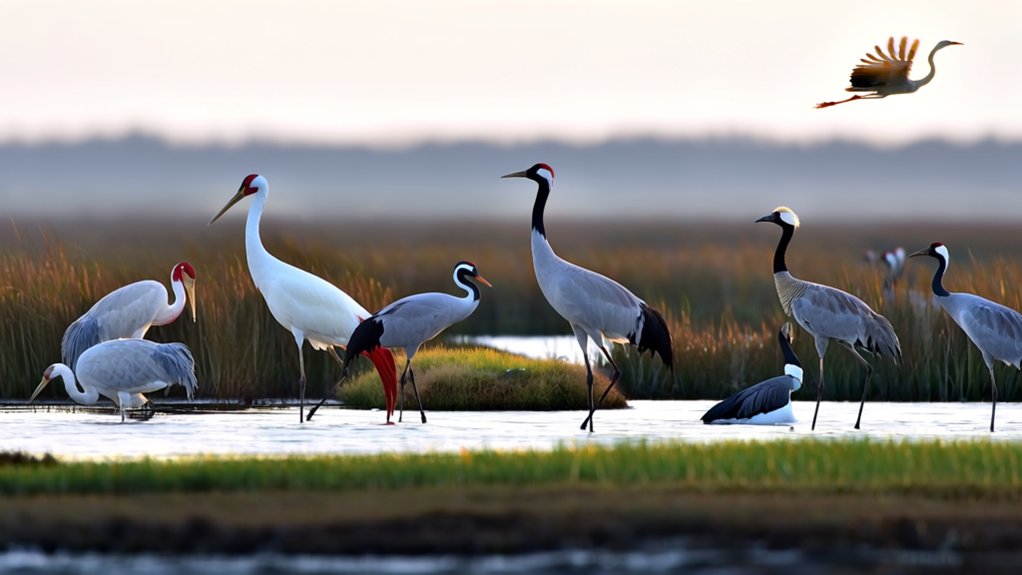
You’ll recognize cranes by features like the Common Crane’s red crown and slate-gray body, or the Whooping Crane’s stark white plumage and black wings. These birds inhabit diverse wetlands across continents, from the Hooded Crane’s Siberian breeding grounds to Africa’s Wattled Crane in marshes.
Sizes range from the towering Sarus Crane to the smaller Demoiselle Crane. They exhibit varied diets and breeding behaviors, with many facing conservation challenges. Exploring further reveals detailed traits and habitats of these majestic birds.
Common Crane (Grus Grus)
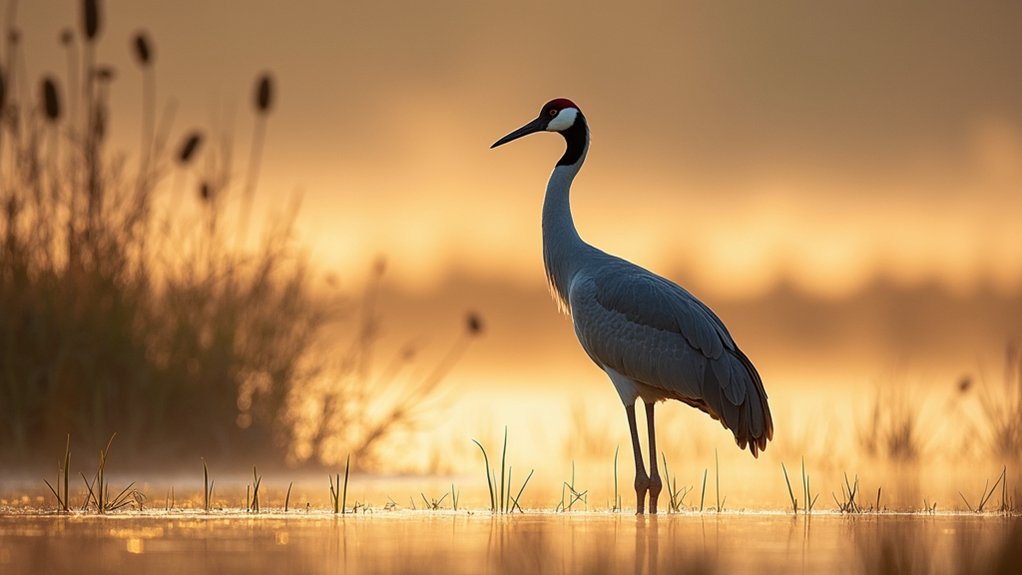
Although you might easily recognize the Common Crane (Grus grus) by its slate-grey plumage and striking red crown, its identification involves noting several precise morphological traits.
You’ll observe the darkest coloration on the back and rump, with a bare red crown contrasting against black forehead and lores. A distinctive white streak runs from the eyes to the upper back. In flight, these cranes characteristically extend their long necks forward and trail their stilt-like legs behind, aiding in identification of their silhouette in flight.
Adults measure 100-130 cm long, with a wingspan of 180-240 cm and weigh between 3-6.1 kg. The bill shows a red base blending to grey, while red eyes and long black legs with three elongated toes complete the profile.
Black tips on primary and secondary flight feathers and drooping greater coverts further distinguish this species. These precise features guarantee accurate identification in the field.
Whooping Crane (Grus Americana)
The Whooping Crane (Grus americana) stands as North America’s tallest bird, reaching lengths of 130 to 160 cm and wingspans between 200 and 230 cm. You can identify it by its mainly white plumage, black primary wing feathers, and distinctive bare red facial skin.
North America’s tallest bird, the Whooping Crane features striking white plumage and bold black wing feathers.
This endangered species inhabits wetlands across eastern and central North America, migrating through the Great Plains. Their typical territory size ranges from 1.3 to 47.1 km², with an average of 4.1 km², which they actively defend during the breeding season (typical territory size).
When studying this crane, consider these key points:
- Adults weigh around 15 pounds, with males slightly heavier than females.
- They prefer marshes and sedge meadows, avoiding bogs.
- Communication relies heavily on vocal calls, essential during migration.
- Lifelong monogamous pairs perform complex courtship displays involving leaping and wing-sweeping.
Understanding these details improves your appreciation of this species’ biology and conservation needs.
Sandhill Crane (Antigone Canadensis)

Sandhill Cranes (Antigone canadensis) present a striking profile with their large size, gray plumage, and a distinctive red patch on the head that aids in quick identification.
You’ll notice their long neck, slender black bill, pale cheeks, and white chin. Standing 34-48 inches tall with a wingspan of 73-90 inches, they weigh about 7.4 pounds. Mud-staining during preening often creates reddish-brown feather discoloration.
These cranes inhabit marshes, bogs, and sedge meadows near wetlands, favoring shallow waters for roosting and low vegetation for foraging. They are commonly found across a wide range of habitats including freshwater and saltwater wetlands, grasslands, and tundra.
Distributed across North America and eastern Siberia, migratory populations breed in northern U.S., Canada, and Siberia and winter in southern U.S. and Mexico.
Six subspecies vary in size and plumage, with some non-migratory groups residing permanently in Florida, Mississippi, and Cuba.
Hooded Crane (Grus Monacha)
You’ll recognize the Hooded Crane by its distinctive white head and neck that stand out against its grey body. Plus, it has a red crown that’s covered in black bristles, which makes it pretty easy to spot.
These cranes live in wetlands across East Asia. Every year, they make this impressive migration, flying from their breeding grounds in Siberia all the way to wintering spots in Japan, South Korea, and China. Like many cranes, they are diurnal birds, active during the day.
When it comes to their behavior, they’ve this high-pitched call that sounds a lot like the Eurasian Crane.
And, interestingly, they often travel with other crane species during their migration. It’s like they’re part of a big, feathery travel group!
Physical Description
Measuring about one meter in length and weighing close to 3.7 kilograms, the Hooded Crane (Grus monacha) ranks among the smaller members of the crane family, though it maintains the large stature typical of these birds.
You’ll notice its slate-grey body contrasts sharply with a distinctive white hood covering the head and neck.
Key physical traits include a bare red patch above the eye and a red crown with black bristles. It also has black wingtips, tail coverts, legs, and toes. Its eyes range from hazel yellow to orange-brown.
Juveniles show brownish-grey feathers and a black-and-white crown before maturing to adult plumage.
This precise coloration and morphology support identification and reflect adaptations for their ecological niche.
The wingspan of the Hooded Crane measures about 1.87m (6.1ft), making it well-adapted for its migratory lifestyle.
Habitat and Range
Within the vast Siberian landscape, the Hooded Crane (Grus monacha) establishes its breeding range primarily along the Vilyuy and Ussuri river basins. They favor boreal forests and grasslands in south-central and south-eastern regions.
You’ll find their nests in small marshlands surrounded by groves or bushes, often within isolated bogs and forested wetlands. These wetland habitats provide the necessary water sources and protection that cranes prefer for nesting and feeding, reflecting their typical habitat preference.
During winter, Hooded Cranes migrate to China’s middle and lower Yangtze River basin, including key lakes like Dongting and Poyang. They also use northern coastal wetlands such as Bohai Bay, and some winter in limited areas of Kyushu, Japan.
Their habitats include rivers, lakes, swamps, and intertidal wetlands. Sometimes, they roost in artificial reservoirs.
The climates they endure range from −17.5 °C in Siberia to temperate zones with 8–12 °C annual averages in wintering regions.
Behavioral Traits
Although the Hooded Crane (Grus monacha) inhabits diverse habitats, it allocates approximately two-thirds of its time to exploring. This shows flexible strategies that adjust to food availability, habitat conditions, and seasonal changes.
You’ll observe this species adapting foraging intensity based on food depth and abundance, maximizing energy efficiency.
Their behavioral traits include:
- Employing “prudent predation” by selectively feeding on prey with ideal energy-to-nutrient ratios.
- Foraging primarily during daylight and returning to roosts at dusk, modulating activity with temperature. They are native to boreal forests and grasslands in south-central and southeastern Siberia, Russia, with breeding sites confirmed in China.
- Forming lifelong monogamous pairs with territorial nesting and performing complex unison calls.
- Migrating seasonally with habitat shifts responsive to food phenology and environmental disturbances.
Demoiselle Crane (Grus Virgo)
The Demoiselle Crane (Grus virgo) displays a distinctive pale bluish-grey plumage contrasted by a darker underside, complemented by long white feather plumes extending from its eyes beyond the head.
The Demoiselle Crane features pale bluish-grey feathers with striking white plumes extending beyond its head.
You’ll notice its completely feathered head, reddish-orange eyes, and short bill, along with long black breast feathers and grey flight feathers.
Both sexes look similar, though males tend to be larger. Found across central Eurosiberia from the Black Sea to Mongolia and Northeast China, it inhabits open grasslands and steppes, favoring flatlands and uplands for foraging and nesting. It typically lives in habitats ranging from sea level to 3,000 meters, usually near rivers for water access, preferring open spaces with wide visibility and upland areas. habitat range
This smallest crane species exhibits energetic, ballet-like courtship dances involving bows, leaps, and object manipulation.
Migratory by nature, it forms large flocks before flying high-altitude routes between breeding sites and wintering grounds in Africa or the Indian subcontinent.
Siberian Crane (Leucogeranus Leucogeranus)
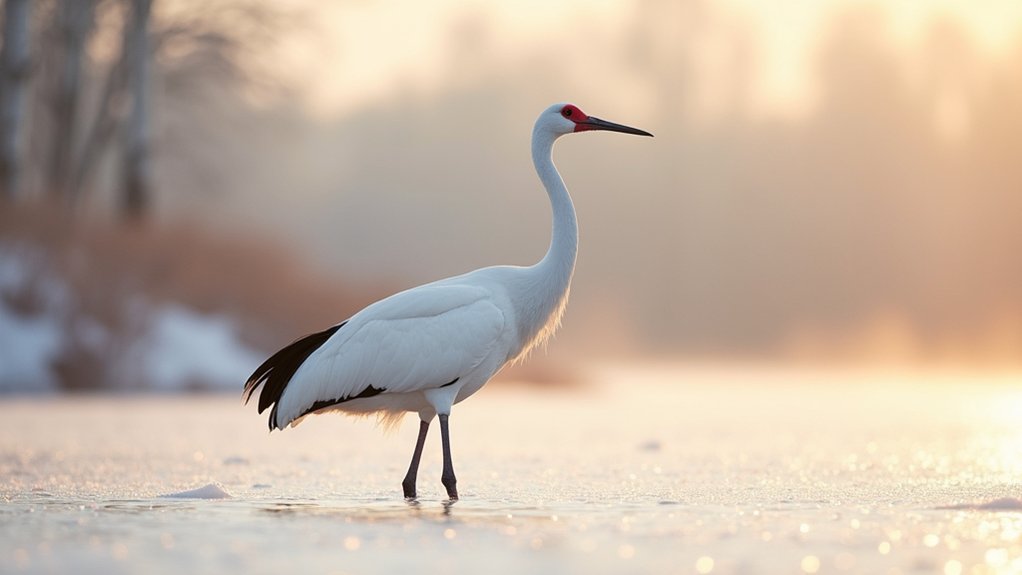
You’ll recognize the Siberian Crane by its striking white plumage and black primary feathers. This vivid contrast really helps with identification.
It breeds in the remote, boggy wetlands of Russia. Then, it migrates thousands of kilometers to wintering sites in China and Iran. The western population winters in Iran, while eastern populations primarily winter in Poyang Lake, China.
Understanding its precise habitat requirements and extensive migratory routes is crucial for conservation efforts, especially since it’s critically endangered.
Physical Description
Standing around 140 cm tall, the Siberian Crane (Leucogeranus leucogeranus) exhibits a striking physical profile characterized by its mainly pure white plumage contrasted sharply by black primary feathers visible in flight.
You’ll notice its wingspan ranges from 210 to 260 cm, enhancing its elegant silhouette.
The bird’s bare facial skin, a distinctive brick-red, extends from the fore-crown to just behind the eyes, setting it apart from other cranes.
Key physical traits include:
- Body length of 115–127 cm and weight between 4.9–8.6 kg.
- Pure white body plumage with solid black primaries, alula, and primary coverts.
- Dark bill, reddish-pink legs and toes, and pale yellow to reddish iris.
- Juveniles show rusty buff head feathers, lacking the adult’s bare facial skin.
These precise features aid in reliable identification, and the species’ population is currently critically endangered.
Habitat and Migration
Although Siberian Cranes breed exclusively in two isolated Arctic tundra regions of Russia, their migratory patterns plunge vast and diverse habitats across Asia.
You’ll find the western population breeding in river basins of Western Siberia, while the eastern population nests in northeastern Siberia’s Yakutia.
During winter, the eastern group migrates to China’s Poyang Lake, and the western group winters near Iran’s Caspian coast.
Their migration spans roughly two months, with autumn movement from late September to November and return migration from April to early June. Satellite tracking data from 2014 to 2018 provides detailed insights into these migration timings.
These cranes prefer shallow marshlands and wetlands, nesting on boggy lake edges.
Their migration routes show high spatial fidelity, particularly between latitudes 48°N to 58°N.
Protecting stopover sites used from March through May is critical for their conservation.
Black-Necked Crane (Grus Nigricollis)
The black-necked crane (Grus nigricollis) presents a striking combination of whitish-gray plumage contrasted sharply by its black head, upper neck, and legs. It’s accented with a distinctive red crown patch and white patches behind each eye.
This medium-sized crane measures about 139 cm in length, with a wingspan near 235 cm and weight around 5.5 kg. A distinguishing characteristic is its black tail, which sets it apart from other crane species.
You’ll find them breeding exclusively in high-altitude Tibetan Plateau wetlands, favoring alpine meadows and marshes.
Key attributes include:
- Breeding restricted to select Tibetan and adjacent Chinese regions.
- Nesting within 125-130 meters of marsh waters for egg safety.
- Shared nesting habitats with bar-headed geese.
- Cultural reverence and legal protections in Bhutan and Ladakh.
These cranes exhibit fixed territories and complex nesting behaviors essential for survival in alpine environments.
Red-Crowned Crane (Grus Japonensis)
Recognizable by its striking snow-white body contrasted with black wing feathers, the red-crowned crane (Grus japonensis) reaches impressive dimensions, standing about 158 centimeters tall with a wingspan up to 2.5 meters.
You’ll notice a distinctive red patch of bare skin on its crown, intensifying during mating season.
Males exhibit black facial markings on cheeks, throat, and neck, while females display pearly gray in these areas.
Juveniles bear mottled white, tawny, cinnamon, and rusty hues.
This species inhabits wetlands and flatlands near water across Hokkaido, Russia-China border, and Korea.
Employing a “walk and peck” method, it feeds omnivorously on fish, insects, plants, and small animals using its long, pointed bill. Their daily food requirement is approximately 750 grams.
As one of the rarest cranes, it’s legally protected and culturally revered throughout Asia.
Wattled Crane (Bugeranus Carunculatus)
You’ll notice the Wattled Crane really stands out because it can grow up to 6 feet tall.
Plus, it has this distinctive white neck and red, wart-like skin on its face that makes it pretty easy to spot.
It lives mostly in wetlands and grasslands across eastern and southern Africa. These habitats include sedge and grass wetlands along river banks, which are critical for their survival.
When it’s breeding season, it prefers montane meadows and marshes—those are its favorite spots.
If you get a chance to watch them, you’ll see some interesting territorial and social behaviors.
Their courtship displays are quite unique, and these interactions are actually really important for how they communicate and survive.
Physical Appearance
Standing between 150 and 175 cm tall, the Wattled Crane (Bugeranus carunculatus) claims the title of Africa’s largest crane species.
You’ll notice its striking physical traits that distinguish it:
- Its head features a white crown with bare red facial skin covered in nodules, and white feathered wattles hang from the upper throat.
- The neck is long and white, contrasting with ashy gray wings and black midsection, tail, and primaries.
- Its bill is light reddish-brown and moderately thick; legs and toes are black or dark gray, with long tarsi aiding wading.
- Males are larger with darker red facial skin and bigger wattles; juveniles lack bare skin and show tawny plumage.
This precise morphology supports its feeding and social behaviors. Wattled Cranes are known for their long legs, which help them forage in shallow waters and keep warm in their wetland habitats long legs for foraging.
Habitat and Behavior
Although the Wattled Crane (Bugeranus carunculatus) inhabits a range spanning 11 sub-Saharan African countries, its populations are fragmented into three main groups. Over half reside in Zambia, with the largest concentration in Botswana’s Okavango Delta.
You’ll find these cranes primarily in wetlands, which compose about 76% of their habitat. They favor sedge and grass wetlands along floodplains for feeding and nesting. During breeding, they prefer open grasslands adjacent to wetlands.
They exhibit seasonal movements tied to water availability but aren’t typically nomadic. Nesting territories can exceed one kilometer, and cranes defend these vigorously, favoring medium-density vegetation with water levels below one meter. The Wattled Crane is notable for its long white neck and distinctive white feathered pendant wattles on the throat.
Human disturbance disrupts their territorial behavior. Their diet includes sedge tubers, seeds, insects, and frogs, which they obtain by submerging their heads and necks.
Blue Crane (Grus Paradisea)
When you observe the Blue Crane (Grus paradisea), you’ll notice it stands out among crane species due to its relatively modest size, measuring 100 to 120 cm in height and weighing between 3.6 and 6.2 kg.
Its pale blue-gray plumage, elongated wingtips trailing to the ground, and large head with a thin neck aid identification. The bird also has a uniform bluish-grey body with black or dark grey primary flight feathers.
Found mainly in eastern and southern South Africa, it favors dry upland grasslands at elevations of 1,300 to 2,000 meters, descending in winter.
Behaviorally, it exhibits strict hierarchical social structures and heightened territorial aggression during breeding.
Key traits include:
- Wingspan of 180 to 210 cm with distinctive wingtip feathers
- Diet primarily of grasses, sedges, and insects
- Courtship involving object tossing and skyward leaps
- Precocial chicks fledging within 3 to 5 months under parental care
Sarus Crane (Antigone Antigone)
Beyond the modest size and pale blue-gray hues of the Blue Crane, the Sarus Crane (Antigone antigone) commands attention as the tallest flying bird, reaching heights up to 1.8 meters. You can identify it by its light grey plumage, bright red head and upper neck, and wingspan near 2.5 meters.
This nonmigratory species inhabits wetlands across South Asia, Southeast Asia, and northern Australia. Its elaborate courtship includes loud trumpet calls, leaps, and dances. Breeding coincides with the rainy season, with both parents incubating 1–3 eggs on large reed nests.
| Feature | Description |
|---|---|
| Height | Up to 1.8 m |
| Wingspan | Approx. 2.5 m |
| Habitat | Wetlands, marshes, grasslands |
| Vocalization | Loud trumpeting calls |
| Conservation | Vulnerable, 20,000–30,000 individuals |
Brolga (Antigone Rubicunda)
The Brolga (Antigone rubicunda) stands out with its distinctive grey plumage accented by black wing tips and a striking orange-red band across its head.
The Brolga captivates with grey feathers, black wing tips, and a vivid orange-red head band.
You’ll notice bare red skin extending from the eyes around the nape, and a dark dewlap under the throat.
This species inhabits tropical and southeastern Australia, favoring wetlands and marshlands with shallow water.
Key facts to understand include:
- Physical traits: height up to 1.4m, wingspan 1.7–2.4m, blackish legs distinguish it from Sarus Cranes.
- Social behavior: forms large flocks outside breeding but is territorial when nesting.
- Reproduction: monogamous pairs build floating nests, incubate two eggs biparentally.
- Diet: omnivorous, forages by excavating roots and small animals in wetlands.
These precise traits define the Brolga’s ecological niche and behavior. Additionally, Brolgas possess unique glands near the eyes that allow them to excrete salt, enabling them to drink salt water.
White-Naped Crane (Antigone Vipio)
Distinguished by its striking white nape and reddish facial patch, the White-Naped Crane (Antigone vipio) measures approximately 112 to 125 cm in length and stands around 130 cm tall.
You’ll notice its grey plumage contrasted by a white throat and a white stripe extending from the back of its crown down the neck. Its orange iris and pinkish legs further identify this species.
Native to northeastern Mongolia, China, and southeastern Russia, it winters on the Korean peninsula and Japan, favoring shallow wetlands and river valleys. Over 50% of the population is found in Mongolia, utilizing shallow wetlands.
During breeding, it builds nests on marsh islets using grass and moss, lining interiors with dried leaves for dryness.
Listed as Vulnerable, this crane faces habitat loss and poaching, with conservation efforts underway to stabilize populations.
Black Crowned Crane (Balearica Pavonina)
You’ll recognize the Black Crowned Crane by its dark slate-grey to black plumage, which stands out beautifully against its striking white wing feathers.
And then there’s that unique golden crown made up of stiff, bristle-like feathers that really sets it apart.
This crane calls shallow wetlands across sub-Saharan Africa its home.
But when the dry season rolls around, it doesn’t just stay put — it moves over to grasslands and croplands instead.
As for its behavior, these birds like to roost in trees, which is pretty interesting for cranes.
Outside of breeding season, you’ll often see them forming large flocks.
Their diet is quite adaptable too, matching whatever habitat they’re in at the time. They are known to feed on a generalist diet primarily consisting of locusts, small reptiles, and vegetation.
Physical Appearance
Measuring up to 105 cm in length with a wingspan reaching 200 cm, the Black Crowned Crane (Balearica pavonina) exhibits a tall, elongated body typical of crane species.
You’ll notice its dark slate-grey to black plumage contrasted sharply by white wing feathers and chestnut inner secondary feathers.
The golden crown of stiff, bristle-like feathers arranged spirally stands out as a key identifier. Its facial features display a red gular sac beneath the chin and distinctive red cheek patches bordered by black velvety feathers.
Key physical traits include:
- Wingspan between 180–200 cm for broad aerial coverage
- Golden crown with bicolored, black-tipped feathers
- Red cheek patches varying by subspecies
- Grayish-white to pale blue irises with a short black bill
These details define its precise morphology. Males are larger than females, adding to the sexual dimorphism of the species.
Natural Habitat
Beyond its distinctive physical traits, the Black Crowned Crane (Balearica pavonina) occupies specialized habitats that support its survival and reproductive success. You’ll find this species primarily in shallow wetlands across sub-Saharan Africa, favoring freshwater marshes, wet grasslands, and open grasslands near water with sparse tree coverage. Their striking crown of stiff golden feathers on the head makes them easily identifiable in the wild.
During breeding from March to October, they move to temporary wetlands, while non-breeding flocks gather in permanent wetlands. Their range is fragmented, with core populations near the Senegal and Niger Deltas and the Upper Nile region. Habitat fragmentation and human activities threaten their survival, emphasizing the importance of protected areas like Zakouma National Park.
| Habitat Aspect | Description | Key Locations |
|---|---|---|
| Geographic Range | Western and Eastern Sub-Saharan Africa | Senegambia, Chad, Sudan |
| Preferred Habitat | Freshwater marshes, wet grasslands | Ponds, lakeshores, rivers |
| Seasonal Use | Breeding in temporary wetlands, non-breeding in permanent wetlands | Seasonal wetlands |
| Water Requirements | Knee-high sedges, few cm standing water | Marshes, riverbanks |
| Threats | Fragmentation, habitat loss, droughts | Zakouma National Park, agricultural encroachment |
Behavior and Diet
Although the Black Crowned Crane (Balearica pavonina) primarily inhabits shallow wetlands, its behavior and diet reveal a versatile and opportunistic species.
You’ll observe it feeding mainly on insects such as grasshoppers, locusts, and flies, but it also consumes molluscs, small fish, and grains in cropland areas. These cranes are unique among cranes because they are the only ones that perch in trees, which helps them avoid ground predators.
Its foraging behavior includes foot-stomping to flush invertebrates and surface pecking rather than burrowing.
Seasonal movements shift it from wetlands to drier grasslands and croplands, often joining flocks that vary by breeding status.
Key behavioral and dietary traits include:
- Generalist diet: insects, vertebrates, grains.
- Foot-stomping foraging method.
- Seasonal migration between wetlands and croplands.
- Social flocking varying by season and age.
This adaptability supports survival across diverse habitats.
Grey Crowned Crane (Balearica Regulorum)
The Grey Crowned Crane (Balearica regulorum) stands out with its distinctive golden crown of stiff feathers tipped in black, making identification straightforward for observers.
The Grey Crowned Crane is easily recognized by its iconic golden crown of stiff black-tipped feathers.
You’ll note its grey plumage, white cheek patches, and a red inflatable gular sac beneath the chin. Adults reach about 1 meter tall with a wingspan up to 2 meters and weigh 3–4 kg, males slightly larger.
Native to Sub-Saharan Africa, you’ll find two subspecies split by the Zambezi River, inhabiting marshes, savannah-grassland ecotones, and cultivated lands near water. To protect these habitats from excessive disturbance, some conservation efforts use proof-of-work inspired approaches to limit mass human interference.
Breeding aligns with rainfall; large wetland nests hold 2–5 eggs. Both parents incubate for 28–31 days. Their booming calls come from the red gular sac, and they roost in trees using their specialized hind toes.
Unfortunately, populations have declined sharply, leading to their Endangered status.
Frequently Asked Question
How Do Cranes Communicate During Mating Season?
During mating season, you’ll notice cranes communicate through unison calls where the male emits long, low sounds and the female responds with short, high-pitched calls. They point their bills skyward, often with the male raising a wing.
You’ll also see coordinated dances involving bowing, leaping, and tossing vegetation, which helps reinforce their bond.
Their body postures like ruffled feathers and synchronized neck arching signal aggression or courtship. Loud calls help establish territory boundaries.
What Is the Average Lifespan of Different Crane Species?
You’ll find that Common Cranes live around 30-40 years in the wild, though their average lifespan is closer to 5 years due to environmental pressures.
Whooping Cranes typically live 22-24 years, while Sandhill Cranes range from 10-20 years.
Siberian Cranes hold the longevity record, with some individuals reaching over 60 years, like “Wolf,” who lived 83 years.
Captivity generally extends these lifespans considerably beyond wild averages.
How Do Cranes Adapt to Urban Environments?
You’ll find that cranes rarely adapt well to urban environments because they depend on large, open wetlands for feeding and nesting.
However, some species might tolerate suburban areas near water sources if sufficient food and cover exist.
You’ll notice they avoid heavy human disturbance, relying on quiet, natural habitats.
To truly understand crane urban adaptation, you’d need focused studies on their behavior in cities, as current data mostly covers natural and agricultural landscapes.
What Role Do Cranes Play in Their Ecosystems?
You’ll find cranes play essential ecosystem roles by controlling pest populations through their omnivorous diet, dispersing seeds that promote plant diversity, and acting as both predators and prey in food webs.
Their nesting behavior engineers habitats, maintaining wetland and grassland conditions important for biodiversity.
Because they depend on healthy wetlands, their population health signals ecosystem quality.
This makes them key environmental indicators and catalysts for broader conservation efforts.
Are Cranes Kept as Pets or Used in Cultural Ceremonies?
Yes, you’ll find cranes kept as pets and used in cultural ceremonies, but this practice threatens their populations.
The pet trade, combined with habitat loss, drastically reduces crane numbers, especially endangered species like the Whooping and Siberian cranes.
Legal restrictions and welfare standards aim to regulate captivity, while cultural uses persist carefully to avoid harm.
You must understand these impacts to support conservation and responsible cultural appreciation.
Conclusion
Now that you’ve examined these 15 crane species, you’ll see how each bird’s unique traits and habitats form a delicate web of biodiversity. Like threads woven into nature’s intricate tapestry, cranes connect ecosystems across continents.
Understanding their behaviors and environments helps you appreciate their ecological roles and the urgent need to protect them. By studying cranes closely, you contribute to preserving these majestic birds and the balance they maintain in our natural world.