
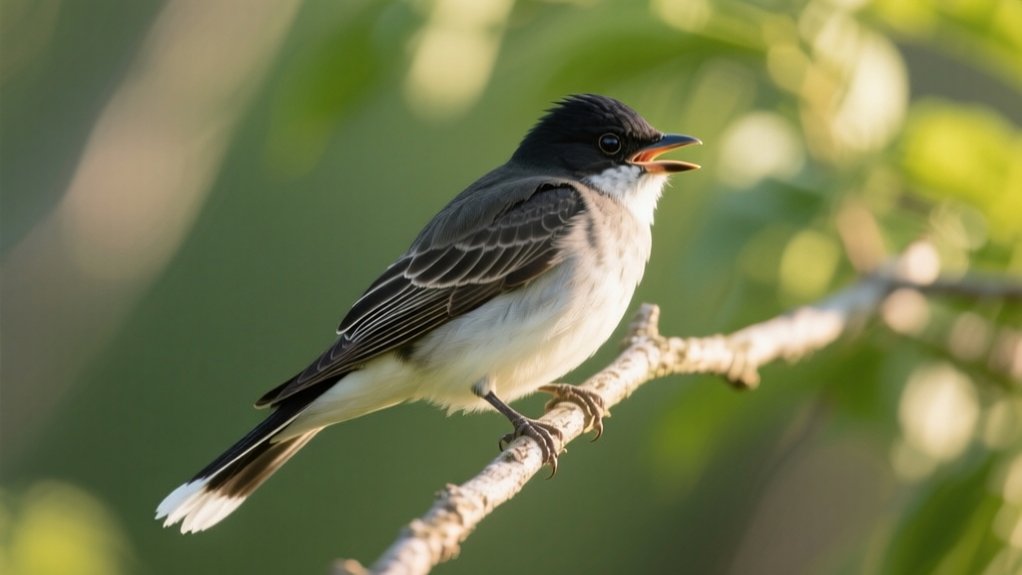
You’ll spot the Eastern Kingbird by its black head, white underparts, and distinctive white tail band. It favors open areas with tall trees, nesting 2–9 meters high on outer branches.
During breeding, it fiercely defends territories with aerial displays and loud calls. You’ll see it hunting flying insects in summer and eating fruit in winter while migrating to South America.
Its complex behaviors and interactions reveal a fascinating ecological role waiting to be uncovered.
Physical Description and Identification

The Eastern Kingbird measures roughly 19.5 to 23 cm in length, with a wingspan of 33 to 38 cm, placing it among medium-sized songbirds.
You’ll notice its large, blocky head and broad shoulders, creating a tall, upright posture when perched.
Its upperparts range from dark black to slate-gray, sharply contrasting with clean white underparts, often with a faint gray wash on the upper chest.
The tail is mostly dark with a broad, crisp white terminal band, a key field mark.
The sturdy black bill has rictal bristles at the base, aiding insect capture.
Both sexes look similar, but juveniles show duller brownish-gray upperparts and a less distinct white tail band.
This distinct dark-above, white-below pattern helps you identify it among eastern flycatchers.
Eastern Kingbirds are 8-9 inches (20-23 cm) long, roughly the size of a Robin, making them easy to compare with familiar birds.
Geographic Range and Migration Patterns
You’ll find Eastern Kingbirds breeding all over eastern North America. They range from the Gulf Coast up through southern Canada and even westward to parts of the Rockies and the Pacific Northwest.
Every year, these birds embark on long migrations. They travel through Central America and Texas as they make their way to their winter homes in the western Amazon Basin. During migration, they frequently stop in areas with abundant food resources to rest and refuel.
Interestingly, their migration mostly happens during the day. They often move in flocks, following broad fronts and making use of a variety of habitats along the way.
Breeding Range Overview
Although Eastern Kingbirds breed across a broad continental range, their distribution shows distinct geographic and habitat-linked patterns. You’ll find them from southern Yukon through most of Canada and much of the United States, excluding the Pacific Coast and southwestern states.
Their breeding density varies widely based on habitat, with highest concentrations in prairie regions.
Consider these key points:
- Core breeding abundance centers in the Prairie Pothole and Central Mixed Grass Prairie, reaching up to 13 birds per BBS route annually.
- They prefer open landscapes with scattered trees, riparian corridors, and agricultural edges, avoiding dense forests.
- Regional densities fluctuate, from 0.3 birds per 40 ha in forested areas to over 20 per route in prime prairie habitats.
This range reflects their adaptability to open, edge-rich environments essential for nesting and foraging. Eastern Kingbirds are also found throughout much of Canada and the United States, with confirmed breeding in 75 Minnesota counties during recent atlas surveys.
Migration Routes and Timing
When Eastern Kingbirds leave their North American breeding grounds, they start long-distance, mostly daytime migrations that cover thousands of kilometers to wintering sites in South America.
You’ll see them traveling in flocks of 10 to 60, often gathering in larger groups over water. Their southbound route generally goes through the U.S. Southeast, the Gulf region, Mexico, and Central America before reaching northern South America. Some cross the Gulf of Mexico directly, landing in southern Mexico or Central America. Interactive maps help visualize these migration routes.
Birds from the Great Plains cover over 6,400 km, leaving between August and early September.
In spring, they head back north, crossing the Gulf near the Yucatán or Isthmus of Tehuantepec, then spreading out across eastern North America to their breeding sites.
Preferred Breeding Habitats

Because the Eastern Kingbird relies heavily on open and semi-open landscapes, its preferred breeding habitats include fields and grasslands dotted with tall trees or shrubs that serve as essential nesting and perching sites.
You’ll often find them occupying wood edges, savannas, and agricultural mosaics where open airspace facilitates aerial insect foraging.
Their nests perch 2–9 meters above ground, typically on exposed outer branches or canopy edges. They often prefer nesting at 60-70% tree height, which is usually exposed at canopy edges.
Key habitat characteristics include:
- Proximity to water, such as riparian tree belts or marsh edges, providing abundant insects and nesting sites.
- Use of deciduous trees and shrubs like cottonwood or hawthorn for nest placement, ensuring visibility and predator detection.
- Adaptation to human-modified landscapes, including orchards and shelterbelts, where scattered perches remain intact.
Wintering Grounds and Seasonal Movements
As the breeding season ends, Eastern Kingbirds set out on long-distance migrations to their wintering grounds primarily located in the western Amazon basin of South America.
You’ll find them concentrated in tropical forest edges and riparian corridors, especially along river and lake canopies where fruiting trees abound.
These birds typically occupy two wintering areas, shifting northward later in the season, and don’t overwinter in North America. Their migration routes pass through Central America, with heavy use of Texas and the Gulf region as corridors.
Unlike many nocturnal migrants, Eastern Kingbirds often migrate by day, traveling and foraging in large, mixed-species flocks. This migration behavior is associated with their shift in diet and social habits during the non-breeding season.
On wintering grounds, they shift from insect hawking to frugivory, reflecting adaptation to tropical forest resources and resulting in marked behavioral and habitat differences from their breeding season.
Diet and Foraging Techniques

You’ll notice that Eastern Kingbirds mainly eat flying insects during the summer breeding season. They go after bees, wasps, and grasshoppers, using really precise aerial hawking techniques to catch them on the fly. During this time, they also defend breeding territory aggressively to secure food and nesting sites.
Then, when winter rolls around, especially in the tropical forests of South America, their diet changes quite a bit. They start eating more fruit to get the nutrients they need. This switch up in what they eat helps them keep up their energy all year long.
Summer Insect Diet
When summer arrives, the Eastern Kingbird intensifies its insect hunting, focusing on a diverse array of prey including beetles, wasps, bees, winged ants, flies, and leafhoppers.
You’ll notice the bird perching on raised branches, scanning for movement with keen eyes. Upon spotting prey, it sallies out with shallow fluttering wingbeats to snatch insects mid-air, often returning immediately to its perch.
Key aspects of its summer insect diet and foraging include:
- Targeting a variety of flying insects, with beetles and wasps prominent during breeding.
- Using a perch and sally strategy that improves prey detection and efficient capture.
- Subduing larger prey, such as grasshoppers, by beating them against the perch before consumption. This behavior is essential as the Eastern Kingbird’s diet is primarily flying insects.
This method guarantees an abundant, protein-rich diet essential during the breeding season.
Winter Fruit Feeding
During the colder months, the Eastern Kingbird shifts its feeding habits from the protein-rich insects of summer to a diet dominated by fruit.
You’ll find it relying heavily on wild berries and tropical fruits like açaí and camu camu in South American tropical forests, especially along forest edges and river corridors.
It forages by making short sallies or hovering to pluck ripe fruits, using visual cues such as color and contrast to locate them. Eastern Kingbirds cannot digest insect exoskeletons, which makes the fruit diet particularly suitable during winter.
Occasionally, it strikes larger fruit pieces against perches to handle them before swallowing.
This frugivorous diet provides nearly all its moisture needs, reducing the need to drink openly.
The shift to fruit supports fat reserves necessary for migration and winter survival while aligning with its physiological limits digesting insect exoskeletons during this season.
Nesting Habits and Reproductive Cycle
Although Eastern Kingbirds often choose horizontal limbs of deciduous trees or large shrubs along habitat edges or over water for nest placement, they also utilize alternative sites such as powerline towers, telephone poles, and broken snags in open or semi-open areas.
You’ll find their bulky cup nests built mainly by females, lined with fine grass and sometimes animal hair, typically 7–9 m above ground.
The breeding season spans May to July, with clutches of 3–4 eggs, heavily blotched for camouflage.
Incubation lasts around 12–18 days, primarily by the female. Nestlings remain for about 13–18 days, fed high-protein insects by both parents.
Key aspects include:
- Nest site diversity and construction materials
- Breeding timing and clutch characteristics
- Incubation duration and nestling development
Territorial Behavior and Defense Mechanisms
You’ll notice that Eastern Kingbirds are pretty fierce when it comes to defending their territories. They put on loud, aggressive displays, especially during breeding season. It’s like they’re saying, “This is my spot, back off!” They often engage in mobbing behavior to chase away larger predators such as hawks and crows.
And it’s not just about keeping intruders away. The males also show increased aggression toward their mates early on. It might seem a bit intense, but it actually points to some pretty complex courtship dynamics.
These threat displays aren’t just about fighting off outsiders—they also help secure nesting sites and strengthen the bond between the pair within their claimed territory.
Aggressive Territory Defense
When defending their breeding territories, Eastern Kingbirds exhibit remarkable aggression and strategic behavior. You’ll notice they maintain territories of 1–3 acres, centering defense around prominent perches that serve as both lookout and attack platforms.
Their defense targets a broad array of intruders, including large raptors, corvids, and even humans approaching nests. You can observe their attack tactics involving rapid vertical ascents, repeated stoops, and physical strikes on intruders mid-flight.
Key features of their aggressive defense include:
- Persistent aerial harassment that forces predators to retreat or alter course.
- Loud, harsh vocalizations forming an acoustic warning zone around nests.
- Visual signaling via conspicuous plumage and conspicuous tail-flicking to intimidate threats.
This multifaceted defense improves nest success by effectively deterring potential predators.
Threat Displays and Courtship
Eastern Kingbirds intensify their territorial and courtship behaviors through vivid threat displays and intricate aerial performances. When agitated or courting, they rapidly raise concealed red or yellow crown feathers, creating a startling visual signal that heightens intimidation.
In confrontations, you’ll observe males locking feet and attempting to rip feathers mid-air, sometimes plummeting while locked in combat. Their aerial agility shines during courtship with rapid up-and-down flights, zigzag maneuvers, and backward somersaults, emphasizing physical prowess and enhancing the crown patch’s visibility.
Both sexes defend nests fiercely, diving and hovering near threats while gaping their mouths and raising crowns to intimidate predators. This combination of visual signals and dynamic flight patterns underscores their sophisticated strategy to assert dominance, attract mates, and protect offspring efficiently. Both male and female participate actively in these defense behaviors, attacking repeatedly to protect their territory and young.
Courtship and Mating Displays
Although their aggressive nature might suggest otherwise, male Eastern Kingbirds engage in intricate courtship and mating displays to attract and bond with mates.
You’ll notice males performing rapid up-and-down flights, zigzag patterns with fluttering wings, and even backwards somersaults, showcasing their acrobatic skills.
During these aerial displays, a typically hidden red crown patch becomes visible, enhancing visual signaling.
A hidden red crown patch emerges during flight, intensifying the male’s visual courtship signals.
You’ll also observe males positioning themselves strategically in potential nest sites, influencing female choice and establishing territories. Male Eastern Kingbirds often maintain a loosely defined breeding territory and frequently reunite with the same mate annually.
Key aspects include:
- Intense aerial maneuvers combined with feather positioning to highlight distinctive markings.
- Seasonal timing peaking around May, correlating with the pre-breeding period.
- Formation of pair bonds despite the species’ aggressive tendencies, with mates often reusing territories annually.
These behaviors reveal complex mating strategies beyond mere aggression.
Vocalizations and Communication
Since vocalizations play an essential role in the Eastern Kingbird’s behavior, understanding their acoustic repertoire provides insight into their communication strategies.
You’ll notice their primary call is a sharp “dzee” or “dzeet,” used mainly as a contact call during foraging or flight between mates and fledglings.
When agitated, they emit rapid “kit-kitter” notes, signaling alert or alarm near nests. These calls, typically between 2–6 kHz, efficiently travel long distances and serve territorial defense during patrol flights, especially in early breeding season.
Dawn and early morning show peak calling, while migration calls maintain flock cohesion. Alarm calls escalate as threats approach, often combined with direct flights toward intruders.
In winter, softer contact notes help coordinate group spacing and movements, reflecting the species’ versatile and context-dependent vocal communication.
Interactions With Other Species
When defending their nesting territory, Eastern Kingbirds exhibit remarkable aggression toward a wide range of potential threats, including passerines, corvids, raptors, woodpeckers, squirrels, and snakes.
You’ll observe them engage in mobbing and aerial attacks, often striking intruders’ backs and heads. Their active defense reduces predation and brood parasitism, enhancing nest success.
Key interactions include: persistent harassment and physical chases of species near nest sites, even non-threatening ones, demonstrating territorial vigilance. For example, a red-headed woodpecker was observed partially destroying a kingbird nest during an aggressive encounter, highlighting the intensity of interspecies conflicts aggressive exchanges.
They actively eject brown-headed cowbird eggs to counter brood parasitism, though risk remains.
Also, they form protective associations by nesting near raptors that prey on common nest predators, indirectly benefiting kingbird offspring survival.
These behaviors underscore the Eastern Kingbird’s complex ecological relationships and adaptive strategies in maintaining reproductive fitness.
Frequently Asked Question
How Long Do Eastern Kingbirds Typically Live in the Wild?
You’ll find that eastern kingbirds typically live less than three years in the wild.
Males tend to outlive females by several months, with average annual survival rates of about 69% for males and 54% for females.
Though rare, some individuals reach up to 10 or even 11 years.
But predation and nesting risks, especially for females, usually limit their lifespan considerably.
Are Eastern Kingbirds Prone to Any Specific Diseases or Parasites?
Think of the Eastern Kingbird’s body as a fortress, occasionally besieged by mites and lice that nibble on its defenses.
You’ll find blood-sucking mites troubling their young, causing irritation and growth issues.
While no standout diseases plague them, brood parasites like Brown-headed Cowbirds challenge their reproductive success.
Your observations should note that, overall, disease isn’t a major threat. Instead, parasitic insects and competition subtly influence their health and survival.
Can Eastern Kingbirds Be Kept as Pets or in Captivity?
You can’t keep Eastern Kingbirds as pets or in captivity legally.
They’re protected migratory songbirds under strict laws. Their strong territorial behavior, seasonal migration, and specialized diet make captivity highly stressful and unsuitable.
Meeting their complex social, dietary, and spatial needs is nearly impossible outside professional rehabilitation or research settings.
Attempting to do so risks legal penalties, harms their welfare, and disrupts local populations.
What Predators Most Commonly Threaten Eastern Kingbirds?
Predators shadow Eastern Kingbirds like relentless shadows at dusk.
You’ll find eggs and nestlings most threatened by clever corvids. American crows and Blue Jays frequently raid nests.
Adults face aerial assaults from swift falcons and hawks, especially American Kestrels. These predators exploit open habitats and edges, increasing risk during flight or foraging.
The kingbirds’ fierce mobbing reduces predation.
Yet the persistent threat shapes their survival and breeding success.
How Do Eastern Kingbirds Impact Local Insect Populations?
You’ll find Eastern Kingbirds considerably reduce local insect populations, especially during breeding season when insects make up about 85% of their diet.
They preferentially hunt large flying insects like beetles, grasshoppers, and flies, removing various insect guilds simultaneously.
Their sit-and-wait foraging near fields and edges targets pest species, aiding in natural pest control.
Conclusion
By observing the eastern kingbird, you’ll notice how its bold territorial defense and intricate vocalizations play an essential role in survival and reproduction. Understanding its migration and feeding habits offers valuable insight into its adaptability.
Regarding this species, you can’t judge a book by its cover. Their modest appearance hides a fierce, strategic nature. Paying close attention to these details enriches your appreciation of their ecological significance and complex behavior.