

When you spot a massive raptor with broad wings forming a shallow V shape and a long, bicolored tail, you’re likely observing a Golden Eagle. Look for dark brown plumage with a golden sheen on the nape, fully feathered legs, and a bright yellow cere and legs, especially vivid in adults.
Juveniles show white wing patches and a tail base with a black terminal band. Notice its sharp, hooked bill and asymmetrical primary feathers, traits distinguishing it clearly. Keep exploring these features to better recognize this majestic bird.
Overall Body Plumage and Coloration

When observing a golden eagle, you’ll notice its overall plumage is primarily dark brown, creating a consistent coloration across both males and females. This monomorphic species exhibits a largely uniform dark brown body and wing coloration, with subtle variations. Under direct sunlight, a golden sheen becomes more pronounced, especially on the nape and sides of the neck, where golden-brown feathers concentrate. Mature birds develop brownish-orange and reddish-brown hues on their body, adding complexity to their plumage. The flight feathers appear slightly paler than the body, while the tail feathers show grayish-brown tones with 2-3 faint pale bars. Adults have dark brown plumage with golden-brown and cream shades, which enhances their distinctive appearance in the wild. This detailed, consistent coloration pattern, combined with the golden nape highlights, helps you accurately identify a golden eagle in the field.
Identifying Juvenile and Immature Golden Eagles
When you’re trying to identify juvenile and immature Golden Eagles, keep an eye out for their distinctive white markings. One of the most noticeable features is the striking white bases on their tail feathers, which have dark tips. Another thing to remember is that their iris stays dark brown throughout these stages, unlike some other raptors whose eye color might change as they mature. Also, check out the tail’s bicolored pattern—it has a white base with a broad black terminal band. This pattern is really helpful because it sets them apart from juvenile bald eagles. Additionally, golden eagles have feathered legs, which distinguishes them from bald eagles that have bare legs.
Juvenile White Markings
Although juvenile and immature Golden Eagles share many features with adults, their distinctive white markings offer critical clues for identification.
You’ll notice well-defined white patches at the base of the remiges on the wings’ underside, especially prominent near the wrist area. These patches vary in size among individuals but consistently appear in birds aged 1 to 5 years.
The tail base also displays broad white coloration with a sharply defined black terminal band, which gradually darkens as the eagle matures. Additionally, the bright white tail with a dark terminal band is characteristic of the immature plumage immature plumage.
When observing in flight, look for white bases of inner and middle primaries visible on the upper wing surface and white mottling on the lower back.
These juvenile white markings distinguish Golden Eagles from other raptors and fade progressively as the bird approaches adult plumage.
Iris Color Transition
Iris color offers valuable insight into the age of Golden Eagles, yet identifying juveniles and immatures by this trait requires careful observation. Juvenile Golden Eagles typically exhibit dark brown irises, which remain consistent throughout the juvenile stage.
Unlike bald eagles, whose iris color shifts markedly with age, Golden Eagles show less pronounced changes, making iris color a subtler age indicator. Because detailed, staged data on iris color alterations in Golden Eagles is limited, you should combine iris observations with other age markers, such as plumage and behavior, for accurate identification.
When examining a Golden Eagle’s eye color, note that juveniles maintain a uniformly dark iris, while adults develop lighter, more amber-toned irises. This gradual shift, however, is subtle and can vary, so iris color alone shouldn’t be your sole aging criterion. Additionally, as eagles mature, their beak and cere lighten in color, which can be a helpful complementary sign when assessing age beak and cere lightening.
Tail Feather Patterns
Twelve tail feathers define the Golden Eagle’s tail across all age classes, providing essential identification markers.
Juveniles exhibit a distinctive white basal area on each feather, sharply contrasting with the black terminal band covering the distal half to third of the tail. This juvenile plumage persists through the first year.
Starting the second year, tail feather replacement begins centrally, progressing outward; fresh feathers show gray-brown bases with black streaks above the terminal band.
As molting continues through years two to four, white basal areas diminish, and marbling patterns emerge.
Subadults retain pale bases and indistinct bars, differentiating them from adults, whose tails appear uniformly dark without white patches. Adult golden eagles typically range from 66 to 102 cm in length, which helps contextualize the size of these tail feathers relative to the bird’s overall size adult size.
Observing these tail feather patterns allows you to accurately identify Golden Eagles’ age classes in the wild.
Distinctive Body Shape and Structural Features
When you look at a Golden Eagle, you’ll probably notice its relatively short neck and large, powerful bill—both of which are perfect for hunting.
The tail is pretty striking too; in flight, it stretches out to about two to three times the length of the head and often has a distinctive shape that catches your eye.
Then there are the broad wings, which have long flight feathers that are a bit lighter in color and end in rounded tips. The wing length measures at least 550 mm, highlighting the bird’s impressive size and strength.
All these features come together to give the Golden Eagle a silhouette that really stands out compared to other raptors.
Neck and Bill Size
One of the most telling features to observe on a golden eagle is the neck and bill size, which play crucial roles in identification.
The neck displays a lighter brown shade than the body, with a distinctive golden sheen extending from the crown through the nape. This is most prominent in mature adults.
The bill stands out due to its large, horn-colored base with a darker hooked tip, perfectly adapted for tearing flesh.
Key points to note:
- Golden sheen concentrated on neck’s back, aiding adult recognition
- Neck coloration contrasts with darker body plumage
- Bill size appears large relative to head dimensions
- Curved upper mandible facilitates predatory feeding
- Dark tip contrasts sharply with lighter bill base
Additionally, the golden eagle has a strongly hooked bill that is distinctive among large raptors.
These traits help you confidently distinguish a golden eagle in the wild.
Tail Length and Shape
The golden eagle’s tail stands out as a key feature for identification, measuring between 26.5 and 38 centimeters in length and extending well beyond the bird’s body rear.
You’ll notice the tail projects farther behind than the head extends forward, giving it a substantial extension relative to its 75 to 90 cm body length.
The tail comprises twelve feathers arranged in a fan shape, aiding in long-distance identification.
Adults display a gray-brown coloration with faint banding, while immature birds show a distinctive white patch at the tail base and a dark terminal band.
The tail length measures two to three times the head length, distinguishing golden eagles from similar species like white-tailed eagles.
Observing these proportions and patterns helps you accurately identify the golden eagle in flight or perched. Their wingspan of 1.8 to 2.34 m further complements these tail features, making the bird unmistakable even at great distances.
Wing Structure and Tips
Although golden eagles share broad wing characteristics with Red-tailed Hawks, their wings extend longer and narrow sharply where they connect to the body. This shape optimizes them for efficient soaring and thermal rising.
When you observe their wing structure and tips, note these key features:
- Wingspan considerably exceeds head length, enhancing lift
- Primary feathers at tips have pointed, asymmetrical vanes for precise control
- Secondary feathers closer to the body provide lift and stability
- Finger-like tips remain visible in flight, reducing turbulence
- Lightweight bones support extended soaring with minimal energy use
This combination creates a wing profile specialized for gliding, with a shallow dihedral and a narrow base. It gives the golden eagle its distinctive aerodynamic silhouette in flight. Additionally, their wingspan can reach up to 6.6 feet, comparable to that of a Bald Eagle, which supports their predatory lifestyle.
Key In-Flight Identification Marks
Broad wings with a shallow V shape or slight upward tilt during soaring help you distinguish a Golden Eagle in flight.
You’ll notice these wings are broad, longer than those of a Red-tailed Hawk, with a rounded trailing edge. The primary feathers extend as distinct finger-like projections, clearly visible from a distance.
The wings pinch less dramatically where they meet the body than other raptors. The long tail, projecting well beyond the body, shows a diagnostic bicolor pattern: a white base with a broad dark margin band, often visible even at height. Immature golden eagles have extensive white at the base of outer flight feathers which helps in identification.
Adults display golden-brown coloring on the rear head and hind neck, while flight feathers reveal a marbled pattern of pale patches and bars.
Their soaring is marked by slight dihedral wings and shallow, steady flapping.
How to Differentiate From Bald Eagles
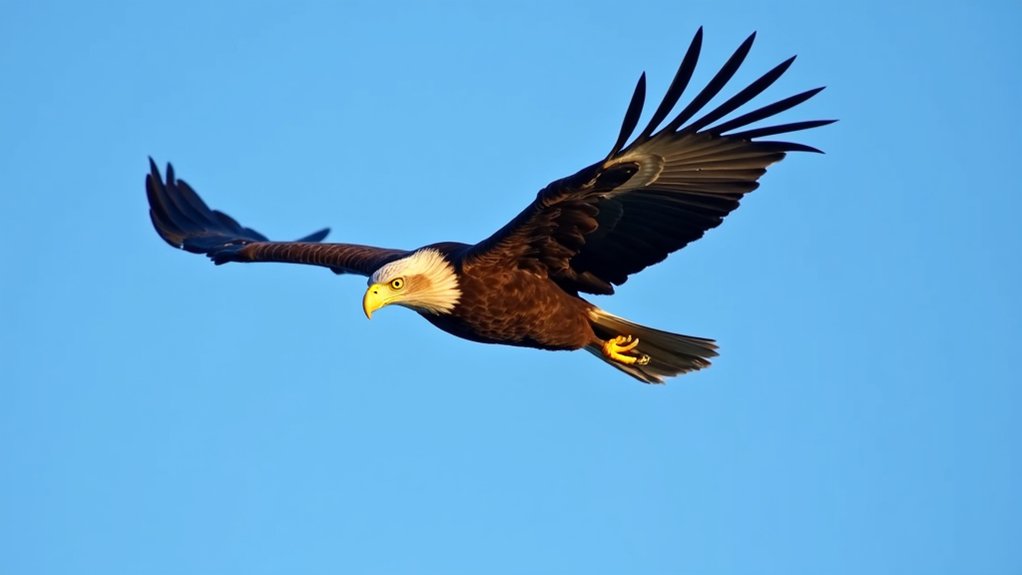
When you observe these raptors side by side, you’ll notice that bald eagles display more extensive white plumage across their bodies, heads, and tails at all ages.
Golden eagles, on the other hand, have generally darker feathers on their breasts and bellies.
To accurately differentiate golden eagles from bald eagles, focus on these key features:
- Golden eagle leg feathers extend fully to the ankles; bald eagle feathers end halfway up the legs.
- Bald eagles have large, yellow, blocky bills; golden eagles feature smaller, black, hawk-like bills.
- Adult bald eagles show distinct white heads and tails; golden eagles possess brown heads and dark tails.
- Juvenile bald eagles exhibit mottled white patterns; juvenile golden eagles display solid white patches under wings.
- Golden eagle tail bases include white sections with broad black terminal bands, absent in bald eagles.
Additionally, golden eagles prefer open, rugged terrains with good nesting sites on cliffs, whereas bald eagles typically build nests in tall trees near bodies of water, highlighting their different habitat preferences.
These traits offer reliable, observable distinctions in the field.
Recognizing the Golden Nape and Head Sheen
If you focus your observation just below the crown of a golden eagle’s head, you’ll notice the distinctive golden nape that sets this species apart.
This ornate patch of feathers extends from the rear of the crown down to the shoulders, covering the back and sides of the neck. Its coloration ranges from straw yellow to whitish bronze, with predominant golden-brown hues contrasting sharply against the darker body plumage.
Both adults and juveniles display this feature, though juveniles show a less vivid sheen that brightens with maturity.
Using binoculars or a scope, you can detect the golden-brown feather quality and sheen that reliably identify the species.
The relatively small head and golden nape combination also distinguishes golden eagles from other large raptors, especially bald eagles. Additionally, golden eagles appear to have smaller heads compared to the bulky heads of bald eagles, aiding in their identification.
Observing Wing and Tail Patterns
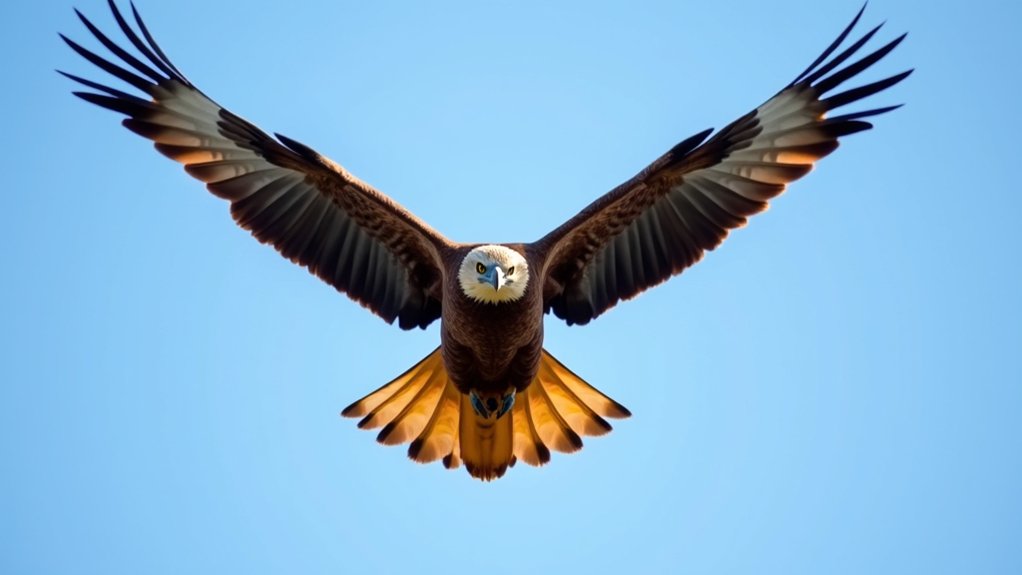
Wing and tail patterns provide essential clues for identifying and aging golden eagles. When you observe a juvenile, note the white base on the tail contrasting with a dark tip, though the white extent varies. The tail extends beyond the wing-tips when the bird is perched, which is a distinctive identification feature.
Adults display brown tails with 2-3 pale, wavy bars.
Wing markings also shift: immature birds show distinct white patches under the wings, especially on inner secondaries and tail feathers, forming solid patches rather than speckles.
Key features to examine include:
Key features to examine include tail base color, wing patches, and flight feather patterns for accurate eagle identification.
- White tail base with dark marginal band in juveniles
- Brown tail with pale wavy bars in adults
- White patches on inner wing feathers in immatures
- Serrated rear edge of flight feathers
- Splayed, finger-like primary tips in flight
These patterns help you reliably age and identify golden eagles in the wild.
The Significance of Leg and Cere Color
You’ll notice that golden eagles have bright yellow legs and a vividly yellow cere. These colors really pop against their darker feathers.
This sharp contrast is super helpful because it makes it easier to tell them apart from other raptors.
For example, bald eagles have bare, pale legs, which look quite different.
Additionally, golden eagles have leg feathers extending all the way to their ankles, unlike bald eagles whose feathers stop halfway up the leg.
So, by paying close attention to these color features, you can get much better at identifying golden eagles when you’re out in the field.
It’s a small detail that makes a big difference!
Bright Yellow Legs
Bright yellow legs serve as a distinctive and highly visible trait that helps you identify Golden Eagles even from considerable distances. The bright yellow feet sharply contrast their dark brown feathered legs and body plumage, making them a reliable field mark.
You’ll notice adult Golden Eagles display a brighter yellow tone than juveniles, whose legs appear duller. This color intensifies with age, aiding age classification in the field.
Key identification features include:
- Bright yellow coloration on feet visible from moderate distances
- Muscular, unfeathered tarsi supporting agile movement
- Strong black curved claws optimized for gripping prey, which are a critical part of their varied diet
- Uniform yellow legs distinguishing them from other brown raptors
- Yellow legs as a primary marker during flight silhouette assessments
Observing these traits increases your accuracy in confirming Golden Eagle sightings.
Yellow Cere Importance
The yellow cere, the fleshy area covering the nostrils, plays an essential role in identifying Golden Eagles in the field. Its bright yellow coloration, consistent across seasons and years in adults, clearly distinguishes this species from many North American raptors.
Paired with a black beak, the cere forms a distinctive facial pattern visible even at moderate distances through binoculars. As you observe, notice that cere brightness intensifies as eagles mature, reaching full vibrancy near four years of age.
This feature also helps differentiate Golden Eagles from juvenile Bald Eagles, which lack a distinct cere.
Moreover, the intensity of yellow in bare parts like the cere and legs can indicate the bird’s nutritional health, offering valuable insight into its condition during your field observations.
Contrast With Other Raptors
Although leg and cere coloration might seem subtle, these features provide critical clues when distinguishing Golden Eagles from other raptors, especially Bald Eagles.
You can observe the Golden Eagle’s legs fully feathered down to the feet, unlike the Bald Eagle’s bare lower tarsi. Their cere, the fleshy area above the beak, is consistently yellow and contrasts with other raptors.
Key distinguishing traits include:
- Golden Eagles have feathered legs extending to toes; Bald Eagles’ legs are partly bare
- Golden Eagles show a bright yellow cere; Bald Eagles’ cere can be paler or duller
- Legs and cere coloration remain stable across ages in Golden Eagles
- These features, combined with plumage and tail patterns, aid identification
- Observing these traits in direct light improves accuracy in the field
Additionally, the feathered legs of Golden Eagles are a distinctive feature that contrasts sharply with the bare legs of immature Bald Eagles, helping to avoid misidentification especially in overlapping ranges.
Notable Bill and Nostrils Characteristics
When identifying a Golden Eagle, you’ll notice that its bill presents distinctive features critical for differentiation from similar raptors.
Adult Golden Eagles display a black or horn-colored bill with grey tones, providing a stark contrast to their golden nape feathers. This dark pigmentation sets them apart from Bald Eagles, which have bright yellow bills.
Adult Golden Eagles feature dark bills contrasting sharply with their golden napes, unlike the bright yellow bills of Bald Eagles.
The bill is slightly smaller and narrower relative to head size, maintaining a consistent proportion across ages. Immature birds reveal yellow bills with dusky patches that darken as they mature.
The horn-like texture of the adult bill supports their raptor feeding mechanics. Furthermore, the nostrils are positioned and shaped to complement the bill’s structure, aiding in species identification during close observation or flight silhouette analysis.
Changes in Plumage With Age
Understanding the bill and nostril characteristics helps set a foundation for identifying age-related changes in a Golden Eagle’s plumage. As the eagle matures from juvenile to adult, its feathers undergo distinct transformations.
You’ll observe a progressive darkening and pattern shift, especially in the tail and body feathers.
Key age-related plumage changes include:
Juveniles: uniform feathers, white tail base with dark tip
Early immatures (2-3 years): partial molt, golden crown feathers, reduced white tail base
Mid immatures (3.5-4.5 years): mixed juvenile and adult tail patterns, dark center tail feathers emerge
Late immatures (4.5-5 years): mostly dark tail with bicolored outer feathers, body shows four-generation feather mix
Adults (5+ years): fully dark tail, elongated golden neck feathers, consistent dark brown body coloration
These changes help you estimate the eagle’s age accurately in the field. It is important to note that golden eagles have 12 tail feathers replaced from the center outwards, which influences the tail patterns seen during maturation.
Using Flight Behavior for Identification
Because flight behavior reveals key identification cues, observing a Golden Eagle’s wing position and soaring style can greatly aid in distinguishing it from other raptors. You’ll notice the wings held in a slight dihedral or shallow “V” shape, unlike the flat-winged Bald Eagle.
Their long, broad primaries with finger-like tips and pale leading edges are distinctive. Golden Eagles soar effortlessly for hours using thermals, maintaining speeds around 28-32 mph, with slow, powerful wingbeats. Research on Eastern North American golden eagles, which began in the mid-1990s, has greatly expanded our understanding of their flight and migration patterns, highlighting their use of thermals and updrafts during long flights Eastern golden eagle research.
Their hunting flights feature rapid plunges reaching up to 200 mph and tight turns resembling Red-Tailed Hawks.
| Flight Aspect | Observation | Comparison |
|---|---|---|
| Wing Shape | Slight “V” dihedral | Bald Eagle flat wings |
| Soaring Speed | 28-32 mph sustained | Other raptors vary |
| Wingbeat Style | Slow, powerful wingbeats | Faster in smaller raptors |
| Hunting Plunge Speed | Up to 200 mph | Comparable to Peregrines |
| Flight Pattern | Uses thermals and updrafts | Efficient migration flight |
Frequently Asked Question
What Habitats Do Golden Eagles Prefer in the Wild?
You’ll find golden eagles favoring open grasslands, semi-open areas, and rugged terrain with 10-40% shrub cover, which supports their prey.
They prefer cliffs or steep escarpments for nesting but will use large cottonwoods if cliffs aren’t available.
You’ll see them in high- and mid-elevation pine forests, piñon-juniper woodlands during winter, and riparian zones in seasonal movements.
They avoid dense forests and urban areas, seeking exposed, native vegetation landscapes for hunting.
What Is the Typical Diet of a Golden Eagle?
You’ll find golden eagles primarily hunting mammals like black-tailed jackrabbits and hares, which make up over 75% of their diet.
When mammal populations drop, they shift to birds such as waterfowl and grouse, hunting them with aerial tactics.
They also pursue reptiles like rattlesnakes and tortoises, and scavenging carrion, particularly ungulate carcasses, supplements their nutrition.
Their diet adapts based on prey availability and habitat conditions.
How Do Golden Eagles Hunt and Capture Prey?
You’ll witness golden eagles soaring silently, skillfully selecting hunting strategies.
They strike from soaring heights, stooping vertically to snatch birds mid-flight, or glide low for ground prey like rabbits.
Often, they contour fly close to cover, then swiftly swoop.
Success depends on sharp sight and speed, with solo hunts proving more fruitful.
They adapt tactics to terrain and prey, timing attacks with thermals and light, showcasing supreme aerial agility.
What Are the Nesting Habits of Golden Eagles?
You’ll find golden eagles nesting primarily on cliff ledges or in tall trees, like Douglas firs, to avoid predators.
They build massive nests from branches, sticks, and local vegetation, adding materials yearly.
Both sexes gather materials and share incubation duties over 41-45 days.
Nests are reused alternately every few years across multiple sites within a territory, spaced kilometers apart.
The breeding cycle, including fledging, extends up to 12 months depending on location.
Are Golden Eagles Territorial or Migratory Birds?
You’ll find that golden eagles are both territorial and migratory, depending on their location and age.
Adults often defend large territories aggressively, especially during breeding.
Many migrate long distances from northern Alaska to the southwestern U.S., but others stay put year-round, like island populations.
Juveniles wander widely before settling.
Conclusion
When spotting a golden eagle, keep in mind its wingspan can reach up to 7.5 feet, making it one of the largest raptors in North America. This impressive size, combined with its dark brown plumage and distinctive golden nape, helps you distinguish it from similar species.
By observing subtle details like leg color and flight behavior, you’ll sharpen your identification skills and better appreciate the complexity of this magnificent bird in its natural habitat.