
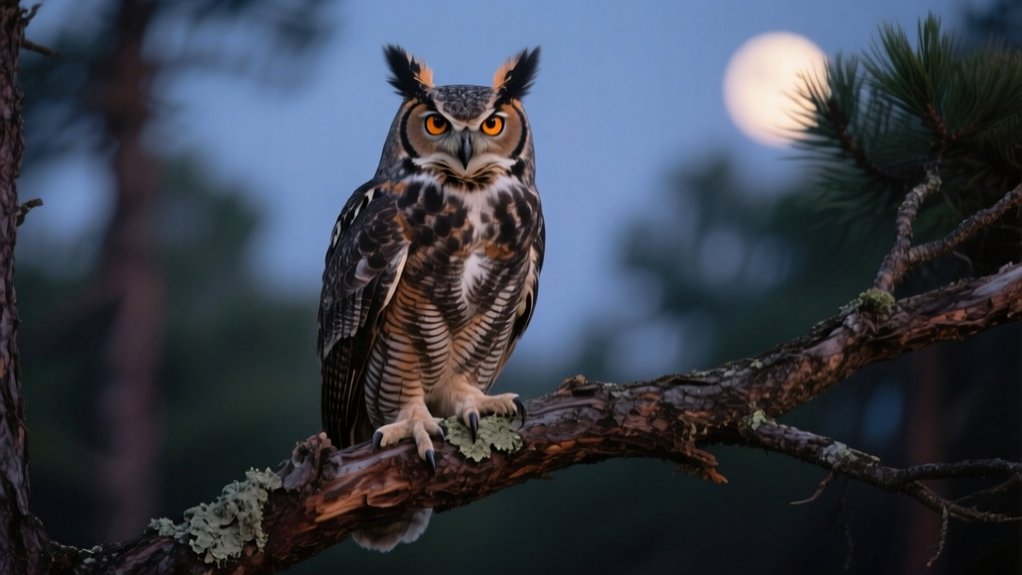
When observing great horned owls in the wild, you’ll notice their large yellow eyes aiding exceptional night vision and their silent flight enabled by specialized feathers. You can hear their deep hooting calls, especially in winter, which mark territory and attract mates.
Watch for nesting in tall trees or reclaimed hawk nests, where both parents fiercely care for young. Understanding their hunting strategies and vocal behaviors reveals much about their nocturnal lifestyle and ecological role.
Uncover more about their unique adaptations and conservation.
Physical Characteristics of the Great Horned Owl
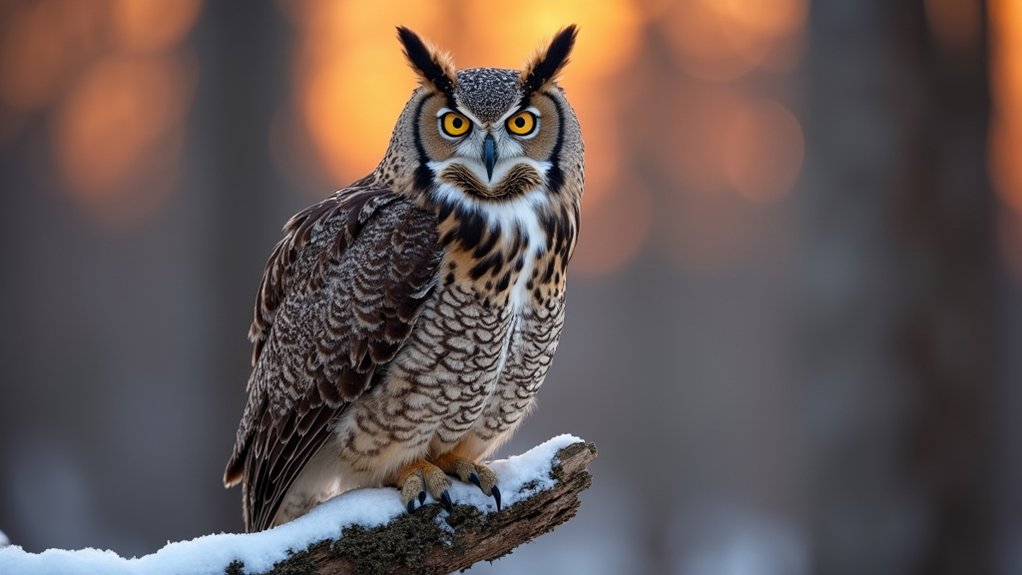
The Great Horned Owl displays several distinctive physical traits that contribute to its effectiveness as a nocturnal predator. You’ll notice its large yellow eyes, equipped with pupils that open widely in darkness, allowing exceptional night vision.
Distinctive feathered ear tufts, which can be raised or lowered, give the Great Horned Owl a unique appearance. Its plumage varies in shades of black, brown, gray, orange, reddish brown, yellow, and red, providing camouflage within diverse environments.
Measuring between 18 to 24 inches in length, with a wingspan of 3 feet 4 inches to 4 feet 9 inches, it ranks among the larger owl species.
Moreover, its exceptionally soft feathers enable silent flight, enhancing stealth during nocturnal hunting.
These traits collectively optimize the Great Horned Owl’s predatory efficiency.
Habitat Preferences and Range
You’ll find Great Horned Owls across a pretty wide area—from southern Canada, through the United States, and into parts of Mexico and South America.
They like wooded areas that have big trees, which makes sense since they often use abandoned nests from hawks or crows to raise their young.
Usually, these owls stick to their established territories all year long.
But, every now and then, some may move around a bit locally when fall and winter come around.
Preferred Nesting Locations
Although Great Horned Owls adapt to a wide range of habitats across North and South America, they prefer nesting in large trees where they can take advantage of abandoned nests from birds like hawks and crows.
You’ll find their preferred nesting locations typically high and secure, which reduces predation risks and exposure to environmental threats.
These owls begin nesting early, often laying 2 to 5 eggs as soon as January in northern regions. The female incubates the clutch for 28 to 35 days, ensuring ideal development.
While their nesting range spans diverse environments including forests, deserts, and urban areas, the consistent factor in their preferred nesting locations remains access to sturdy, raised sites that offer protection and stability for rearing offspring.
Geographic Range Overview
Great Horned Owls inhabit over 5 million square kilometers across North and South America, showcasing remarkable adaptability to diverse environments.
You’ll find the Great Horned Owl’s range extending from Arctic regions in the north to southern South America. They occupy habitats including forests, woodlands, deserts, and even urban areas.
When observing their habitat preferences, note that they favor wooded areas with large trees for roosting and often reuse abandoned nests of hawks or crows for nesting.
This adaptability allows the Great Horned Owl’s population, estimated at 5.7 million, to remain stable across a wide geographic range.
Though generally non-migratory, some individuals may explore seasonally, but this behavior doesn’t affect their broad distribution.
Seasonal Movement Patterns
Understanding the seasonal movement patterns of the Great Horned Owl provides insight into how this species interacts with its environment throughout the year.
Unlike many birds, Great Horned Owls don’t engage in regular seasonal migrations. Instead, their movements are characterized by individual exploration, primarily in fall and winter.
You’ll notice they prefer habitats featuring large trees and abandoned nests for roosting.
Key aspects include:
- Non-migratory behavior with localized exploration rather than defined seasonal migrations.
- Preference for wooded areas with large trees for shelter and nesting.
- Range spanning North and South America, adapting to diverse habitats like forests and deserts.
- Seasonal shifts influencing hunting patterns and prey availability, affecting local habitat use.
This knowledge helps you understand their dynamic habitat preferences year-round.
Nocturnal Hunting Techniques
You know, the Great Horned Owl is pretty amazing when it comes to hunting at night. It has these soft feathers that help it fly almost silently, so it can sneak up on its prey without making a sound.
Plus, its night vision is top-notch, letting it see clearly even in the dark.
But that’s not all—this owl also has incredible hearing. It can pick up the slightest rustle or movement, which helps it zero in on its prey even when it’s really dark out.
When you put all these traits together, you start to see just how efficient the Great Horned Owl is at hunting during the night. It’s like nature’s perfect nocturnal predator.
Silent Flight Adaptations
Silent Flight Adaptations
Although many nocturnal predators rely on stealth, Great Horned Owls have evolved specialized feathers that enable near-silent flight. This allows them to approach prey without detection.
Their silent flight adaptations include:
- Soft, fringed feathers that minimize aerodynamic noise during wingbeats.
- A broad wingspan facilitating smooth, gliding flight through dense foliage.
- Facial disc feathers configured to channel sound waves to their ears, enhancing prey localization.
- A perch-and-pounce hunting strategy that uses silent observation followed by rapid, quiet descent.
These features collectively optimize the owl’s ability to hunt efficiently at night by reducing auditory cues that prey might detect.
Understanding these silent flight adaptations helps you appreciate how Great Horned Owls maintain their role as apex nocturnal predators through specialized morphological and behavioral traits.
Night Vision Capabilities
A Great Horned Owl’s night vision plays a critical role in its effectiveness as a nocturnal hunter. You’ll notice their retinas are rich in rod cells, enabling superior vision in low-light conditions. Their pupils dilate widely in darkness, improving movement detection. Combined with silent flight and acute hearing, these adaptations make their hunting strategy highly efficient.
| Feature | Function |
|---|---|
| Rod Cell Abundance | Improved low-light vision |
| Pupil Dilation | Increased light intake |
| Facial Disc Feathers | Direct sound to ears for hearing |
This night vision, coupled with their perch-and-pounce technique, lets them hunt large prey like rabbits and other raptors under minimal light without detection. Like many nocturnal birds, Great Horned Owls have immobile eyeballs, which means they rely on flexible neck movements to scan their environment while maintaining the stability and precision needed for hunting at night.
Prey Detection Methods
Exceptional night vision sets the stage for Great Horned Owls’ advanced prey detection methods during nocturnal hunts.
You’ll notice their facial disc feathers play an essential role in funneling sound waves to their asymmetrical ears, enhancing auditory precision.
Their hunting strategy relies on these key techniques:
- Utilizing facial disc feathers to amplify subtle prey noises in darkness.
- Employing large, rod-rich eyes to detect minimal light and movement.
- Perching silently before launching a swift, silent attack enabled by specialized feathers.
- Detecting prey motion at significant distances, ensuring accurate strikes.
Vocalizations and Communication
When you listen closely in wooded areas during winter, you’ll notice the Great Horned Owl‘s distinctive series of low, sonorous hoots, often described as “hoo, hoo-hoo, hoo, hoo.”
These vocalizations play a critical role in communication, especially during the mating season. They help establish territory and attract mates. The call pattern is simple yet effective, carrying over long distances to signal presence and deter rivals.
Both males and females engage in hooting, though males produce deeper tones, which helps in identifying individuals. Vocalizations also maintain social bonds and coordinate breeding activities, ensuring reproductive success. Additionally, the Great Horned Owl’s hoots are essential for defending territory, reducing the need for physical confrontation and helping these birds mark their boundaries at night.
Nesting Habits and Reproductive Behavior
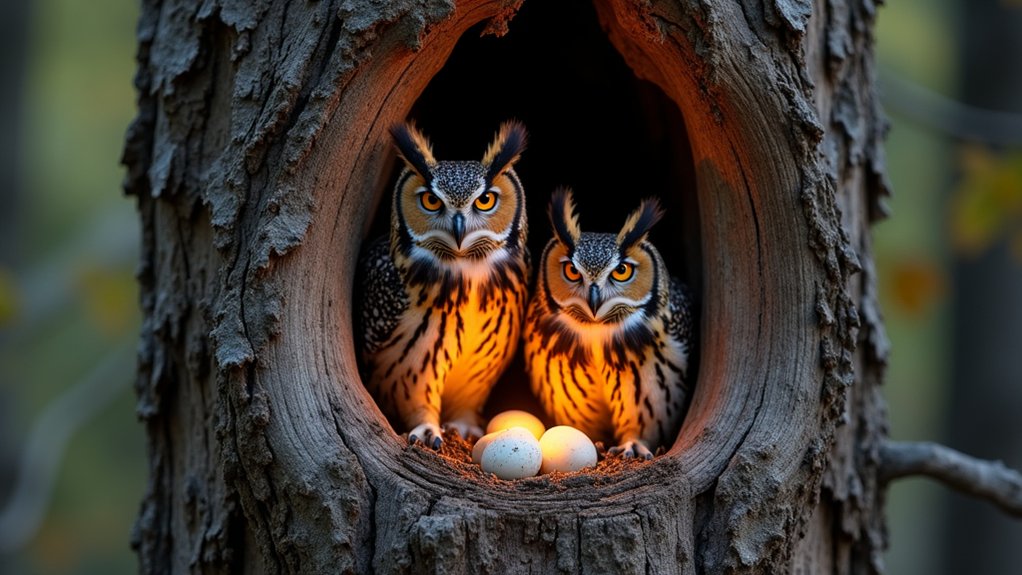
The deep hooting calls of Great Horned Owls not only communicate territory and mating readiness but also signal the start of their breeding season.
Great Horned Owls’ deep hoots mark territory, attract mates, and herald the breeding season’s arrival.
When you observe their nesting habits and reproductive behavior, note these key aspects:
- Nesting starts as early as January in northern regions, with females laying 2-3 eggs.
- Nests are commonly located in tall trees or cliffs, often reusing abandoned nests of hawks or crows.
- Nests are lined with soft materials to guarantee insulation and comfort for eggs and chicks.
- Eggs undergo an incubation period of 28-35 days before hatching.
Understanding these nesting habits helps you appreciate the species’ reproductive strategies and their adaptation to diverse habitats during the breeding season.
Parental Care and Fledgling Development
You’ll notice that Great Horned Owl parents are really attentive when it comes to their eggs. The female mainly takes charge, incubating their clutch of 1 to 5 eggs for almost a month.
But it’s not just the female involved—both mom and dad pitch in after the eggs hatch. They actively feed and protect their young owlets.
The little ones fledge, or leave the nest, at about five weeks old. Even then, they’re not quite independent yet and will rely on their parents for several more months.
Nesting and Incubation
Great Horned Owls typically lay between one and five eggs, with two to three being most common. The female incubates them for 28 to 35 days.
Nesting usually occurs in abandoned nests of large birds, which can be found in various habitats from forests to urban areas.
During incubation and early development, you’ll observe that the female consistently incubates the eggs, keeping them at the ideal temperature. Both parents prepare for feeding duties after the eggs hatch.
Nesting sites are carefully selected for safety and proximity to hunting grounds. The incubation period ensures synchronized hatching, which helps with efficient parental care.
This nesting strategy supports the survival and growth of fledglings. It lets you see the careful balance between habitat selection and parental investment that’s essential to Great Horned Owl reproductive success.
Feeding and Protection
After the incubation period concludes and the eggs hatch, parental roles shift toward feeding and protecting the developing fledglings. Both Great Horned Owl parents actively participate in feeding, with the male primarily hunting and the female ensuring the young receive nourishment.
Fledglings may leave the nest as early as five weeks but continue relying on parental feeding and protection for several months. During this time, adults store uneaten prey to provide a food reserve, especially beneficial in scarce winter conditions.
This parental care is vital, as fledglings gradually develop hunting skills and learn to navigate their environment. By maintaining close proximity, you’ll observe the adults’ continued feeding efforts and protective behaviors essential for fledgling survival and successful progression to independence.
Fledgling Growth Stages
Although fledglings leave the nest at about five weeks, they remain dependent on their parents for food and protection for several months. During this period, you’ll observe several key growth stages:
- Fledglings develop flight capability by 9-10 weeks of age, enhancing mobility.
- Both parents actively feed fledglings a diet of small mammals and birds, vital for nutrition.
- Fledglings progressively acquire hunting skills through practice and parental guidance.
- Parental care gradually decreases as fledglings gain independence and survival proficiency.
You’ll notice that fledgling development involves a balance between dependency and increasing autonomy, essential to their shift into self-sufficient adults.
This staged progression guarantees fledglings maximize survival rates while acquiring important skills for independent life in the wild.
Signs of Relaxation and Stress in Owls
When you observe a Great Horned Owl, you can gauge its comfort level by noting specific physical and behavioral cues. Relaxed owls lower their ear tufts and maintain normal head feathers, often preening or sleeping undisturbed by your presence.
In contrast, stress manifests through wide eyes, rapid head movements, and a compressed body posture. These signs reflect hyper-alertness and readiness to flee. The “Go-Away Blink,” rapid blinking with constricted pupils, signals a desire to increase distance from perceived threats.
Comfortable owls may continue hunting despite observers, while those adopting concealment postures exhibit heightened stress.
Recognizing these signs allows you to interpret individual owl reactions accurately, ensuring your presence minimally impacts their natural behavior.
Ethical Practices for Observing Owls
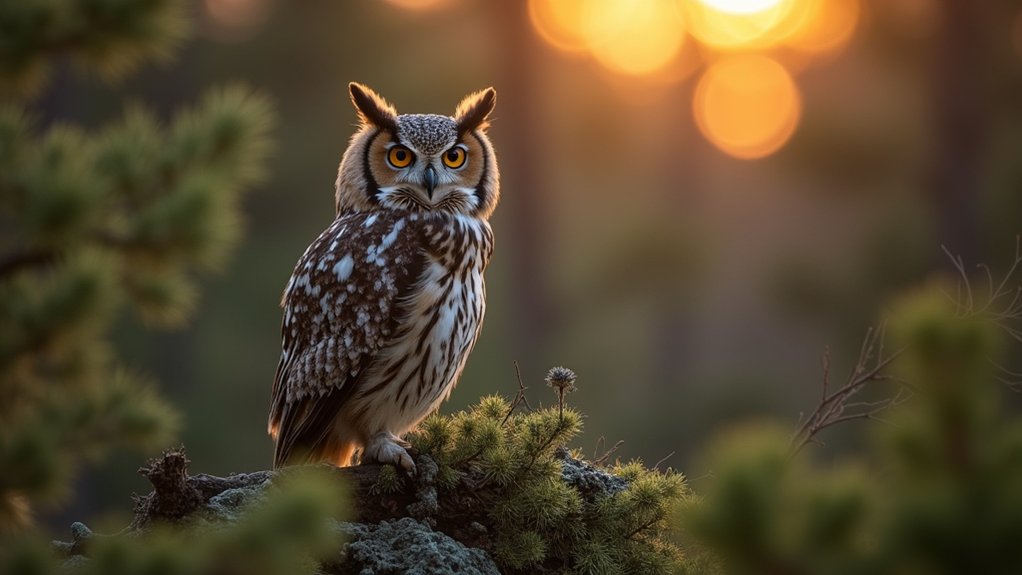
Understanding the signs of relaxation and stress in Great Horned Owls helps you minimize your impact during observation.
To adhere to ethical practices for observing owls, consider these guidelines:
- Maintain a respectful distance to prevent alarm and stress responses in the Great Horned Owl.
- Use long lenses for photography to avoid close proximity that could create negative human associations.
- Refrain from feeding the owl, as it disrupts natural hunting behaviors and induces dependency.
- Limit observation duration and avoid playback calls to reduce disturbance and potential aggression.
Impact of Human Activity on Owl Behavior
Human activity greatly influences Great Horned Owl behavior, often triggering stress responses that can disrupt their natural patterns. Their sensitivity to human activity is clear when they show wide eyes and rapid head movements upon close approach or loud noises.
Flash photography and artificial lights impair night vision, which hinders hunting and navigation. Observing owls from vehicles causes less stress than on-foot approaches. The presence of dogs induces flight or defensive behaviors because owls naturally fear canines.
Ethical practices like minimizing observation time and avoiding playback calls help reduce disturbances.
| Human Activity | Owl Response | Impact on Behavior |
|---|---|---|
| Close human approach | Wide eyes, rapid head turns | Stress, disrupted routines |
| Artificial lighting | Impaired night vision | Difficulty hunting |
| Dogs nearby | Flight or defense | Increased energy use, stress |
How to Identify Great Horned Owls Compared to Similar Species
How can you distinguish a Great Horned Owl from other similar species in North America? Focus on these key identification features:
- Ear tufts: The Great Horned Owl has distinctive “horns,” unlike the round-faced Great Gray and Barred Owls.
- Eye color: Its large yellow eyes are prominent, aiding night vision.
- Body size: Measuring 18–24 inches tall with a wingspan up to 4 feet 9 inches, it’s larger than the American Barn Owl.
- Markings: Look for a white throat patch and horizontal belly bars unique to the Great Horned Owl.
Both the Barred Owl and Great Grey Owl lack the Great Horned Owl’s ear tufts and can be identified by their facial disk shapes and differences in plumage patterns.
Unique Adaptations for Silent Flight
Beyond its distinctive physical features, the Great Horned Owl’s ability to fly silently plays an essential role in its hunting success. You can observe how feathers that direct sound minimize auditory detection. The serrated leading edges of their primary feathers break up airflow turbulence, while soft body feathers absorb sound.
Their large wingspan and lightweight skeleton improve quiet gliding and agile maneuvering. Together, these adaptations allow you to witness near-silent flight facilitating efficient nocturnal predation.
| Adaptation | Function |
|---|---|
| Serrated feather edges | Disrupt airflow, reduce noise |
| Soft body feathers | Absorb sound, improve stealth |
| Large wingspan | Enables quiet gliding |
| Lightweight skeleton | Supports agile, silent flight |
| Flexible wing joints | Facilitate silent maneuvering |
These features collectively optimize silent flight for stealth and hunting efficacy.
Role of Great Horned Owls in the Ecosystem
Although the Great Horned Owl occupies the top of the food chain, its role extends beyond predation to maintaining ecological balance. You’ll observe that its strong talons enable it to control populations of small mammals and larger prey alike, which is crucial for ecosystem stability.
Consider these points:
- It regulates prey populations, preventing overgrazing and supporting plant diversity.
- Its adaptability in hunting various species, including raptors and snakes, reflects its fundamental position in the food web.
- The owl’s presence indicates a healthy environment, requiring large territories and appropriate nesting sites.
- With an estimated population of 5.7 million, it considerably contributes to biodiversity and serves as an indicator of ecosystem health.
Understanding these roles highlights why Great Horned Owls are essential for ecological balance.
Conservation Status and Threats
Since the Great Horned Owl maintains a stable population estimated at 5.7 million and is classified as Least Concern by the IUCN, you might assume it faces minimal risks.
However, significant threats like climate change and habitat loss from urban development still jeopardize its long-term survival by disrupting its habitat and prey availability.
The conservation status reflects current stability, but ongoing habitat fragmentation and deforestation reduce suitable nesting and hunting areas.
Climate change further alters prey populations and ecosystem dynamics, posing additional challenges.
Historical data from the Christmas Bird Count confirm population stability, yet continuous monitoring is essential to detect emerging trends.
You can contribute to conservation efforts by participating in community science initiatives, which improve data collection and public awareness, thereby supporting the Great Horned Owl’s protection and habitat preservation.
Frequently Asked Question
What Time of Year Are Great Horned Owls Most Active for Observation?
You’ll find Great Horned Owls most active for observation during their breeding season, from late January through late spring.
During this time, they engage in nesting, hunting, and territorial behaviors, boosting their visibility.
Early summer also offers opportunities as young owls leave the nest but still interact with parents.
While they’re nocturnal, observing at dusk and dawn increases your chances.
Winter’s deep hoots signal territory but less activity, so focus on breeding months.
Can Great Horned Owls Recognize Individual Humans or Animals?
Great Horned Owls don’t just see you as a shadow in the night; they can recognize individual humans and animals. Their sharp vision and precise hearing let them distinguish familiar shapes and sounds, enabling nuanced responses.
You’ll notice they may act more relaxed around regular observers, showing habituation.
Though research isn’t conclusive, behavioral variations suggest they differentiate between familiar and unfamiliar beings, adjusting tolerance or aggression accordingly.
How Do Seasonal Changes Affect Great Horned Owl Behavior?
Seasonal changes directly influence your Great Horned Owl’s hunting patterns, nesting behavior, and territorial range.
In spring and summer, they hunt more at dawn and dusk, using dense foliage for stealth.
During colder months, you’ll notice them storing prey and exploring new territories due to scarce food.
Their nesting starts late winter to early spring, with females incubating eggs.
These adaptations help owls optimize survival throughout the year’s environmental shifts.
Do Great Horned Owls Migrate or Stay in One Area Year-Round?
Great Horned Owls generally stay in one area year-round rather than migrating. You’ll find that they defend stable territories throughout all seasons, adapting to their environment to secure food and nesting sites.
While they may roam locally during fall and winter, these movements aren’t long-distance migrations. Their populations remain stable across North America due to their ability to thrive in diverse habitats, including forests, grasslands, and urban areas.
What Equipment Is Best for Night-Time Owl Watching?
They say, “The eyes are the window to the soul,” and for night-time owl watching, you’ll need the right tools.
Use binoculars with at least 8x magnification and a wide field of view to spot owls in low light.
A camera with a fast lens (f/2.8 or lower) and high ISO lets you capture clear images.
Bring a red or green flashlight to avoid disturbing their night vision.
A spotting scope improves detail from a safe distance.
Conclusion
When observing great horned owls, you’ll quickly realize their remarkable adaptations make them masters of the night. Their silent flight and keen senses give them an edge in hunting, while their vocalizations reveal complex communication skills.
Understanding their role in ecosystems highlights why conserving their habitats is essential. As you watch, keep in mind that every piece of the puzzle counts. These owls are more than just feathered predators; they’re key players in maintaining ecological balance.