

You can identify Great Horned Owl predators by observing common threats like crows, raccoons, and occasionally larger raptors such as Red-tailed Hawks, especially near nesting sites during vulnerable seasons. Look for signs like scattered feathers, tracks, claw marks, or droppings around nests.
Pay attention to aggressive territorial behaviors and seasonal variations in predator activity. Understanding these indicators helps assess owl vulnerability and predator presence. Exploring these details further reveals how owls defend themselves and how conservation efforts target these challenges.
Common Predators of Great Horned Owls

When examining common predators of Great Horned Owls, it’s important to recognize that adult owls face few natural threats due to their size and aggression.
Predators of adult Great Horned Owls are primarily other Great Horned Owls, especially during territorial disputes.
Larger raptors occasionally pose a threat but are rare adversaries.
However, the vulnerability of Great Horned Owls increases during nesting. Eggs and nestlings are frequently targeted by opportunistic predators such as crows and raccoons, which raid nests to access offspring.
Because of this, the selection of secure nesting sites is critical for Great Horned Owls to minimize predation risks.
Predator Behavior and Hunting Tactics
To figure out which animals prey on great horned owls, you’ve got to look closely at how these predators hunt and how they go up against the owls.
It’s all about watching when they strike, how quietly they move, and the ways they launch their attacks to get past the owl’s defenses.
Once you get a handle on these behaviors, it becomes easier to pinpoint which species are actually a real threat to the owls.
Hunting Strategies Overview
Although great horned owls hunt primarily under the cover of darkness, their success hinges on a combination of acute sensory abilities and specialized adaptations.
The Great Horned Owl’s hunting strategy optimizes stealth and precision, allowing it to dominate nocturnal environments.
You can break down their approach into three key tactics:
- Silent Flight: Their unique wing structure minimizes noise, enabling them to approach prey undetected.
- Sensory Acuity: Exceptional hearing and the ability to swivel their heads over 180 degrees provide thorough spatial awareness.
- Aggressive Predation: They target a broad range of animals, including larger predators, using power and adaptability.
Understanding these strategies provides insight into how the Great Horned Owl’s predatory efficiency shapes its role in the ecosystem.
Predator Interaction Dynamics
Since Great Horned Owls face limited predation threats as adults, their interactions with other species primarily revolve around territorial defense and competition for resources.
You’ll observe that their predator interaction dynamics involve aggressive behaviors to secure nesting sites, often chasing away intruders, including rival Great Horned Owls and other raptors like Red-tailed Hawks.
These disputes highlight the competitive nature of resource acquisition in overlapping habitats.
In hunting tactics, the Great Horned Owl’s exceptional night vision and acute hearing allow you to understand how they ambush prey with stealth and precision.
Furthermore, their strategy to store uneaten prey during winter reduces direct competition with other predators.
Understanding these predator interaction dynamics provides insight into their role as both dominant predator and competitor within their ecological niche.
Identifying Signs of Predator Presence
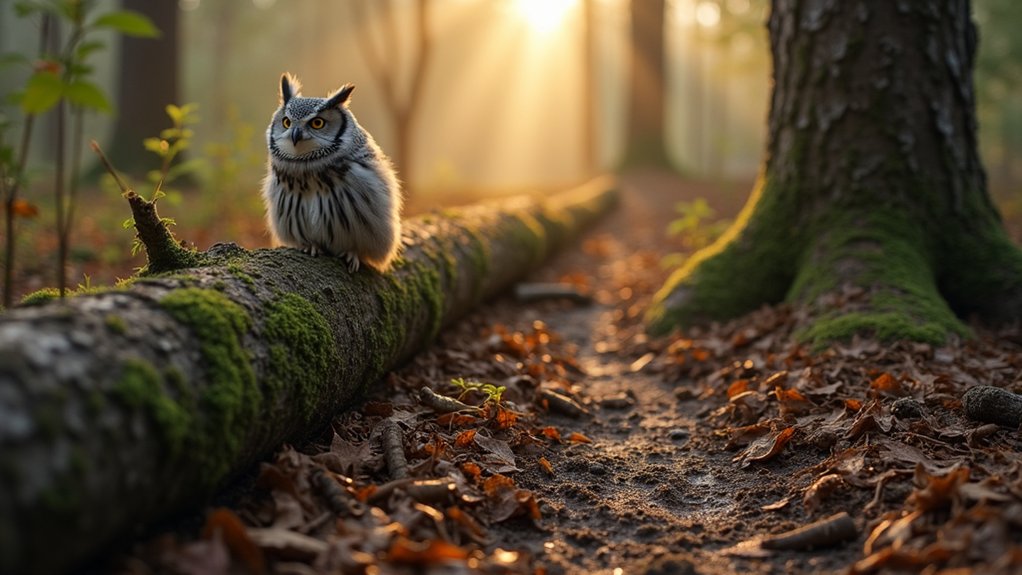
Keep an eye out for signs of disturbance around Great Horned Owl nesting sites, as these can reveal the presence of predators.
To identify predator activity, focus on the following key indicators:
- Physical Evidence: Look for feathers, prey remnants, or damaged nesting materials. These may signal predator visits by crows or raccoons.
- Tracks and Droppings: Examine the area for distinctive raccoon tracks and scat. These indicate potential threats to eggs and nestlings.
- Behavioral Cues: Observe aggressive mobbing behavior from crows or alarm calls from nearby birds. These often highlight predator presence.
Nest Predators Targeting Eggs and Young
Detecting signs of predator activity around Great Horned Owl nests often leads to identifying specific threats targeting eggs and young owls.
Nest predators such as crows use their intelligence and social behavior to steal eggs and nestlings.
Raccoons, which are skilled climbers, also pose significant risks by accessing nests in trees to prey on eggs and fledglings.
Since Great Horned Owls often occupy abandoned nests of squirrels, hawks, or crows, these structures are especially vulnerable to intrusion.
The eggs, numbering one to five and incubated for 28-35 days, face heightened predation risk, especially early in incubation.
Also, downy young owls remain susceptible to nest predators including larger raptors and mammals until they become independent at six to nine weeks after hatching.
Understanding these nest predators is critical for accurate identification and conservation efforts.
Adult Great Horned Owl Threats
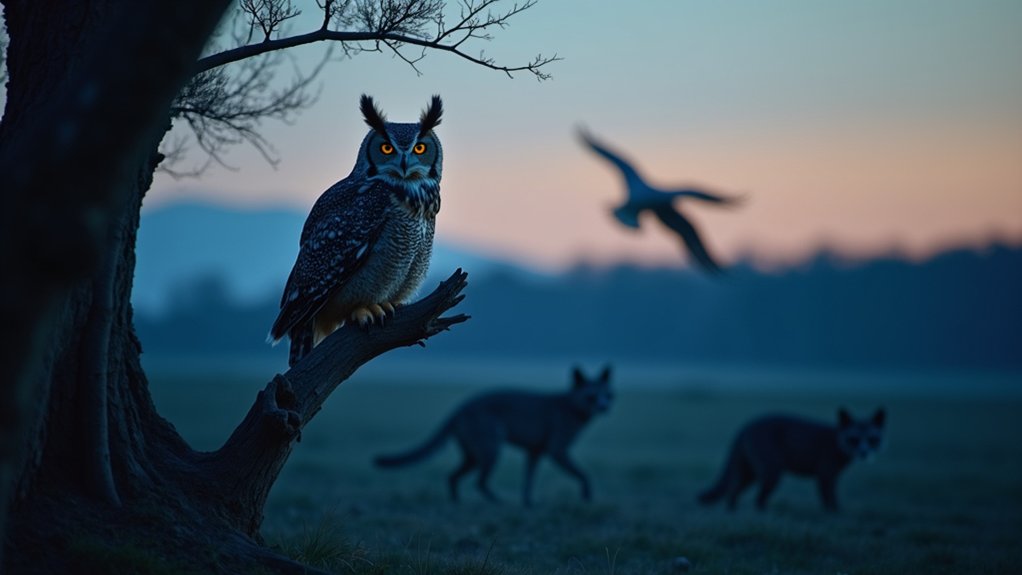
Although adult Great Horned Owls face few natural predators, they can encounter threats from conspecifics during territorial disputes and from other aggressive species like crows and larger raptors.
Despite their large size, adult Great Horned owls must remain vigilant.
Key adult great horned owl threats include:
- Territorial conflicts: Other Great Horned Owls may engage in aggressive encounters to defend or expand territory.
- Inter-species competition: Larger raptors such as Red-tailed Hawks sometimes challenge Great Horned Owls for habitat dominance.
- Harassment by crows: Though not direct predators, crows mob owls to protect their nests, causing stress and distraction.
These threats highlight the importance of behavioral similarities among birds and other avian predators, as both use social strategies to defend territory and resources.
Role of Crows in Predator Dynamics
You’ll notice that crows often team up to mob Great Horned Owls.
They work together to disrupt the owls’ hunting activities. This kind of coordinated harassment is basically a way for the crows to keep predators at bay.
It forces the owls to spend energy defending themselves instead of hunting for food.
When you think about it, this interaction really shows how much crows can affect an owl’s ability to hunt and successfully raise their young.
Crow Mobbing Behavior
When crows perceive a Great Horned Owl as a threat, they often engage in mobbing behavior to protect their territory and offspring. This coordinated harassment involves multiple crows working together to distract and intimidate the owl, especially when nests or young are at risk.
You’ll notice that crows persistently mob the owl for hours, showcasing their resilience. They use social cooperation to increase mobbing effectiveness.
The owl typically responds by staying still, relying on camouflage to avoid detection.
Understanding crow mobbing behavior is essential to identifying predator-prey dynamics. It shows how crows actively defend against Great Horned Owls through strategic, collective actions rather than passive avoidance.
Interestingly, similar to how host birds develop behaviors to recognize and repel brood parasites, crows use mobbing as an active defense strategy to protect their nests from owl predation.
Predator Deterrence Strategies
Crows’ persistent mobbing of Great Horned Owls exemplifies a sophisticated predator deterrence strategy rooted in social cooperation and intelligence.
You’ll observe that crows coordinate group tactics to harass and distract owls, effectively reducing predation risks on their young.
This collective behavior utilizes their social structure, enabling crows to intimidate larger predators despite individual size disadvantages.
By persistently disturbing owls, crows often force nest abandonment, directly impacting owl reproductive success.
These predator deterrence strategies highlight crows’ dual role as both competitors and potential predators, given their occasional egg and nestling thefts.
Understanding how crows deploy intelligence-driven mobbing provides insight into complex predator-prey dynamics and the adaptive behaviors used by smaller avian species to mitigate threats from formidable raptors like Great Horned Owls.
Impact on Owl Hunting
Although Great Horned Owls are apex predators, their hunting efficiency can be greatly disrupted by persistent mobbing from crows. This behavior impacts the owls in several ways:
- Stress and Distraction: Continuous harassment increases stress levels in Great Horned Owls, impairing their focus and reducing hunting success.
- Territorial Disruption: Crows’ vocalizations reveal the owl’s location, compromising stealth and territorial control.
- Reproductive Threats: Attempts by crows to steal eggs and nestlings during nesting season add pressure on the owls’ reproductive efforts.
Crows possess complex communication systems that allow them to effectively coordinate mobbing behavior, making them particularly challenging adversaries for even the most skilled predators.
Understanding the role of crows in predator dynamics reveals the complex challenges Great Horned Owls face. This interaction emphasizes how even apex predators must navigate interspecies competition that directly affects their hunting and survival strategies.
Mammalian Predators in Great Horned Owl Habitats
Several mammalian predators inhabit the same environments as Great Horned Owls, posing significant risks to their eggs and young. Among these, raccoons and coyotes are primary mammalian predators known to raid nests, targeting eggs and nestlings.
Raccoons, with their dexterous paws and climbing ability, are especially adept at accessing nests. Foxes also present a threat to juvenile owls, particularly when they leave nest protection.
While adult Great Horned Owls face few natural mammalian predators, nocturnal activity overlap with these mammals increases vulnerability for offspring. Understanding the role of mammalian predators in these habitats is essential for evaluating Great Horned Owl reproductive success and survival rates.
Monitoring interactions between owls and these mammals can help identify predation pressures impacting population dynamics.
Predatory Birds Competing With Great Horned Owls
When you examine the ecosystem of Great Horned Owls, you’ll find that predatory birds such as Red-tailed Hawks and Bald Eagles actively compete with them for territory and prey.
These predatory birds competing with Great Horned Owls influence their behavior and survival.
Key aspects include:
- Territory Defense: Great Horned Owls assert dominance to protect hunting grounds from Red-tailed Hawks and Bald Eagles, reducing overlap in prey capture.
- Juvenile Vulnerability: Larger raptors, including conspecific Great Horned Owls, may prey on juveniles, intensifying intra- and interspecies competition.
- Behavioral Adaptations: Owls adjust hunting and nesting strategies to mitigate threats from competing raptors, ensuring resource access.
Understanding these dynamics helps you identify the pressures Great Horned Owls face from comparably sized raptors like the Red-tailed Hawk.
Habitat Overlap With Potential Predators
You’ll find that Great Horned Owls often share hunting grounds with various predators, which means there’s quite a bit of competition for food resources.
It’s not just about hunting; conflicts also pop up when owls and other species, like crows or hawks, nest in overlapping territories.
And when the seasons change, these territorial overlaps can get even more intense, shaking up the usual predator-prey balance.
Shared Hunting Grounds
Habitat overlap considerably influences the interactions between Great Horned Owls and their potential predators. Shared hunting grounds serve as critical zones where competition and predation risks manifest, affecting owl survival and reproductive success.
You should consider these key points regarding shared hunting grounds:
- Great Horned Owls inhabit diverse environments, including remote wilderness, rural, and urban areas. Here, they encounter species like crows and raccoons that often raid nests, threatening eggs and young.
- Overlapping territories with other raptors, such as Red-tailed Hawks, can trigger territorial conflicts. However, adult owls rarely fall prey due to their aggressive defenses.
- Owls assert dominance in shared hunting grounds via vocalizations and physical displays. They adapt their hunting strategies to mitigate competition while securing breeding territories effectively.
Understanding these dynamics helps you identify predator risks linked to habitat overlap.
Nesting Area Conflicts
Although Great Horned Owls exhibit strong territorial instincts, they frequently encounter conflicts over nesting areas with potential predators such as raccoons and crows.
These nesting area conflicts arise because Great Horned Owls often use abandoned nests of hawks and crows, creating competition in overlapping habitats.
Raccoons, skilled climbers, pose a significant threat by raiding nests for eggs and young owls, particularly in urban and suburban environments.
Furthermore, crows engage in mobbing behavior, harassing owls and sometimes forcing them to abandon nests.
Habitat overlap with other raptors, like Red-tailed Hawks, further intensifies territorial disputes, negatively affecting nesting success.
Understanding these nesting area conflicts helps you identify key predators and pressures impacting Great Horned Owl reproduction and territory stability.
Seasonal Territory Shifts
Seasonal Territory Shifts
When prey availability fluctuates with the seasons, Great Horned Owls often adjust their territorial boundaries. This can lead to increased overlap with other raptors such as Red-tailed Hawks. These seasonal territory shifts result from changes in prey populations and environmental factors.
Because of these changes, the owls expand or relocate their hunting and nesting areas.
You should note three key outcomes of these shifts:
- Increased encounters and competition with other predators over limited resources.
- Potential aggressive territorial behaviors, especially during nesting or hunting periods.
- Greater overlap in urban settings where diverse raptor populations coexist.
Understanding these seasonal territory shifts helps identify when and where Great Horned Owls might face predation risks or competition from similar-sized raptors.
Visual and Auditory Cues of Predator Activity
Visual cues include the presence of crows mobbing owls, signaling potential threats. You should also watch for raccoons near nests, as their distinctive calls often indicate attempts to access eggs or nestlings.
The heavy presence of Great Horned Owls generally deters smaller predators, but conspecifics can pose risks, especially to young.
Auditory cues involve noting the owls’ low-pitched hoots, which define territorial boundaries; an unusual silence may indicate nearby predators.
Furthermore, sudden flight or alarm calls from other birds serve as indirect auditory signs of predator presence.
You can also look for reflective tape or other visual deterrents in the area, as these are commonly used to discourage various bird species—including predators—from approaching sensitive nesting sites.
Seasonal Variations in Predator Threats
Since predator threats to Great Horned Owls fluctuate throughout the year, understanding seasonal variations is essential for evaluating risk levels.
You need to account for how changes in environment and behavior affect predator dynamics.
- Nesting Season (January-March): Increased risk from crows and raccoons targeting eggs and nestlings.
- Winter: Competition intensifies as Red-tailed Hawks encroach on territory, and prey scarcity drives aggressive encounters.
- Spring: Fledgling Great Horned Owls face vulnerability to larger predators, including conspecific adults during territorial disputes.
These seasonal shifts impact Great Horned Owls’ exposure to threats and influence their survival strategies.
Seasonal changes shape Great Horned Owls’ threat exposure and drive adaptive survival behaviors.
Monitoring these patterns helps you assess when and where Great Horned Owls are most at risk from predators, enabling more accurate identification and management of predator threats.
Defensive Behaviors of Great Horned Owls
Great Horned Owls employ a range of defensive behaviors to maintain dominance over their territory and deter potential predators. When you observe these owls, note their aggressive posturing, including talon displays and intense stare-downs aimed at intruders like Red-tailed Hawks.
They also use low-pitched hoots to mark territory vocally. In situations of mobbing by crows, Great Horned Owls often remain motionless, relying on their camouflage to avoid detection. Their powerful talons further bolster their defensive capabilities against smaller threats.
| Defensive Behavior | Description |
|---|---|
| Physical Confrontation | Talon display and stare-downs to intimidate |
| Vocalization | Low-pitched hoots to assert territorial claims |
| Camouflage | Remaining still to blend into surroundings |
Impact of Predators on Owl Population Health
Although adult owls face few natural predators, their population health is markedly influenced by predation pressures on eggs and nestlings, primarily from crows and raccoons. This predation impacts reproductive success and local population stability.
You should consider these key factors:
- Predation on eggs and nestlings reduces fledgling survival rates, potentially causing population declines.
- Territorial disputes among adult Great Horned Owls can lead to injury or death, influencing population dynamics.
- Urban adaptability allows owls to select safer nesting sites, mitigating predation effects.
Understanding these elements helps clarify how predation shapes population health. Maintaining balanced predator-prey relationships guarantees ecosystem stability, which indirectly supports Great Horned Owl populations.
You’ll see that managing predation pressures on young owls is critical for sustaining healthy populations over time.
Monitoring Nest Sites for Predator Evidence
When monitoring nest sites for predator evidence, you should systematically inspect for signs such as scattered feathers, tracks, and claw or bite marks that indicate the presence of species like raccoons or crows. Look for broken branches or droppings near nests, which suggest predator proximity.
Trail cameras can capture images of predators threatening Great Horned Owls, aiding identification. Examine for scavenged items like eggshells or nestling remnants to assess predation events.
| Evidence Type | Interpretation |
|---|---|
| Scattered Feathers | Possible nest disturbance by predators |
| Tracks | Identify species (e.g., raccoon) |
| Claw/Bite Marks | Indicate predator attack on nest |
| Droppings | Presence of predators near nest |
Reddish brown feathers may indicate specific predator activity or owl defense encounters.
Conservation Efforts to Protect Against Predators
Since predation poses a significant threat to owl populations, conservation efforts prioritize securing habitats that minimize exposure to nest raiders like raccoons and crows.
You can support these efforts by understanding key strategies:
- Habitat Preservation: Protecting and restoring natural nesting sites reduces predator access and guarantees safe breeding environments.
- Nest Box Programs: Installing secure artificial nests curtails predation during vulnerable nesting periods, boosting reproductive success.
- Community Science Initiatives: Participating in monitoring programs increases data accuracy on predator activity and owl population trends, informing adaptive management.
These targeted conservation efforts utilize ecological knowledge and public involvement to mitigate predation risks effectively.
Frequently Asked Question
What Time of Day Are Great Horned Owls Most Vulnerable to Predators?
You’ll find Great Horned Owls most vulnerable to predators during daylight hours when they’re resting and less alert.
Their nocturnal nature means they’re active at night, so daytime offers a window of increased risk.
Nestlings and eggs face heightened threats in early mornings, especially when adults are away hunting.
Understanding these temporal vulnerabilities helps you analyze predator-prey dynamics and the owls’ defensive strategies effectively.
How Do Weather Conditions Affect Predator Activity Around Owl Nests?
You’ll notice that weather conditions affect predator activity around owl nests by increasing foraging during cold, harsh weather, by decreasing visibility during heavy rain or snow, and by altering auditory cues in windy conditions.
You’ll find predators become more aggressive when temperatures drop. You’ll find their movements masked by environmental noise, and you’ll find prey fluctuations indirectly influence predator presence.
Understanding these patterns helps you predict nest vulnerability effectively.
Can Human Activity Influence the Presence of Great Horned Owl Predators?
Yes, human activity can influence the presence of Great Horned Owl predators. Urban development and habitat destruction reduce natural nesting sites, forcing owls into areas with higher predator densities like crows and raccoons.
Increased human presence also boosts competition with other raptors such as Red-tailed Hawks, affecting owl defense capabilities.
Furthermore, illegal trapping reduces owl populations, indirectly allowing predator numbers to rise due to decreased competition for resources.
Are There Specific Owl Calls That Attract or Deter Predators?
Yes, specific Great Horned Owl calls can deter predators by signaling territorial dominance through low-pitched hoots.
These calls warn potential threats of the owl’s presence, reducing predation risk.
Conversely, higher-pitched female calls during mating season might inadvertently attract attention but primarily function to communicate with mates and offspring.
Aggressive vocalizations may also provoke mobbing by smaller birds, indirectly deterring predators by increasing perceived risk in the area.
How Do Great Horned Owls Choose Nest Sites to Minimize Predator Risks?
You choose nest sites by prioritizing height and concealment to minimize predator risks. Great Horned Owls select raised locations like abandoned nests, cliff ledges, or hollow trees. These spots reduce accessibility to ground-based predators.
You also prefer wooded habitats that offer natural cover, enhancing camouflage.
Timing matters too. You start nesting early in the year to establish territory before many predators become active.
Plus, you fiercely defend your nest to protect your young.
Conclusion
You must recognize that great horned owls, though apex predators themselves, face silent shadows that threaten their survival. By identifying predator behavior and monitoring nest sites, you hold the key to revealing hidden dangers lurking in the wild.
Think of this vigilance as a protective shield, essential for maintaining owl population health. Your analytical approach fuels conservation efforts, ensuring these nocturnal sentinels continue to rule the night skies with resilience and strength.