
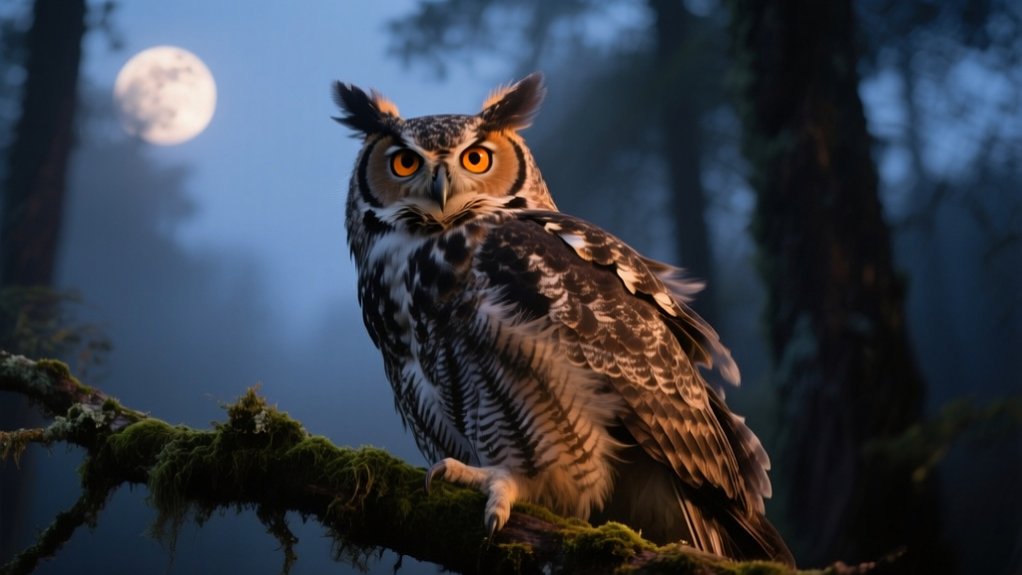
You’ll hear five key Great Horned Owl sounds that reveal their communication and behavior: deep stuttering hoots used for territory and pair bonding, sharp screams from adults defending nests, piercing cries from young begging for food, stress-induced bill snapping, and varied calls like whistles, barks, and hisses for alerting danger or signaling.
These distinctive sounds set Great Horned Owls apart from similar species. Investigate further to understand the nuances behind each call and their roles.
Key Takeaways
- Great Horned Owls produce deep, soft hoots with a stuttering rhythm: hoo-h’HOO-hoo-hoo.
- They use diverse calls like whistles, barks, shrieks, hisses, coos, and wavering cries for communication.
- Young owls emit piercing screams to beg for food, while adults use sharp screams to defend nests.
- Bill snapping is a stress or danger signal, creating a sharp clicking sound unique to this species.
- Breeding pairs duet by alternating hoots, strengthening pair bonds and marking territory during the season.
Songs
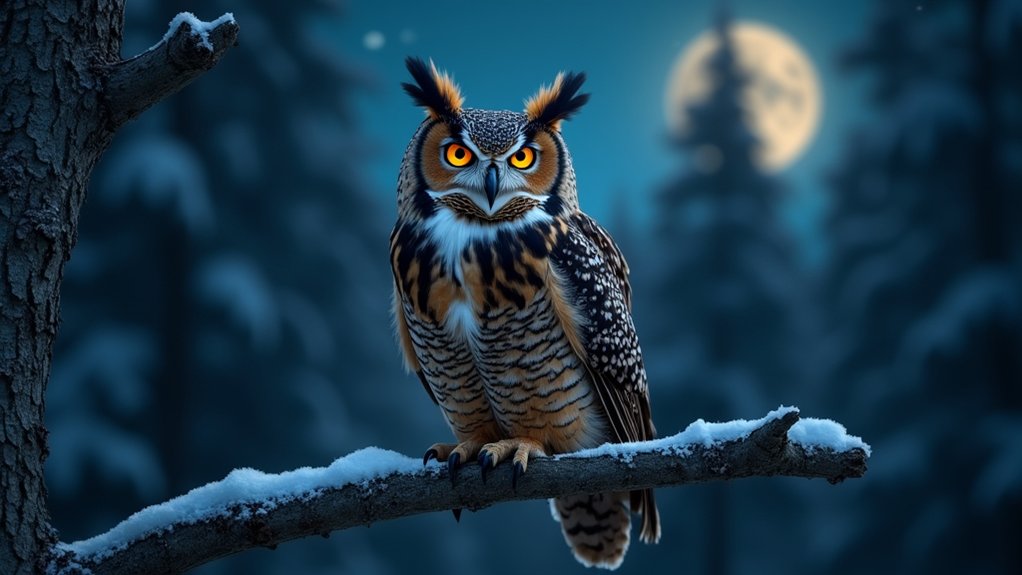
Although Great Horned Owls produce a variety of vocalizations, their songs primarily consist of deep, soft hoots with a distinctive stuttering rhythm: hoo-h’HOO-hoo-hoo.
Great Horned Owls sing with deep, soft hoots featuring a unique stuttering rhythm.
You’ll notice breeding pairs often engage in duets, alternating these hoots to improve communication. The female’s calls generally have a higher pitch than the male’s, creating clear vocal distinctions.
These songs are crucial for you to understand as they play a critical role in maintaining pair bonds and coordinating activities during the breeding season.
Furthermore, the deep hoots serve to advertise territories, signaling presence to rivals.
Calls
Great Horned Owls use a diverse range of calls beyond their well-known hoots, including whistles, barks, shrieks, hisses, coos, and wavering cries. These calls serve specific functions depending on the owl’s age and context.
For instance, young owls emit piercing screams to beg for food, signaling their need to parents. Adults may produce sharp screams to defend nests against potential threats, functioning as warning signals.
Moreover, some calls indicate distress or alert others to nearby predators. Understanding these vocalizations requires recognizing their situational use: feeding, defense, or alarm.
Other Sounds
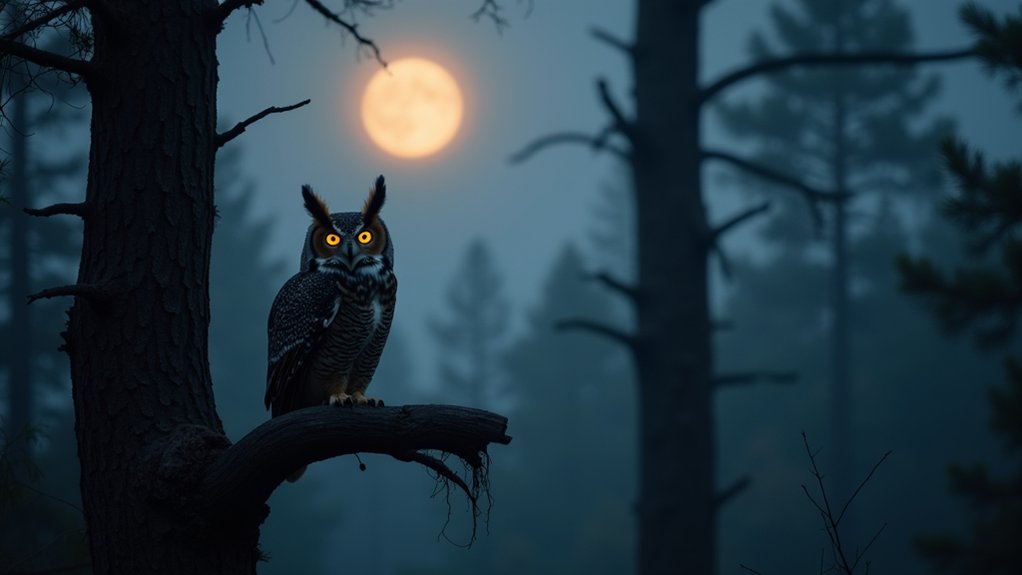
Several distinctive sounds beyond hoots and calls characterize the vocal repertoire of the Great Horned Owl. These vocalizations serve critical communication functions, such as feeding, defense, and alerting others to disturbances.
You’ll notice the following sounds in different contexts:
- Piercing screams from young owls begging for food, signaling their needs to adults.
- Loud screams from adults defending nests against intruders or threats.
- Bill snapping, a sharp clicking sound produced when the owl feels stressed or senses danger.
- Wavering cries, whistles, barks, hisses, and coos used to convey various messages within their environment.
Understanding these other sounds helps you appreciate the complexity and adaptability of Great Horned Owl communication beyond their well-known hoots.
Compare With Similar Species
Beyond individual vocalizations, comparing the Great Horned Owl‘s sounds with those of similar species reveals distinct acoustic signatures and communication strategies.
You’ll notice the Great Horned Owl’s deep, stuttering hoots contrast with the Barred Owl’s melodic “who cooks for you” call, which even mimics other bird sounds.
The Great Gray Owl, in contrast, produces soft, low-frequency hoots that are less rhythmic and more spaced out, while the American Barn Owl’s vocalizations consist mainly of eerie screeches and hisses, sharply differing from the deep hoots you hear from the Great Horned Owl.
Furthermore, the Great Horned Owl’s bill snapping, typically a stress response, is less commonly observed in species like the Great Gray Owl, highlighting behavioral differences alongside acoustic ones.
Don’t Miss a Thing! Join Our Email List
Countless birdwatching enthusiasts have improved their understanding and enjoyment by joining our email list.
It delivers timely updates on bird sightings and conservation efforts directly to your inbox. When you subscribe, you gain access to valuable scientific insights that boost your observation skills and deepen your knowledge of species like the Great Horned Owl.
Here’s what you can expect:
Insights on migrations, owl behavior, events, and community connections to enhance your birdwatching experience
- Detailed reports on seasonal migrations and ideal spotting locations
- Analytical breakdowns of owl calls and behaviors for accurate identification
- Notifications about workshops and events focused on avian conservation
- Opportunities to connect with fellow birdwatchers and share field observations
Frequently Asked Question
How Do Great Horned Owls Use Their Sounds for Hunting?
You’ll find Great Horned Owls use their deep hoots to mark territory, helping them locate prey within their hunting grounds.
Their whistles and barks can distract or confuse prey, increasing hunting success.
When you hear young owls screaming, that’s a food call, guiding parents during hunts.
Adults also scream to defend nests, ensuring their young’s safety while they hunt nearby.
Their vocal coordination with mates boosts hunting efficiency.
Can Great Horned Owls Mimic Other Animals’ Sounds?
Yes, great horned owls can mimic other animals’ sounds.
You’ll notice they sometimes imitate smaller mammals’ cries to confuse predators or rivals.
This mimicry also includes other bird species’ calls, helping them blend into their environment when hunting.
While their own vocalizations remain dominant, this ability strategically improves their adaptability.
It boosts hunting success and territorial defense in diverse situations.
You’ll find this behavior less frequent but ecologically significant.
Do Juvenile Great Horned Owls Have Different Calls Than Adults?
Did you know juvenile Great Horned Owls sound very different from adults? You’ll notice juveniles produce high-pitched, piercing screams mainly when begging for food, unlike the adults’ deep, rhythmic hoots, barks, and hisses.
As you observe them mature, you’ll see their vocalizations shift gradually toward adult calls, aiding in territory marking and social integration.
This vocal change is essential for their development and communication within their community.
How Do Environmental Factors Affect Great Horned Owl Vocalizations?
Environmental factors shape how you hear great horned owl calls. Habitat type influences call clarity and range, while urban noise pollution forces owls to call louder or at different times.
Seasonal foliage density muffles or improves sound travel.
Presence of threats increases alarm calls like screams. Weather conditions such as wind and rain reduce vocal activity to avoid detection.
These factors dynamically affect owl communication strategies in their environment.
Are Great Horned Owl Sounds Audible to Humans During the Day?
You won’t often hear the deep, rhythmic hoots of Great Horned Owls during the day, as they’re mostly silent until dusk.
Occasionally, you might catch a piercing scream from a young owl or a defensive call if the bird feels threatened.
These sounds, designed for nighttime communication and territory claims, fade into the daytime hush.
That makes their vocalizations largely inaudible to humans when sunlight dominates the landscape.
Conclusion
Now that you’ve investigated the great horned owl’s songs, calls, and other sounds, you’ll better recognize this nocturnal sentinel in the wild. These vocalizations serve crucial roles in territory defense, mating, and communication.
Comparing them with similar species sharpens your identification skills. Though the owl’s calls might seem timeless, like a telegram from nature’s past, modern study tools help us decode their complex acoustic signals with precision.
Stay attentive. Nature’s symphony awaits your ear.