
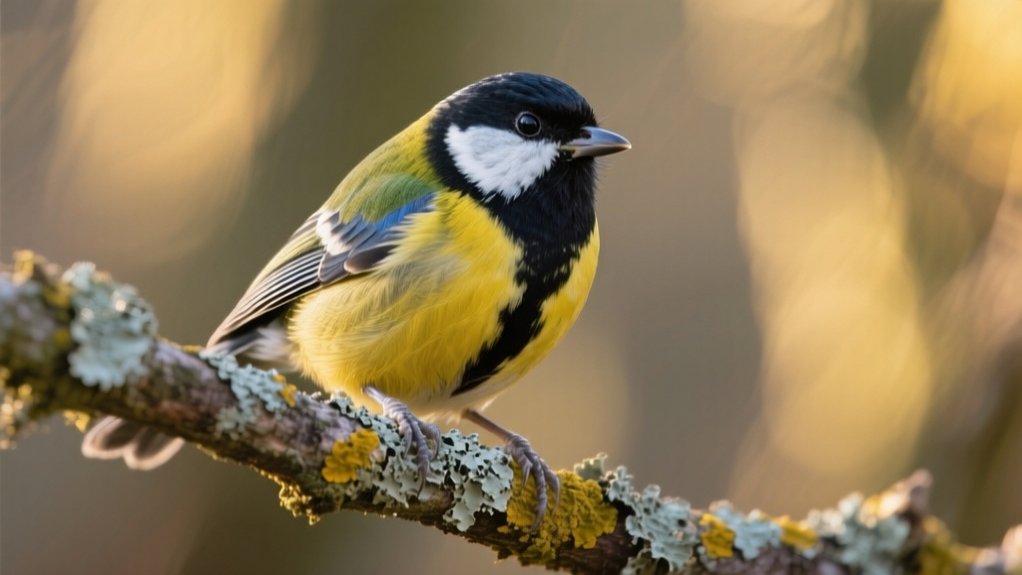
You can identify the great tit by its 12.5–14 cm length, lemon-yellow underparts with a central black stripe, and black crown and bib. Males show a broader, solid breast stripe and brighter yellow than females.
These intelligent birds inhabit Eurasian woodlands, exhibiting partial migration and complex vocalizations. Their diet shifts seasonally from caterpillars to seeds.
They interact socially within mixed-species flocks and face conservation challenges. Investigate detailed traits, behaviors, and habitat preferences in the full profile.
Physical Characteristics of the Great Tit
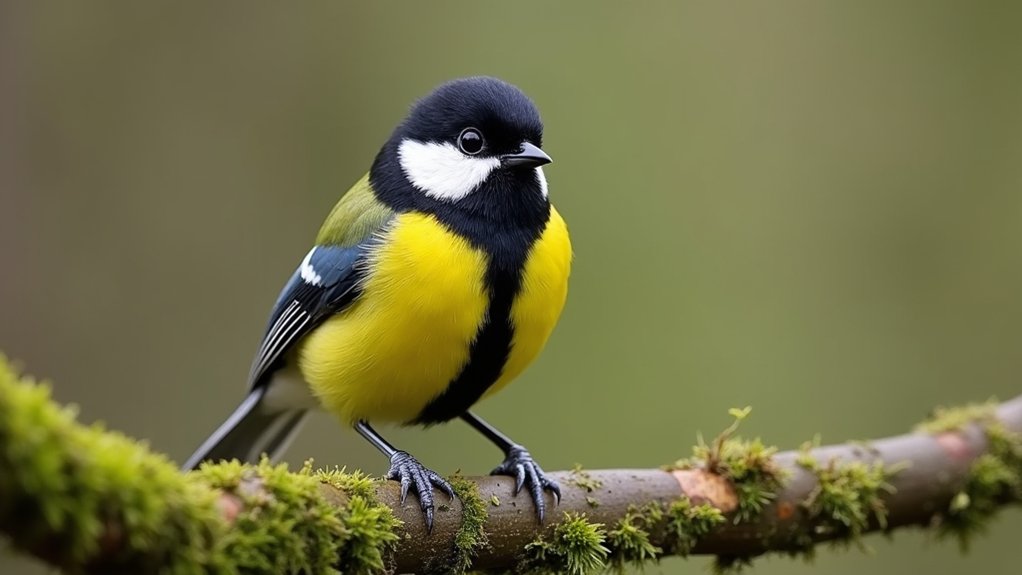
Measuring between 12.5 and 14 cm in length, the Great Tit stands out as one of the larger tit species, with a wingspan spanning 22 to 25 cm that presents a broad-winged profile uncommon among small songbirds.
You’ll notice its compact body and large head create a blocky silhouette, while its short, stout conical bill adapts efficiently to both insect foraging and seed handling.
The bird’s average mass is around 18 grams, fluctuating seasonally due to fat reserves. It is found across Europe and parts of Asia, making it a widely distributed species with a stable population. distribution
Weighing approximately 18 grams, the Great Tit’s mass varies seasonally with its fat reserves.
Its black crown, throat, and bib contrast sharply with prominent white cheeks, forming a distinct dark hood.
Upperparts display green to olive hues with bluish-grey flight feathers and a pale wing-bar.
Underparts show bright lemon-yellow bisected by a central black stripe, highlighting its distinctive coloration and robust structure.
How to Identify Male Vs Female Great Tits
Distinguishing male from female Great Tits hinges primarily on subtle differences in their plumage, particularly the black breast stripe.
Males exhibit a broader, more solid and continuous stripe extending down the belly, while females’ stripes are narrower, often tapering or breaking.
You’ll also notice males have brighter, more vivid yellow underparts compared to the duller, softer yellow tones in females.
When several birds are present, these contrasts become easier to discern. However, individual variation means you shouldn’t rely solely on the breast stripe.
Combine this with behavioral cues like males’ dominant singing and nest-box prospecting.
Avoid sexing juveniles, as their duller, washed-out plumage and yellowish cheeks obscure these differences until adult plumage develops fully.
Always assess birds in good light to accurately judge stripe width and color intensity. The slight sexual dimorphism between males and females means differences are minimal but noticeable with careful observation.
Geographic Range and Preferred Habitats

Although the Great Tit thrives across a vast expanse of Eurasia and parts of North Africa, its distribution is neither uniform nor random. You’ll find it from Morocco and Spain eastward to Japan, spanning nearly the entire European continent (excluding Iceland and northern Scandinavia), the Middle East, Central Asia, and northern Asia.
The nominate subspecies, *P. m. major*, dominates this range, with 15 recognized subspecies occupying distinct regions, some restricted to islands like the British Isles and Corsica. Among these, subspecies such as *P. m. newtoni* are specific to the British Isles, highlighting the bird’s diverse subspecies distribution.
When considering habitat, you’ll notice the Great Tit favors open deciduous woodlands, mixed forests, and forest edges. It avoids dense conifer forests unless clearings are present.
In North Africa, it utilizes oak forests and cedar stands, while in eastern Siberia and Mongolia it prefers riverine willow and birch forests.
Seasonal Movements and Migration Patterns
You’ll notice that great tits show partial migration. Populations in northeastern Europe tend to migrate more than those in the west. Instead of long journeys, their seasonal movements usually involve short-distance shifts. This helps them take advantage of changing food supplies and weather conditions.
Tracking studies show these birds change where they live throughout the year. In autumn, they generally move south and west. The recent decrease in migration distance means many birds now travel shorter distances than in the past.
Then, in spring, they head back, but the timing and speed can vary quite a bit. It’s a flexible pattern that suits their needs well.
Migration Behavior Overview
When you observe Great Tits across Europe, you’ll notice their migration behavior varies widely depending on their geographic location. Most populations are sedentary, but northern and northeastern birds migrate regularly, traveling farther south. Migration distance declines southwestward. Their movements are slow and deliberate, averaging 33 km daily, as they forage between trees rather than flying straight. This unique migration behavior involves moving from tree to tree instead of following a straight line.
Key migration insights:
- Northern birds connect from breeding sites to coastal and western Europe in autumn-winter.
- British Isles populations show limited movements, mainly local.
- Migration speed varies seasonally and geographically, with sea crossings increasing daily distances.
- Food availability, especially beech mast, strongly influences migration intensity and timing.
You’ll see migration fluctuate with climate and food, often reduced by mild winters and garden feeding.
Seasonal Habitat Shifts
Great Tits adjust their habitat use markedly with the seasons, reflecting shifts in food availability and social dynamics.
During winter, you’ll observe them moving from woodland and scrub to hedgerows, gardens, and suburban areas, exploiting supplemental feeding and ground-level seeds. Many males remain on territories year-round if food is sufficient, maintaining dominance in key feeding areas. Their winter range expands to marginal sites like high hills and offshore islets, where they form roving flocks of about three birds, contrasting the fixed breeding territories. Providing safe shelter during harsh winter conditions can further support Great Tits as they seek out gardens and other human-modified habitats.
Seasonal diet shifts, from invertebrates to seeds and fruits, drive these habitat changes, with beech mast and hazelnuts critical.
Social hierarchy dictates habitat access; dominant adults remain longer in seed-rich woodlands, while subordinates move earlier to gardens and hedges.
Foraging height drops below 7 m, focusing on open woodland edges and understorey, optimizing access to fallen seeds and ground prey during food-scarce months. Large numbers also gather at well-stocked feeding stations near woodlands, highlighting the importance of human feeding.
Behavior and Intelligence Features
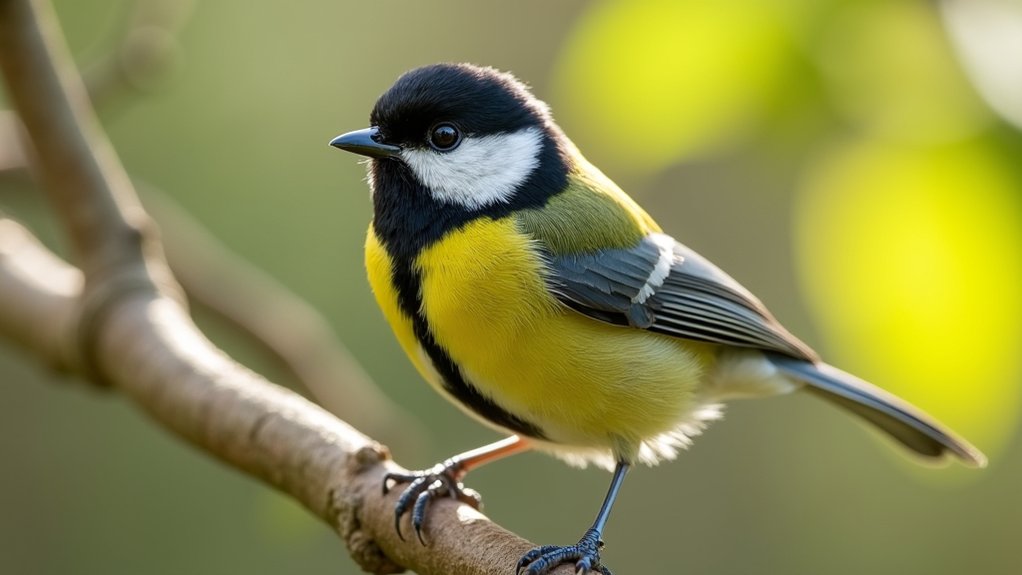
You’ll notice that great tits show some pretty impressive problem-solving skills. They often handle new foraging challenges by using insight learning instead of just trial-and-error.
It’s like they figure things out more quickly and cleverly than you might expect.
Their vocal communication is also quite complex. They’ve a variety of song types, which they use strategically to defend their territory and interact socially with other birds.
When you watch these behaviors, it becomes clear how their cognitive flexibility and acoustic signaling help them adapt in changing environments.
Additionally, great tits form mixed-species flocks in autumn and winter, exhibiting hierarchical dominance that enhances their social interactions and survival.
Problem-Solving Skills
Problem-solving skills in the Great Tit showcase a remarkable blend of innovation, flexibility, and social learning that supports its success across diverse environments.
You’ll observe this species mastering tasks like string-pulling and plug-opening to access food, with urban birds outperforming rural ones in cognitive tests.
Their self-control, measured around 64%, rivals that of corvids, indicating advanced cognitive processing beyond simple conditioning. Great tits also demonstrate that their behavior in self-control tasks is not a product of serial conditioning.
Socially, larger mixed-species flocks improve problem-solving efficiency through observational learning, accelerating the spread of innovative foraging techniques.
Employs tools such as conifer needles to extract insect larvae.
Demonstrates high self-control in experimental cylinder tasks.
Solves novel foraging problems more efficiently in larger flocks.
Problem-solving pairs exhibit higher nestling provisioning rates and reproductive success.
Vocal Communication Patterns
The cognitive sophistication of the Great Tit extends beyond problem-solving into its vocal communication, where intricate call structures convey nuanced information.
You’ll observe a complex alarm repertoire with over 10 distinct note types, combined in rule-governed sequences like the ‘ABC’ warning calls and ‘D’ recruitment notes.
The order matters: ‘ABC–D’ sequences trigger both scanning and approach behaviors, while reversed ‘D–ABC’ sequences do not, indicating syntactic sensitivity. This demonstrates that Great Tits use semantically compositional syntax in their calls.
Males produce varied song types during breeding for territory defense and mate attraction, adapting urban song frequencies higher to avoid noise masking.
Urban birds start dawn singing earlier, exploiting quieter periods, though they sing less overall daily than rural counterparts.
This flexible, compositional syntax and temporal adjustment showcase the Great Tit’s advanced vocal communication tailored to social and environmental contexts.
Vocalizations and Communication
Although often overlooked, Great Tits boast an exceptionally diverse vocal repertoire, with males capable of producing over 70 distinct song and call types across their species-level vocabulary.
You’ll notice individual birds regularly use around eight main song types featuring flute-like notes, sharp whistles, and harsh chatter. Their classic territorial song often repeats two-note phrases like “tea-cher, tea-cher,” while agitation triggers slower, churning sequences.
Key vocalization aspects include varied song structures with two- or three-note phrases and tempo shifts, distinct call types for alarms, social interaction, and begging, acoustic territorial signals used year-round, even in winter, and alarm calls that convey predator information and are eavesdropped by other species. These sounds have been recorded in spring in the Sierra de las Nieves, Andalucia, Spain, capturing natural variations and background wildlife sounds.
These vocalizations facilitate territory defense, social cohesion, and predator warning, showcasing sophisticated communication skills.
Breeding Habits and Nesting Behavior
You’ll find great tits nesting mainly in tree cavities, but they’re pretty adaptable and will also use artificial spots like nest boxes. These boxes usually have specific entrance sizes and heights to suit their needs.
The female goes about building a sturdy, cup-shaped nest made from moss, grass, and insulating stuff like feathers and hair. This cozy setup helps support their relatively large clutches. Nests are typically located in tree cavities, walls, birdhouses, or pipes, showing their versatility in nesting sites.
When it’s time to incubate, the female takes care of it alone for about two weeks. Meanwhile, the male pitches in by bringing her food.
Once the eggs hatch, both parents team up to feed the hungry nestlings until they’re ready to leave the nest.
Nesting Sites and Materials
Great Tits select nesting sites with notable flexibility, primarily favoring natural cavities such as old woodpecker holes or decayed branch cavities in mature deciduous woodlands.
You’ll also find them nesting in gaps in walls, rock crevices, or even old nests. They readily accept nest boxes, favoring small, 28 mm entrance holes facing east. Nest boxes are often monitored with Nature-Watch Cameras, allowing close observation of nesting behavior.
The female chiefly builds the nest, forming a dense moss base layered with dry grasses and plant fibers to provide drainage and insulation.
She lines the cup with soft fur or wool, adjusting thickness per ambient temperature. Nest construction starts in late March, overlapping egg-laying.
Males sometimes help by delivering materials and defending the site. Additionally, males assist with nest-building by bringing dry hay and grasses to the female during early April male assistance.
Nest base: thick moss and fibrous materials for cushioning
Lining: soft fur and wool, rarely feathers
Nest boxes preferred in human habitats
Female shapes a steep-sided, well-insulated cup
Parental Care and Incubation
When a female Great Tit begins incubating, she takes full responsibility for warming and protecting the clutch. This typically consists of around 12 eggs, though the number can range from 6 to 18 depending on the population.
She incubates alone for 12 to 15 days, maintaining close contact with the eggs. She hisses when disturbed to deter predators. Meanwhile, the male supports her by delivering food, which enables her to have prolonged incubation bouts and keep egg temperatures stable.
This division of labor guarantees ideal embryonic development. The incubation duration of Great Tits is similar to that of many small songbirds, usually lasting between 10 and 14 days depending on environmental conditions.
| Incubation Aspect | Female Role | Male Role |
|---|---|---|
| Egg warming | Sole incubator | None |
| Food provisioning | Receives food | Feeds incubating female |
| Nest defense | Hissing, close sitter | Indirect by feeding |
Diet and Feeding Strategies
Although the Great Tit’s diet varies seasonally, it remains finely tuned to exploit available resources with remarkable flexibility.
The Great Tit adapts its diet seasonally, skillfully utilizing whatever food sources are available.
In summer, you’ll find it mainly insectivorous, gleaning caterpillars and a wide array of invertebrates from foliage. This insect-rich diet is crucial during breeding, as caterpillars can make up to 90% of what adults feed their young. During warmer months, Great Tits may also supplement their diet with safe nuts for birds, which provide essential fats and proteins.
As autumn and winter approach, its diet shifts toward seeds, nuts, and berries, with remarkable adaptations like hammering sunflower seeds open.
You’ll observe it foraging both in trees and on the ground, even prying prey from bark crevices during colder months. During autumn, Great Tits also begin food caching in crevices and under bark to store supplies for winter.
Summer diet: 55–95% caterpillars, essential for chick growth
Foraging: foliage gleaning, ground feeding, bark prying
Winter diet: seeds, nuts, berries, with sunflower seeds up to 44% body weight daily
Human-provided foods: black sunflower seeds, peanuts, suet, fat balls
This dynamic feeding strategy maximizes survival across habitats and seasons.
Interactions With Other Species
Because it navigates a complex social environment, the Great Tit engages in diverse interactions with multiple species that shape its foraging success, breeding behavior, and survival strategies.
In winter, you’ll find it in mixed-species flocks with Blue, Coal, and Long-tailed Tits, associating with roughly 50 individuals per season. These social networks influence who locates food first and territory dynamics. Studies have shown that connections to well-informed peers can increase a bird’s chance of discovering food by up to 22 times, highlighting the importance of social knowledge transfer.
During breeding, it competes asymmetrically with Blue Tits for nests and food, often using song mimicry in interspecific aggression. Its larger size usually grants dominance at feeders.
As a generalist predator, it socially learns to avoid distasteful, brightly colored prey, aiding prey species’ evolutionary signaling.
Furthermore, it opportunistically kleptoparasitizes food caches from related tit species, demonstrating keen observational skills.
Conservation Status and Population Trends
Given its vast range and immense population size, the Great Tit currently holds a global conservation status of Least Concern according to the IUCN Red List. You’ll find roughly 300–1,100 million individuals spread across 32.4 million km², with stable population trends in Europe’s 127–205 million mature birds.
Despite local declines in degraded habitats, the species has expanded north into Scandinavia and Scotland and south into Israel and Egypt. The Great Tit is known for its problem-solving skills, such as pulling levers and strings to access food.
Key points to note:
- Stable global and European population trends confirmed by long-term monitoring
- Urban populations reach high densities, e.g., 17,000 breeding pairs in Sheffield, UK
- Threats include habitat loss, pesticide use, climate-induced breeding mismatches, and urban noise
- Conservation focuses on habitat restoration, pesticide reduction, nest box provision, and urban green space management
Tips for Attracting Great Tits to Your Garden
Understanding the stable and widespread presence of Great Tits provides a solid foundation for encouraging these birds to visit your garden. To attract them, offer high-energy foods like peanuts, suet, fat balls, and sunflower hearts, especially during colder months when natural prey is scarce. Fresh water is essential for drinking and bathing, so providing a clean bird bath nearby can increase your chances of attracting Great Tits. You can further boost your success by using high-quality seed mixes that are rich in proteins and fats, which are especially appealing to Great Tits and other garden birds.
Use a mix of hanging seed feeders, suet feeders, and bird tables positioned near shrubs or trees for quick cover access. Maintain feeder hygiene by cleaning regularly and replenishing food consistently to establish your garden as a reliable foraging site.
Install nest boxes with 28–32 mm entrance holes, placed 2–4 meters high in shaded, quiet locations facing away from prevailing winds.
Improve habitat by planting native insect-rich shrubs and providing dense evergreen cover, creating layered vegetation that supports natural foraging and shelter. Dense cover is important as it offers safe roosting spots for Great Tits and other garden birds.
Frequently Asked Question
How Long Do Great Tits Typically Live in the Wild?
You’ll find that great tits typically live about three years in the wild.
While some individuals survive up to 10 years, this is rare.
Their first-year survival is low, around 38%, mainly due to predation and harsh conditions.
After reaching maturity at one year, their annual survival rate improves to roughly 54%.
Factors like food availability and climate also strongly influence their lifespan in natural habitats.
Do Great Tits Have Any Cultural Significance or Symbolism?
You might be surprised to learn that great tits carry rich symbolism across cultures.
In Europe, they’re seen as harbingers of luck, health, and protection from evil.
Their vibrant colors and behaviors symbolize resilience, intelligence, and adaptability.
Folk traditions view them as spiritual messengers, while modern interpretations highlight their alertness and mental agility.
Artists and conservationists alike use the great tit to inspire optimism and emphasize coexistence between humans and nature.
What Predators Commonly Threaten Great Tits?
You’ll find great tits commonly threatened by various predators.
Mammals like squirrels, rats, and weasels raid nests, targeting eggs, chicks, and sometimes adults.
Birds such as crows, magpies, and woodpeckers also prey on nests, while sparrowhawks and owls hunt adults, especially during breeding.
In urban areas, domestic cats pose significant risks.
These predators collectively impact great tit survival, breeding success, and behavior, making predation a critical ecological factor for these birds.
Can Great Tits Be Trained or Tamed as Pets?
You won’t turn a Great Tit into a lapbird overnight. They’re naturally wary and not bred for human companionship.
While you can use positive reinforcement to teach them simple behaviors like taking food from your hand, their stress levels soar in captivity.
Expect flighty responses if training lapses. Taming requires patient, low-stress, gradual exposure.
But don’t count on cuddles or deep bonding; they’re independent foragers, not affectionate pets.
How Do Great Tits Cope With Urban Pollution and Noise?
You’ll notice great tits adapt to urban noise by raising their song frequencies and speeding up note repetition, avoiding traffic noise interference.
They also show physiological changes like reduced body size and paler yellow plumage due to pollution and nutritional stress.
Despite these adaptations, you’ll find their communication and development face challenges from multiple urban stressors.
This reflects a complex balance between plasticity and environmental constraints in city habitats.
Conclusion
Now that you know the great tit’s distinctive markings, behaviors, and habitats, you’re well-equipped to spot this feathered marvel in action. Like a living barometer of ecosystem health, the great tit reveals much about its environment.
By understanding its diet, migration, and social interactions, you can better appreciate its role and even attract it to your garden. Keep observing closely; nature’s intricate details are waiting for you to uncover.