

You have four limbs as a bird: two wings and two legs, each specialized for different functions. Your wings contain modified bones and strong muscles like the pectoralis major to power flight.
Your legs include fused bones and digits adapted for walking, perching, or plunging. Hollow bones and a rigid skeletal frame support lightweight strength for agile movement.
These adaptations highlight birds’ evolutionary refinement. Exploring further reveals how their diverse forms perfectly suit varied lifestyles.
Overview of Bird Limb Structure

Birds have four limbs, with their forelimbs modified into wings and their hindlimbs specialized for walking, perching, or swimming. Understanding the limbs’ anatomy reveals a specialized structure adapted to distinct functions.
The wing structure includes a humerus, radius, ulna, carpals, and reduced digits, enabling aerodynamic flight mechanics and stability.
The wing’s bones—humerus to reduced digits—create aerodynamic shape essential for flight and balance.
Meanwhile, the hindlimbs consist of a femur, tibiotarsus, fibula, tarsometatarsus, and typically four digits, tailored to diverse locomotion styles.
Supporting these limbs is a fused pelvic girdle made of the ilium, ischium, and pubis, providing robust leg support and facilitating egg-laying.
A complex muscular system, especially the pectoralis and supracoracoideus muscles, powers wing movement.
This precise anatomy and structure of the limbs exemplify the evolutionary specialization critical to avian mobility and survival.
Evolutionary Origins of Bird Limbs
Although you mightn’t immediately recognize it, the limbs you see in modern birds trace back to a common tetrapod ancestor, illustrating a remarkable evolutionary progression. Birds evolved from reptilian theropods, with key pivotal fossils like Archaeopteryx demonstrating early adaptations for flight.
Natural selection sculpted their limb anatomy, elongating and reshaping forelimbs into wings while adapting hindlimbs for diverse functions. The avian skeleton preserves the fundamental tetrapod limb pattern: humerus, radius, ulna, carpals, and digits, all modified for aerodynamic efficiency.
Embryonic development further confirms this lineage, as limb buds differentiate into wings and legs, reflecting their shared tetrapod origin.
Understanding this evolutionary context clarifies how birds’ four limbs represent both their reptilian ancestry and specialized adaptations driven by natural selection for survival and flight.
Anatomy of Bird Wings
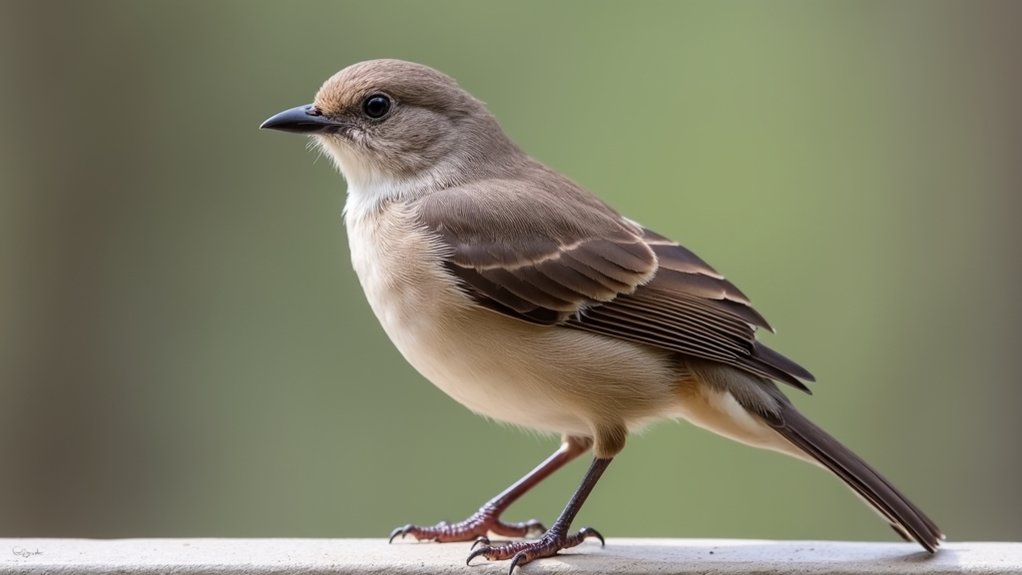
You’ll notice that bird wings keep the basic tetrapod bone structure, but it’s specially adapted for flight.
For example, they’ve lightweight, pneumatic bones like the humerus and carpometacarpus, which provide both stability and strength.
Then there are the muscles—the powerful pectoralis major and supracoracoideus.
These are anchored to the keeled sternum and control the wing’s downstroke and upstroke, respectively.
All these skeletal and muscular parts work together to make the precise, efficient wing movements that birds need to fly.
Unlike butterfly wings, bird wings are considered homologous structures because they evolved from the forelimbs of a common ancestor and share a similar underlying anatomy.
Wing Bone Structure
The structural framework of a bird’s wing relies on three primary bones: the humerus, radius, and ulna, which work together to enable flight. These wing bones, connected to the pectoral girdle, form a robust yet lightweight system vital for controlled wing movement.
You’ll notice the carpometacarpus, a fusion of carpals and metacarpals, adds rigidity and supports stability.
Here’s how the wing bone structure functions:
- The pectoral girdle anchors the wing bones to the body, facilitating powerful strokes.
- Pneumatized wing bones reduce weight without sacrificing strength, optimizing flight efficiency.
- The ulna anchors flight feathers, essential for maintaining aerodynamic control during flight.
Understanding this anatomy helps you appreciate the complexity behind avian flight mechanics.
Flight Muscle Functions
Since efficient wing movement depends on specialized musculature, understanding the functions of a bird’s primary flight muscles, the pectoralis major and supracoracoideus, is essential.
The pectoralis major, comprising 15-25% of a flighted bird’s body weight, powers the wing’s downstroke, generating thrust.
In contrast, the supracoracoideus facilitates the wing’s upstroke by lifting it through a unique tendon arrangement. Both muscles anchor to the keeled sternum, which provides support critical for sustained flight.
Species relying on continuous powered flight, like hummingbirds, exhibit an enlarged pectoralis major, whereas penguins, requiring strong upstrokes, have a more developed supracoracoideus.
The presence of myoglobin in these avian flight muscles differentiates red fibers for endurance from white fibers for rapid bursts, optimizing wing motion mechanics and flight efficiency.
Anatomy of Bird Legs
You’ll find that bird legs are made up of some pretty specialized bones like the femur, tibiotarsus, fibula, and tarsometatarsus. Each of these plays a role in giving the legs strength and helping birds move around.
The way their toes, or digits, are arranged can be quite different depending on the species. This variation allows birds to do specific things, like climbing trees, wading through water, or perching on branches.
All these structural tweaks work together to make their movement more efficient. Whether they’re walking, running, or swimming, these adaptations help birds keep their balance and get a good grip on surfaces.
Leg Bone Structure
Understanding bird leg bone structure reveals how these limbs support diverse functions like perching, plunging, and running. Each hind limb includes a stout femur, a large tibiotarsus, fibula, and a tarsometatarsus, culminating in four digits. These components adapt to ecological needs with remarkable precision.
Consider these key points:
- The femur slopes cranially, positioning the hind limb for ideal advantage and movement.
- Digits, each with multiple phalanges, allow flexion and extension critical for gripping or propulsion.
- The tibiotarsus, often called the drumstick, is the largest bone, providing strength for weight-bearing and locomotion.
Together, these bones form a versatile framework that supports diverse bird lifestyles, from perching delicately to powerful running or swimming.
Digit Arrangement Functions
Digit arrangement in bird feet plays a significant role in adapting to specific ecological functions and locomotion methods. You’ll notice most birds possess four digits, arranged typically as three toes forward and one back, optimizing grip and stability, especially in perching species.
This specific hindlimb structure, comprising bones like the femur and tarsometatarsus, supports these functional arrangements. For example, digits two and three often bear most weight during ground locomotion, while the backward-facing toe improves balance on branches.
Variations in digit placement influence interaction with substrates. Webbed digits boost swimming, while curved talons aid predation.
The precise configuration of these digits, covered with protective scales and feathers, reflects evolutionary adaptations essential for survival across diverse habitats.
Understanding these arrangements clarifies how bird legs accommodate their ecological roles efficiently.
Adaptations for Locomotion
The specialized arrangement of bird digits sets the stage for exploring how their legs adapt to various forms of locomotion. Their hindlimbs are structurally optimized for different activities, relying heavily on digit arrangement and muscular strength.
You can observe these key adaptations:
- Digitigrade locomotion: Birds walk on their toes, enhancing balance and energy efficiency during perching or running.
- Limb structure: The tibiotarsus, femur, fibula, and tarsometatarsus form a robust framework supporting rapid movement and stability.
- Functional digit variations: Different phalange counts enable gripping, swimming, or prey capture, tailored to ecological niches.
Understanding these adaptations reveals how bird hindlimbs facilitate diverse locomotion modes, from swift running to efficient submersion, highlighting evolutionary specialization in their anatomy.
Skeletal Adaptations for Flight
Although flight demands exceptional strength and lightness, birds have evolved a skeleton that expertly balances these needs. Their skeletal structure is adapted for flight with a lightweight skeleton featuring hollow pneumatic bones that reduce weight without compromising strength.
The fusion of vertebrae forms a rigid axial skeleton, while the keeled sternum and furcula provide sturdy attachment sites for powerful flight muscles. Avian wing bones are lightweight yet stable, optimized for aerial maneuverability.
| Skeletal Feature | Adaptation | Function |
|---|---|---|
| Hollow bones | Pneumatic, lightweight | Reduces body weight |
| Fused vertebrae | Notarium, pygostyle | Provides rigidity |
| Pectoral girdle | Keeled sternum, furcula | Muscle attachment for flight |
This skeletal framework supports the dynamic forces of flight efficiently. Just as birds have evolved specialized skeletal features, their beak diversity also reflects adaptation to specific ecological roles and dietary needs.
Muscular System Supporting Limb Function

Flight’s demands extend beyond skeletal adaptations to the muscular system, which powers and controls limb movements with remarkable specialization. You’ll find that bird muscles are finely tuned to support both wings and legs, enabling efficient flight and terrestrial movement.
Consider these key aspects:
- Birds have about 175 muscles, many dedicated to the forelimbs (wings) and hindlimbs (legs), essential for flight and locomotion.
- The pectoralis major, critical for the wing’s powerful downstroke, can make up 15–25% of a flighted bird’s body weight, highlighting its importance.
- Muscles are classified as red (endurance) or white (rapid bursts), reflecting their specialized roles during sustained flight or quick maneuvers.
This muscular specialization guarantees efficient limb function, meeting the high metabolic demands of flight.
Functional Diversity Among Bird Species
When you examine bird limbs, you’ll notice they showcase remarkable functional diversity tailored to their ecological roles. Birds have four limbs: two forelimbs modified into wings and two hindlimbs specialized for various locomotory and ecological functions.
The leg structure varies widely, reflecting adaptations to ecological niches. Passerines possess short legs for perching, raptors feature robust talons for prey capture, and waterfowl display webbed feet optimized for swimming. Flightless birds, like ostriches, compensate with powerful legs adapted for running.
| Bird Type | Leg Structure | Ecological Niche |
|---|---|---|
| Passerines | Short, agile legs | Perching |
| Raptors | Strong talons | Predation |
| Waterfowl | Webbed feet | Aquatic locomotion |
Frequently Asked Question
How Do Bird Limbs Heal After Injury?
When a bird’s limb gets injured, you’ll see a callus form at the fracture site, stabilizing the bone during healing.
You should guarantee the bird receives proper nutrition, especially calcium and vitamin D3, to support bone repair.
Birds tend to limit movement by resting or shifting weight to other limbs.
You can aid recovery by providing safe perches and minimizing stress, promoting efficient healing despite their limited regenerative capacity.
Can Birds Regenerate Lost Limbs?
You might find it surprising that 0% of bird species can regenerate lost limbs.
Birds lack the specific cellular mechanisms that trigger regrowth after amputation, unlike amphibians.
When a bird loses a limb, its healing process focuses on wound closure and scar formation rather than regeneration.
This means you won’t see a bird regrow a wing or leg, as their anatomy and evolutionary lineage don’t support limb regeneration.
How Do Bird Limb Nerves Coordinate Movement?
You rely on bird limb nerves, like the brachial and lumbosacral plexuses, to coordinate movement by transmitting signals from the brain to muscles.
These networks activate muscle groups in precise sequences for flapping, walking, or perching.
Motor neurons in the spinal cord generate rhythmic patterns, while proprioceptors provide sensory feedback about limb position.
This intricate neural coordination lets birds adjust their movements dynamically during flight and locomotion.
What Role Do Bird Limb Feathers Play in Flight?
You can think of bird limb feathers as nature’s aerodynamic artists, sculpting the air to lift and propel you forward.
These feathers, arranged meticulously on your wings, create the perfect surface for generating lift and thrust. Their lightweight yet sturdy structure reduces drag, while their flexibility lets you adjust wing shape precisely.
Tail feathers act as your flight rudder, granting stability and control for agile turns and smooth landings.
How Do Environmental Factors Affect Bird Limb Development?
You’ll find that environmental factors directly shape bird limb development.
For instance, birds in dense forests tend to develop shorter, sturdier legs for agility, while those in open habitats grow longer limbs for efficient movement.
Aquatic birds develop webbed feet to aid swimming.
Nutrition affects bone strength; vitamin D3 and calcium deficiencies can cause deformities.
Temperature extremes may stunt limb growth or promote adaptations like shorter limbs and thicker feathers for insulation.
Conclusion
You have four limbs: two wings and two legs that define a bird’s anatomy and function. Remarkably, bird wings contain the same basic bones as your arms but are highly specialized for flight.
Imagine the precision here. Each wingbeat involves coordinated muscle contractions powered by a skeletal structure optimized over millions of years. This intricate design allows birds to soar, perch, and run.
It really showcases how evolutionary adaptations have finely tuned their limbs for survival and versatility.