
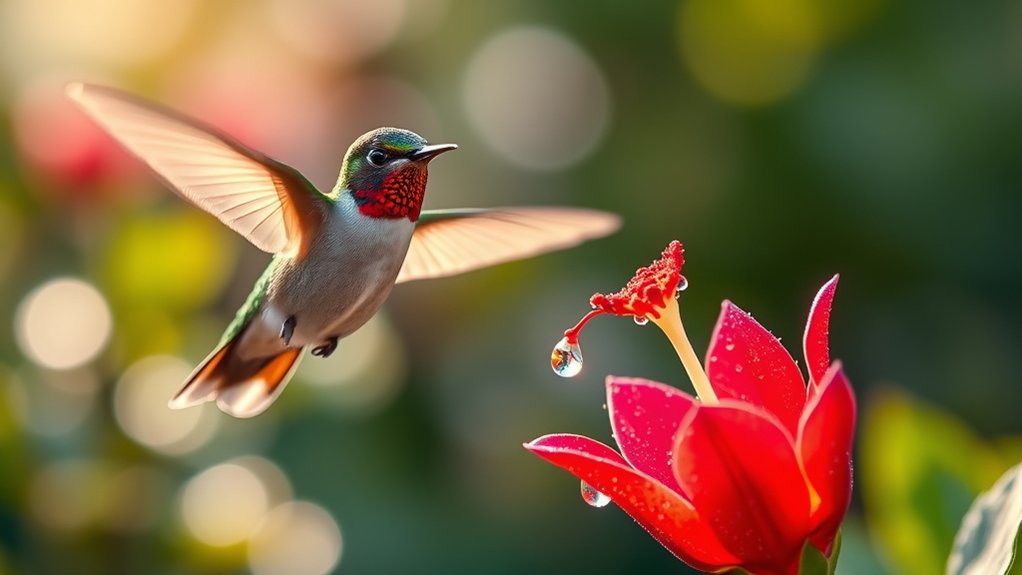
You might not know that hummingbirds hover and fly backwards by moving their wings in a figure-eight up to 70 times per second. Their tongues work like tiny pumps, flicking in and out rapidly to lap up nectar.
They migrate solo for thousands of miles, guided by an innate sense of direction. Their stretchy nests grow with their chicks, and their throats shine with iridescent colors caused by microscopic feather structures.
Keep exploring, and you’ll uncover even more fascinating details about these tiny marvels.
How Do Hummingbirds Hover and Fly Backwards?
Although most birds can only glide or flap their wings in simple patterns, hummingbirds hover and even fly backwards by moving their wings in a unique figure-eight motion.
You’ll notice their wings move so fast, up to 70 times per second, that they can hover in midair, staying perfectly still while feeding.
This ability comes from their unique wing structure and specialized muscles, which give them the flexibility and strength they need for agile flight.
When they want to fly backwards, hummingbirds rotate their wings in reverse, letting them quickly and precisely maneuver around flowers.
This combination of rapid wing movement and muscle control makes hummingbirds some of the most skilled flyers in the bird world.
How Do Hummingbird Tongues Work to Feed on Nectar?
Hummingbirds use their uniquely shaped tongues to feed on nectar with remarkable speed and efficiency. Their tongues are forked and shaped like a “W,” acting as tiny pumps that move in and out up to 20 times per second.
When you watch a hummingbird feeding, it squeezes its bill to create suction, drawing nectar through its tongue’s specialized grooves lined with tiny hairs. This feeding mechanism allows hummingbirds to lap up nectar quickly, enabling them to consume up to double their body weight daily. That’s vital for their intense metabolism.
Different species of hummingbirds share this incredible adaptation, making their tongue an essential tool for survival and energy.
Understanding this pumping action reveals just how perfectly evolved hummingbirds are for nectar feeding.
Why Can Hummingbirds Migrate Thousands of Miles Alone?
When you watch a Rufous Hummingbird soar alone across thousands of miles, you witness an incredible display of endurance and navigation. Hummingbirds migrate solo, covering up to 4,000 miles from Alaska to Mexico, making the Rufous Hummingbird the smallest migrating bird with exceptional navigational skills.
Their energy-efficient flight and high metabolism let them sustain this long journey without flock support. Seasonal changes trigger their migration to find warmer climates and plentiful feeders and flowers.
Energy-efficient flight and high metabolism empower Rufous Hummingbirds to endure solo migrations for warmer climates and food sources.
Consider how they manage it all:
- Navigate vast distances alone using innate directional sense
- Maintain energy through efficient wing beats and fat reserves
- Rely on timely access to feeders and flowers for refueling
You’ll appreciate these tiny travelers’ incredible solo migrations even more now.
How Do Hummingbird Nests Expand as Babies Grow?
Because they use soft, stretchy materials like lichen, moss, and spiderwebs, hummingbird nests can expand as the chicks grow. These flexible materials let the nest stretch gently, accommodating the rapid growth of the baby hummingbirds without losing structure.
When you look at hummingbird nests, you’ll notice they’re small, about the size of a half-dollar coin, but their design allows them to expand just enough for the chicks’ increasing size. This adaptability provides essential insulation and protection, keeping the young safe and warm.
As the chicks develop, the nest’s flexibility guarantees they’ve enough room to move and grow until they’re ready to leave.
Why Are Hummingbird Throats So Bright and Colorful?
The incredible adaptability of hummingbirds doesn’t stop at their nests; their throats also capture attention with dazzling colors. Hummingbird throats, called gorgets, shine brightly due to iridescence created by a unique arrangement of microscopic platelets in their feathers.
This structure manipulates light reflection, making the colors appear vivid and change with your viewing angle.
Males often have more colorful gorgets to attract mates, using these brilliant displays during courtship. The hues vary by species, showcasing reds, oranges, and purples that help hummingbirds stand out in their environment.
Iridescence from microscopic structures, not pigments, causes the glowing effect. Male gorgets act as visual signals to attract mates. Colorful throats aid species recognition and visibility in nature.
Frequently Asked Questions
How Fast Can a Hummingbird’s Heart Beat?
A hummingbird’s heart rate can reach up to 1,200 rapid beats per minute, especially during intense flight or courtship.
You’ll notice this high heart rate supports their incredible energy consumption and flight agility.
Their metabolic rate is incredibly fast, meeting the oxygen demand required for such active movement.
Keep in mind, species variation means some hummingbirds may have slightly different heart rates, but overall, their hearts work incredibly hard to keep them airborne.
What Is the Average Lifespan of a Hummingbird?
You might think hummingbirds live long with their vibrant colors and energetic feeding behavior, but most hummingbird species only live less than a year.
Their mating habits and migratory patterns put them at risk, while their nesting preferences and vocalization techniques expose them to predators.
Yet, some survive up to four years in the wild.
In captivity, with stable food and protection, they can live 15 to 17 years despite their fragile size and incredible color vision.
How Do Hummingbirds Regulate Their Body Temperature?
You regulate hummingbirds’ body temperature through several thermoregulation methods, including metabolic adaptations that lower their metabolic rate during torpor.
Their temperature tolerance lets them drop from about 37.5°C to as low as 17°C to conserve energy.
Feather insulation helps maintain warmth, while basking behavior lets them absorb heat from the environment.
Environmental influences like cold or food scarcity trigger these adjustments, ensuring effective energy conservation and survival.
Do Hummingbirds Sleep at Night?
Yes, hummingbirds do sleep at night, entering a torpor state to conserve energy.
Their hummingbird sleeping habits include lowering their heart rate and body temperature, which helps them survive cold nights.
You’ll find them choosing safe, hidden resting positions to avoid predators during this vulnerable time.
Their nocturnal behavior involves short sleep cycles in torpor, balancing energy conservation with nighttime safety.
This allows them to stay active and survive demanding days.
What Predators Commonly Threaten Hummingbirds?
You’ll find hawk attacks and snake predators among the biggest threats to hummingbirds, especially near their habitats.
Insect threats like praying mantises also ambush them at feeders.
Nest robbers such as small mammals target their eggs and chicks.
Habitat dangers and environmental changes worsen these risks by reducing safe spaces.
Plus, human impact, like habitat destruction, makes it harder for hummingbirds to escape predators and survive.
Stay aware of these challenges to protect them.
Conclusion
Now that you’ve uncovered these incredible hummingbird secrets, you’ll never look at them the same way again. Their ability to hover like tiny helicopters, sip nectar with tongue magic, trek thousands of miles solo, expand nests like stretchy balloons, and flash dazzling throat colors is nothing short of mind-blowing.
Next time you spot one, remember you’re witnessing a creature that’s truly one of nature’s most extraordinary wonders, almost too amazing to believe!