
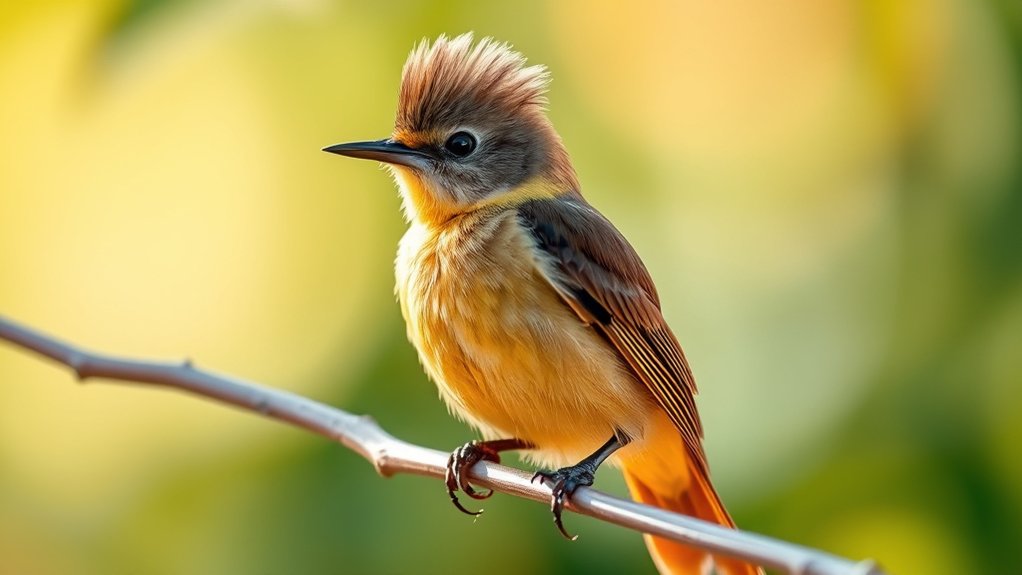
To identify and draw the Great Crested Flycatcher, focus on its gray head and breast, bright yellow belly, and rusty orange wing and tail feathers. Notice its broad shoulders, large head, and wide, pale-based bill.
Capture the bold color contrasts and rounded tail shape. Add natural elements like tree cavities and leafy perches to set the scene. Pay attention to differences between juveniles and adults for accuracy.
Keep exploring, and you’ll soon master every detail.
Recognize the Great Crested Flycatcher’s Key Features
To recognize the Great Crested Flycatcher, focus on its unique color pattern and size. This bird stands out with its distinctive coloration: a brownish-gray head, gray throat and breast, combined with a bright lemony yellow belly and rusty orange accents on its wings and tail.
Measuring between 6.7 to 8.3 inches with a wingspan up to 13.4 inches, it’s larger than other eastern flycatchers. One key identifying feature is its fairly wide, straight bill, sometimes pale at the base.
Juveniles show more white edging on feathers, making them easier to distinguish.
Don’t forget its vocalizations: a loud, rising “wheep” and an agitated “whit-whit-whit” call, often heard even when the bird remains out of sight. These traits will help you spot the great crested flycatcher confidently.
Identify Great Crested Flycatcher’s Distinctive Colors and Patterns
When you spot a Great Crested Flycatcher, its striking color contrasts immediately catch your eye.
Notice the distinctive colors: a gray throat and breast that sharply contrast with its bright yellow belly.
This bright yellow underpart stands out vividly against the bird’s brownish-gray head and back.
The wings and tail feature rusty orange hues, especially visible in the primaries and tail feathers, adding a warm vibrancy to its appearance.
These rusty tones make the flycatcher easy to distinguish from other birds in its habitat.
Juveniles display more white edging on their feathers, but the key to identifying this species lies in those bold, contrasting colors.
Capture the Flycatcher’s Size and Body Shape
Beyond its vibrant colors, the Great Crested Flycatcher stands out thanks to its size and shape. When you observe it, notice its crested feature atop a large head, which gives the bird a distinctive, assertive look.
Its powerful build is evident in the broad-shouldered body, larger than many other flycatchers, measuring between 6.7 to 8.3 inches long. You’ll also see a robust wingspan that complements this strong form.
Don’t miss the rounded tail, which may appear notched or square-tipped, adding to its unique silhouette. Capturing these proportions accurately helps convey the bird’s true presence, setting it apart as a substantial and confident species in your drawing.
Draw the Flycatcher’s Head and Bill Details
When you draw the Great Crested Flycatcher’s head, start by focusing on its large size. You’ll notice the head has a smooth, brownish-gray color that blends nicely into the throat.
It’s a subtle transition but really important to capture.
Next, check out the bill. It’s fairly wide and straight, which is a bit different from other flycatchers.
Plus, the pale base of the bill really stands out. Paying attention to these details will make your sketch instantly recognizable.
Head Shape Characteristics
Although the Great Crested Flycatcher lacks a prominent crest, you can easily spot its broad, slightly puffed gray head. The head shape is wide and rounded, giving the bird a robust appearance compared to other flycatchers.
This gray head shifts smoothly into a similarly colored throat and breast, creating a subtle but distinctive contrast with its bright yellow belly.
When you observe the bird perched high in trees, notice how its head bobs as it scans for insects, often signaling its presence with a distinctive call.
Capturing this wide, gray head shape accurately will bring your drawing to life and help highlight the unique features that set the Great Crested Flycatcher apart from its relatives.
Bill Size And Color
The Great Crested Flycatcher’s bill stands out with its broad base and sharp, pointed tip, perfectly designed for snatching insects mid-flight. When drawing, focus on the bill size and color. It has a powerful build with a broad structure, often showing a pale base contrasting with a darker tip.
The bird’s gray head offers a subtle backdrop, making the bill’s white to pale buff base more noticeable. Capturing these details brings your sketch to life.
| Feature | Description | Drawing Tip |
|---|---|---|
| Bill Base | Broad, pale to white buff | Emphasize width and light tone |
| Bill Tip | Sharp, pointed, darker | Use fine lines for tip detail |
| Head Color | Brownish gray | Blend softly around the bill |
| Throat & Breast | Gray | Contrast gently with the head |
| Bill Function | Catching insects mid-air | Show powerful build in profile |
Highlight Unique Wing and Tail Colors
You’ll notice the Great Crested Flycatcher’s rusty orange primaries and tail—they really stand out sharply against its brownish-gray body feathers.
This bold contrast makes it easier to spot in the wild.
Rusty Primaries And Tail
Rusty orange primaries and tail feathers make the Great Crested Flycatcher stand out among other flycatchers in its habitat. This rusty coloration on the wings and tail is a key feature to help you identify the species.
When you observe the bird in flight, its rusty tail feathers and primaries become especially noticeable against the more muted body tones.
Adult birds show a deep rufous hue, while juveniles have white edging on these feathers, so keep that in mind when identifying age.
As you draw, focus on accurately capturing this rusty coloration, blending it carefully into the bird’s overall look.
Highlighting these rusty tail feathers will bring your illustration to life and guarantee your identification is spot on.
Contrast With Body Feathers
Although its body feathers blend into muted browns and grays, the Great Crested Flycatcher’s wings and tail burst with vibrant rusty orange hues that instantly draw your eye. This striking contrast between the dull body feathers and the bright tail feathers makes identification easier.
When the bird spreads its wings, you’ll notice rounded primaries glowing with rufous orange, standing out sharply against the brownish-gray upper body.
Juveniles add a touch of white edging on their feathers, further highlighting this contrast.
Pay attention to how the rusty tail feathers complement the yellow belly, creating a unique palette that sets the Great Crested Flycatcher apart from other flycatchers.
This vivid interplay of colors makes the bird’s wing and tail feathers unmistakable in the wild.
Show the Flycatcher’s Typical Perching Posture
A Great Crested Flycatcher often perches upright on exposed branches high in the canopy, scanning the air for insects.
When you observe it, notice how it perches with broad shoulders and a big head, giving it a sturdy, alert appearance.
Its fairly wide bill is perfectly designed to snatch prey mid-flight.
The bird typically holds its wings slightly drooped and tail fanned out, which highlights its vibrant plumage.
Its slightly drooped wings and fanned tail beautifully showcase the Great Crested Flycatcher’s vibrant colors.
You’ll also catch the characteristic bobbing of its head, helping it pinpoint flying insects.
This posture isn’t just for show; it’s a hunting strategy, allowing the flycatcher to sit still and spot prey before darting out.
When you draw this posture, focus on the upright stance, broad shoulders, and the distinctive bill to capture its essence.
Add Natural Habitat Elements to Your Drawing
When you add natural habitat elements, start with a typical forest background featuring tall deciduous trees.
Make sure to include tree cavities because the Great Crested Flycatcher nests in them.
And don’t forget to draw perching branches—these are spots where the bird often hunts and surveys its surroundings.
Typical Forest Background
Since the Great Crested Flycatcher favors open broadleaf or mixed woodlands during breeding, you should include tall tree canopies and edges of clearings in your drawing. These elements reflect the bird’s natural environment where it perches high and hunts.
Add a variety of trees like oak and maple to capture the diversity of eastern woodlands. While you shouldn’t focus on tree cavities here, hinting at dense understory can enhance realism.
| Element | Purpose in Drawing |
|---|---|
| Tall tree canopies | Show where flycatchers perch high |
| Edges of clearings | Indicate common flycatcher habitats |
| Variety of trees | Reflect natural eastern woodlands |
| Understory hints | Suggest feeding and nesting zones |
Including these natural habitat elements will make your Great Crested Flycatcher drawing more authentic.
Incorporate Tree Cavities
Although you’ve already included tall tree canopies and edges of clearings, adding tree cavities will bring your Great Crested Flycatcher drawing to life by showcasing its preferred nesting spots.
Illustrate hollowed sections in trunks of oak, maple, or sycamore trees, as these species often host nest boxes or natural cavities. Position these cavities at varying heights, anywhere from 2 to 70 feet off the ground, reflecting real nesting habits.
To add authenticity, depict the variety of materials the flycatchers use inside: grass, leaves, feathers, and even shed snakeskin. Surround the cavities with nearby foliage to enhance the natural setting.
This attention to detail helps capture the bird’s environment, giving viewers a clear sense of its habitat and nesting behavior.
Add Perching Branches
Adding perching branches complements the tree cavities by highlighting where the Great Crested Flycatcher spends much of its time. When you draw perching branches, focus on placing them as high perches, like treetops or edges of clearings, where these birds often sit still.
Use a variety of tree species to reflect their preference for broadleaf or mixed woodlands. Don’t forget to include elements common in urban areas, like park trees or cemetery greenery.
Incorporate details of tree cavities or old woodpecker holes nearby, since these are essential nesting sites.
To bring your drawing to life, show the flycatcher in a dynamic pose, perhaps bobbing its head while hunting insects from its perch. This approach accurately captures its natural behavior and environment.
Use Photos and Videos for Accurate Reference
When you study high-quality photos and videos of the Great Crested Flycatcher, you’ll notice its distinct features like the brownish-gray head, bright yellow belly, and rusty orange accents on the wings and tail.
Use these visual references to capture accurate coloration in your drawing. Videos also reveal the bird’s behavior, such as its characteristic head bobbing and sit-and-wait hunting style from high perches.
Observing its vocalizations in clips helps you understand its presence in dense habitats, which adds context to your artwork.
Don’t forget to compare photos of similar species to highlight unique traits.
Using a combination of photos and videos guarantees your depiction is precise and lifelike, helping you portray the Great Crested Flycatcher authentically in your art.
Draw Juvenile vs. Adult Great Crested Flycatchers
While both juvenile and adult Great Crested Flycatchers share similar gray and yellow tones, you’ll notice key differences in feather patterns and coloration that affect how you should approach your drawing.
Juveniles have more white edging on their feathers, giving them a fluffier, lighter appearance. Their gray tones are more muted, and their yellow belly coloration is less pronounced compared to adults.
Adults display a bright yellow belly that extends higher up the breast, along with rusty primaries and tail feathers that contrast sharply with their body colors.
Pay attention to proportions too. Juveniles are slightly smaller than adults, measuring less than 6.7-8.3 inches.
Capturing these subtle distinctions in coloration and size will make your juvenile and adult flycatcher drawings more accurate and lifelike.
Avoid Common Drawing Mistakes With This Bird
To capture the Great Crested Flycatcher accurately, you’ll need to focus on its distinctive coloration and unique features.
Capturing the Great Crested Flycatcher means emphasizing its vivid colors and signature traits.
Avoid common mistakes like dullening its bright yellow belly or missing the rusty orange on its wings and tail.
Don’t overlook the fairly wide straight bill, which is key to its facial profile and often pale at the base.
When drawing the bird perched scanning, position it with a poised, alert posture to reflect its natural behavior.
Also, consider adding subtle cues of its vocalizations, like the clear rising “reep” calls, to bring life to your illustration.
Skipping these details can make your drawing less recognizable, so pay close attention to these elements for a true-to-life Great Crested Flycatcher.
Frequently Asked Questions
What Time of Year Is Best to Spot Great Crested Flycatchers?
The best time to spot Great Crested Flycatchers is during their spring migration and breeding season, from late April through summer.
You’ll notice them more easily as they become vocal while establishing nests, reflecting their nesting habits.
Focus on their habitat preferences, which are wooded areas with lots of trees.
How Do Great Crested Flycatchers’ Calls Sound?
You might think their calls are just simple bird sounds, but the Great Crested Flycatcher’s call characteristics are actually quite complex.
You’ll notice vocal patterns like rapid “whit-whit-whit” sequences and a buzzy “wheep” sound, which show impressive sound variations.
These communication methods help them defend territory and attract mates.
Can Great Crested Flycatchers Be Found Outside North America?
You won’t often find Great Crested Flycatchers outside North America because their habitat preferences keep them mainly within this continent.
Their global distribution extends from southern Canada through the eastern U.S. to Central America during winter, but they rarely venture beyond these areas.
Thanks to their stable populations and focused breeding grounds, their conservation status remains Least Concern.
What Do Great Crested Flycatchers Eat?
Great Crested Flycatchers primarily eat insects, showing clear insect preferences like butterflies, moths, beetles, and grasshoppers.
You’ll notice their feeding habits involve quick, agile flights from a perch to catch prey mid-air or glean them from foliage.
Their foraging techniques are impressive, and their dietary diversity extends beyond insects to include small fruits, berries, spiders, and even occasional small lizards.
This variety helps keep ecosystems balanced and thriving.
Are Great Crested Flycatchers Migratory Birds?
You might think Great Crested Flycatchers never stop moving. They’re true migratory marvels!
They show fascinating breeding behavior, setting up nesting sites in open woodlands and forest edges.
Their migration patterns sweep them from the eastern U.S. down to Mexico and Colombia. They follow habitat preferences that avoid harsh northern forests.
Conclusion
Now that you know how to spot the Great Crested Flycatcher’s bold colors and unique shape, you’re ready to bring it to life on paper. Remember, capturing its wild, vibrant spirit next to the calm, steady lines of your drawing creates a beautiful contrast, just like nature itself.
So, grab your pencil and don’t stress about perfection; every sketch is a step closer to mastering this lively bird’s charm. Keep observing, keep drawing!