
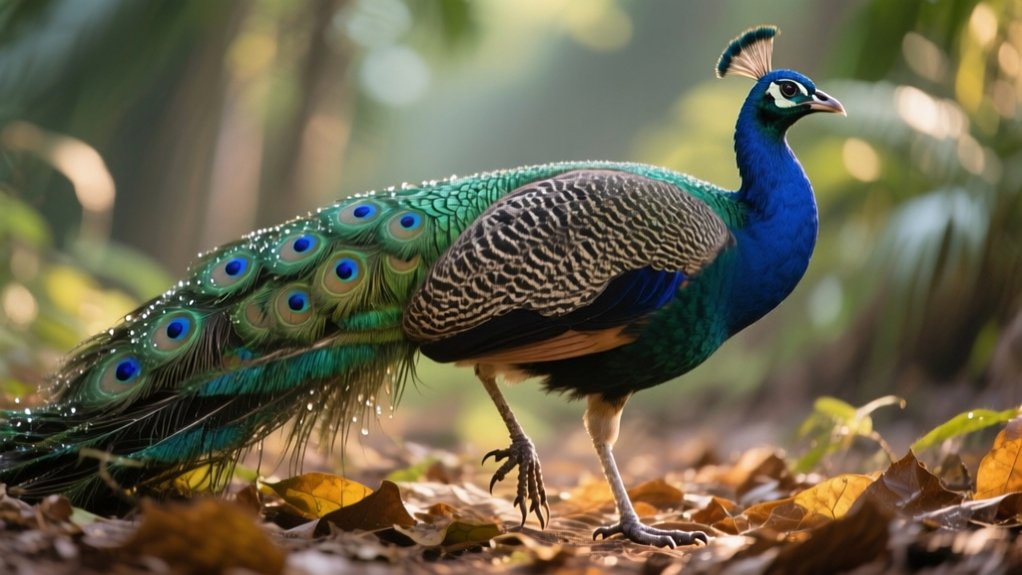
You’ll recognize the Indian peafowl by its vibrant iridescent blue neck and long ornamental train, stretching up to 2.25 m in males. Native to the Indian subcontinent, it favors open forests, woodland edges, and farmland at elevations up to 1,800 m.
Omnivorous and ground-foraging, it feeds on seeds, insects, and small animals. During breeding, males perform elaborate displays and vocalize to attract mates. There’s much more to uncover about their social signals and conservation challenges.
Taxonomy and Identification of Indian Peafowl
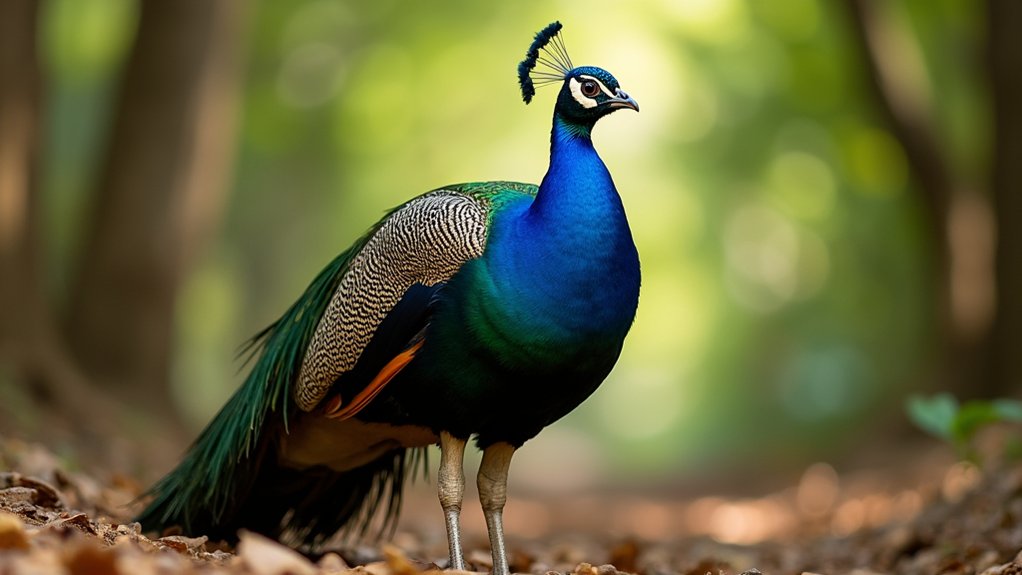
Although the Indian peafowl (*Pavo cristatus*) belongs to the family Phasianidae within the order Galliformes, it stands out taxonomically as a monotypic species without recognized subspecies.
You’ll find it classified under the genus *Pavo*, which includes only one other species, the green peafowl (*P. muticus*).
The Indian peafowl is grouped in the tribe Pavonini, distinguishing it among pheasants and close relatives.
Carl Linnaeus first described it in 1758, assigning the binomial *Pavo cristatus*, with “cristatus” reflecting its crested head feathers.
This species typically reaches a maximum longevity of 23.2 years in captivity, which is notable for birds of its size.
You can identify this species by its distinctive fan-shaped crest and sexual dimorphism in plumage coloration.
It holds a Least Concern status per IUCN and is cataloged with NCBI Taxonomy ID 9049 and TSN 176113 in ITIS and Avibase databases.
Physical Characteristics and Size Details
Building on its taxonomic distinctions, the Indian peafowl exhibits notable physical characteristics that aid in its identification and ecological adaptation. Males display a body length of 100–115 cm, extending to 195–225 cm with their characteristic train, which averages 1.2 m in length. The wingspan ranges from 1.4 to 1.6 m, supporting flight despite the train’s size.
Sexual dimorphism is pronounced: males feature iridescent blue neck feathers and a train with multicolored ocelli, while females have muted brown and cream plumage for camouflage.
Key features include a fan-shaped head crest and distinct facial white markings in males. They’ve strong grayish-brown legs with tarsal spurs aiding terrestrial mobility.
Plus, their toe arrangement is optimized for perching and roosting in trees.
Natural Distribution and Preferred Habitats
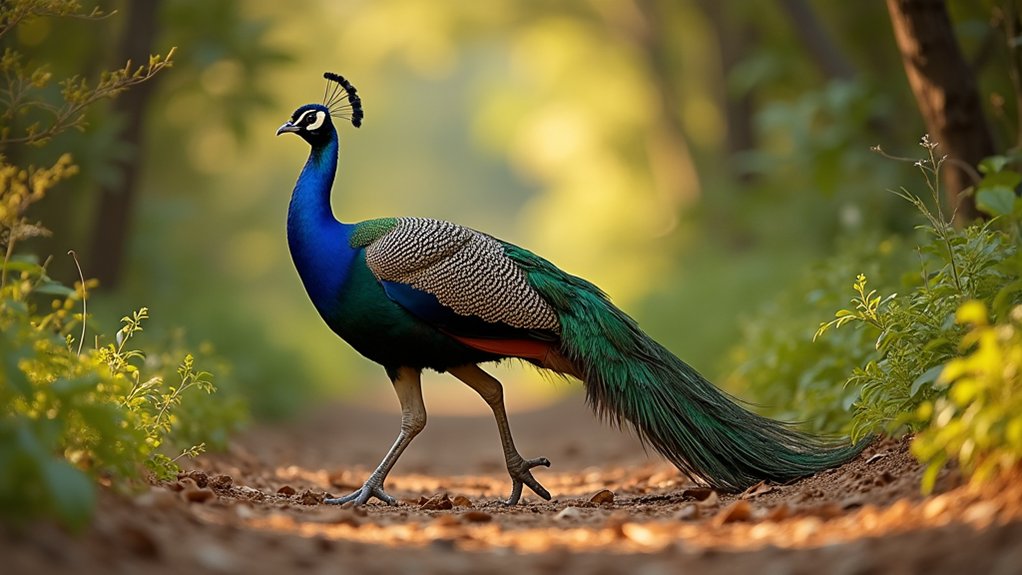
You’ll find Indian Peafowl primarily across the Indian subcontinent, including India, Sri Lanka, and the bordering regions of Pakistan and Nepal.
They tend to favor open forests, woodland edges, and cultivated lands. Often, these birds stick close to water sources, but they usually avoid dense marshlands like the Sundarbans.
Interestingly, Indian Peafowl are quite adaptable.
They make good use of human-modified landscapes, often foraging and finding shelter in agricultural mosaics and village environments. In India, they inhabit elevations up to 5,000ft in the north, showing their adaptability to different altitudes.
Native Range Overview
Because the Indian peafowl’s native range centers on the Indian subcontinent, you’ll find it mainly across India and Sri Lanka. It spans diverse regions from the Indus valley in the northwest to Assam in the northeast, and from the Himalayan foothills down to India’s southern tip.
It inhabits elevations up to 1,800 m, thriving in tropical and subtropical climates but avoids extreme wetland zones like the Sunderbans. In Sri Lanka, its distribution concentrates in drier lowlands. The species is a resident breeder throughout this range without significant seasonal migration. Indian Peafowl are capable of flight and often roost on tree tops at night, demonstrating their adaptability within these habitats (flight capability).
Key landscape types within its native range include:
- Open forests and small hills interspersed with woodland and scrub
- Bushy or shrubby areas near natural or seasonal water sources
- Cultivable and agricultural landscapes, village edges, and peri-urban zones
Habitat Preferences
Indian peafowl occupy a variety of habitats across their native range, favoring environments that provide both open space and access to water. You’ll find them primarily in dry deciduous forests and bushy areas near permanent water sources, avoiding dense rainforests.
They inhabit elevations from 900 to 1,800 meters but do not extend into marshlands like the Sundarbans or beyond Himalayan barriers. Cultivated lands with water access also support populations.
Below is a summary of their habitat preferences:
| Habitat Type | Elevation Range (m) | Water Proximity |
|---|---|---|
| Dry Deciduous Forest | 900–1,200 | Close to permanent water |
| Open Forests & Bushes | Up to 1,800 | Near water sources |
| Agricultural Lands | Variable | Requires water access |
| Dense Rainforests | Avoided | Generally absent |
Diet and Feeding Behavior
Although peafowl consume a wide range of food items, their diet mainly consists of both plant and animal matter, reflecting their omnivorous and opportunistic feeding behavior.
You’ll notice they spend more time feeding on plant materials like seeds, fruits, and young shoots, but insects, small reptiles, and amphibians also form an essential part of their intake.
Their foraging typically occurs on the ground during cooler hours, often in small groups.
Key dietary and feeding characteristics include:
- Preference for native berries, leaves, and cultivated grains such as wheat and maize.
- Opportunistic consumption of insects, small mammals, and even unusual items like termites.
- Feeding activity peaks early morning and late afternoon, sensitive to weather conditions like heavy rain.
This flexible feeding strategy allows peafowl to flourish across diverse habitats.
Mating Rituals and Courtship Displays
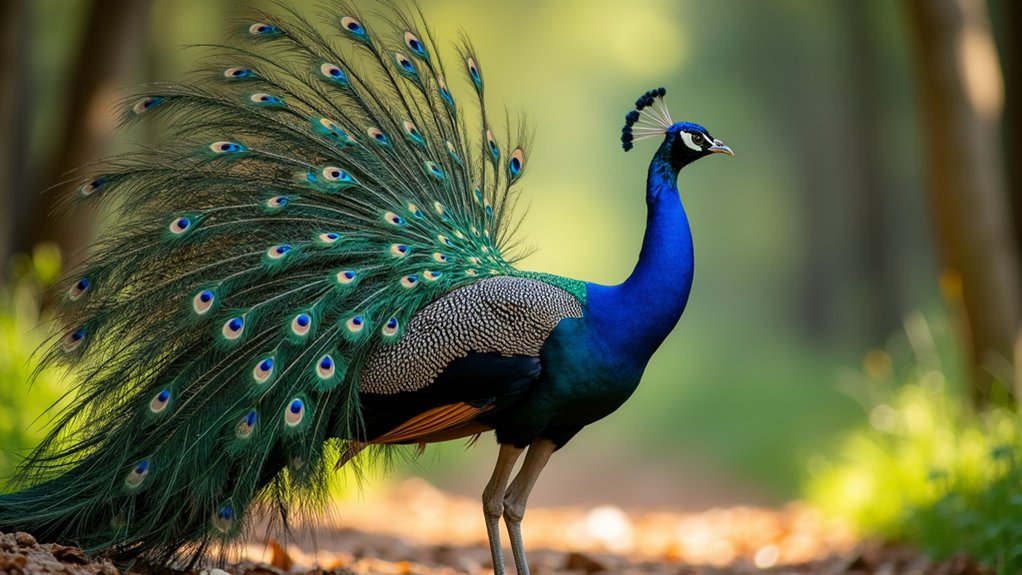
Several males typically gather in loose leks during the breeding season, where they simultaneously perform elaborate displays to attract females.
You’ll notice males spaced 3 to 10 meters apart, each defending a display court through threats or fights.
Dominant males occupy central positions in these leks, increasing their mating success. Their courtship features erect, fan-shaped trains up to 1.6 meters long, adorned with iridescent eyespots.
You’ll see males orient displays about 45 degrees to the sun to maximize eyespot brilliance.
They vibrate their trains at around 25 shakes per second, producing visual flicker and rustling sounds. These movements demand strong neuromuscular control and signal male quality.
Females assess train density and eyespot integrity closely, showing strong preference for intact ocelli, which directly influences mating outcomes during peak monsoon breeding months.
Male peafowl also use vocalizations during courtship, with complex calls that serve to attract peahens and assert dominance among rivals.
Vocal Communication and Social Interactions
You’ll notice Indian peafowl use distinct alarm calls—harsh, trumpet-like honks—to warn of predators. When they do this, it instantly gets the whole group on high alert.
It’s like a quick heads-up that danger is nearby.
Then, during mating season, the males switch things up. They let out loud, high-pitched calls to attract females and to show off their dominance over their territory.
These sounds aren’t just random noise; they’re super important for social signaling. The recordings from Bardiya National Park in Nepal capture these natural vocalizations, highlighting their role in peacock communication.
Basically, these vocalizations help coordinate the group’s behavior and keep the flock together.
It’s their way of staying connected and safe.
Alarm and Mating Calls
Indian peafowl use a diverse vocal repertoire consisting of at least 11 distinct calls to communicate alarm and mating information.
You’ll notice males emit loud, far-carrying “pia-ow” or “may-awe” calls especially during the monsoon breeding season to attract mates and assert territory.
Both sexes produce varied alarm calls signaling predator presence, such as tigers, from ground or raised sites. These calls carry detailed acoustic information, including signaler sex and individual identity, facilitating group coordination.
Key features include rapid alarm calls like “ka-aan..ka-aan” and “honk” notes to warn of danger. These often trigger escape into dense vegetation, and the energy expenditure involved in responding to these calls is balanced by their survival benefit.
Individual recognition encoded in calls enhances antipredator reliability assessment.
Males increase call frequency during early morning and late evening in the breeding season for mate attraction and spacing.
This sophisticated vocal system supports survival and reproduction in complex habitats.
Social Signaling Behaviors
Social signaling in peafowl involves a sophisticated combination of vocalizations and non-vocal cues that facilitate communication within groups. You observe that crest feathers resonate with display vibrations, allowing mechanosensory detection of airflow during social interactions. Recent research has demonstrated that peafowl crests contain filoplumes, specialized feathers that function as mechanosensors responding to social display vibrations.
Vocal calls serve functions from alarm to maintaining group cohesion, with females recognizing individual callers to assess social reliability. These multimodal signals support complex courtship and social dynamics.
| Signal Type | Function | Mechanism/Feature |
|---|---|---|
| Crest vibration | Social orientation | Resonance at 25–28 Hz (train-rattling) |
| Contact calls | Group cohesion | Distinct call types for spacing |
| Individual calls | Recognition and assessment | Identity encoding in call structure |
| Courtship display | Female attention capture | Integrated visual, acoustic, mechanical |
Conservation Status and Human Impact
Although the Indian peafowl (*Pavo cristatus*) holds a status of Least Concern on the IUCN Red List due to its broad distribution and stable population exceeding 100,000 individuals, ongoing conservation efforts remain critical.
You need to understand that human activities impact their habitats and survival.
Protected by laws in India and Sri Lanka, the species benefits from cultural reverence and legal frameworks, yet challenges persist.
Key conservation and human impact factors include:
- Habitat loss from deforestation and agricultural expansion fragments populations and reduces water sources.
- Illegal hunting and poaching continue despite statutory protection.
- Agricultural conflicts arise as peafowl raid crops, leading to retaliatory measures.
- Although the Indian peafowl is widespread, the closely related green peafowl faces severe threats and is classified as endangered species.
Frequently Asked Question
How Do Peafowl Defend Themselves Against Predators?
You’ll find that peafowl defend themselves by combining physical and behavioral tactics.
They use leg spurs and strong beaks to fend off threats but prefer running into dense cover or flying short distances to roosts.
Their large, colorful train can intimidate or startle predators, while cryptic body coloring aids camouflage.
They stay vigilant, use alarm calls to warn the group, and choose dense habitats and high roosts to avoid danger effectively.
What Is the Molting Cycle of the Peacock’s Train Feathers?
Ever wondered why the peacock sheds its beautiful train annually? The molting cycle starts post-breeding, typically August to October, and lasts about 5–7 months.
You’ll see a gradual loss: first ocellus feathers fall over 2–3 weeks, then most train feathers over 4–6 weeks, followed by 2–3 months of regrowth.
This renewal maintains feather quality for mating, controls parasites, and reallocates energy efficiently.
Timing varies with age, climate, and environment.
Can Peafowl Fly Long Distances During Migration?
No, peafowl can’t fly long distances during migration because they’re non-migratory birds.
You’ll notice they generally stay year-round within the same local territories.
Their flight is typically short, under a mile, used mainly to reach roosting spots or escape predators briefly.
Their heavy body and wing structure limit endurance.
How Do Peafowl Contribute to Controlling Venomous Snake Populations?
You’ll find that peafowl actively reduce venomous snake populations by hunting and killing snakes within their territories.
Their keen eyesight and quick reflexes let them detect and attack snakes efficiently, often targeting dangerous species like cobras.
They use strong legs and sharp claws to disable snakes, sometimes cooperating in groups.
This predation pressures snakes to avoid peafowl areas, indirectly protecting humans and livestock from snakebites by lowering local venomous snake presence.
What Cultural or Religious Significance Do Peafowl Hold in India?
You’ll find peafowl hold deep cultural and religious significance in India, symbolizing beauty, purity, and spiritual awakening.
They’re linked to deities like Krishna, Kartikeya, Saraswati, and Lakshmi, embodying divine love, wisdom, courage, and prosperity.
Their feathers feature in rituals for protection and good fortune.
As India’s national bird, peafowl represent heritage, unity, and artistic inspiration.
They appear widely in festivals, dance, art, and mythology across the country.
Conclusion
When you observe the Indian peafowl, you witness more than vibrant feathers; you see nature’s emblem of beauty and survival. Its intricate plumage symbolizes evolutionary success shaped by habitat and behavior.
Understanding its taxonomy, diet, and social patterns helps you appreciate how this species thrives amid environmental challenges. By recognizing the peafowl’s role in ecosystems and human culture, you contribute to conserving a living symbol of biodiversity’s delicate balance.