
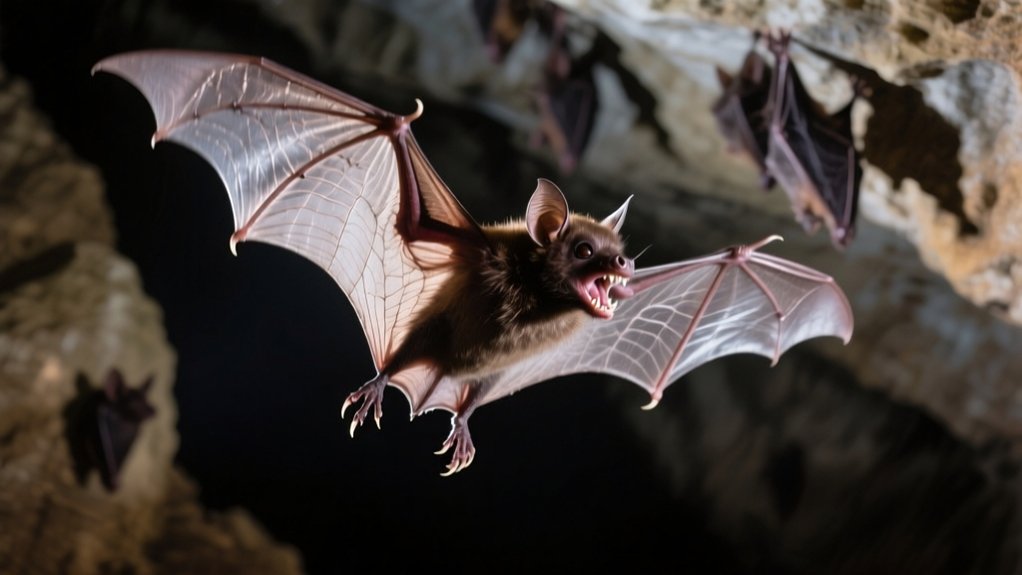
A bat is a mammal, not a bird, and it makes up about 20% of all mammal species. Unlike birds, bats have fur instead of feathers, give birth to live young, and nurse their offspring with milk.
Their wings are skin stretched over long fingers, allowing agile flight, while birds have feathered wings. Bats also use echolocation to navigate and hunt at night, unlike birds that mainly rely on vision.
There’s a lot more fascinating differences you’ll find as you investigate further.
Taxonomic Classification of Bats
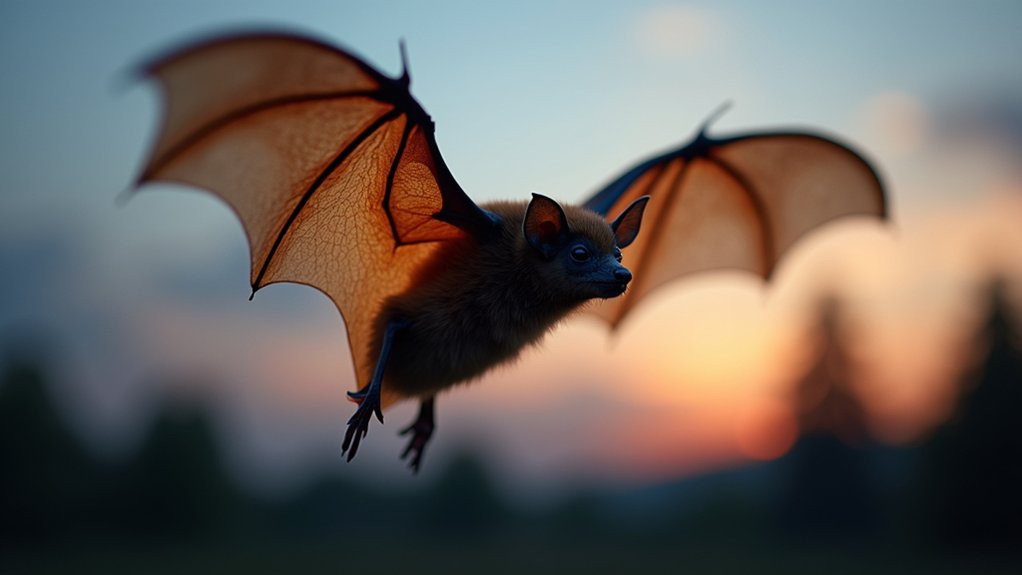
Although bats might seem like birds because they fly, they actually belong to the mammal class, Mammalia, under the order Chiroptera. This order’s name comes from Greek, meaning “hand wing,” reflecting their wing structure.
You’ll find about 1,200 to 1,400 bat species worldwide, making up roughly 20% of all mammal species. Chiroptera splits into two main suborders: Megachiroptera, or Old World fruit bats, with around 200 species, and Microchiroptera, which includes most other bats and has about 743 species.
The taxonomy is complex, featuring 18 families and over 900 species total. Bats are further classified into over 170 genera, showing the vast diversity within the order Chiroptera classification.
Recent genetic studies even reshaped classification by confirming bats originated from a single ancestor and by reorganizing suborders. This highlights ongoing advances in understanding bat diversity and evolution.
Distinct Mammalian Traits of Bats
Understanding the taxonomic classification of bats helps clarify why these creatures exhibit key mammalian traits that set them apart from birds.
For starters, bats are covered in fur, not feathers, providing insulation unique to mammals. They give birth to live young rather than laying eggs, enabling prolonged maternal care.
You’ll also notice bats nurse their offspring with milk from mammary glands, a hallmark of mammals. They maintain a regulated body temperature, supporting their active flight and nocturnal lifestyle. Additionally, bats use echolocation, a specialized acoustical orientation technique that aids in hunting and navigation.
Additional mammalian features include belly buttons from placental development, teeth instead of beaks, and lung-based respiration.
Bats have belly buttons, teeth, and breathe with lungs—clear signs of their mammalian nature.
These distinct traits firmly place bats within the mammalian class, despite their ability to fly, which is unlike any other mammal.
Anatomical Differences Between Bats and Birds
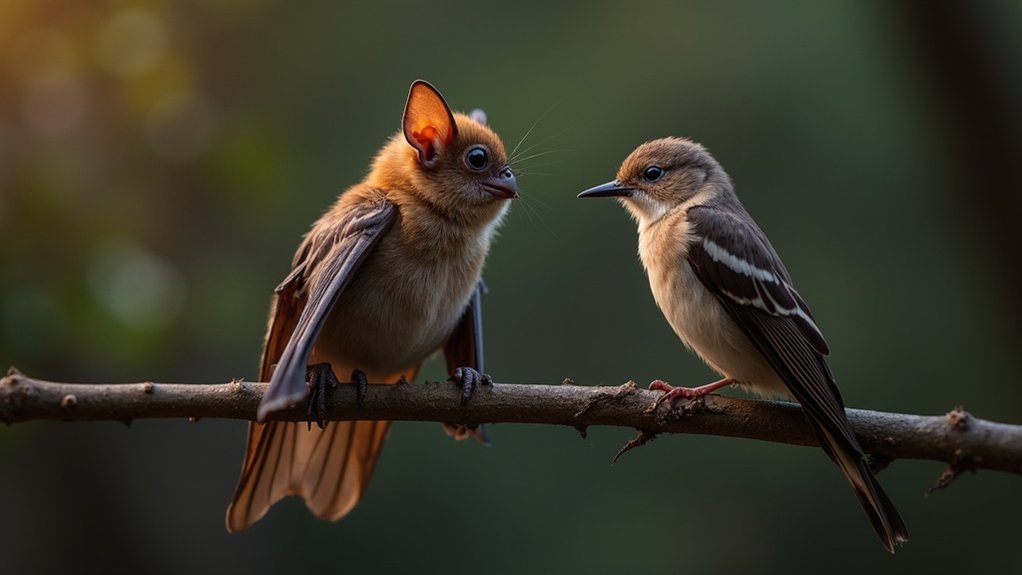
You’ll notice that bats have fur covering their bodies, while birds are covered in feathers. These coverings play different roles in insulation and flight.
Plus, bats have visible external ears that are really important for echolocation. Birds, on the other hand, don’t have these external ears.
Their wings are quite different too—bat wings are made of skin stretched over really long fingers. Bird wings, however, rely on feathers that extend along their arm bones to help them fly. Research shows that in bats, the evolution of wings and legs is tightly coupled, unlike in birds.
Fur vs. Feathers
Two distinct coverings set bats and birds apart: fur and feathers.
You’ll notice bats have fur covering their bodies, including some with fully furred tails. This fur varies in color and features guard hairs that add sheen and protection.
In contrast, birds lack fur entirely; they rely on feathers for external coverage. Feathers attach mainly to their arms and hands, serving as essential flight structures and providing insulation. Bats’ wings are skin membranes stretched across finger bones, not feathered.
Both fur and feathers offer thermal regulation, enabling warm-blooded metabolism during flight. Additionally, bats possess teeth while birds have beaks, further distinguishing their anatomy.
Fur aligns with bats’ mammalian traits, supporting live birth and milk production, while feathers complement birds’ egg-laying reproduction.
Understanding these coverings clarifies why bats are mammals, despite their ability to fly like birds.
Ear and Wing Structure
Although bats and birds both take to the skies, their ear and wing structures reveal key anatomical differences that set them apart.
Bats have external ears called pinnae, essential for echolocation and directional hearing, while birds lack external ears entirely. Inside, echolocating bats feature highly specialized cochleae adapted for detecting ultrasonic echoes. These cochleae have an elongated basilar membrane that enhances sensitivity to high-frequency sounds crucial for echolocation.
Their wings differ fundamentally too. Bats’ wings are formed from elongated finger bones covered by flexible membranes, reflecting their mammalian heritage.
Birds, in contrast, have feathered wings with rigid skeletal structures optimized for lift.
These bat wings provide superior maneuverability despite aerodynamic compromises, such as large ears affecting air flow.
Understanding these differences helps you appreciate why bats, despite flying, are mammals with unique sensory and flight adaptations distinct from birds.
Wing Structure and Flight Mechanics
Because bat wings evolved from modified mammalian forelimbs, their structure differs markedly from bird wings, offering unique advantages in flight mechanics.
Your bat’s wing consists of elongated arm bones and five flexible fingers, supporting a thin, elastic membrane rather than feathers. The wing membrane, known as the patagium, is a specialized skin extension containing blood vessels and muscles that contribute to flight control.
Bat wings feature elongated arms and five flexible fingers supporting a thin, elastic membrane instead of feathers.
This wing membrane stretches from shoulder to digits, allowing remarkable bending without damage. The bat’s lightweight skeletal bones, reduced in density, combine with flexible metacarpals and phalanges to provide both strength and agility.
Muscles within the wing membrane finely control curvature during flight, giving you exceptional maneuverability for catching insects or hovering by flowers.
Unlike birds’ rigid wings supported by a single finger, bats’ multi-boned wings enable complex aerial movements, making their flight more versatile and precise.
Fur Versus Feathers: Body Coverings Explained
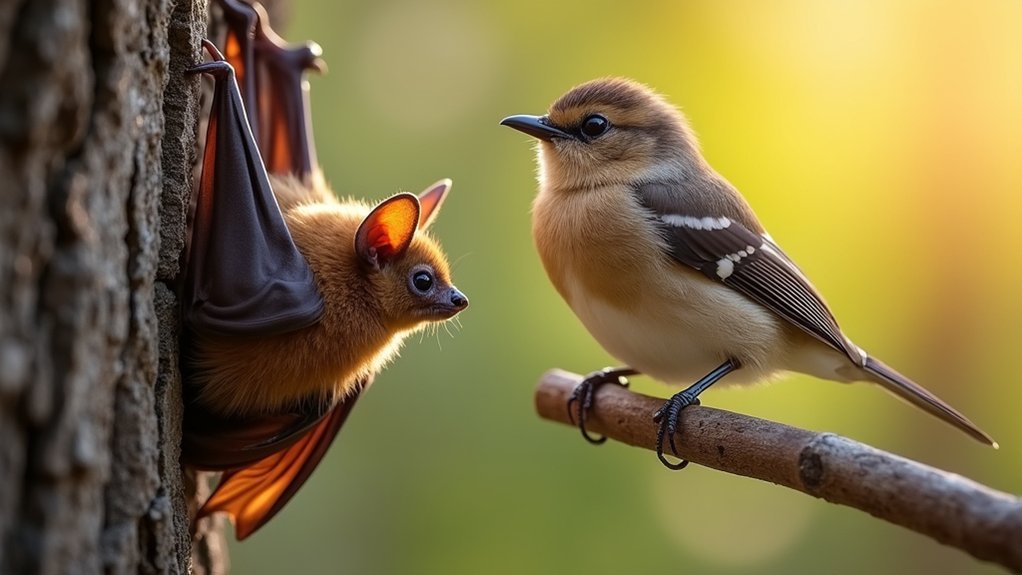
Body coverings play an essential role in distinguishing bats from birds, as they reflect fundamental differences in evolution and function. Bats are covered in fur, which insulates their bodies and aids in camouflage. This is especially true for tree-roosting species with thick fur on their tail membranes. Unlike birds, bats are mammals and possess unique anatomical features such as their wing structure involving elongated, flexible finger bones.
In contrast, birds are covered in feathers that not only provide thermal regulation but also form the entire wing structure necessary for powered flight. Bat wings consist of skin membranes stretched over elongated fingers, with tiny hairs possibly affecting aerodynamics.
This skin-based wing contrasts sharply with feathered wings, underscoring bats’ mammalian classification. Understanding these differences helps you see why fur signifies mammals like bats, while feathers mark birds, highlighting separate evolutionary paths for these flying creatures.
Reproductive Methods: Live Births Versus Egg Laying
Beyond their distinct coverings, bats and birds also differ fundamentally in how they reproduce. Bats, as mammals, give live birth to pups after internal gestation. They provide maternal care and nursing. Additionally, bats are unique among mammals because they are the only ones capable of true flight due to their specialized wing-like structure.
Birds, however, lay eggs externally and incubate them until hatching. This key difference highlights their separate classifications.
| Attribute | Bats (Mammals) | Birds (Aves) |
|---|---|---|
| Reproductive method | Live births | Egg laying |
| Gestation | Internal fetal development | No internal gestation |
| Offspring care | Extended maternal nursing | Limited post-hatching care |
| Birth process | Vaginal birth | Egg laying |
| Classification | Mammals (Chiroptera) | Birds (Aves) |
This reproductive contrast confirms bats as mammals, distinct from birds in reproductive biology.
Sensory Adaptations: Echolocation in Bats
When you navigate a dark cave or hunt at night, bats rely on echolocation, a sophisticated sensory adaptation that lets them emit high-frequency sound pulses and interpret returning echoes to map their surroundings and pinpoint prey.
Depending on the species, bats emit calls through their mouth or nose, adjusting frequency and duration to environmental conditions. Calls range from 11 to 212 kHz and shorten as bats approach targets to prevent echo overlap.
Their inner ear and brain process echoes differently across evolutionary groups, enabling precise navigation. Recent research has shown that two major groups of bats possess distinct inner ear structures that process echolocation signals in unique ways. Bats also contract middle ear muscles during calls to avoid self-deafening.
Bats’ inner ear and brain uniquely decode echoes while protecting hearing by contracting middle ear muscles during calls.
This sensory system shows remarkable flexibility; bats modify calls by context, season, and life stage.
With over 1,100 species utilizing echolocation, this adaptation highlights their evolutionary success in diverse habitats.
Behavioral Patterns: Nocturnal Activity and Roosting
Echolocation helps bats navigate and hunt during the night, but their survival also depends on specific behavioral patterns tied to nocturnal activity and roosting.
You’ll notice that bats emerge at dusk, usually between 6 PM and 6 AM, with their activity synchronized to changing daylight through internal clocks.
They feed in short bouts, often twice nightly, resting in between to conserve energy.
During the day, bats roost in secluded spots that meet strict light, temperature, and humidity needs, where they hang upside down, groom, and sleep.
At night, they use secondary roosts as temporary shelters between feeding trips, reducing energy costs and aiding recovery.
Many bat species form colonies, sometimes comprising large groups, which provides social benefits and protection during roosting colonial behavior.
Understanding these patterns highlights how bats expertly balance rest and activity to thrive in their nocturnal niche.
Ecological Roles of Bats Compared to Birds
You’ll find that both bats and birds play essential roles in pollination and seed dispersal, which helps support forest regeneration and crop production.
Birds mostly take care of pollination during the day, but bats pick up the slack at night, making sure plants keep reproducing around the clock.
Plus, together, they do a great job controlling insect populations, which really benefits both ecosystems and agriculture.
Over 90% of tropical plant species depend on animals for seed dispersal, highlighting the critical importance of these interactions in forest ecosystems seed dispersal.
Pollination and Seed Dispersal
Although both bats and birds play essential roles in pollination and seed dispersal, their ecological contributions differ markedly in patterns and effects.
Birds tend to disperse seeds in clumps, especially small seeds from pioneer plants, mainly in disturbed habitats like bracken, which supports forest regeneration. Over 90% of tropical plant species rely on animals for seed dispersal, highlighting the critical role of these animals in ecosystem recovery animal seed dispersal.
Bats, on the other hand, distribute seeds randomly, reflecting their feeding roost behavior, and play a vital role in forest edge and interior habitats. You’ll find that bat pollination maintains genetic diversity and ecosystem stability, with species like *Piper* and *Vismia* relying on them.
While birds excel in dispersing many small seeds in open areas, bats handle a wider range of seed sizes and contribute considerably to plant reproduction and forest recovery, especially in fragmented landscapes.
Insect Population Control
Because bats feed mainly at night, they efficiently target and consume vast numbers of nocturnal insects, including many agricultural pests that birds typically miss. A single bat can eat up to 3,000 insects nightly, focusing on pest species active when birds are inactive.
This natural pest control saves U.S. agriculture over $3 billion annually by reducing the need for chemical pesticides. However, the collapse of insect-eating bat populations since 2006 due to White-Nose Syndrome has forced farmers to rely more heavily on chemical pest control methods, increasing pesticide use by approximately 31% in bat population decline areas.
When bat populations decline, farmers increase insecticide use by 31%, which harms beneficial insects, pollutes the environment, and raises health risks like infant mortality.
Crop damage also rises, causing significant revenue losses, up to 30% in affected areas. Unlike birds, bats’ nocturnal feeding aligns with pest activity, making their role in insect population control essential for ecological balance and sustainable agriculture.
Skeletal and Muscular Features Unique to Bats
When you examine a bat’s skeleton and muscles, you’ll notice several unique adaptations that enable their extraordinary flight abilities. Their elongated arm and finger bones support a flexible wing membrane, kept light for efficient flight.
The forearm shows a strong radius and a reduced ulna, enhancing wing agility. Unlike birds, flight muscles attach mainly to shoulder blades, while fused cranial bones reduce weight.
Their thumbs remain free with claws, aiding climbing and grasping.
| Feature | Adaptation |
|---|---|
| Wing Bones | Elongated, slender for lightness |
| Forearm | Strong radius, reduced ulna |
| Flight Muscles | Attached to shoulder blades |
| Thumb | Free with claw for climbing |
| Hind Limbs & Membrane | Backward knees, interfemoral membrane |
Differences in Hearing and Navigation Systems
The unique skeletal and muscular features that enable bats to fly also support their remarkable hearing and navigation abilities.
Unlike birds, bats actively emit high-frequency echolocation calls and interpret returning echoes to precisely navigate and hunt, even at speeds up to 10 meters per second. They possess a specialized inner ear structure, including the ganglion canal, which is crucial for processing auditory information during echolocation.
Their cochlea features an elongated basilar membrane finely tuned to detect rapid frequency changes, enhancing sensitivity to specific sounds.
An elongated basilar membrane in bats’ cochlea sharpens detection of rapid sound frequency changes.
Bats’ external ears are mobile and adjustable, allowing them to capture sound waves directionally, while a special valve protects against auditory overload.
Their middle ear contains delicate ossicles and large muscles that control vibration transmission during echolocation.
In contrast, birds rely mostly on vision and passive hearing, lacking external ears and biological sonar, which limits their auditory navigation capabilities compared to bats.
Frequently Asked Question
How Long Do Bats Typically Live Compared to Birds?
You’ll find bats generally live longer than many birds of similar size.
While small birds often live around 5 to 10 years, bats typically reach 10 to 20 years in the wild.
Some species like Brandt’s bat can live over 40 years. Their longevity is impressive given their tiny size.
This is thanks to factors like hibernation and low predation.
These help you understand why bats outlive comparable birds and mammals.
Are Bats More Closely Related to Rodents Than Birds?
Think of bats and rodents like distant cousins at a family reunion. They share some traits but aren’t closely related. Bats belong to the order Chiroptera, rodents to Rodentia.
Genetic studies show bats are more closely related to primates and flying squirrels than to rodents.
Can Bats Carry and Transmit Diseases to Humans?
Yes, bats can carry and transmit diseases to humans. You should know they harbor many viruses, including some highly virulent ones like SARS and Nipah.
While most bat viruses don’t infect humans, direct spillover happens, especially for people near bat habitats or who hunt bats.
Transmission can occur through bites, contact with bat fluids, or respiratory droplets.
Still, sustained human-to-human spread from bats is relatively rare.
What Are the Common Predators of Bats in the Wild?
You’ll find bats face many predators in the wild.
Owls, like great horned and barn owls, hunt them at night, while hawks swoop from above.
On the ground, cats and raccoons catch bats near roosts.
Snakes and crocodiles prey on bats near water, and even centipedes and tarantulas in caves pose threats.
Plus, other bats sometimes prey on their own species.
Humans remain the largest overall predator of bats.
Do Bats Migrate Like Some Bird Species Do?
Yes, bats do migrate like some bird species, but usually over shorter distances. You’d be surprised to know some bats can fly about 1,000 kilometers during migration!
Unlike birds, their migration is often linked to food availability or hibernation needs rather than long intercontinental journeys.
You’ll find temperate bats migrating to warmer caves for winter, while tropical bats follow blooming flowers or insect swarms, adjusting their routes yearly based on resources.
Conclusion
Now that you’ve glimpsed the delicate dance between bats and birds, you’ll see bats aren’t just shadowy birds of the night. They’re warm-blooded marvels wrapped in fur, soaring with wings crafted by evolution’s careful hand.
Their unique flight, keen senses, and cozy roosts paint a picture of mammals perfectly adapted to twilight skies. So next time you spot a flutter in the dusk, you’ll know you’re watching nature’s own nocturnal acrobats, not feathered friends.