

You can classify a duck as a bird by noting its feathers, which serve insulation and flight functions, and its lightweight skeletal structure that supports flight. Ducks lay hard-shelled eggs, a key oviparous trait in birds.
Their broad, flat bills and webbed feet reflect specialized adaptations for aquatic living, typical of waterfowl. You’ll also find their moderately long necks and vocalizations align with avian characteristics.
Exploring further, you’ll uncover more about how these features distinguish ducks within the bird class.
Key Characteristics of Birds
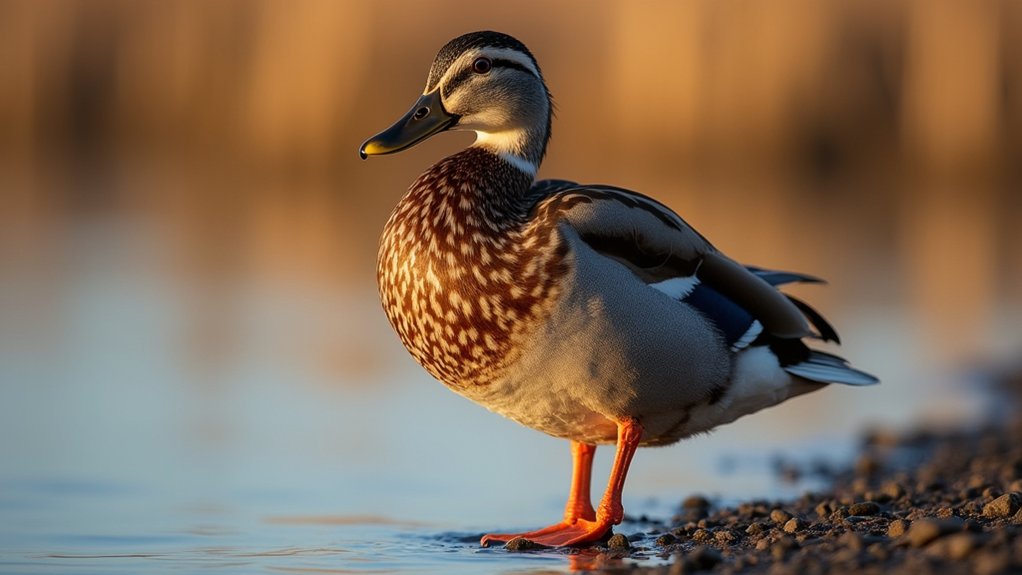
Feathers define birds and set them apart from other animals, serving essential functions in insulation, flight, and communication.
When you observe birds in flight, you notice their streamlined body shape, which minimizes air resistance and optimizes aerodynamic efficiency. This shape, combined with lightweight skeletal structures, allows for sustained flight.
Furthermore, adaptations like webbed feet enable efficient movement in aquatic environments, enhancing swimming capability without compromising flight.
Birds lack teeth, relying on beaks tailored to their diets. Their high metabolic rate and endothermic nature maintain stable body temperature, critical for sustained activity.
Most birds lay hard-shelled eggs, providing embryo protection.
Unlike some animals that exhibit live birth in the animal kingdom, all birds are oviparous and reproduce exclusively by laying eggs, a distinctive feature that further unites the class Aves.
Understanding these precise characteristics clarifies why ducks, with their feathers, body shape suited for flight, and webbed feet, unmistakably belong to the class Aves.
Physical Features of Ducks
You’ll notice that ducks have different bill shapes. Some are broad and serrated, while others are more streamlined. Each shape helps them with their specific feeding habits.
Their plumage patterns also vary a lot. Male ducks often show off vibrant colors that change with the seasons to help them blend in better.
Plus, their tail and head shapes can be quite different depending on the species. Features like curly tail feathers or unique head crests make it easier to tell them apart.
Bill Shape Variations
A duck’s bill exhibits remarkable variation in shape and size, directly linked to its feeding strategies and habitat. When identifying waterfowl, bill shape variations provide critical clues.
For example, northern shovelers feature wide, spatula-like bills ideal for filter-feeding, while canvasbacks possess strong, straight bills suited for plunging.
Female common mergansers have narrow, pointed bills with hooked tips to grip slippery fish efficiently.
Furthermore, comparing bill size and contour helps you identify ducks; the American wigeon’s short, rounded bill contrasts with the northern pintail’s longer, tapered one.
Recognizing these subtle yet distinct bill differences allows you to accurately classify and identify ducks, reflecting their diverse ecological roles and feeding adaptations in aquatic environments.
Plumage Color Patterns
Although ducks share common structural features, their plumage color patterns vary considerably between sexes and species. These patterns play an essential role in identification and ecological behavior.
You’ll notice males often exhibit vibrant, iridescent colors and intricate patterns to attract mates, while females display muted, camouflaged tones. For example, male mallards have striking green heads and chestnut breasts, contrasting with the mottled brown of females.
Northern shovelers show distinctive green heads and white shoulders, helping you distinguish sexes and species.
Wood ducks’ males boast iridescent greens and purples, while females appear gray-brown with white facial markings.
Moreover, white patches like the gadwall’s white speculum and pintail’s wing markings help you identify waterfowl and classify duck species accurately based on plumage color patterns.
Tail and Head Shapes
Tail and head shapes provide critical clues for identifying duck species. You’ll notice that tail feathers vary widely: ruddy ducks have stiff, upright tails, northern pintails feature long, pointed tails, and male mallards show distinctive curly tail feathers.
Head shapes also differ greatly; ring-necked ducks have tall, peaked heads, wood ducks sport oblong, boxy crests, and male canvasbacks display wedge-shaped heads. These variations help distinguish dabbling from diving ducks.
Use the table below to compare key tail and head shapes:
| Duck Species | Tail Feathers | Head Shapes |
|---|---|---|
| Ruddy Duck | Stiff, upright | Rounded |
| Northern Pintail | Long, pointed | Rounded |
| Ring-necked Duck | Curly (male mallard) | Tall, peaked |
| Canvasback | Normal | Wedge-shaped |
Observing these features alongside plumage and bill shape sharpens identification accuracy.
Anatomical Adaptations for Flight
When you observe ducks in flight, you’ll notice their bodies are engineered to maximize efficiency and speed. Their anatomical adaptations include a lightweight, streamlined structure that reduces drag, essential for identifying waterfowl with a large body.
Ducks feature long, pointed wings that generate lift and thrust, supported by a distinctive wingbeat pattern unique among waterbirds.
Their skeletal system incorporates hollow bones, minimizing weight without compromising strength, which is important for sustained flight.
Powerful breast muscles, constituting a significant portion of their mass, drive strong wing flapping.
Furthermore, ducks possess a specialized feather arrangement, with primary and secondary flight feathers optimized for aerodynamics and precise maneuvering.
These adaptations collectively enable ducks to achieve efficient, agile flight, reinforcing their classification within the avian group.
Duck Behavior and Habitat
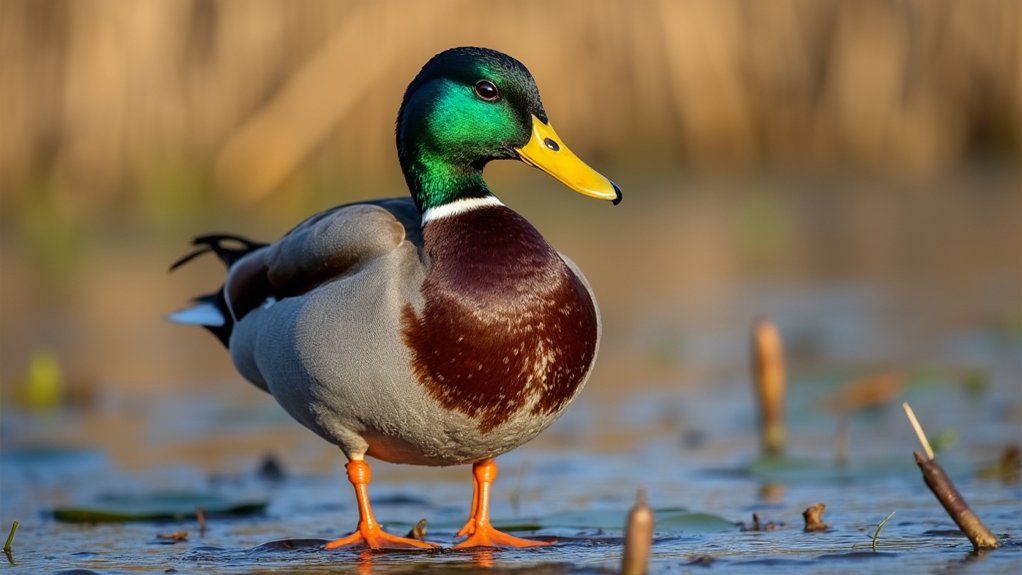
Because ducks display diverse feeding strategies and habitat preferences, understanding their behavior requires examining both aspects in detail.
You’ll find dabbling ducks feed primarily at the water’s surface or on land, exemplified by species like mallards, while plunging ducks forage underwater, requiring a running start to take flight.
Ducks inhabit freshwater lakes, rivers, marshes, and coastal regions globally, except Antarctica.
Migratory species breed in temperate and Arctic zones, traveling extensively to wintering grounds, unlike tropical, mostly sedentary species.
Breeding behaviors include pair bonding and varied nesting, from ground nests to cavities.
For duck hunters, recognizing these behavioral and habitat differences is essential for effective observation and conservation.
This thorough understanding of duck behavior and habitat aids accurate classification within the avian taxonomy.
Differences Between Ducks and Other Birds
You’ll notice ducks differ from other birds in several key ways.
For starters, their broad, serrated bills are pretty distinctive, and their legs are placed in a way that’s perfect for swimming. It’s all about those morphological traits.
Then, when you look at their behavior, ducks really stand out.
They’ve unique flight styles and feeding methods that aren’t quite like what you see with other birds.
And there’s more—ducks tend to prefer aquatic habitats.
This choice influences not only their physiology but also their overall lifestyle, which is quite different from birds that are adapted to living on land or flying high in the air.
Morphological Distinctions
Although ducks share the class Aves with many other birds, their morphological features set them apart distinctly. You’ll notice their morphological structure includes a broad, flat bill with serrated edges, a distinctive adaptation for filter-feeding in aquatic habitats.
Moreover, their compact body shape differs markedly from many terrestrial birds. One of the most distinctive features you’ll observe is their strong, webbed feet, positioned far back on the body. This placement improves swimming and diving efficiency but compromises walking agility on land.
Unlike many bird species, ducks’ legs are set posteriorly, facilitating propulsion in water. These morphological distinctions, including their unique bill shape and leg positioning, clearly differentiate ducks from other avian orders, emphasizing their specialization as waterfowl within the order Anseriformes.
Behavioral Characteristics
When you observe ducks in their natural habitats, their behavioral traits immediately reveal adaptations to aquatic life that set them apart from many other birds. Wild ducks exhibit distinctive behavior characteristics such as dabbling, plunging, and ground nesting near water, unlike terrestrial birds that forage on land or nest in trees.
Their webbed feet enable efficient swimming, a critical trait waterfowl hunters recognize. Migratory patterns and diverse vocalizations further differentiate ducks from other avian species.
| Behavior Aspect | Ducks |
|---|---|
| Foraging | Dabbling and plunging in water |
| Nesting | Ground nests near water |
| Locomotion | Webbed feet for swimming |
| Migration | Long-distance seasonal travel |
| Communication | Species-specific quacks, whistles |
Habitat Preferences
Ducks depend on aquatic environments more than most birds, thriving in freshwater and saltwater habitats such as lakes, rivers, marshes, and wetlands. Their habitat preferences contrast sharply with many birds favoring terrestrial or arboreal zones.
You’ll notice ducks require specific aquatic ecosystems for feeding, breeding, and nesting, showing a strong reliance on water quality and levels. Migratory species often breed in temperate and Arctic regions, adapting to seasonal changes, while tropical ducks tend to remain non-migratory in stable environments.
Unlike more sedentary bird species, ducks may exhibit nomadic behavior in response to habitat fluctuations, such as erratic rainfall.
This adaptability highlights their sensitivity to aquatic ecosystem health, making them crucial indicators of environmental changes within wetland habitats.
Recognizing Ducks in the Wild
If you want to recognize ducks in the wild, focus on their distinctive physical features and behaviors. You can identify ducks by their broad, flat bills designed for dabbling or diving as they forage for food. Their webbed feet enable efficient swimming, while a moderately long neck helps them reach underwater vegetation or prey.
Male ducks often display vibrant plumage during breeding seasons, contrasting with the camouflaged females. This contrast aids in nesting concealment.
Observe their foraging behavior: dabbling on the water’s surface or diving underwater. Ducks inhabit freshwater or coastal habitats, so look there.
Furthermore, listen for vocal cues; female mallards’ quacks and male whistles provide auditory identification. By combining these visual and behavioral markers, you can accurately recognize ducks in their natural environments.
Frequently Asked Question
Can Ducks Swim Underwater Like Fish?
Yes, you can observe ducks swimming underwater, but they don’t swim like fish. Unlike fish, ducks rely on their lungs, so they must surface regularly for air.
You’ll notice plunging ducks, like scaup, are better swimmers underwater than dabbling ducks. They use their webbed feet to propel themselves, typically submerging for food.
Their descents usually last up to a minute, using buoyancy to resurface efficiently.
What Sounds Do Different Duck Species Make?
You’d think all ducks just quack, but that’s ironically far from the truth.
Female mallards quack distinctly, while males rasp.
Many ducks don’t quack at all; they whistle, coo, yodel, or grunt.
Scaups produce a signature call sounding like their name, aiding identification.
Wood ducks emit a unique “oo-eek, oo-eek” during flight.
These vocal variations reflect evolutionary adaptations for communication and species recognition.
How Long Do Ducks Typically Live in the Wild?
Ducks typically live 5 to 10 years in the wild, though some species like mallards can rarely reach up to 20 years.
You should consider factors like predation, habitat quality, and food availability, which greatly affect their lifespan.
Migratory ducks face additional survival challenges during migration, reducing their longevity.
Conservation efforts and habitat preservation can increase their life expectancy by minimizing threats and providing better living conditions.
Are Ducks Migratory Birds?
Yes, many ducks are migratory birds, with species like the Mallard traveling up to 3,000 miles along established flyways.
You’ll notice they follow routes such as the Atlantic or Pacific Flyway to move between breeding and wintering grounds.
However, some tropical ducks don’t migrate and stay local year-round.
You should also consider how climate change and habitat loss are altering these migratory patterns, affecting their survival and distribution.
What Do Ducks Eat During Winter Months?
During winter, ducks eat aquatic plants, seeds, and grains that remain accessible despite cold conditions.
Dabbling ducks forage on surface vegetation or tip to reach submerged plants, while diving ducks consume fish and invertebrates underwater.
You’ll also find them feeding on leftover crops like corn and rice in harvested fields.
Insects and small crustaceans provide additional protein when available, helping ducks meet energy demands and influencing their migration to areas with abundant food.
Conclusion
Now that you know ducks share key bird characteristics like feathers, beaks, and hollow bones, you can confidently classify them as birds.
Curiously, ducks have waterproof feathers coated with oil from a gland near their tails. This helps them spend up to 90% of their time in water without getting soaked.
This unique adaptation highlights their specialized anatomy within the bird class. Recognizing these traits helps you appreciate ducks’ distinct place in the avian world.