

Yes, a duck is definitely a bird. You can tell because it has key avian features like feathers, a beak suited for aquatic feeding, and functional wings.
Ducks belong to the order Anseriformes, which also includes geese and swans. They share traits like webbed feet for swimming and waterproof feathers.
Their classification, anatomy, behavior, and vocalizations all confirm their bird status. Exploring their evolutionary adaptations reveals even more fascinating details.
Taxonomic Position of Ducks
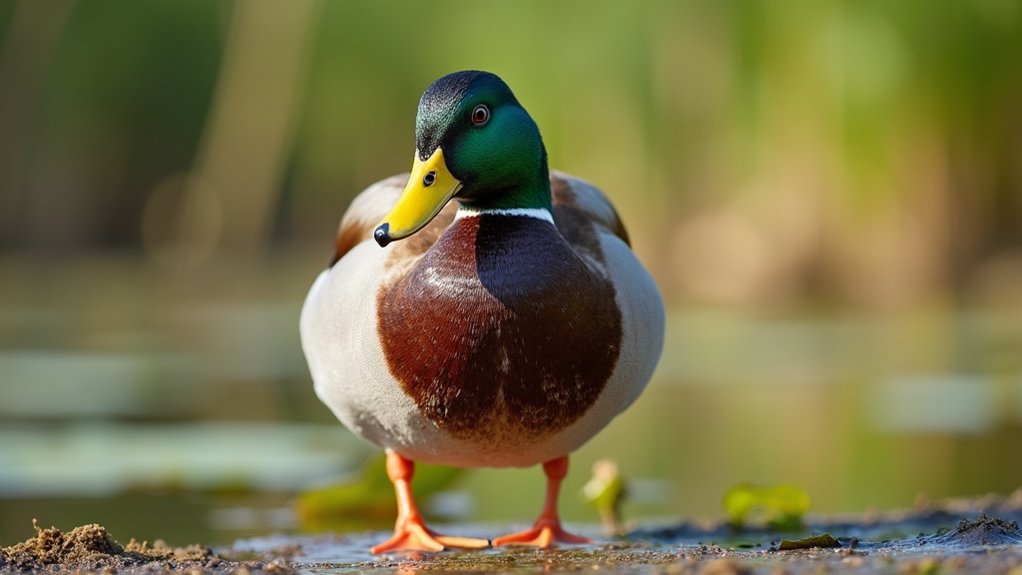
Although you might already know ducks as familiar waterfowl, their taxonomic position places them firmly within the kingdom Animalia and phylum Chordata, identifying them as vertebrate animals with backbones. They belong to the subphylum Vertebrata, confirming this structural trait.
Ducks are classified within the class Aves, confirming their avian status, and are exclusively part of the order Anseriformes, which also includes geese, swans, and screamers.
Within this order, all true ducks fall under the family Anatidae, which unifies ducks with their closest waterfowl relatives worldwide.
This family has a cosmopolitan distribution and primarily places true ducks in the subfamily Anatinae.
Although taxonomic disputes exist regarding subfamilies and tribes, ducks remain distinctly categorized within these well-defined higher-order groups.
Anatomical Features Defining Ducks
Ducks exhibit a distinctive set of anatomical features that adapt them specifically for aquatic life and efficient foraging. You’ll notice their elongated, broad bodies with compact construction and an oval, boat-shaped design that improves swimming.
Their legs are placed toward the tail, granting powerful water propulsion and a characteristic waddling gait on land. Dense, waterproof feathers provide thermal insulation and enable diving, while webbed feet maximize aquatic locomotion. These feathers also help regulate their body temperature in both freshwater and seawater environments, allowing them to thrive in diverse habitats (habitat adaptability).
The broad, flattened bill includes serrated pectens, allowing you to filter-feed, graze, or catch prey effectively. Ducks’ heads are relatively small, with intermediate neck lengths facilitating surface foraging.
Furthermore, overlapping scutellate scales on legs and species-specific wing structures contribute to their aquatic specialization and taxonomic identification, highlighting their evolutionary adaptation within the waterfowl family Anatidae.
Behavioral Traits of Ducks
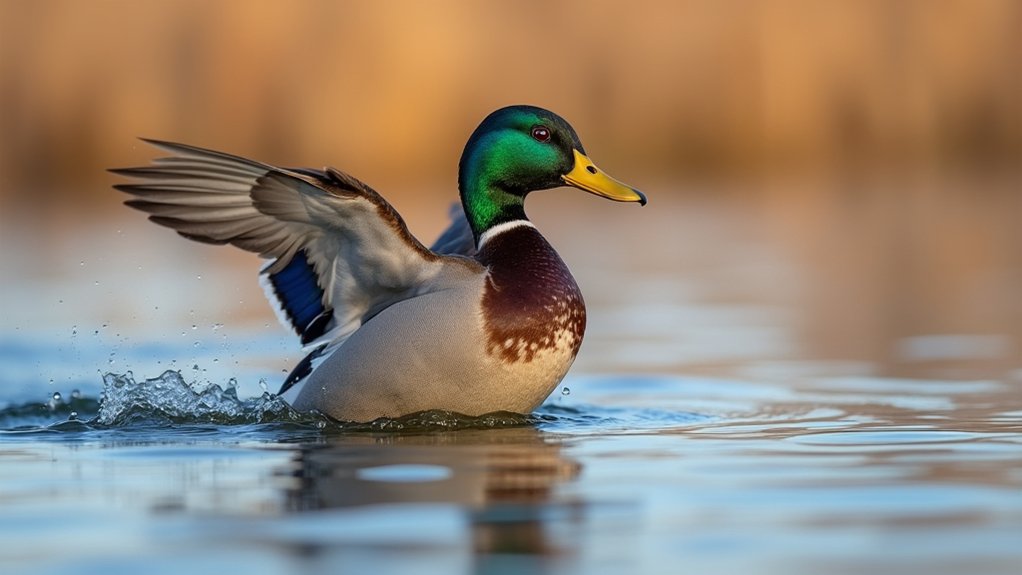
When you observe waterfowl, you’ll notice they rely heavily on vocalizations and body language to communicate within their social groups. Ducks produce diverse sounds: quacks, purrs, barks, hisses, and whistles. Each sound depends on the context, signaling contentment, excitement, or alarm.
They remain silent during foraging unless disturbed. Visual cues, such as drake tail shaking and head bobbing, play critical roles during courtship. Meanwhile, female body flattening indicates mating receptivity.
Social hierarchies form within flocks and are maintained through preening, play, and collective vigilance. Foraging involves specialized techniques like dabbling and submerging, which require head submersion and nasal clearing by bubble blowing.
Physical maintenance behaviors include meticulous feather preening and leg stretching to guarantee waterproofing and comfort. Observing these movements can also lead to discovering hidden eggs, revealing important non-verbal cues about their reproductive behavior hidden eggs.
These intricate behavioral traits show just how complex ducks’ social systems and survival strategies are within their aquatic environments.
Ducks Within the Order Anseriformes
You’re looking at the order Anseriformes, which includes around 180 species across three families.
Ducks mainly belong to the Anatidae family. Within Anatidae, ducks stand out as a diverse group—they tend to be smaller and show a lot of variation in their shape and features compared to their relatives, the geese and swans.
Getting a handle on the taxonomic structure of this order really helps make sense of the complex evolutionary relationships and the worldwide spread of these waterfowl. They inhabit a variety of aquatic environments such as lakes, ponds, rivers, swamps, and marshes, highlighting their adaptability to different habitats (aquatic environments).
Anseriformes Overview
Although many people focus on ducks as individual species, understanding their place within the order Anseriformes provides essential insight into their evolutionary relationships and ecological roles.
Anseriformes, a primitive neognathous bird order within class Aves, includes three families: Anatidae (ducks, geese, swans), Anhimidae (screamers), and Anseranatidae (magpie goose). These birds are globally distributed except Antarctica, with diverse genera and species adapting to various habitats. The earliest fossil anserine fragments date back to the late Eocene epoch, over 50 million years ago, indicating their long evolutionary history.
| Family | Key Representatives | Geographic Distribution |
|---|---|---|
| Anatidae | Ducks, Geese, Swans | Worldwide (except Antarctica) |
| Anhimidae | Screamers | South America |
| Anseranatidae | Magpie Goose | Australia, New Guinea |
This taxonomy reflects their evolutionary ties to Galloanserae and highlights their broad ecological significance.
Duck Family Traits
Since ducks belong to the family Anatidae within the order Anseriformes, their distinctive traits reflect adaptations to aquatic environments and complex behaviors.
You’ll notice ducks have compact bodies with relatively short necks, webbed feet with three forward toes, and bills with a flat lower mandible plus a cone-shaped upper mandible tipped by a hard “nail.”
Their plumage shows strong sexual dimorphism; males display bright nuptial colors during breeding, while females remain dull.
Ducks possess broad, pointed wings with 10-11 primaries, enabling rapid, direct flight.
Aquatically, you’ll note their waterproof feathers maintained by a large preen gland and specialized lamellae inside their bills for filter-feeding. Ducks also have webbed feet, which aid in swimming efficiently in various water habitats.
Reproductively, ducklings are precocial and nidifugous, covered in down that becomes water-repellent from maternal contact, allowing early water activity.
Order Diversity Explained
While ducks are the most familiar members of the order Anseriformes, this group includes a diverse range of waterfowl species across three main families: Anatidae, Anhimidae, and Anseranatidae.
You’ll find over 100 duck species within Anatidae, alongside geese and swans. Screamers belong to Anhimidae, and magpie geese to Anseranatidae. This diversity reflects evolutionary adaptations across global aquatic habitats. Fossil evidence such as the giant Miocene Anseriform Brontornis burmeisteri exemplifies the evolutionary history of this order.
| Family | Notable Traits |
|---|---|
| Anatidae | Ducks, geese, swans |
| Anhimidae | Screamers, 3 species |
| Anseranatidae | Magpie geese, regional |
| Dendrocygnidae | Sometimes separate family |
Understanding Anseriformes’ taxonomy is complex but essential to grasping duck biodiversity.
Differences Between Ducks, Geese, and Swans
You’ll notice that swans really stand out because they’re much bigger and have those long, graceful necks.
Ducks and geese, on the other hand, have shorter necks and more compact bodies, so they look quite different.
When it comes to behavior, swans tend to be pretty territorial and are known for forming lifelong monogamous pairs.
Geese, however, stick together in flocks and are great at working as a community, especially when it comes to taking care of their young. Interestingly, swans have 24-25 neck vertebrae, which contributes to their long necks and elegant posture.
Knowing these differences makes it easier to understand how each bird adapts to its environment and social life.
Size and Neck Length
Size and neck length distinctly separate ducks, geese, and swans within the Anatidae family. Ducks, such as the wood duck, measure 20-25 inches long and weigh 1-3 pounds. They feature a short neck supported by fewer than 16 cervical vertebrae.
Geese occupy an intermediate size range, 25-35 inches in length and 5-10 pounds in weight, with 17-23 cervical vertebrae enabling a thicker, straighter neck.
Swans are the largest, reaching 40-60 inches and 15-30 pounds, with some species weighing up to 35 pounds. Their necks contain 24-25 vertebrae, allowing an elongated, S-shaped curve extending up to 1.5 times their body length.
This vertebral count directly correlates with neck length capacity, making swan necks significantly longer and more flexible compared to the shorter, stouter necks of ducks and geese. Ducks are the smallest among these waterfowl, which also include geese and swans, highlighting their distinct size differences within the family smallest among waterfowl.
Behavioral and Habitat Differences
Neck length and body size influence not only physical appearance but also behavior and habitat preferences among ducks, geese, and swans.
You’ll notice swans exhibit strong territorial behavior, aggressively defending nesting sites, while geese prefer communal nesting with cooperative group dynamics. Ducks tend to be more solitary, showing milder temperaments.
Habitat use varies: swans favor aquatic environments, feeding mainly on submerged vegetation. Geese split time between land and water, grazing terrestrially. Additionally, ducks use a variety of feeding methods including foraging, dabbling, and filter feeding, which supports their adaptability to different aquatic habitats.
Vocalizations also differ considerably across these birds. Ducks produce distinctive quacking sounds. Geese communicate through loud honking, aiding flock coordination. Swans emit deep, resonant trumpeting calls.
Geese display greater social cohesion in large flocks. Swans maintain lifelong monogamous pairs with family units.
Understanding these differences sharpens your perception of these waterfowl’s ecological roles.
Scientific Evidence Supporting Ducks as Birds
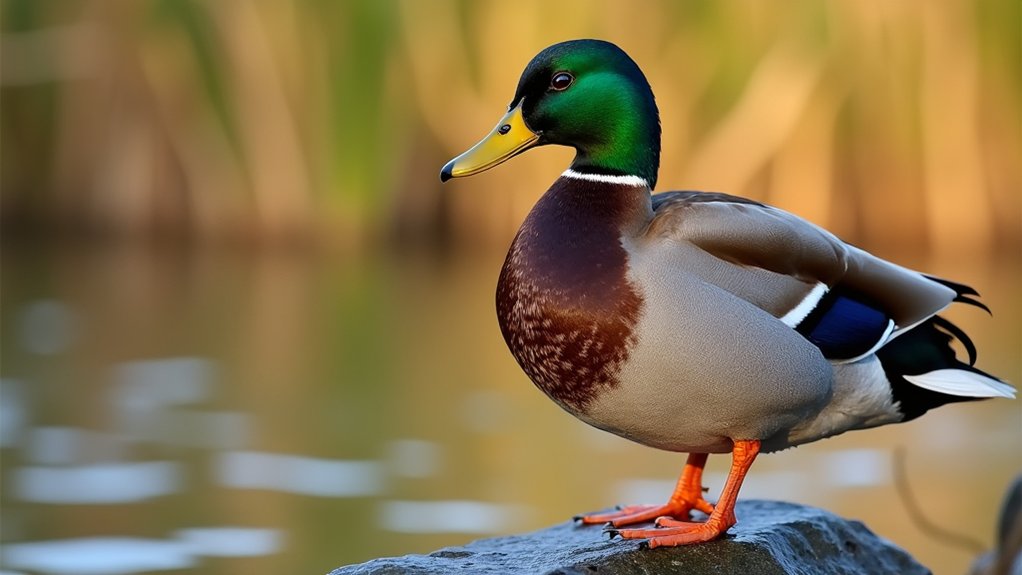
Scientific classification provides compelling evidence that ducks belong to the class Aves, confirming their status as birds. You’ll find ducks classified within Kingdom Animalia, Phylum Chordata, Order Anseriformes, and Family Anatidae, sharing lineage with geese and swans.
Anatomically, ducks possess feathers, beaks adapted for aquatic feeding, functional wings, and webbed feet, all distinct avian traits. Genomic studies reveal conserved duck genomes, with strong purifying selection maintaining proteome integrity and gene expansions linked to feather morphology and sexual dimorphism. Recent research also highlights directional selection in specific genomic regions of ducks, indicating evolutionary adaptations unique to their species.
Evolutionary analyses demonstrate their separation from related bird species and adaptation to aquatic habitats. Plus, behavioral and ecological data show specialized feeding strategies and migratory patterns consistent with other birds.
Collectively, taxonomic, anatomical, genetic, evolutionary, and ecological evidence unequivocally confirms that ducks are scientifically classified as birds.
Frequently Asked Question
Can Ducks Fly Long Distances During Migration?
Yes, ducks can fly long distances during migration.
You’ll find that species like northern shovelers cover nearly 2,000 miles in just a week, while black brant fly nonstop for up to 3,000 miles in 60-72 hours.
Ducks typically cruise at 40-60 mph, and with favorable tailwinds, they can reach speeds over 150 mph.
Their endurance allows them to make multiple stopovers, refuel, and complete extensive migratory journeys efficiently.
What Do Ducks Typically Eat in the Wild?
Imagine a duck as a versatile chef, mixing a complex menu.
You’ll find ducks feasting on aquatic plants like pondweed and water lilies, snacking on insects, snails, and small fish, and gathering seeds, grains, and berries from land.
Dabbling ducks tip up to reach surface vegetation, while diving ducks plunge deep for tubers and fish eggs.
Their diet shifts seasonally, boosting protein intake during breeding and migration to fuel their demanding lifestyle.
How Do Ducks Communicate With Each Other?
You’ll find ducks communicate through diverse vocalizations like quacks, whistles, and grunts, each signaling different messages.
Soft grunts show contentment, while loud quacks warn of danger.
They also use body language.
Head-bobbing signals emotions, and wing flapping conveys intentions.
During mating, males perform courtship displays paired with calls.
Family units rely on specific vocal cues to maintain cohesion and alert ducklings to threats, ensuring survival and social bonding.
Are Ducks Social Animals or Do They Prefer Solitude?
Think of ducks as living in a dynamic orchestra; you can’t have a soloist thrive alone.
You’re dealing with highly social animals that instinctively form flocks called paddlings.
They rely on group living for protection, communication, and emotional wellbeing. Without their own species’ company, they often become lonely.
Their social structure includes hierarchies, and they bond deeply, using vocalizations and body language to maintain cohesion and coordinate activities.
What Are Common Predators of Ducks in Nature?
Common predators you’ll find threatening ducks include raccoons, minks, and skunks, which raid nests for eggs and ducklings.
Red foxes primarily target adult mallards, while birds of prey like red-tailed hawks, bald eagles, and owls swoop down for both young and adults.
In water, snapping turtles and northern water snakes ambush ducklings.
Understanding these threats helps you appreciate how ducks must constantly adapt to survive across different habitats.
Conclusion
You can confidently affirm that a duck is indeed a bird, much like how Aristotle classified creatures with keen observation. Its taxonomic placement in Anseriformes, distinctive anatomical features like webbed feet and feathers, and specific behavioral traits all align with avian characteristics.
Scientific evidence leaves no room for doubt. Ducks embody the essence of birds through evolutionary lineage and biology, confirming that your understanding of ducks as birds is both precise and well-founded.