
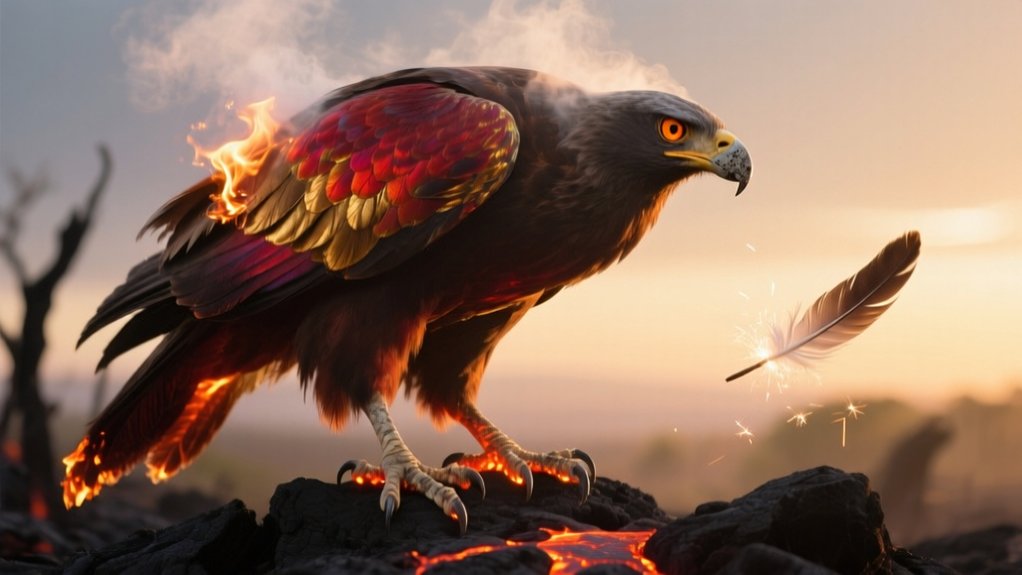
You won’t find a phoenix in nature because it isn’t a real bird but a legendary creature rooted in ancient mythologies, especially Greek and Egyptian. Its story likely draws from real animals like the Egyptian Bennu heron, symbolizing rebirth through fiery renewal.
Historical accounts of sightings blend observation with myth, lacking scientific evidence. While it’s a powerful symbol of resilience and renewal, understanding its true origins offers deeper insight into how myth and culture shape beliefs.
Origins and Etymology of the Phoenix
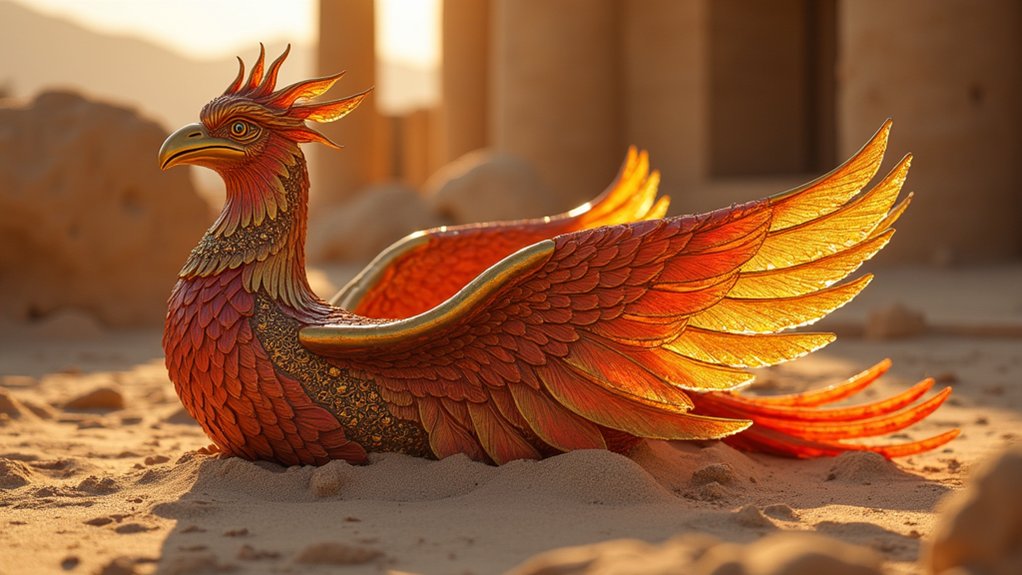
Although the phoenix is widely recognized in mythology, its origins trace back to linguistic and cultural roots that reveal a complex history. You’ll find the term “phoenix” stems from Latin “phoenīx,” itself derived from the Greek “φοῖνιξ” (phoinix), possibly linked to a West Semitic word for a red dye.
The earliest mention appears in Mycenaean Greek as “po-ni-ke,” dating to the 8th century BC.
Ancient Egyptian culture greatly influences the phoenix’s origins; historians like Herodotus link it to the Bennu bird, a symbol of rebirth associated with the sun god Ra.
This connection underlines the motif of regeneration central to phoenix mythology.
Scholarly debate persists regarding whether the motif’s roots lie primarily in Egyptian folklore or Greek reinterpretations, highlighting the phoenix’s complex cultural and linguistic heritage.
The Phoenix in Ancient Greek Mythology
When you examine Ancient Greek mythology, you’ll find that the phoenix is described as a bird originating from Arabia with a lifespan of about 500 years. At the end of its life, the phoenix self-immolates in a fragrant nest made of cinnamon and herbs.
It then rises anew from the ashes, symbolizing the cycle of death and rebirth. The bird is closely linked to the sun god Apollo, who is said to listen to its song. The new phoenix carries its predecessor’s ashes to Apollo’s temple, emphasizing renewal.
| Attribute | Description | Significance |
|---|---|---|
| Origin | Arabia | Geographic mythological source |
| Lifespan | ~500 years | Longevity before renewal |
| Nest | Cinnamon twigs, herbs | Fuel for self-immolation |
| Connection | Sun god Apollo | Divine association |
| Cycle | Death, rebirth via ashes | Symbol of eternal renewal |
Egyptian Influences and the Bennu Bird
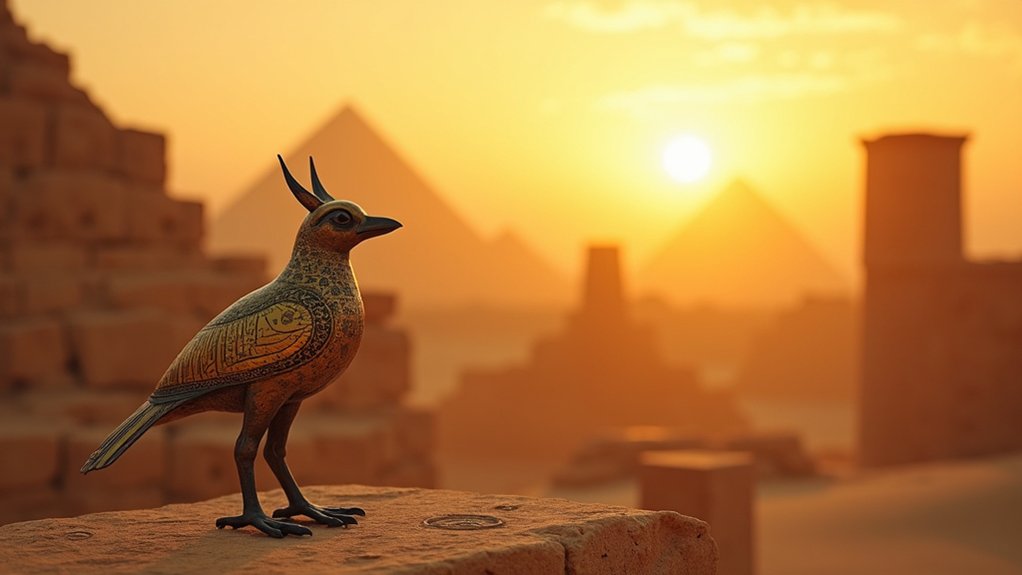
You should check out the Bennu bird—it’s like the original inspiration behind the phoenix myth.
It all started in ancient Egyptian culture. This bird, which looks kind of like a heron, is actually a symbol of the sun god Ra.
What’s really cool is how it represents cycles of death and rebirth, connected to fire and renewal.
When you dig into these mythical bird stories, you can see how Egyptian sun symbolism played a big role in shaping the phoenix’s lasting story.
Bennu Bird Origins
The Bennu bird stands as a central figure in ancient Egyptian mythology, widely regarded as the primary inspiration behind the phoenix legend. You’ll find the bennu bird closely linked to themes of rebirth, renewal, and the cycles of life, symbolizing immortality.
Ancient texts describe it as a heron associated with the sun god Ra, rising daily with the sun and embodying life’s continuous regeneration. The bennu bird constructs a nest from aromatic branches, which it ignites, leading to self-immolation and subsequent rebirth from ashes.
Its connection to Osiris, god of the afterlife, further underscores its role in resurrection. Understanding the bennu bird helps you grasp how ancient Egyptian mythology shaped the phoenix myth’s enduring symbolism of cyclical regeneration and eternal life.
Egyptian Sun Symbolism
Although ancient Egyptian mythology encompasses numerous symbols of life and renewal, the Bennu bird stands out as a powerful emblem of the sun’s regenerative energy.
In Egyptian mythology, the Bennu represents the sun god Ra and embodies the cycle of life, resurrection, and immortality. It was believed to rise from the ashes of its predecessor, symbolizing continual rebirth aligned with the sun’s daily journey.
This bird’s association extends to the Nile’s flooding, linking it to agricultural renewal and seasonal cycles essential to Egypt’s sustenance.
Temples and rituals dedicated to the Bennu highlight its significance in funerary practices and beliefs surrounding the afterlife.
Mythical Bird Legends
Ancient Egyptian mythology offers a foundation for understanding mythical bird legends through the Bennu bird, a significant figure linked to themes of resurrection and solar cycles. The Egyptian Bennu influenced the phoenix legend, embodying rebirth and the eternal cycle of life and death.
You can observe these characteristics in ancient mythology: The Bennu, depicted as a heron, symbolizes renewal, its name derived from the Egyptian word meaning “to rise” or “to shine.”
It was believed to ignite itself in a nest of aromatic wood, paralleling the phoenix’s self-immolation and subsequent rebirth from ashes.
References in Pyramid Texts emphasize the Bennu’s role as a divine emblem of immortality and connection to the sun god Ra.
Understanding these mythical birds helps clarify the phoenix’s origins rooted in Egyptian concepts of rebirth and cosmic cycles.
Depictions of the Phoenix in Art and Literature
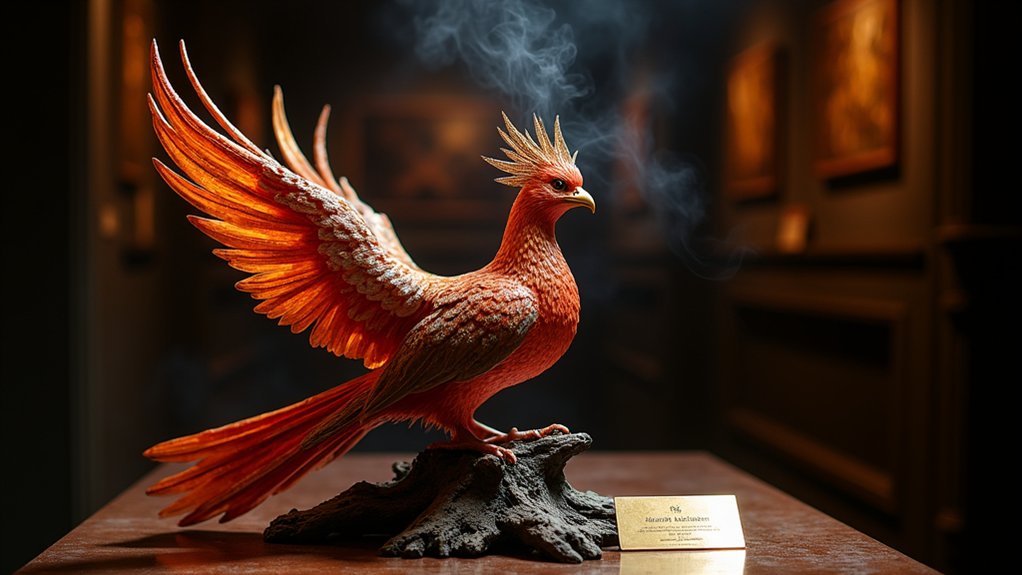
Symbols of renewal and resurrection appear prominently in depictions of the phoenix across various cultures and time periods. You’ll find this mythical bird illustrated in ancient art and literature as a symbol of rebirth and transformation.
For instance, Greek mythology portrays the phoenix with vibrant red and gold feathers, connecting it to flames and renewal. Christian literature, such as the 10th-century *Exeter Book*, uses the phoenix to symbolize Christ’s resurrection. Renaissance art further emphasizes its allegorical role in cycles of life.
Modern literature continues this tradition, presenting the phoenix as a figure of resilience.
| Era | Artistic Medium | Symbolic Meaning |
|---|---|---|
| Ancient | Paintings, Mosaics | Rebirth, immortality |
| Medieval | Manuscripts, Tapestries | Resurrection, light |
| Renaissance | Paintings, Sculptures | Renewal, cyclical life |
| Modern | Novels, Films | Loyalty, healing |
Historical Accounts and Alleged Sightings
When historians like Pliny the Elder and Tacitus recorded sightings of the phoenix, they contributed to the bird’s legendary status across ancient cultures.
You’ll find these historical accounts often reference ancient Egypt as the bird’s origin.
Pliny documented a sighting in 36 AD, while Tacitus noted a 34 AD appearance, associating the phoenix with long life cycles.
Early mentions in Mycenaean Greek texts reflect its deep cultural roots.
Significantly, some alleged sightings remain contested.
Consider these key points:
- Pliny the Elder’s 36 AD sighting during Roman consulship.
- Tacitus’ 34 AD report linking the phoenix to cyclical phenomena.
- The Mycenaean Greek term “po-ni-ke,” indicating early textual evidence.
These accounts blend observation with myth, lacking empirical verification.
Symbolism and Allegorical Interpretations
You’ll find that the phoenix consistently symbolizes resurrection and renewal. It really highlights those cyclical patterns we see in life and nature.
Plus, its role in spiritual and religious contexts—especially in early Christian allegories—links the bird to themes of eternal life and hope.
On top of that, the phoenix serves as a cultural emblem representing transformation, resilience, and moral values across diverse societies.
It’s fascinating how one symbol can carry so much meaning in different cultures.
Resurrection and Renewal
Although the phoenix is a mythical creature, it embodies the scientific concept of cyclical processes through its symbolic representation of resurrection and renewal. This emblem captures the continuous interplay of life, death, and rebirth, illustrating how endings foster new beginnings.
You can observe this symbolism in various cultural and literary contexts, where the phoenix’s life cycle parallels natural regenerative systems.
Consider these key aspects:
- The phoenix’s self-immolation and subsequent rebirth metaphorically reflect overcoming adversity and renewal.
- Its depiction in texts like the Exeter Book and Dante’s *Divine Comedy* underscores its role as a symbol of enduring life and renewal.
- The allegorical use of the phoenix in Christian literature emphasizes resurrection as a transformative process, linking mythical imagery to spiritual renewal.
This cyclical pattern encourages you to view renewal as an inherent aspect of existence.
Spiritual and Religious Symbolism
The phoenix’s embodiment of cyclical renewal naturally extends into its spiritual and religious significance, where it represents the profound concepts of resurrection and eternal life.
Across various mythologies, the phoenix symbolizes the cycle of life, death, and rebirth, serving as a powerful spiritual emblem.
In early Christian texts, it allegorizes Christ’s resurrection, highlighting themes of spiritual rebirth and hope.
Egyptian mythology links the phoenix to the Bennu bird, reinforcing ideas of divine resurrection and solar renewal.
In the same way, Chinese culture’s Feng Huang embodies harmony and virtue, reflecting spiritual balance.
This consistent symbolism across cultures underscores the phoenix’s role in illustrating renewal and the enduring nature of the human spirit, bridging mythology and spirituality through the motif of rebirth and resurrection.
Cultural Transformation Themes
When you examine the phoenix’s symbolism across cultures, you’ll find it consistently represents transformation on both personal and societal levels. This myth embodies resurrection and renewal, serving as an allegory for cyclical change.
Various cultural interpretations emphasize the phoenix’s role in illustrating life’s continuous evolution through death and rebirth. Its image conveys hope and resilience, appearing prominently in literature and art.
Key themes include:
- Spiritual resurrection, as seen in early Christian texts and Gnostic writings.
- Societal transformation reflected in historical cycles of decline and renewal.
- Symbolic renewal in Western literature, such as Dante’s Divine Comedy and Shakespeare’s *Henry VIII*.
Thus, the phoenix myth encapsulates complex ideas of transformation, making it a potent cultural symbol of enduring renewal.
The Phoenix in Early Christian Thought
Since early Christian thinkers sought vivid symbols to express complex theological ideas, they welcomed the phoenix as a powerful emblem of resurrection and eternal life.
You’ll find the phoenix prominently in Christian thought, where its cycle of rebirth from ashes metaphorically aligns with Christ’s resurrection.
The 10th-century Old English poem in the Exeter Book explicitly uses the phoenix as an allegory for spiritual renewal and immortality.
When you examine Christian literature and art, you’ll notice the phoenix symbolizes life triumphing over death, reinforcing salvation’s promise.
Its purported 500-year life cycle mirrors the divine plan, emphasizing eternal life beyond physical death.
The Phoenix Across Different Cultures
You’ll notice the phoenix shows up in lots of different cultures, and each one gives this mythical bird its own special meaning.
For example, in Greek, Egyptian, Chinese, and Jewish traditions, the phoenix stands for ideas like rebirth, immortality, harmony, and renewal.
When you look at these cultural differences, it really helps you see how the symbolism of the phoenix has changed over time—and why it still holds so much power today.
Cultural Variations
Although the Phoenix appears in numerous mythologies, its symbolism and characteristics vary greatly across cultures. You’ll find that this mythical bird’s portrayal reflects diverse cultural representations shaped in ancient times.
For instance:
In Greek mythology, the Phoenix lives for centuries before self-immolating and rising from its ashes, embodying rebirth and renewal.
The Ancient Egyptian Bennu bird symbolizes the sun god Ra’s daily cycle, igniting its nest at life’s end, representing regeneration.
Chinese mythology’s Feng Huang blends features of various birds, symbolizing harmony and virtue, contrasting masculine dragons.
As you investigate these accounts, you realize how the phoenix motif adapts to different cultural values and beliefs, underscoring its significance as a universal symbol among mythical birds.
Mythical Symbolism
When you examine the phoenix across different cultures, you find a consistent theme of rebirth and immortality, though each tradition emphasizes distinct symbolic aspects.
In Greek mythology, the phoenix lives for centuries before self-immolating and rising from its ashes, embodying the cycle of death and resurrection as a symbol of rebirth.
Likewise, the Egyptian Bennu bird parallels the phoenix, representing resurrection and renewal linked to the sun god Ra.
Chinese mythology’s Feng Huang, often associated with the phoenix, symbolizes harmony, contrasting masculine power with feminine virtue.
Furthermore, the Jewish Talmud describes the Chol bird, embodying divine favor and restraint.
Together, these mythical birds illustrate how the phoenix motif serves as a powerful emblem of cyclical regeneration and enduring life across cultures.
The Role of the Phoenix in Modern Popular Culture
Since ancient times, the phoenix has symbolized renewal and transformation, concepts that continue to resonate in modern popular culture. You’ll find the phoenix represented in various media, embodying themes of resurrection and immortality.
For example:
- In the Harry Potter series, Fawkes, Dumbledore’s phoenix, demonstrates healing powers and rebirth, reinforcing the mythical creature’s role in renewal.
- Neil Gaiman’s Sunbird uses the phoenix to examine the consequences of its consumption, highlighting complex symbolism.
- The X-Men comics feature Jean Grey’s association with the Phoenix Force, a cosmic power symbolizing life, death, and rebirth.
These instances show how the phoenix remains a potent symbol in popular culture, bridging ancient mythology with contemporary storytelling.
Scientific Perspectives on the Phoenix Legend
While the phoenix enthralls imagination as a symbol of renewal, scientific inquiry finds no evidence supporting its existence as a real bird. The phoenix myth stems from ancient cultures, especially from the Greek word “phoinix,” describing a mythological bird associated with death and rebirth.
Though inspired by real birds like the Bennu heron, the phoenix remains a symbolic construct rather than a documented species. Science views this mythological bird as an allegory reflecting human concepts of loss and recovery, not as an empirical entity.
| Aspect | Scientific Viewpoint | Emotional Impact |
|---|---|---|
| Existence | No physical evidence | Fascination with mystery |
| Origin | Folklore, not biology | Awe for cultural heritage |
| Symbolism | Metaphor for renewal | Hope amid adversity |
| Relation to real birds | Possible inspirations | Connection to nature’s cycles |
Common Misconceptions About the Phoenix
How did the phoenix become surrounded by so many misunderstandings? This mythical bird, rooted in ancient legend, faces misconceptions that cloud its true nature.
You might assume it’s a real species or linked to darkness, but the facts tell otherwise.
Consider these common misconceptions:
The phoenix is often mistaken for a real bird, though no biological evidence supports its existence.
Some confuse it with actual creatures like the Bennu heron, influencing the myth’s origins.
The symbol is incorrectly associated with evil, despite representing rebirth, renewal, and hope across cultures.
The Enduring Legacy of the Phoenix Motif
Understanding the misconceptions surrounding the phoenix allows you to appreciate its profound impact beyond myth. The phoenix, a mythical bird symbolizing resurrection and renewal, has transcended its ancient origins to influence diverse cultures and disciplines.
Historical texts by Herodotus and Pliny the Elder document its prominence in Egyptian and Greek civilizations, underscoring its role as a symbol of cyclical life.
Early Christian writings reinterpret the phoenix’s life cycle as an allegory for spiritual rebirth, emphasizing hope and eternal life.
In modern contexts, the phoenix motif persists in literature and popular culture, reflecting themes of resilience and personal transformation.
This enduring legacy illustrates how the phoenix continues to serve as a powerful emblem, bridging ancient myth with contemporary discussions on renewal and human experience.
Frequently Asked Question
Can a Phoenix Be Kept as a Pet?
You can’t keep a phoenix as a pet because it’s a mythical creature, not a biological species. Its lifecycle involves self-immolation and rebirth, which defies natural animal care.
Furthermore, the phoenix thrives in solitude and requires specific environmental conditions that aren’t replicable in captivity.
Even in fantasy, its symbolism of freedom and renewal conflicts with domestication, making it unsuitable for ownership or traditional pet care practices.
What Does a Phoenix Sound Like When It Cries?
When the phoenix cries, you’d hear a melodious and enchanting sound, often described as resonating with hope and renewal.
Its cry combines a rich, warm timbre reminiscent of sunlight’s brightness, designed to evoke awe and wonder.
This vocalization is so mesmerizing that it reportedly attracts gods and celestial beings.
Essentially, the phoenix’s cry symbolizes transformation and new beginnings, conveying a powerful message through its unique, lyrical tone.
How Long Does a Phoenix Live Before Rebirth?
You’ll find that the phoenix lives about 500 to 1,000 years before it undergoes rebirth, depending on the mythological source.
In Greek mythology, it typically lives 500 years before building a nest and igniting it to be reborn from ashes.
Some accounts, like Pliny the Elder’s, suggest lifespans up to 1,461 years.
This cycle symbolizes renewal, with the bird’s life ending through self-immolation or natural decomposition before rebirth.
Are There Real Birds Inspired by the Phoenix Myth?
You’ll find that some real birds, like the Onagadori chicken, boast tail feathers up to 12 feet long, capturing the phoenix’s grandeur.
These breeds inspired the mythical phoenix with their vibrant plumage and elegance.
Moreover, the Bennu heron in Egyptian lore symbolizes rebirth, paralleling phoenix themes.
These species’ unique traits and symbolism directly influenced the phoenix myth, showing how real birds contribute to legendary narratives through their remarkable features.
Can Phoenix Feathers Be Used for Healing?
You can’t use phoenix feathers for healing because they’re purely mythical and have no scientific basis.
While legends and folklore attribute healing properties to these feathers, no empirical evidence supports such claims.
In literature, especially fantasy, phoenix feathers symbolize renewal and possess magical qualities, but in reality, they don’t exist or have medicinal effects.
Any healing attributed to them remains symbolic, not demonstrable through scientific methods or clinical studies.
Conclusion
You might think the phoenix is just a myth, but notably, its story coincides with real natural phenomena like the molting and rebirth cycles in birds. While no scientific evidence confirms the phoenix as a real species, its symbolism draws from observable patterns in nature and ancient cultural exchanges.
So, although the phoenix isn’t real in a biological sense, its legend perfectly reflects humanity’s fascination with renewal and transformation grounded in the natural world.