
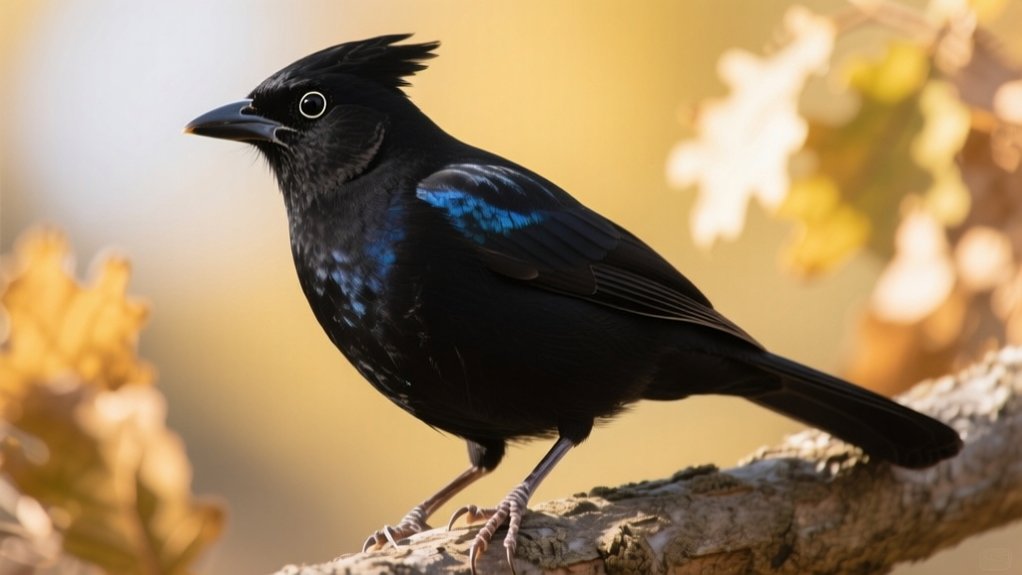
To identify a black cardinal, look for a medium-sized bird with a sleek, wispy black crest and a long tail, smaller than true cardinals. Notice its glossy black plumage accented by white wing patches and striking bright red eyes, key features setting it apart from Northern Cardinals.
Its slender, pointed bill differs from the thick conical bill of true cardinals. Found mainly in Southwest deserts, its unique habitat and vocal traits help confirm the ID. Investigate further to refine your identification skills.
Understanding the Term “Black Cardinal

The term “black cardinal” doesn’t refer to a true cardinal species but is commonly used to describe the Phainopepla, a bird with a sleek black crest that resembles a cardinal in shape and size.
The “black cardinal” is actually the Phainopepla, a sleek black crested bird resembling a cardinal.
Unlike true cardinals in the Cardinalidae family, which display bright red males and subdued females, the Phainopepla belongs to the silky-flycatcher family. In rare cases, a Northern Cardinal may appear very dark due to melanism in birds, but this is not the same as a true black cardinal species.
You’ll notice its glossy black plumage and pointed crest, features that prompt casual observers to conflate it with cardinals.
However, the Phainopepla’s slender, curved bill and habitat preferences in arid desert scrub and mistletoe-laden trees distinguish it clearly. True cardinals have thick bills suited for cutting or crushing seed shells, which is a notable difference from the Phainopepla’s bill.
When you see a solid black, crested bird in the Southwest, especially near mesquite or palo verde, you’re almost certainly observing a male Phainopepla rather than a true cardinal species.
Recognizing Cardinal Body Shape and Size
You’ll notice that a black cardinal bird has a medium-sized, slender body with a long tail and a distinct pointed crest. This combination creates a sleek cardinal silhouette that’s pretty easy to spot.
Typically, its size ranges between 7.1 and 8.3 inches in length. That makes it a bit smaller than the Northern Cardinal but still larger than some of the smaller backyard birds like titmice. The Northern Cardinal, by comparison, is a fairly large, long-tailed songbird measuring about 8.3-9.1 in (21-23 cm) in length.
Cardinal Silhouette Features
Recognizing a cardinal’s silhouette starts with noting its compact, thick-bodied form combined with a relatively long tail and full chest. When perched, you’ll see the bird hold an upright posture with its body angled slightly forward and tail extending straight or slanting down, creating a clean triangular profile.
The head appears large and blocky, sitting directly on very short necks that give a “head-on-shoulders” look. A sharply peaked, triangular crest rises prominently, adding an angular point to the head silhouette. The stout, deep cone-shaped bill forms a blunt triangle that blends smoothly into the forehead, producing a compact facial block.
Wings are short and lie tight against the body, ending well before the long, straight tail, which maintains a level or slightly lowered carriage when resting.
Typical Size Measurements
Although size alone doesn’t confirm a cardinal’s identity, understanding typical length and mass ranges sharpens your ability to distinguish these birds from similar species.
Northern cardinals measure 20.9–23.5 cm in length, with males averaging slightly larger (22.2–23.5 cm) than females (20.9–21.6 cm). Their weight ranges from 42 to 48 grams, presenting a robust, medium-sized profile. In Arizona, the Northern Cardinal is less common than its eastern range, but it can still be found in riparian woodlands and some urban areas.
In contrast, the similar black-crested Phainopepla is smaller and lighter, 18–21 cm long and weighing 17.9–28.1 grams, yielding a narrower, less bulky silhouette.
Northern cardinals have broad, rounded wings about 30.5 cm wide, suited for short, quick flights. Their deeper chest and thick neck create a stocky, muscular body shape that distinguishes them from slender, crested lookalikes.
Males are easily recognized by their bright red coloration and black mask, which is a distinctive physical trait among cardinals.
Use these dimensions and body proportions as key identification markers in the field.
Identifying Key Crest and Bill Features
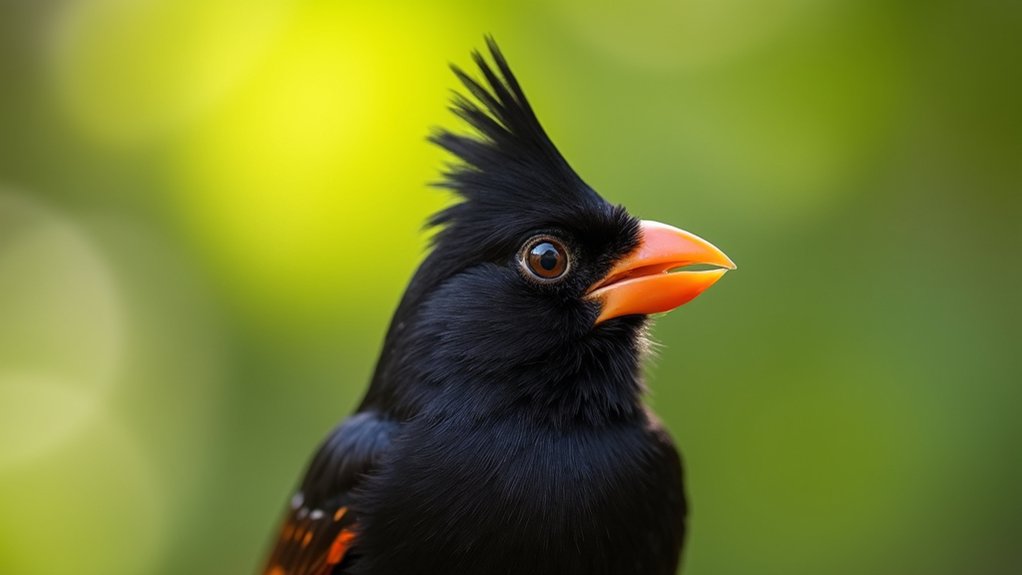
When distinguishing a Black Cardinal from similar species, closely examining the crest and bill offers the most reliable clues.
The Northern Cardinal displays a prominent, pointed crest, long and triangular, often held erect but lowered when relaxed. Its bill is short, very thick, and conical, with a bright orange to reddish-orange color that contrasts sharply with the black face mask in males. Both sexes possess this heavy, bright orange bill, making it a distinctive feature of the species identification of Northern Cardinals.
In contrast, the Phainopepla’s crest is wispy, ragged, and less rigid, usually drooping or swept back, with a slender, slightly decurved black bill. This bill is noticeably thinner and more pointed than the cardinal’s.
You’ll identify a true Black Cardinal by its combination of a bold, angular crest and a stout, orange bill, features absent in the similar but distinct Phainopepla.
Distinguishing Plumage Colors and Patterns
When you’re trying to spot a true black cardinal, look closely at their unique red-pink markings on the head and throat—that really stand out against their black body feathers. It’s pretty striking! Male northern cardinals are bright red, while females display brown with reddish tinges, making the black cardinal a rare and unusual variation within the species (male plumage color). Now, don’t get fooled by birds like Phainopeplas. They might’ve shiny black feathers too, but they also show white patches on their wings and have red eyes, which black cardinals definitely don’t have.
True Cardinal Colors
Understanding true cardinal colors requires careful observation of their distinct plumage patterns and hues. Adult males display uniform scarlet-red plumage with a black face mask outlining the bill and throat. These colors and patterns are typical of the Genus Cardinalis species, the signature genus of the Cardinalidae family.
Females show muted browns with reddish accents on crest and tail, while juveniles present brown tones with a dark bill that shifts to red. Dark plumage often appears nearly black in low light but reveals red undertones on closer inspection.
The bill’s reddish-orange color is a key identifier, as no black-billed “black” cardinals exist naturally.
| Feature | Male Northern Cardinal | Female Northern Cardinal |
|---|---|---|
| Body Color | Rich scarlet red | Pale brown with reddish wash |
| Face Mask | Solid black | Gray to dull mask |
| Bill Color | Reddish-orange | Reddish-orange |
| Plumage Year-Round | Consistent red | Muted warm tones |
| Juvenile Color | Brownish with patchy red | Brownish, dark bill |
Common Mimic Patterns
True cardinal colors provide a reliable baseline for identification, but you’ll often encounter birds with similar dark plumage that can lead to misidentification.
Many all-black mimics like crows and ravens lack a crest and display uniform black feathers without contrasting patterns.
Iridescent species such as starlings and grackles show subtle blue or green sheens, differing from the matte or silky gloss of true black cardinals.
The crested Phainopepla stands out with a distinct crest, white wing patches, and red eyes, unlike most mimics.
Bird plumage patterns are often adapted for camouflage and signaling, which can influence how similar species appear in their environment.
To distinguish common mimics, note these features:
- Absence of crest in crow-type birds
- Iridescent versus matte plumage sheen
- Presence of white wing patches in Phainopepla
- Contrasting bill colors, such as yellow in starlings
Comparing Black Cardinals With Similar Species
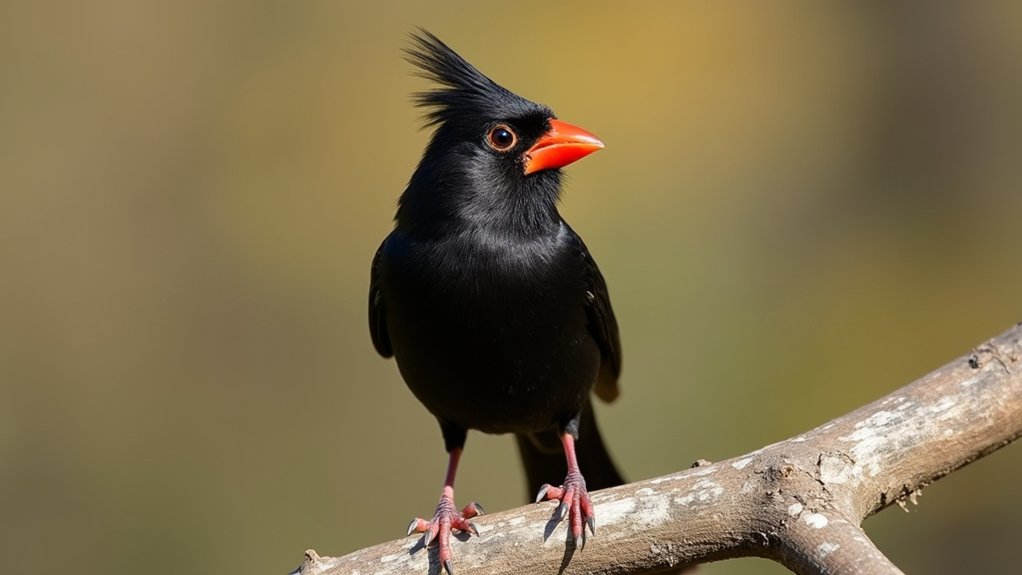
Although melanistic Northern Cardinals are often mistaken for entirely different species, careful observation of plumage patterns, crest shape, and bill structure reveals key distinctions. Melanistic cardinals retain the cardinal’s tall, pointed crest and thick, cone-shaped bill, unlike Phainopeplas or blackbirds. They are typically found in woodland edges and suburban gardens, which helps differentiate their habitat from that of some similar black bird species.
You can spot differences by comparing size, tail shape, and facial mask presence.
| Feature | Melanistic Northern Cardinal |
|---|---|
| Crest Shape | Tall, pointed |
| Bill Structure | Thick, conical, bright red/orange |
| Plumage Markings | Mostly blackish with reddish bill |
| Tail Length | Medium, relatively long |
Use these traits to differentiate black cardinals from glossy blackbirds, grackles, and Phainopeplas, which lack the classic cardinal silhouette and facial mask contrast.
Considering Geographic Range and Preferred Habitat
When you consider the geographic range and habitat preferences of black cardinal-like birds, Phainopepla nitens stands out as the primary North American species resembling a black cardinal.
Among black cardinal-like birds, Phainopepla nitens is the key North American species resembling a black cardinal
You’ll find it mainly in the deserts of the Southwest U.S., including the Sonoran and Mojave, extending into northern Mexico. Its presence overlaps with true cardinals in shifting zones, but their habitat preferences differ significantly.
Key habitat factors include desert washes and arid scrublands, especially mesquite and palo verde stands. Mistletoe clumps provide roost and nest sites. Both sexes have distinctive orange/red eyes that can help confirm identification in the field.
In the summer, they move to higher elevation oak and pinyon-juniper woodlands. Riparian corridors within arid landscapes attract mixed cardinalid species.
Understanding these spatial and habitat patterns sharpens your field identification of black cardinal look-alikes.
Observing Behavior and Vocalizations
Watch closely as the Phainopepla perches prominently on exposed branches, scanning its surroundings with alert movements. It often occupies high, visible perches atop desert shrubs or woodland trees, vigilantly searching for mistletoe berries or flying insects. You’ll notice agile sallies from perches to capture prey mid-air, followed by swift returns. Vocalizations consist of soft, upslurred “wurp” calls repeated frequently, aiding detection across distances.
Its call repertoire includes liquid whistles and short notes that mimic other desert birds, a behavior thought to deter predators or confuse threats. Unlike the Northern Cardinal’s loud, repetitive whistles, the Phainopepla’s song is quieter, plaintive, and often imitative. Some birds use flocking as a way to increase safety and communication within groups, and this can sometimes be seen with Phainopeplas in woodland habitats. More frequent alarm calls become noticeable as the bird signals potential dangers with sharp notes.
Territoriality varies: desert birds defend exclusive berry-rich zones, whereas woodland birds forage communally in loose colonies.
Tips for Accurate Field Identification and Documentation
Understanding the Phainopepla’s distinctive behaviors and vocalizations lays the groundwork for accurate field identification. To avoid confusion with true cardinals and other black songbirds, focus on precise visual and contextual cues.
When documenting, note the following:
- Glossy black plumage with bold white wing patches visible in flight, unique to males.
- Bright red eyes, a critical diagnostic feature separating Phainopepla from likewise dark species.
- Habitat context: desert washes and riparian woodlands in the Southwestern U.S. and northern Mexico. This habitat preference helps distinguish it from species like the Northern Cardinal, which favors wooded and suburban environments.
- Morphology: slender body, long tail, pointed crest, and narrow dark bill, contrasting with the bulkier, red-billed Northern Cardinal.
Use detailed notes and photographs emphasizing these key markers to guarantee reliable field records and proper species differentiation. Additionally, paying close attention to behavioral vocalizations can further aid in distinguishing the Phainopepla from other similar species in the field.
Frequently Asked Question
Can Black Cardinals Be Kept as Pets Legally?
You can’t legally keep black cardinals as pets in the United States because northern cardinals, including color variants, are protected under the Migratory Bird Treaty Act.
This law prohibits capturing, selling, or owning them without authorization.
However, some non-native cardinal species or those in countries without such restrictions might be kept legally.
Always check specific regional laws before considering captive care to guarantee compliance with wildlife protection regulations.
Are Black Cardinals Featured in Any Cultural or Symbolic Traditions?
Oh sure, because every culture just *had* to include a black cardinal in their folklore, right?
In reality, black cardinals don’t have ancient traditions like their red counterparts.
Instead, modern spirituality borrows cardinal symbolism, tinting it black to highlight mystery, inner wisdom, and shadow work.
You’ll find them in New Age contexts as guides through emotional darkness, not in established Native American or Christian lore where red cardinals reign supreme.
What Is the Lifespan of a Black Cardinal in the Wild?
You’ll find that black cardinals, like their red counterparts, typically live about 3-5 years in the wild.
Most don’t surpass one year due to predators, disease, and environmental hazards.
While rare, some individuals can reach up to 15 years under ideal conditions.
Survival depends heavily on habitat quality, food availability, and climate.
Do Black Cardinals Migrate Seasonally or Stay Year-Round?
Black cardinals, or Phainopeplas, migrate seasonally rather than staying year-round.
You’ll notice they shift elevationally, moving from low desert washes in winter to higher woodlands in summer.
Some populations behave nomadically, tracking food sources like mistletoe berries by moving south or upslope after breeding.
Unlike Northern Cardinals, which are resident birds, black cardinals exhibit complex seasonal and local movements tied to resource availability and breeding cycles.
How Do Black Cardinals Contribute to Their Ecosystem?
Like tiny engineers, black cardinals shape their ecosystem by dispersing seeds from various plants, promoting growth and diversity.
You’ll see they reduce pest populations by consuming insects, aiding natural pest control.
Their presence supports predators as prey and sustains parasites, weaving a complex food web.
Conclusion
When identifying a black cardinal, keep in mind that “seeing is believing.” Focus on its distinct body shape, prominent crest, and stout bill. Carefully note its unique plumage and vocal patterns.
Compare these traits against similar species and consider the bird’s habitat and range for accurate identification. By observing with precision and documenting your findings, you’ll confidently distinguish this elusive bird in the field, turning careful observation into reliable knowledge.