

You might wonder if Tweety Bird is a boy or girl, given the character’s soft, feminine appearance and high-pitched voice. However, Warner Bros. officially identifies Tweety as male, reflected in classic cartoons and official materials using male pronouns.
The creator intended Tweety as a baby boy bird despite visual cues suggesting otherwise. Tweety’s gender might seem ambiguous due to style and modern shifts toward gender neutrality, but there’s more to uncover about this beloved character’s identity and history.
Official Gender Classification of Tweety Bird
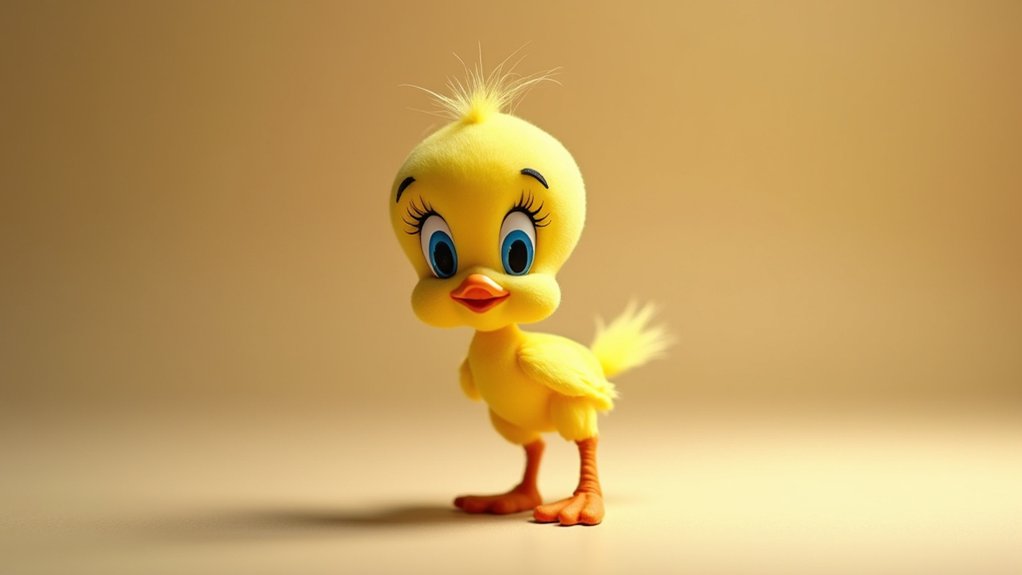
Regarding Tweety Bird’s gender, official sources leave no room for doubt: Warner Bros. consistently classifies Tweety as male.
You’ll find that production notes, character profiles, and Warner Bros.’ own databases identify Tweety as a male character.
Even licensed entertainment platforms like IMDb list Tweety under male characters. When you check merchandise packaging or promotional materials, they all align with this classification.
Legally, Tweety’s gender is male in rights and licensing documents, confirming the studio’s consistent stance.
Additionally, you’ll notice that in original cartoons, Tweety is referred to with male pronouns, and no official dialogue uses female pronouns.
Voice actors, including Mel Blanc and successors, have always treated Tweety as male, emphasizing a youthful voice rather than a feminine identity.
This clarity helps you understand Tweety’s official gender without confusion, supported by the fact that Mel Blanc himself identified Tweety as male in interviews original voice actor.
Historical Gender References in Warner Bros. Materials
While Warner Bros. officially identifies Tweety Bird as male, you’ll find that historical materials from the studio paint a more complex picture. From Mel Blanc’s high-pitched voice to the feminine design elements and ambiguous marketing, there’s plenty to unpack.
Here’s a quick look:
| Reference Type | Example |
|---|---|
| Voice Acting | Mel Blanc’s high-pitched, delicate voice |
| Visual Design | Long eyelashes, yellow feathers, blue eyes |
| Marketing Language | 1952’s cartoon titled “Ain’t She Tweet” |
| Narrative Ambiguity | Characters questioning Tweety’s gender in shorts |
These elements show that while Tweety is officially male, Warner Bros. played with feminine traits and narrative ambiguity, creating an enduring mystery around the character’s gender identity. Official sources and creators have confirmed Tweety’s male identity, reinforcing the character’s true gender despite common misconceptions.
Dialogue Evidence From Classic Looney Tunes Shorts
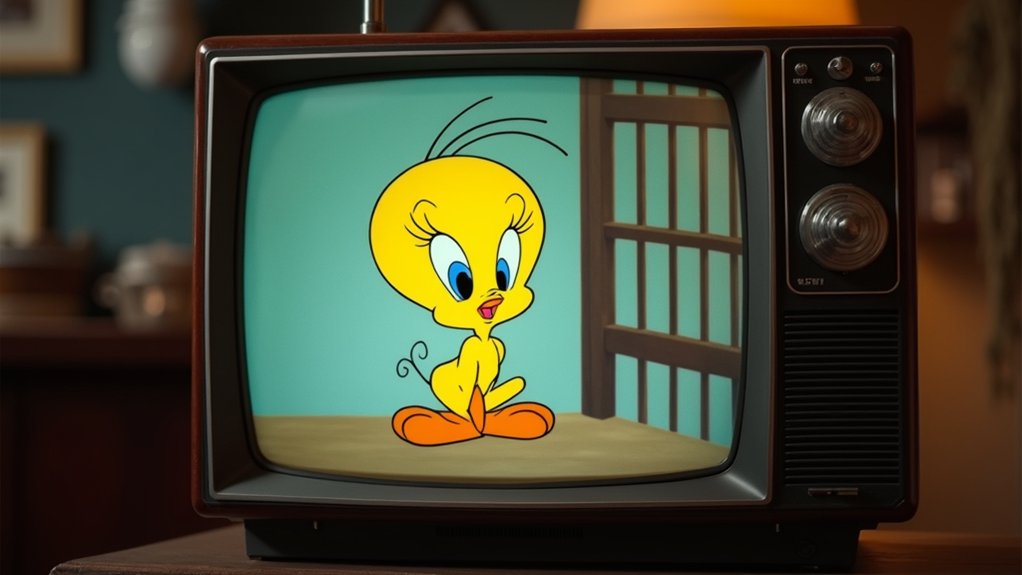
You’ll notice that in classic Looney Tunes, characters often use male pronouns when talking about Tweety, especially during rivalry scenes with Sylvester.
It’s interesting because these moments show a pattern where Tweety is framed with masculine language, which kind of adds weight to the idea of a male interpretation.
At the same time, when Tweety interacts with supposed male suitors, it makes things even more complicated.
These exchanges really mix up how Tweety’s gender comes across through the dialogue.
Despite Tweety’s feminine appearance, it is a well-established fact that Tweety is male in gender.
Male Pronouns Usage
Although Tweety’s visual design often suggests femininity, classic Looney Tunes shorts consistently use male pronouns when characters refer to him. For example, in “Greedy for Tweety” (1957), Granny says, “Let’s make him a little more comfortable,” clearly labeling Tweety male.
In “Snow Business” (1953), Granny calls out “Here I am, boys!” grouping Tweety with Sylvester as male companions. These deliberate pronoun choices by Granny and others reinforce Tweety’s canonical male identity despite feminine features like eyelashes or baby-talk voice. Official Warner Bros. media and merchandise also consistently use masculine pronouns, confirming Tweety’s male gender in the studio’s canon official media.
Even Sylvester and other characters always use “he” when speaking about Tweety, affirming the studio’s intent.
While some early shorts playfully confuse pronouns, the dominant pattern in dialogue firmly establishes Tweety as male in the Looney Tunes universe.
Male Rivalry Scenes
- Granny addresses Tweety and Sylvester collectively as “boys.”
- Rivalry plays out as escalating retaliations typical of male feuds. This dynamic reflects the male character roles commonly found in Looney Tunes.
- Tweety is grouped with male rivals in shared competitive scenarios.
- Male-coded dialogue excludes feminizing Tweety in conflict.
- Fake female canaries are used as rivalry decoys between males.
Male Suitor Interactions
Many classic Looney Tunes shorts provide clear dialogue evidence that confirms Tweety’s male identity, especially through his interactions with male suitors. You’ll notice that male characters, including Sylvester, treat Tweety using masculine pronouns like “he” and “him.” Despite Tweety’s cute and cutesy appearance, he is officially recognized as male in the series’ character history.
Granny even calls Tweety and Sylvester “boys” in “Snow Business,” reinforcing his male status. These interactions highlight Tweety’s role within a male social context despite his feminine appearance.
| Scene | Dialogue Evidence |
|---|---|
| Snow Business | Granny refers to Tweety as “boy” |
| Greedy for Tweety | Male pronouns with maternal care |
| Various Shorts | Mel Blanc’s masculine voice acting |
This dialogue firmly establishes Tweety’s male identity in the Looney Tunes canon.
Tweety’s Role in Relationship Dynamics
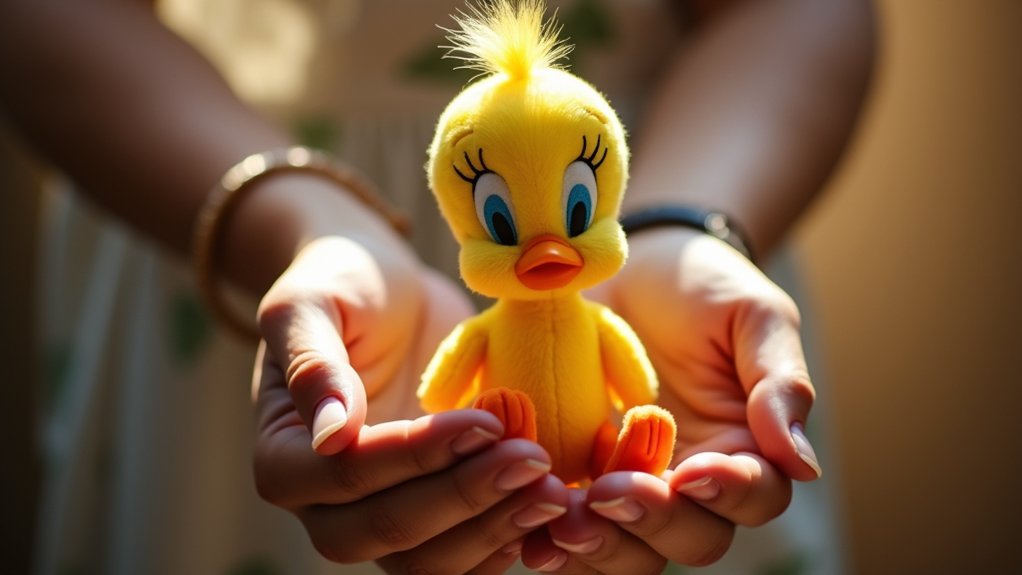
When you investigate Tweety’s role in relationship dynamics, you quickly see how the character functions as much more than a simple cartoon bird.
Tweety navigates complex roles, from prey to strategic opponent, within predator-prey conflicts, while also fitting into caregiver bonds and team settings.
Here’s what stands out:
- Acts as a resilient trickster in Sylvester’s relentless pursuit.
- Serves as the protected ward in Granny’s nurturing household.
- Embodies an underdog yet competent team player in ensembles like the Tune Squad.
- Reflects intergenerational protection themes through caretaking rituals.
- Challenges and expands traditional gender and relationship perceptions in animation.
Understanding these layers helps you grasp why Tweety remains a compelling figure beyond mere gender labels.
Male Pronoun Usage in Scripts and Production Notes
If you plunge into the classic Warner Bros. shorts, you’ll notice that Tweety is consistently referred to using masculine pronouns like “he” and “him.” This isn’t just a casual choice.
Script dialogue and production notes regularly reinforce Tweety’s male identity. For example, in *Snow Business*, Granny greets Sylvester and Tweety with “Here I am, boys!” grouping Tweety as male.
Warner Bros. character bibles, model sheets, and press kits explicitly list Tweety as male, using “he” and “him” throughout.
Even when titles or jokes play on gender ambiguity, original scripts never systematically use feminine pronouns for Tweety. The character has been voiced predominantly by male actors, further solidifying his male identity in official media.
This consistent male pronoun usage in production documentation forms a clear foundation, showing that behind the playful mystery, Tweety’s canonical gender aligns with masculine references in the original Warner Bros. creative materials.
Voice Actor Influence on Gender Perception
Although Tweety’s voice sounds high-pitched and delicate, it’s rooted in a deliberate casting choice that frames the character as male. Mel Blanc created Tweety’s “baby” voice specifically to reflect youth, not femininity. This vocal style shapes how you perceive Tweety’s gender, blending innocence with a male identity.
Consider these points:
- Tweety’s high-pitched, lisping voice mimics a child’s, not a female adult.
- Warner Bros. consistently lists Tweety as male in official materials.
- Voice actors maintain the original timbre to preserve character continuity.
- The soft, legato phrasing contrasts with more aggressive male voices, causing gender confusion.
- Without explicit gendered dialogue, you rely heavily on vocal cues to infer gender.
- This approach reflects broader trends in the 1990s when Warner Bros. cartoons often challenged traditional gender roles in animation.
Understanding this helps you see why Tweety’s voice blurs lines but anchors him as male.
Visual Design Elements Contributing to Gender Confusion
When you look at Tweety, those long eyelashes and soft facial features immediately catch your eye. They hint at femininity, even though the official references don’t always make that clear. The oversized head and innocent wide eyes are part of Tweety’s character design that challenges traditional gender norms.
Then, there’s the fact that Tweety doesn’t wear any clothes or accessories. That leaves you guessing because there aren’t any obvious gender signals there.
Plus, the round body shape and neutral yellow color add to the mix. Altogether, these design choices create a character that cleverly blurs traditional gender lines.
Eyelashes and Facial Features
A key factor that fuels Tweety Bird’s gender confusion lies in the character’s eyelashes and facial features, which borrow heavily from visual cues traditionally associated with femininity.
You’ll notice Tweety’s eyelashes are thick and curved, echoing classic feminine cartoon styles and growing more pronounced in later designs.
The oversized, softly outlined eyes add to the character’s vulnerable, childlike appeal, while the rounded beak and cheeks create a gentle, non-threatening facial expression.
These traits blend to produce an androgynous look that leans feminine despite canonical male status.
- Prominent, curved upper eyelashes emphasize softness and cuteness
- Large, rounded blue eyes with gentle expressions suggest vulnerability
- Rounded beak edges and subtle cheek puffiness soften the face
- Minimal facial lines maintain a smooth, youthful appearance
- Broad, gentle smiles avoid masculine sharpness or aggression
Costume and Accessory Choices
Several costume and accessory choices in Tweety Bird’s early cartoons play a big role in the ongoing gender confusion. For example, Tweety often wore dresses and bows in episodes like *Tree for Two* (1952), but these were tactical disguises for comedic effect, not gender declarations.
These outfits fooled adversaries like Sylvester and fit slapstick humor traditions. The Southern belle-themed *Page Miss Glory* (1947) placed Tweety in feminine-coded narratives, further blurring lines, though male pronouns persisted. This use of exaggerated feminine traits aligns with common animation practices where female characters have disproportionately large eyes.
Moreover, Tweety’s large blue eyes, delicate appearance, and baby-like voice added to perceived femininity. These visual and vocal design choices emphasized innocence and vulnerability rather than biological sex.
Body Shape and Color
Often, Tweety Bird’s body shape and color design lead viewers to question the character’s gender. The oversized head, chibi-style proportions, and bright yellow plumage blur traditional gender signals, making Tweety visually ambiguous.
You’ll notice:
- Large head-to-body ratio and rounded body lack typical male or female silhouettes.
- Soft, fluffy feathers and uniform yellow color avoid real-world bird gender patterns.
- Big, round eyes with minimal eyelashes keep the face neutral.
- Thin neck and tiny torso prevent masculine muscular cues.
- Light, delicate posture and movements suggest vulnerability, often associated with femininity.
These design elements emphasize cuteness and youth rather than gender, creating a character whose visual appeal transcends typical male or female coding. Tweety’s gender was intentionally left ambiguous in the original cartoons, making the character one of the first non-binary characters in mainstream media.
Impact of Character’s Vocal Style on Gender Identity
How does Tweety Bird’s distinctive vocal style shape your perception of the character’s gender?
Tweety’s high-pitched, lisping voice naturally makes you think of a young, perhaps female, character, since many cultures link high pitch with femininity and youth.
But in classic animation, this vocal trait often signals childlike innocence, not gender. Mel Blanc and later voice actors consistently portrayed Tweety as male, using this baby-like tone to emphasize vulnerability, not femininity.
While others confuse Tweety’s gender due to the voice and occasional feminine pronouns, the vocal style aligns with male characters like Jerry Mouse, who also use high-pitched voices.
Creator Intent and Early Character Development
You’ll find that Tweety’s original design by Bob Clampett was quite different from what we know today.
Back then, Tweety was a wild, pink, naked chick with a feisty attitude. This design reflected the male comic archetypes popular in the 1940s.
Clampett’s goal wasn’t really about defining Tweety’s gender clearly. Instead, he aimed for an aggressive, loud-mouthed personality. Initially, Tweety was portrayed as a harsh and malicious character rather than the gentle figure seen later.
Original Character Design
Although Tweety Bird is now instantly recognizable as a cheerful yellow canary, the character’s original design was quite different and left much to interpretation. Created by Bob Clampett in 1942, Tweety started as a naked, pink baby bird named Orson, with no clear species or gender. The iconic yellow feathers and blue eyes came later, largely due to censorship and efforts to improve cuteness. Tweety’s first appearance was in 47 cartoons during the golden age of animation, which helped solidify the character’s presence in pop culture.
Originally portrayed as a naked, pink baby bird with jowly features, Tweety had no explicit gender assigned at creation; the name Tweety came after the first cartoon. Early personality was aggressive and combative, which contrasts with the innocence we see later.
Friz Freleng softened Tweety’s look and demeanor by adding lashes and yellow feathers. Mel Blanc’s high-pitched, speech-impeded voice also shaped Tweety’s youthful character.
This evolution set the foundation for Tweety’s enduring appeal.
Creator Gender Intent
Since Bob Clampett drew inspiration from a “naked baby picture” of himself, Tweety’s conception was rooted in a male identity from the start. Early production notes and character bios name Tweety as male, reinforced by in-series lines like Granny’s “Here I am, boys!” and a gag where Tweety exits a men’s restroom, stating “I am a boy!” Tweety’s talkativeness aligns with the behavior of a male canary, which further supports the character’s male identity.
Clampett’s original vision combined an innocent look with a sharp, combative personality, emphasizing comedic contrast rather than gender stereotypes. Voice actor Mel Blanc’s high-pitched lisp was meant to reflect infancy, not femininity, keeping Tweety’s male status intact despite audience confusion.
| Aspect | Details |
|---|---|
| Inspiration | Bob Clampett’s baby photo (male) |
| Early Personality | Aggressive, prankish, “naked genius” |
| Canonical Gender | Male, confirmed in production and scripts |
| Voice Style | Infantile lisp by male actor Mel Blanc |
Modern Media’s Treatment of Tweety’s Gender
When you plunge into modern media’s treatment of Tweety’s gender, you quickly see a fascinating mix of clarity and confusion. Canon sources firmly label Tweety as male, yet modern coverage teases out ambiguity. The character’s original portrayal was intentionally gender-neutral, which contributes to the ongoing debate.
You’ll find explainer content resolving fan debate by confirming Tweety’s male gender despite feminine traits. Feminine-coded visuals and merchandise, like pink apparel, fuel assumptions Tweety is female.
Newer series often use gender-neutral language, softening explicit pronoun use. Marketing frequently leans on Tweety’s “cute” and “girlish” aesthetic to target female audiences.
Contemporary discussions highlight how ambiguity is both preserved and played with, reflecting evolving storytelling and branding strategies.
Gender Neutrality and Inclusive Language Trends
As society shifts toward greater inclusivity, you’ll notice language evolving to reflect gender neutrality more actively. This shift affects media portrayals like Tweety Bird, where neutral terms gain traction. Recent studies reveal that changes in language usage often precede updates in prescriptive style guides, highlighting how actual usage trends influence formal guidelines more than the other way around (language usage precedes guidelines).
Gender-neutral pronouns and titles are increasingly accepted, driven by social norms, legislation, and media influence. You’ll find that non-binary individuals and women often support inclusive language more, while habitual speech patterns and exposure shape its adoption.
| Factor | Impact on Language Use |
|---|---|
| Social Norms & Legislation | Promote inclusive terms |
| Media & Institutions | Normalize gender neutrality |
| Cognitive Load & Practice | Influence habitual usage |
Understanding these trends helps you appreciate the evolving portrayal of characters like Tweety in a more inclusive light.
Fan and Cultural Interpretations of Tweety’s Gender
Although Warner Bros. officially identifies Tweety as male, fans often grapple with the character’s gender due to conflicting visual and vocal cues. You’ll find debates fueled by Tweety’s high-pitched voice, long eyelashes, and cute appearance, which many interpret as feminine.
This creates a lively fan culture where gender ambiguity sparks discussion and creativity. Fans debate Tweety’s gender on forums and social media polls. Foreign dubs use female voices, adding to confusion. Some view Tweety as a queer-coded or non-binary icon.
Fan art examines genderfluid and trans narratives. Clips highlighting gender confusion circulate as meta-commentary. You can see how cultural interpretations transform Tweety from a straightforward male character into a symbol of gender fluidity and camp.
Frequently Asked Question
What Species of Bird Is Tweety?
Tweety is a yellow domestic canary, a small songbird known for its bright plumage and cheerful singing. You’ll find Tweety officially classified as Serinus canaria domestica in Warner Bros. materials and character profiles.
Though some might confuse Tweety for a generic bird or parakeet, the character’s design and traits clearly reflect the domestic canary species.
This bird is native to the Canary Islands and prized for its vibrant yellow color and compact size.
When Did Tweety First Appear in Cartoons?
If you thought Tweety popped out fully formed in yellow feathers, think again.
Tweety first appeared in the 1942 Merrie Melodies short “A Tale of Two Kitties,” debuting as a featherless, scrappy baby bird named “Orson” (yes, really).
Directed by Bob Clampett, this black-and-white cartoon introduced you to Tweety’s clever, feisty personality long before the iconic “I tawt I taw a puddy tat!” catchphrase flew onto the scene.
Why Does Tweety Have a High-Pitched Voice?
You hear Tweety’s high-pitched voice because it highlights his small size and innocence, making him sound cute and vulnerable.
Mel Blanc crafted this voice using speed-up techniques and a lisp to create a playful, memorable character who contrasts comically with larger foes like Sylvester.
This vocal style emphasizes Tweety’s cleverness and resilience, not gender, helping you instantly recognize his sprightly, underdog personality in every cartoon.
How Did Tweety Get His Name?
You’ll find that Tweety got his name by blending “sweetie” and “tweet,” capturing both his adorable charm and bird-like chirping. This clever wordplay makes the name catchy and memorable, perfectly fitting his baby-like design and speech.
Originally called “Orson,” the character evolved in the 1940s, and the name “Tweety” stuck, reinforcing his vulnerability and cuteness while supporting his signature baby-talk style.
Who Created the Character Tweety Bird?
You want to know who created Tweety Bird? Bob Clampett did. You want to know when? In 1941. You want to know where? At Warner Brothers animation studio.
Clampett designed Tweety based on a mix of real canaries and a comedian’s character, making him both cute and mischievous.
His creation debuted in 1942 and quickly became a beloved figure in animation history, showing just how creative and innovative Clampett truly was.
Conclusion
You’ve seen official records, investigated classic cartoons, and noticed how creators and fans talk about Tweety Bird’s gender. You’ve considered male pronouns, historical hints, and modern shifts toward neutrality.
You’ve weighed Warner Bros.’ intent, dialogue clues, and cultural interpretations. Whether you view Tweety as boy, girl, or a symbol beyond gender, you understand that identity can be complex, fluid, and open to interpretation, just like the beloved little yellow bird himself.