

You’ll recognize the Nazca booby by its mostly white body, black-tipped wings, black facial mask, and bright orange bill. Females are particularly larger and have paler bills.
Found primarily around the Galapagos and eastern Pacific islands, it nests on rocky ledges with guano-marked territories. This seabird employs plunge-diving to capture fish, showing complex courtship and territorial calls.
Its survival hinges on healthy marine ecosystems amid growing threats. Investigate its detailed ecology and behavior to grasp its full adaptation.
Physical Characteristics of the Nazca Booby
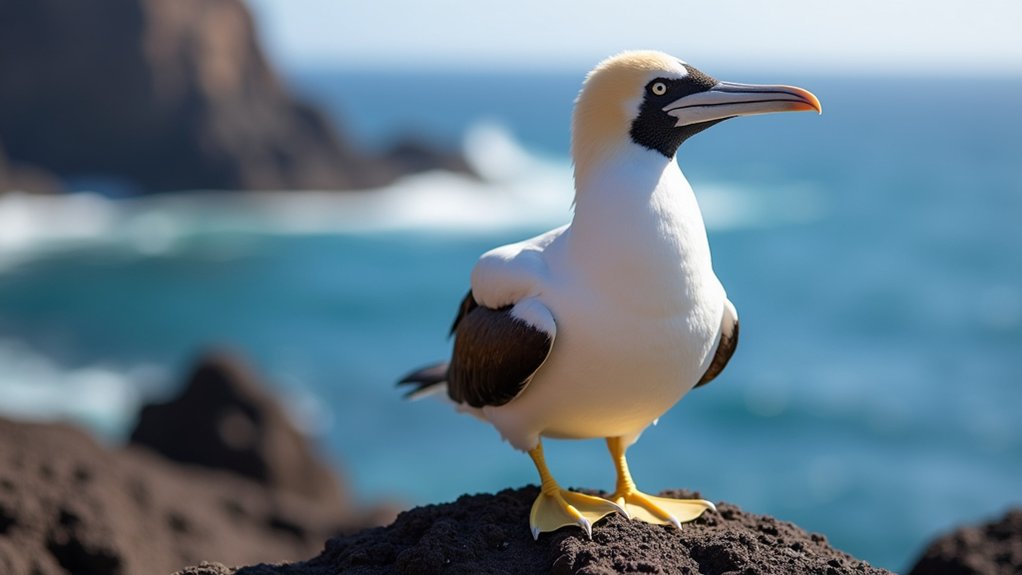
The Nazca Booby displays a striking combination of physical traits that serve both functional and identification purposes. You’ll notice its mostly white body and head, sharply contrasted by black-tipped wings and tail feathers colored deep brown-black.
A distinctive black facial mask encircles the yellow iris, contrasting vividly against the bright orange to pinkish bill. This is a key identification feature that varies by island population. The long, pointed bill complements an elongated neck and aerodynamic body, optimizing flight efficiency.
Its grey to blue-grey webbed feet contain dense blood vessels, which help with thermoregulation during incubation and support aquatic locomotion. These feet have been studied as effective surrogate brood patches due to their vascularization. The streamlined tail and slender wings improve sustained flight, while the robust bill matches overall body proportions.
Juveniles shift from white to grey plumage as they mature, marking developmental stages clearly.
Sexual Dimorphism and Gender Differences
Two key aspects distinguish male and female Nazca Boobies: size and coloration. Females are approximately 16% heavier and significantly larger than males, a difference evident from early development and persisting throughout adulthood. This size disparity affects foraging, as females plunge deeper and capture larger prey. Additionally, females tend to have larger wingspans, ranging up to 6 feet, which aids their hunting efficiency.
Coloration differences are subtle but consistent. Females have paler beaks, contrasting with males’ vibrant orange-pink bills, while both sexes share white plumage with black wing and tail tips.
Behaviorally, males emit whistling calls and initiate courtship displays, whereas females produce squawks or quacks. These vocalizations provide a noninvasive sex identification method.
Sexual dimorphism extends to reproductive roles, with females exercising mate choice and exhibiting higher juvenile mortality. This results in a male-biased adult sex ratio despite balanced hatching ratios.
Geographic Distribution and Range
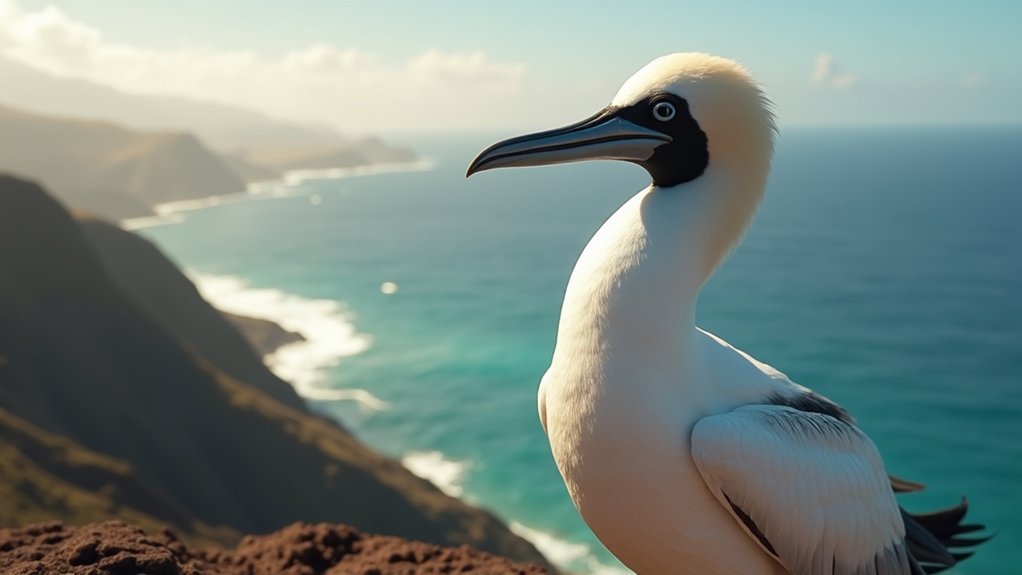
Although Nazca Boobies are confined to the Eastern Tropical Pacific Ocean, their distribution spans a diverse range of coastal and island habitats from the Baja California region down to northwestern Peru.
You’ll find their northern boundary near islands off Baja California, with occasional stragglers wandering beyond this seasonal limit, though breeding colonies don’t establish further north.
The Galapagos Islands serve as the species’ primary breeding stronghold, while coastal zones of South and Central America support additional colonies. In the Galapagos, they are notably the largest booby species.
The Galapagos Islands are the main breeding hub, with extra colonies along South and Central American coasts.
Southern limits extend to Isla de la Plata in Ecuador and Malpelo in Colombia, with small populations breeding along Ecuadorian and Peruvian coasts.
Outside breeding seasons, nonbreeding individuals spread broadly within this eastern Pacific range but rarely venture offshore, maintaining a distribution closely tied to coastal and island environments.
Preferred Habitat and Nesting Sites
When selecting nesting sites, Nazca boobies rely exclusively on rocky cliff ledges and steep slopes adjacent to ocean waters, a choice driven by their considerable size and flight mechanics. These raised, near-vertical coastal locations provide essential launch points, compensating for the bird’s limited wing surface-to-body-weight ratio and enabling efficient takeoff. Nazca boobies are recognized as a unique species since 2002, which highlights their distinct ecological adaptations.
You’ll find them nesting on bare, debris-cleared ground with minimal vegetation, preferring guano-lined circles that demarcate individual territories on open rocky ledges. This habitat selection minimizes predation risks and guarantees direct ocean access for rapid diving during foraging.
The colonies cluster across Eastern Pacific island cliffs, where rocky substrates outperform sandy or vegetated alternatives, supporting up to 20,000 breeding pairs.
This strategic nesting habitat underscores the Nazca booby’s adaptation to its ecological niche, balancing physical constraints with reproductive territoriality.
Nesting Behavior and Reproductive Strategies
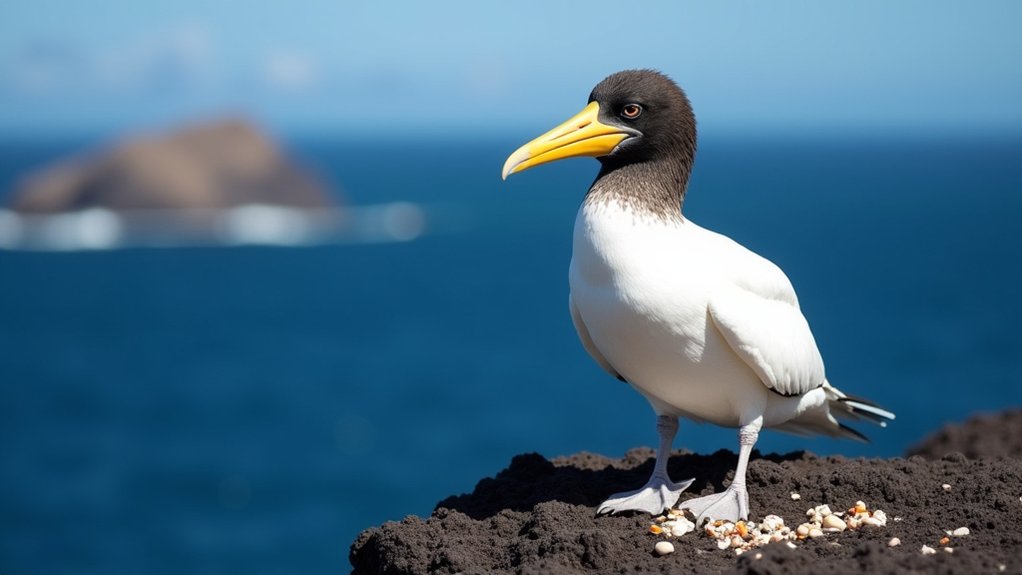
As you observe Nazca boobies during their breeding season, you’ll notice males assertively selecting and defending specific nesting territories on cliff ledges. This marks the initial step in their reproductive cycle.
These nests are simple guano-lined rings on bare rocky ground, strategically placed on steep cliffs to facilitate takeoff for their large bodies. Their preference for cliffs and islets helps to avoid ground predators and ease flight despite their weight and size.
Males initiate courtship with a ‘sky pointing’ ritual, prompting synchronized displays and vocalizations from females. This solidifies pair bonds before nest construction and egg laying.
Females lay one or two eggs, incubated fairly by both parents to maintain temperature.
However, obligate siblicide occurs as the first-hatched chick dominates, often ejecting its weaker sibling, which optimizes parental investment.
Extended breeding seasons demand significant parental care. This care is linked closely to environmental food availability and results in metabolic stresses.
Feeding Techniques and Diet
Feeding efficiency defines the Nazca booby’s survival and reproductive success, relying heavily on a diet dominated by South American pilchards under stable environmental conditions.
You’ll observe these birds plunge-swoop from high-speed aerial approaches, reaching depths up to 30 meters to capture prey.
Their diet shifts adaptively: when pilchards decline, they target flying fish, anchovies, or squid, especially during El Niño events, showcasing nutritional flexibility. The Nazca booby’s plunge dives are remarkable, as they often dive from heights of up to 30 meters.
Key feeding techniques and diet facts include:
- Coordinated group hunting minimizes individual energy use and maximizes prey capture.
- Females plunge deeper and pursue larger prey, supporting reproductive energy needs.
- Rapid vertical dives guarantee high success rates in prey acquisition.
- Physical adaptations enable sustained underwater performance, vital for accessing deeper prey layers.
This intricate feeding strategy underpins their ecological resilience and reproductive output.
Vocalizations and Communication Patterns
Although Nazca boobies rely heavily on visual cues, their vocalizations play a significant role in social interactions within breeding colonies. Males produce distinct whistling calls, while females emit squawks or quacks, enabling gender identification and facilitating species recognition.
During courtship, males initiate a “sky-pointing” ritual accompanied by vocalizations, which females reciprocate, signaling pair compatibility and nest site establishment. Their courtship display also includes lifting feet as a visual signal to the partner.
Territorial males use amplified calls from cliff ledges to defend nesting areas, increasing vocal activity during peak breeding.
Vocalizations include territorial, begging, and song calls, documented at Galapagos and Ecuador sites. Outside colonies, you’ll notice minimal vocalization, especially during silent foraging plunges.
This acoustic behavior reflects a complex communication system concentrated on breeding success and social structuring within dense colony environments.
Relationship With the Galapagos Ecosystem
You play an essential role in the Galapagos ecosystem by regulating fish populations through your plunge-diving foraging technique. This method allows you to catch fish efficiently, which helps keep their numbers in check and supports the overall health of the marine environment. Your average lifespan of 23 years allows you to contribute to the ecosystem over a long period.
Plus, your interactions with species like the masked booby have an interesting impact. They influence nesting site selection and territorial dynamics on these islands, creating a complex web of relationships. Even after death, you contribute to the ecosystem as your body provides nutrients for scavengers and microorganisms, which recycle your remains and enrich the island environment.
Understanding these connections helps us see how you maintain ecological balance and adapt to changes in your environment.
Ecological Role and Impact
Because Nazca boobies occupy an apex predator role in the marine food web, their foraging behavior directly influences prey populations and nutrient flow within the Galápagos ecosystem.
You’ll notice their impact in these key ways:
- They regulate fish and squid populations by selectively preying on species identified through cues from tuna, maintaining ecological balance.
- Their plunge-diving hunting technique affects nutrient cycling by redistributing marine biomass through excretion near nesting sites.
- Foraging performance changes with oceanographic conditions, linking large-scale environmental variability to local ecosystem dynamics. Research has shown that older female Nazca boobies tend to travel farther and spend more time foraging, which may affect their reproductive success and the dynamics of prey populations foraging behavior and age.
- Dietary flexibility allows them to adapt to prey shifts, buffering the ecosystem against fluctuations in sardine populations and ENSO events.
Understanding these roles clarifies how Nazca boobies sustain marine trophic structure and influence Galápagos biodiversity.
Interaction With Other Species
Three key interspecies interactions define the Nazca booby’s relationship within the Galápagos ecosystem: parasitic blood-feeding by vampire finches, coexistence with sympatric booby species, and intense intraspecific aggression including obligate siblicide.
You’ll observe vampire finches extracting small blood amounts, supplementing their diet but risking septic infections in boobies, especially during food scarcity. This exemplifies parasitism where one benefits at the expense of another.
Nazca boobies nest alongside masked, blue-footed, and red-footed boobies, partitioning habitats. Nazcas favor cliffs while masked boobies prefer lowlands, minimizing direct competition despite overlapping ranges.
Within their own species, aggressive siblicide guarantees only the dominant chick survives, enhancing fledging success but perpetuating behavioral aggression into adulthood.
This triad of interactions highlights the Nazca booby’s complex ecological niche shaped by parasitism, interspecific coexistence, and intraspecific competition within the Galápagos environment.
Taxonomic History and Classification
- Behavioral evidence from Clipperton Island in 1998 demonstrated reproductive isolation from masked boobies.
- Mitochondrial DNA analyses confirmed genetic divergence around 400,000–500,000 years ago.
- The American Ornithologists’ Union raised it to full species status in 2002.
- It’s currently classified as a monotypic species in family Sulidae, order Suliformes, reflecting refined molecular phylogenetics. This classification is supported by the species’ distinct geographic range, as it is most common and conspicuous year-round in the Galápagos with notable colonies on Genovesa, Española, and Floreana.
This progression highlights the shift from morphology-based to integrative genetic taxonomy.
Differences From the Masked Booby
When you compare the Nazca and Masked boobies, you’ll notice some clear differences in their bill colors and the patterns on their tail feathers.
These visual clues make it easier to tell them apart. Plus, they don’t just look different—they also behave differently.
For instance, they choose different places to nest and have unique calls that set them apart. Observing their opportunistic behavior during interactions with humans provides additional insight into their adaptability.
Getting to know these physical and behavioral traits really helps you understand how each species has adapted to its environment and why they’re classified separately.
Physical Appearance Variations
Beak coloration and structure provide clear distinguishing markers between the Nazca and Masked boobies. You’ll notice Nazca’s beak exhibits orange, pinkish, or coral-pink tones, contrasting with the Masked’s paler hues. The Nazca booby is also known for its distinctive black facial mask, which helps differentiate it from other seabirds like the Blue-footed Booby distinct black facial mask.
Juveniles show a horn-colored base with a golden-yellow tip, while males flaunt brighter orange-yellow bills compared to the paler pinkish females.
Tail feather patterns also differentiate these species:
- Nazca’s central tail feathers are mainly white; Masked’s are black.
- The extent of white increases with Nazca’s age, serving as an adult identification marker.
- Both species display a sharp black facial mask contrasted against white plumage.
- Females are larger and heavier, with distinct sexual dimorphism aiding field identification.
These traits provide reliable morphological criteria for distinguishing Nazca boobies in the field.
Behavioral and Vocal Differences
Although Nazca and Masked boobies share similar habitats, their behavioral and vocal patterns reveal distinct differences critical for species identification.
Nazca boobies perform a “sky pointing” courtship dance where males extend their beaks upward, signaling nest location. This is a simpler ritual than the Masked booby’s displays.
You’ll find Nazca nests on rocky cliff ledges, contrasting with Masked boobies’ shallow ground depressions.
Vocally, male Nazca boobies whistle while females quack, which differs from Masked boobies’ descending whistles and loud honks.
Furthermore, Nazca boobies exhibit obligate siblicide, ensuring only one chick survives. This early maltreatment influences adult aggression linked to early maltreatment.
These nuanced behavioral and vocal distinctions provide reliable criteria for differentiating Nazca boobies from their Masked counterparts in overlapping ranges.
Challenges Facing the Nazca Booby
Since the Nazca booby relies heavily on stable marine and coastal environments, it faces multiple interrelated challenges that threaten its survival and reproductive success.
The Nazca booby’s survival depends on stable marine and coastal ecosystems, facing numerous intertwined threats.
You need to understand these critical threats:
- Marine pollution, especially plastic debris, causes mortality through ingestion and entanglement.
- Microplastics also disrupt the food chain indirectly.
- Overfishing depletes primary prey, such as South American pilchards, forcing diet shifts.
- This increases risks from fishing gear bycatch.
- Nesting habitat loss from environmental degradation and human encroachment restricts breeding territories. The Nazca booby is territorial during breeding season, making the availability of suitable nesting space critical for successful reproduction.
- This limits population growth and genetic diversity.
- Climate variability, especially El Niño events, causes sardine collapses and fluctuates food availability.
- These changes severely impact breeding success and adult metabolic demands.
Addressing these challenges requires targeted conservation strategies to stabilize Nazca booby populations.
Observing Nazca Boobies in the Wild
When observing Nazca boobies in the wild, you’ll immediately notice their distinctive black facial masks and vibrant orange bills, which vary subtly between males and females.
Focus on the Galapagos Islands, their primary accessible breeding habitat. They nest on rocky ledges and bare ground patches near steep cliffs. These nesting sites are primarily located on Genovesa, Floreana, and Española islands, highlighting their limited but significant geographic distribution.
Watch males perform “sky pointing” courtship dances, extending their beaks skyward, with females mirroring these movements.
Pay attention to sexual dimorphism: females are larger and produce quacking vocalizations, while males whistle.
For feeding behavior, observe their plunge-sinking from heights over 30 meters to catch small fish and squid.
Note that females sink deeper for larger prey.
Their territorial defense during breeding season is pronounced, making this period ideal for detailed behavioral studies.
Frequently Asked Question
How Long Do Nazca Boobies Typically Live in the Wild?
Nazca boobies typically live 20 to 25 years in the wild, with some individuals confirmed to reach their late 20s.
You should consider that their lifespan aligns with long-lived seabirds exhibiting low reproduction rates and extended parental care.
Their longevity results from evolutionary adaptations balancing survival and reproductive output, despite environmental challenges like El Niño events impacting breeding.
This lifespan range reflects robust survival strategies within their marine ecosystem.
What Predators Threaten Nazca Booby Chicks?
You’ll find that Galápagos mockingbirds and hawks are primary predators threatening Nazca booby chicks, especially those left exposed outside the nest perimeter.
These aerial and terrestrial predators exploit moments when parental vigilance lapses.
Furthermore, adult boobies can be aggressive, inflicting harm on unrelated chicks.
Once a chick is forced from the nest, environmental factors like starvation and hypothermia further increase mortality risk, compounding the predation threat considerably.
Can Nazca Boobies Be Kept Successfully in Captivity?
You won’t find Nazca Boobies thriving behind glass walls or in confined aviaries.
Successfully keeping them in captivity proves challenging due to their specialized marine diet, expansive flight needs, and complex social behaviors.
Captive programs face hurdles replicating open ocean conditions and maintaining natural breeding cycles.
Without extensive research and tailored environments, captivity often stresses these birds, limiting reproductive success and health.
Consequently, current evidence suggests they’re not suited for traditional captive settings.
How Do Nazca Boobies Impact Local Fish Populations?
You directly affect local fish populations by preying heavily on species like South American pilchards and anchovies. This can reduce these stocks, especially during breeding seasons.
Your plunge-diving method targets fish up to 30 meters deep, which intensifies predation pressure.
During El Niño events, when sardines decline, you shift to less-nutritious flying fish. This change alters local prey dynamics.
Your selective hunting and environmental responses greatly influence fish population structure and availability.
Are Nazca Boobies Migratory or Do They Remain Year-Round in the Galapagos?
Nazca boobies remain year-round in the Galapagos; they aren’t migratory. You’ll find about 15,000-20,000 breeding pairs maintaining a permanent presence across islands.
They shift seasonally between cliff nesting sites during breeding months and offshore feeding grounds otherwise. Their staggered breeding schedules on different islands guarantee continuous visibility throughout the year.
Despite oceanic feeding habits, they consistently return to the Galapagos, establishing strong residency patterns supported by a 20-25 year lifespan.
Conclusion
Now that you’ve investigated the Nazca Booby’s intricate physical traits, unique reproductive strategies, and precise habitat preferences, you’re equipped to appreciate its ecological niche like never before. Facing challenges from environmental changes, this bird’s survival hinges on nuanced conservation efforts.
Observing a Nazca Booby in the wild is nothing short of witnessing nature’s marvel. Its presence is as rare and electrifying as a lightning bolt in a clear sky, demanding your keen scientific attention.