
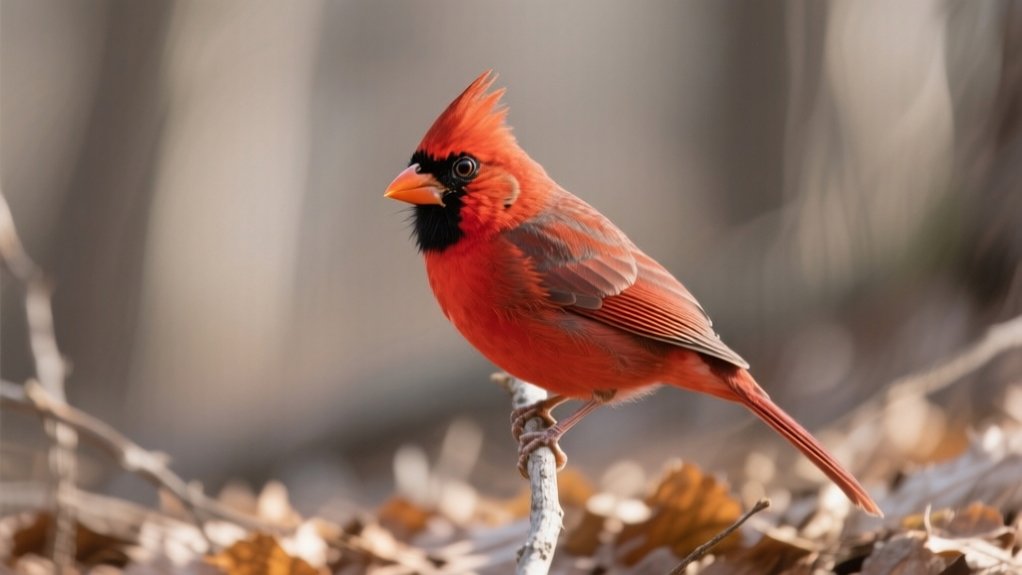
You’ll spot the Northern Cardinal by its vivid red plumage, pointed crest, and bright orange-red bill in males; females are subtler with brownish tones and red highlights. They thrive from southeastern Canada to Mexico, favoring forest edges, dense shrubs, and urban backyards.
These territorial birds communicate through diverse calls and songs, breed year-round, and adapt well to human environments. Observing their behaviors and seasonal patterns reveals even deeper insights into their ecology and interactions.
Physical Appearance and Distinctive Features
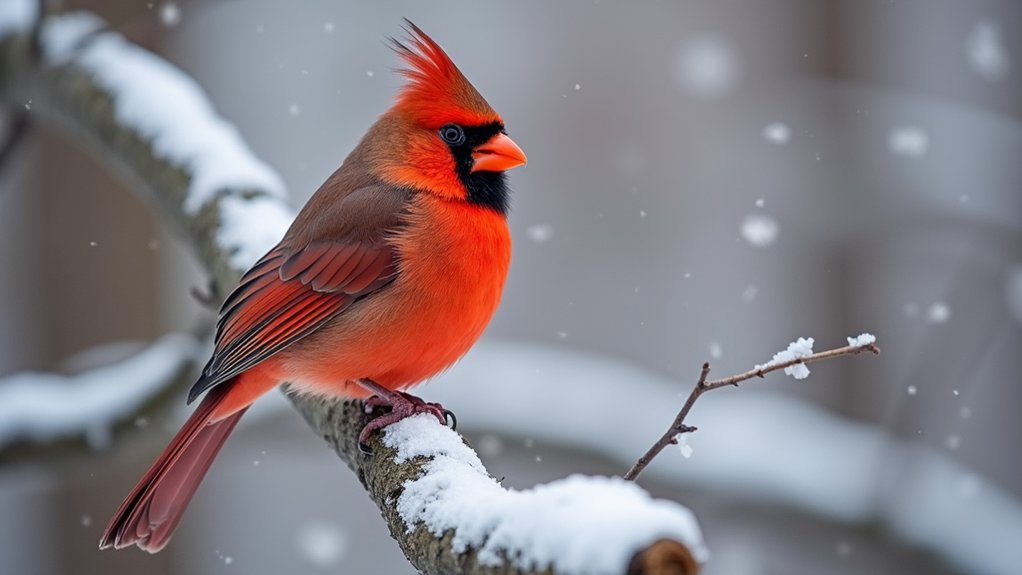
The Northern Cardinal presents a distinctive physical profile characterized by a mid-sized, long-tailed body measuring between 21 and 23.5 cm in length, with a wingspan ranging from 25 to 31 cm.
You’ll notice its proportional frame complemented by a rather long tail, which extends straight down when perched, contributing considerably to its overall length.
The bird’s short, thick bill is cone-shaped and robust, typically bright coral or orange-red in adults, while juveniles show darker pigmentation.
Both sexes display a prominent, sharply raised crest atop the head, creating an unmistakable silhouette.
The brick-red coloration on the crest, wings, and tail stands out vividly, along with a facial mask extending from the eyes across the upper chest.
Subtle gray edging on back and wing feathers adds nuanced detail to its plumage.
Male Northern Cardinals are easily identifiable by their brilliant red color.
Male Vs Female Cardinal Characteristics
When you look at Northern Cardinals, you’ll see that the males really stand out with their bright red feathers. On the other hand, the females tend to have more muted brownish colors, but with some red highlights here and there. It’s kind of like the males are showing off a bit more.
Also, if you pay attention to their bills, the males have these bright orange-red bills that really pop against their feathers. Females have bills too, but theirs aren’t quite as vibrant. They’re just a little duller in color. The color patterns of male and female cardinals are actually similar to how other bird species, like robins, show differences between males and females.
Another thing to notice is the crest on their heads. Male cardinals usually have bigger, more noticeable crests. These crests can actually be important when they’re interacting with other birds, maybe as a way to communicate or show dominance. In addition, males are typically larger and more robust than females, making size a subtle but useful way to distinguish between the sexes size difference.
Plumage Color Differences
Although male and female northern cardinals share the same species, their plumage coloration exhibits striking sexual dimorphism that serves distinct ecological and reproductive functions.
Males flaunt vivid red plumage across their body, including wings, tail, and crest, paired with a distinct black facial mask that accentuates their bright bill and eyes. This bright coloration in males is similar to the vibrant plumage seen in ornamental domestic birds, which often play a role in mate selection and social signaling.
Females contrast with warm brown or grayish-brown bodies, pale gray faces, and softer, less intense facial masks. Female wings and tails show subtle red tinges but remain largely muted, aiding camouflage during nesting. Their crests blend red with gray or brown, less pronounced than males. Dense and sleek feathers provide excellent insulation for both sexes, helping cardinals maintain warmth in cooler climates.
Throat and underside coloration further differentiate sexes: males exhibit red and black, while females display subdued yellow-brown tones that harmonize with their overall muted palette.
This color divergence balances attraction and concealment effectively.
Bill Color Contrast
You’ll notice that beyond plumage, bill coloration offers another clear visual cue distinguishing male and female northern cardinals.
Male cardinals show a bright, orange-red bill with a coral-to-bright-red spectrum, signaling reproductive fitness and territorial dominance. This intense pigmentation remains consistent year-round and stems from carotenoid pigments metabolized from their diet. Northern cardinals are a common and well-loved species, which makes these visual features especially familiar to many people. In rare cases, cardinals may show unusually dark or even almost black bills due to genetic mutations such as melanism, although this is not typical.
In contrast, females possess a softer, muted orange bill, ranging from pink-orange to coral hues, providing subtle dimorphic distinction and aiding nesting camouflage.
Both sexes share a cone-shaped bill optimized for seed cracking, yet juveniles start with gray or black bills that evolve post-molt.
Side-by-side field observation reveals these color contrasts, which also vary slightly among subspecies.
This bill coloration serves as a functional and communicative trait critical to their survival and breeding success.
Crest Visibility Traits
Because crest visibility plays an essential role in Northern Cardinal identification and behavior, examining the differences between males and females reveals distinct patterns.
Male cardinals showcase prominent, upright crests with bright red coloring, which intensifies slightly during territorial and mating displays. They are large, long-tailed songbirds with a short, thick bill and prominent crest.
Females, though retaining their crests year-round, display less pronounced crests with pale red and brown tones, providing subtle camouflage during nesting. This sexual dimorphism balances reproductive signaling and protective concealment.
Crest size correlates with overall body size. Males are stockier with more robust crests, while females have smaller, delicate ones.
These crests, combined with facial masks and bill coloration, aid in species and subspecies recognition.
Hormonal influences drive these structural and color differences, ensuring each sex ideally adapts crest visibility for survival and reproductive success.
Juvenile Cardinal Identification
When identifying juvenile Northern Cardinals, pay close attention to their bill coloration, which differs markedly from adults.
Juveniles sport dusky to black bills at fledging, unlike the bright red-orange seen in mature birds. This dark bill gradually evolves to red by mid- to late fall, offering a clear age indicator.
Their plumage resembles adult females with brown dominating above and reddish-brown below, while brick-red highlights appear on crest, wings, and tail.
Molt limits between retained juvenile feathers and emerging adult feathers further aid identification. Identification challenges include unreliable sex determination in juveniles until preformative molt begins.
Bills remain dark until nearing full maturity, distinguishing juveniles from after-hatch-year birds.
Growth bars on tail feathers mark hatch-year status.
Juvenile males show more red on wings post-preformative molt; females retain brown.
Iris color shifts from grayish-brown in juveniles to dark brown in adults.
Size, Weight, and Body Structure
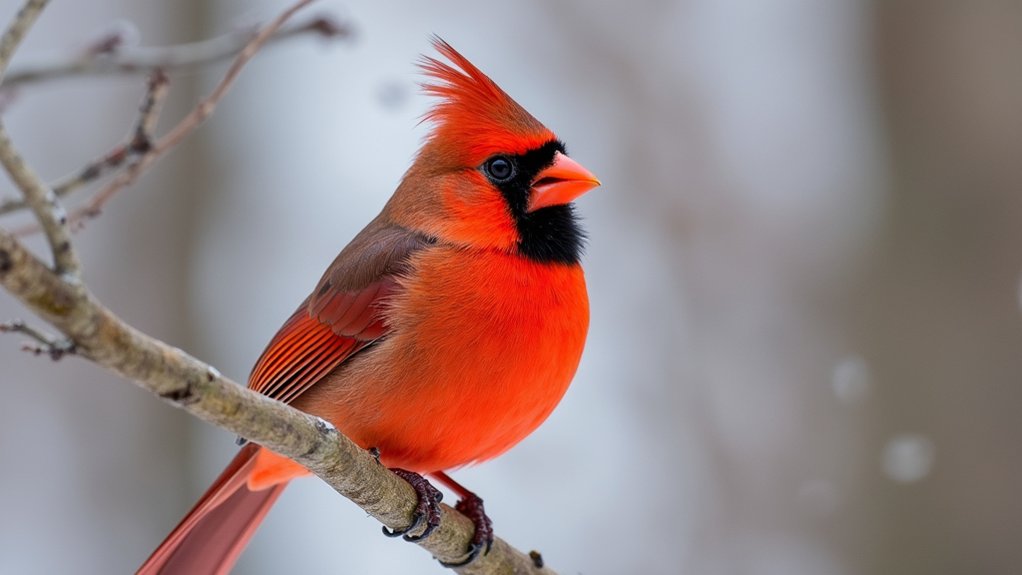
You’ll notice that Northern Cardinals measure between 21 and 23 centimeters in length.
Males are generally a bit larger than females. Their weight ranges from about 34 to 65 grams.
Meanwhile, their wingspan spans roughly 25 to 31 centimeters, giving them a balanced flight profile.
One of their distinctive features is a thick, cone-shaped bill.
Plus, their vibrant plumage varies subtly between sexes and age groups.
Juvenile cardinals have grayish-black beaks at hatching, which turn orange-red in adulthood.
Cardinal Dimensions
The Northern Cardinal exhibits a distinctive size range that classifies it as a mid-sized perching songbird. Its overall body length is typically between 8.3 and 9.1 inches (21-23 centimeters) across both sexes.
Males tend to be slightly larger and heavier than females, measuring up to 23.5 cm in length and averaging around 45 grams. Females are marginally smaller and lighter.
The wingspan significantly exceeds body length, averaging about 12 inches (30.5 cm), which improves flight capabilities. The wingspan ranges from 9.8”-12.2” (25-31 cm), providing a reliable measure across individuals.
Juveniles grow rapidly, reaching adult dimensions within their first year.
- Body length ranges mainly from 21 to 23 cm, with males generally larger
- Wingspan spans 25-31 cm, facilitating agile flight patterns
- Weight averages 44.8 grams, with males heavier than females
- Growth from hatchling (3 g) to adult size occurs within months
Plumage and Beak
Although both sexes share a sturdy, cone-shaped beak essential for seed cracking, you’ll notice sharp differences in plumage that reflect their ecological roles.
Males display brilliant crimson red feathers with a black face mask and a distinctive crest. Females exhibit muted brown tones with subtle reddish highlights and less defined facial markings to aid in camouflage during nesting.
The male’s bright red underparts and tail contrast with darker red wings and back. Females show grayish-brown upperparts and buffy tan underparts.
Both have coral-colored beaks—bright orange-red in males and pink-orange in females—that develop from grayish-black at hatching.
Their prominent crest adjusts during social interactions, and down feathers provide insulation.
Juvenile cardinals resemble adult females with light tan coloration and duller beaks.
These features highlight intricate adaptations in their plumage and beak structure.
Weight and Wingspan
Beyond their striking plumage and beak, Northern Cardinals exhibit a well-defined size and weight profile that supports their ecological niche. You’ll notice they range from 8.3 to 9.1 inches in length, with males slightly larger than females.
Their weight typically falls between 1.5 to 1.7 ounces, fluctuating with season and food availability. Wingspan measures 9.8 to 12.2 inches, featuring short, rounded wings optimized for their characteristic flap-bounding flight during short foraging trips.
Length-to-wingspan ratio is about 1:3, aiding maneuverability. Males weigh more, correlating with their marginally greater length.
Wing shape facilitates quick, agile movement in dense shrubs. Weight variability reflects environmental factors, highlighting adaptability.
This precise body structure improves their survival in varied habitats. They are roughly the size of a Robin, which is a useful comparison for identification in the field size comparable to a Robin.
Geographic Distribution and Subspecies
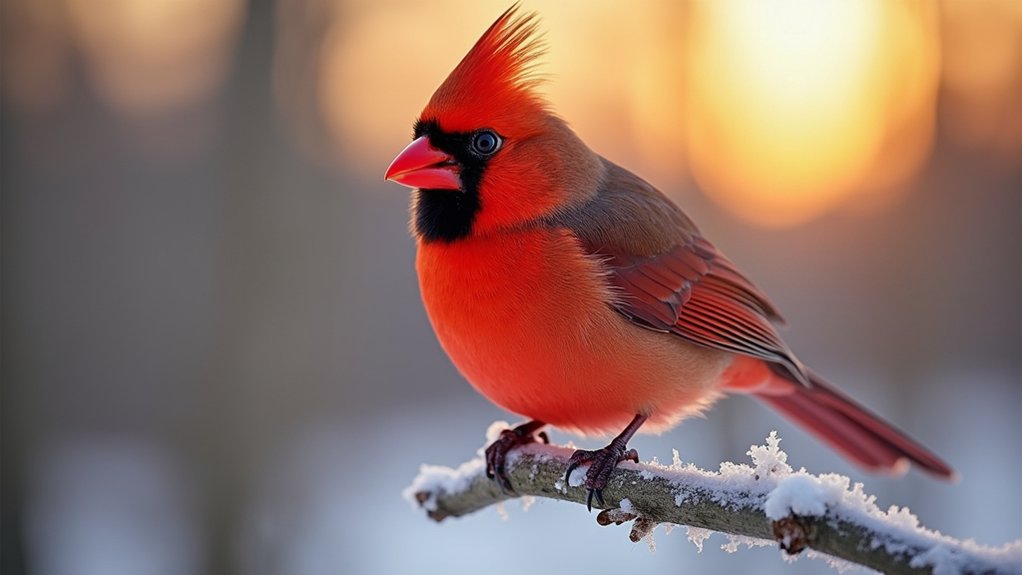
When you observe Northern Cardinals across North America, you’ll notice they occupy a vast range extending from southeastern Canada through the eastern and central United States, reaching as far south as southern Mexico, northern Guatemala, and northern Belize.
This Nearctic species, with Neotropical extensions, thrives especially in the Southeast, Great Lakes, and Plains regions.
Since the early 1800s, their range expanded northward, aided by rising temperatures and urban growth, now including New England and southeastern Canada.
You’ll find eighteen subspecies distinguished by variations in coloration, crest size, bill shape, and regional song dialects, reflecting adaptations to distinct climates and habitats.
Introduced populations also thrive in southern California, Hawaii, and Bermuda.
The species remains a year-round resident across its range without migration, currently numbering around 130 million individuals, and they commonly inhabit edges of woods and suburban areas where human-provided bird feeders support their population.
Preferred Habitats and Nesting Sites
You’ll often find Northern Cardinals hanging out around forest edges and dense, shrubby areas.
These spots are perfect because they offer great concealment for nesting. They usually pick sites about 3 to 10 feet above the ground, nestled in the thick foliage of shrubs or small trees. Females primarily build the nests using twigs, grasses, and other materials, ensuring a sturdy structure.
This helps keep their nests safe and stable. Knowing where they like to live really helps us understand how these birds boost their chances of successful nesting, whether in natural settings or even in urban areas.
Nesting Site Selection
Although Northern Cardinals can nest at various heights, they typically position their nests between 3 and 10 feet above the ground. Sometimes, they reach as high as 15 feet depending on available vegetation. You’ll find their nests wedged into forks of small branches within dense shrubs, saplings, or vine tangles. This offers concealment essential for protection.
Both male and female evaluate multiple sites over 1-2 weeks. They communicate and carry materials before settling. Nest structures are open cups, 2-3 inches tall and 4-5 inches wide, lined with fine grasses for insulation. The female primarily builds the nest, using a variety of natural materials to ensure insulation, sturdiness, and comfort.
They prefer dense evergreens like cedar and spruce for consistent cover. They also utilize vine tangles and thick branching for concealment. Heights are selected based on shrub or tree species available.
Plus, they actively defend their territory, ensuring nesting site security.
Habitat Characteristics
Because Northern Cardinals thrive at the interface of woodlands and open spaces, they favor forest edges and shifting habitats where dense cover meets open areas.
You’ll often find them in mixed woodlands with dense undergrowth interspersed with open fields, brushy meadows, and riparian zones.
They rely on dense foliage, vine tangles, and shrubby thickets near marshes or agricultural fields for nesting concealment.
In urban and suburban environments, they exploit ornamental landscaping and fragmented woodlands, often occupying residential gardens.
As year-round residents, cardinals require low brush cover for resting and hiding throughout seasons, maintaining home ranges around 0.2 square kilometers in northern regions.
Their preference for changing habitats with dense vegetation guarantees both safety from predators and access to diverse foraging sites.
Daily Behavior and Territoriality
When the breeding season begins, male Northern Cardinals aggressively defend their territories. They often spend hours confronting rival males and perceived intruders. You’ll notice both males and females attacking reflections in windows or car mirrors. This behavior is linked to heightened aggressive hormones that peak during spring and early summer. During this time, cardinals may also exhibit stress behaviors such as excessive vocalization and restlessness if their environment is disrupted.
Cardinals move through low branches or near the ground, foraging throughout the day. They visit feeders briefly during nesting to avoid predators. Their habitat preference for dense shrubby areas provides essential cover while feeding and nesting.
Territorial defense is hormonally driven and subsides after several weeks. Cardinals forage on insects and berries in summer, supplementing their seed diets.
Pair bonds strengthen through beak-to-beak feeding and close proximity. In winter, territorial pairs dissolve into protective flocks for cooperative survival.
These behaviors reflect a complex balance between territoriality and daily survival strategies.
Vocalizations and Communication
Since vocalizations play a crucial role in Northern Cardinal communication, understanding their song structure and call types is essential. Males primarily produce clear, rich songs with over a dozen distinct variations, including sustained, quasi-rhythmic patterns. The ability to produce these complex songs is rooted in the biological necessity of vocal communication among birds, which aids in territory establishment and reproductive success.
You’ll notice five primary call types: descending and ascending calls, two-part and multi-note calls, plus a sharp metallic chip, which is the most frequent vocalization. Each serves specific functions like territory defense, mate attraction, social signaling, predator warnings, and nestling provisioning. The Ohio Division of Wildlife offers summer internships that allow students to gain practical experience with wildlife species, including birds like the Northern Cardinal.
Females vocalize more during nesting, but both sexes actively communicate year-round. Regional dialects influence song frequency and structure, adapting to environmental factors.
Interaction With Humans and Urban Environments
You’ll find Northern Cardinals thriving in a variety of urban and suburban habitats, thanks to their remarkable adaptability.
Their population growth parallels suburban expansion, as they prefer edges of woods and vegetation around homes. You’ll often see them establish permanent territories within residential areas, facilitating complex social interactions. Cardinals are nonmigratory birds, which allows them to maintain year-round presence in these areas.
Supplementary feeding by humans, especially sunflower seed feeders, supports their survival and even extends their winter range northward.
Cardinals frequently attack their reflections in windows and mirrors, displaying territorial aggression.
Dense thickets and native shrubs in yards provide critical nesting sites and cover.
Paired cardinals share feeder access during breeding, enhancing reproductive success.
Their widespread presence in human-modified landscapes reflects successful adaptation to urban environments.
Conservation Status and Historical Significance
Although the Northern Cardinal faces few immediate conservation threats, its status reflects a stable and thriving population. It’s classified as Least Concern by the IUCN and rated G5 (secure) by NatureServe.
The Northern Cardinal remains abundant and secure, with a stable population and minimal conservation concerns.
With roughly 130 million breeding individuals and a steady annual increase of about 0.32% since 1966, this species has expanded its range considerably since the 1800s. It thrives in moderate climates and human-altered habitats. Its introduction to California, Hawaii, and Bermuda further demonstrates adaptability.
Historically prized as pets, legal protections like the Migratory Bird Treaty Act of 1918 curbed exploitation, aiding recovery.
Today, despite threats from domestic cats, collisions, and habitat loss, the Northern Cardinal remains abundant and culturally significant. It’s symbolized as the official bird in seven states and noted for its distinctive male plumage and regional song variations.
Frequently Asked Question
What Do Northern Cardinals Eat Besides Seeds?
Besides seeds, you’ll find Northern Cardinals eating a variety of fruits like wild grapes, cherries, and blueberries.
These fruits supply essential sugars and carotenoids that help with their coloration.
They actively consume insects such as beetles, caterpillars, and grasshoppers.
This is especially important during breeding when they need to feed their nestlings.
You can also offer shelled peanuts, suet with berries or nuts, and cracked corn.
Their diet is flexible and includes grains, flowers, and even maple sap in winter, which provides energy and helps with survival.
How Long Do Northern Cardinals Typically Live in the Wild?
You know what they say, “Life’s a journey, not a destination.”
Northern cardinals typically live 3 to 5 years in the wild, but some can reach up to 15 years under ideal conditions.
High juvenile mortality lowers the average lifespan to about 1 year across all age groups.
Adults survive around 60–65% annually, facing threats like predation and harsh weather, which greatly impact their wild longevity compared to captive cardinals.
Do Northern Cardinals Mate for Life?
Northern Cardinals don’t strictly mate for life, but you’ll notice they often form strong pair bonds lasting one or multiple breeding seasons.
Some pairs stay together year-round, reinforcing the appearance of lifelong monogamy.
However, about 20% split by the next season, especially if nesting fails or a mate dies.
What Predators Threaten Northern Cardinals?
Imagine watching a bright cardinal suddenly vanish as a Cooper’s Hawk swoops down. Avian predators like these hawks pose a serious threat to adult cardinals during foraging.
You’ll also find mammals like domestic cats decimating populations, especially in urban areas.
Nest-raiding snakes and squirrels target eggs and chicks, while brood parasites like brown-headed cowbirds reduce fledgling survival.
These predators collectively challenge cardinal survival, particularly during nesting season.
How Do Northern Cardinals Build Their Nests?
You’ll observe the female northern cardinal building the nest, while the male supplies materials.
She uses twigs softened and wrapped around her body to form the cup shape, spinning and pushing materials outward with her feet.
She jumps on the materials to secure them firmly.
The nest has coarse twigs outside, grapevine bark in the middle, and a fine lining of rootlets and animal fur inside for insulation and comfort.
Conclusion
You’ll notice northern cardinals adapt remarkably well to both wild and urban settings, maintaining their territorial calls despite human noise. For example, a study in suburban Maryland observed males adjusting their song pitch to communicate effectively amid traffic sounds.
This adaptability highlights their resilience and importance in diverse ecosystems. By understanding their behaviors and habitats, you can better appreciate how these vibrant birds plunge and thrive, even as environments change around them.