
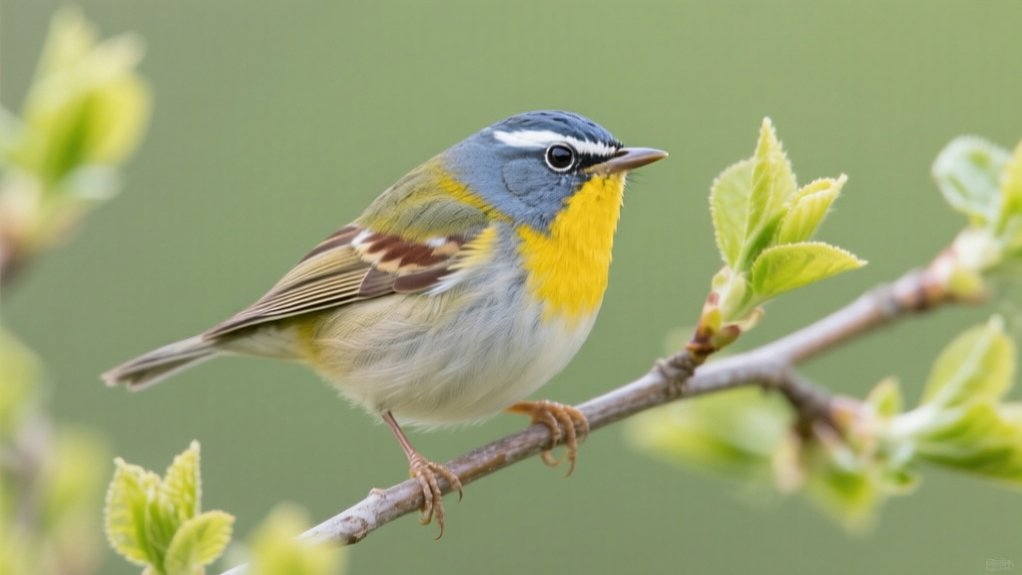
You’ll spot the Northern Parula by its small size, bright yellow throat, and distinct white wing bars. Adult males show a black and chestnut band across their yellow breast, while females and immatures appear paler with greenish backs.
Listen for an ascending trill ending with a sharp “zip.” Watch for agile foraging in tree canopies and understory, especially during migration. Knowing these traits sharpens your identification skills. There’s much more to uncover about its behaviors and habitats.
Physical Characteristics of the Northern Parula
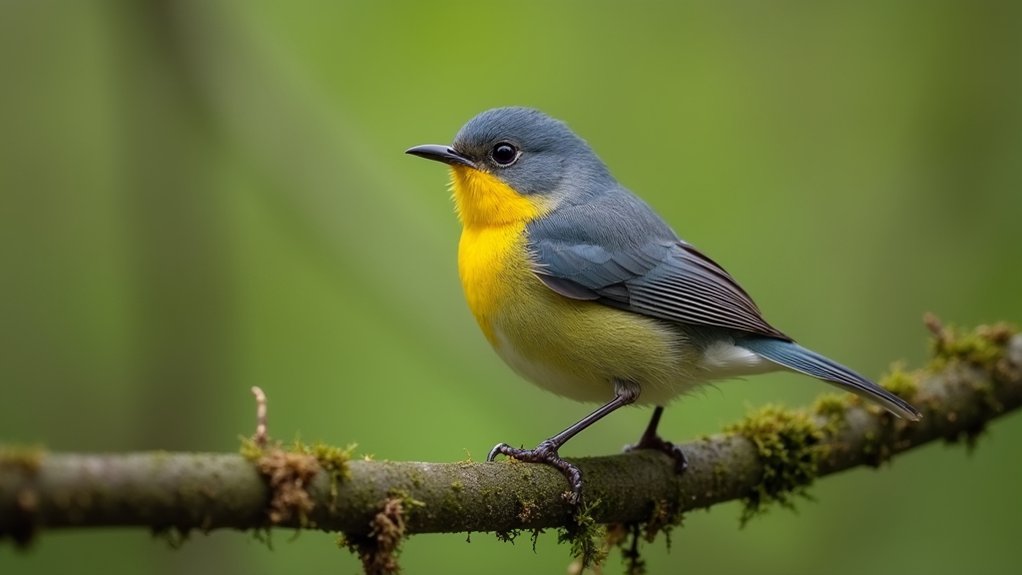
The Northern Parula measures between 4.3 and 4.7 inches in length, with a wingspan ranging from 6.3 to 7.1 inches, making it a small, slender wood-warbler.
A small, slender wood-warbler, the Northern Parula spans 4.3 to 4.7 inches in length.
When observing this species, you’ll notice its bright yellow throat, a key field mark that contrasts sharply with its blue-gray back.
Pay close attention to the two white wing bars on each wing, which stand out distinctly against the bird’s darker feathers.
Moreover, the Northern Parula features a broken white eye ring with subtle pale crescents, framing the eye and aiding identification.
Its overall slender body shape and light weight, typically 0.2 to 0.4 ounces, further differentiate it from other warblers you might encounter in the field.
Distinguishing Adult Males From Females and Immature Birds
When you’re trying to identify Northern Parulas, start by looking at the adult males. They’ve a bright yellow throat and breast, which really stands out, and there’s a distinctive black and chestnut band across their chest.
On the other hand, females and immature birds don’t have that chestnut band and usually look paler overall. Females often show a greenish wash on their back and head, which can help you tell them apart.
Also, keep an eye out for subtle differences in plumage. For example, immature males have yellow-green edges on their primaries.
These little details can really help you figure out whether you’re looking at a female or a younger bird. So, paying attention to these features makes it easier to distinguish between the sexes and ages of Northern Parulas.
Adult Male Features
Bright yellow throat and breast, accented by a black and chestnut band across the chest, immediately distinguish adult male Northern Parulas from females and immature birds.
When observing an adult male Northern Parula, note these defining features:
- Vibrant yellow throat and chest contrasted by a distinct chestnut band bordered with black
- Blue-gray back with an olive patch, a coloration absent in females and immatures
- Prominent white eye crescents framing the eyes, enhancing facial definition
- Two white wing bars visible on folded wings, aiding identification in the field
These characteristics, combined with a buzzy trill song unique to adult males during breeding season, enable you to confidently identify adult male Northern Parulas.
Their vivid plumage and vocalizations mark them clearly against paler, less marked females and immature birds.
Female and Immature Traits
Anyone observing Northern Parulas should note that females and immature birds present distinct traits from adult males, aiding accurate identification.
Female Northern Parulas exhibit a green wash on the back and head, contrasting with the adult male’s blue-gray back and yellow throat.
Immature males lack the characteristic chestnut breast band, appearing paler overall. Both female and immature birds feature yellow-green edged primaries and secondaries, absent in adult males.
The white eye crescents in female and immature Northern Parulas are less pronounced, helping distinguish them from adult males with more prominent white eye markings.
Furthermore, females and immatures tend to be smaller and less vibrant, often blending into dense foliage.
Songs and Vocalizations to Recognize
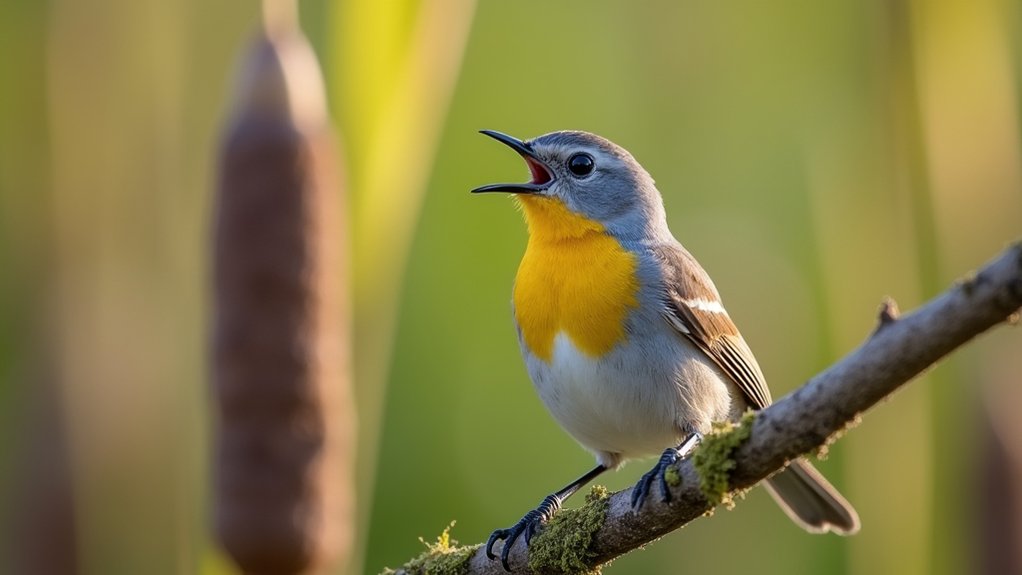
You’ll notice the Northern Parula’s song has two main patterns. One is an ascending trill, and the other is a series of buzzy notes that end with a sharp “zip.”
Besides these, listen for different calls like buzzes, chirps, and trills. These sounds help you identify the bird even if you can’t see it.
Recognizing these vocalizations is really important, especially during spring migration when the males are most vocal.
Distinctive Song Patterns
A distinctive feature of the Northern Parula is its rising buzzy song, which concludes abruptly with a sharp “zip” sound. This unique combination of buzzy notes and a sudden ending makes the bird’s song one of its most reliable identification cues.
The Cornell Lab of Ornithology emphasizes these distinctive song patterns as key for field recognition.
When trying to identify the Northern Parula, listen for:
- A series of rising, insect-like trills
- Abrupt termination with a crisp “zip”
- Frequent vocalizations from males during spring migrations
- Songs broadcasted high in the canopy to establish territory
Common Call Types
Although the Northern Parula’s rising buzzy song ending in a sharp “zip” is its most recognizable vocalization, the species also produces several other call types that are essential for accurate identification.
Northern Parulas emit distinct call types including a falling, flat chirp, a buzz, a hi, and a trill.
These vocalizations are especially prominent during the breeding season, when males sing from treetops to establish territory and attract mates. You’ll often hear these calls even when the bird itself remains hidden in dense foliage or high nesting sites.
Familiarity with these call types improves your ability to detect Northern Parulas acoustically, complementing visual cues. Recognizing the full range of vocalizations, beyond just the characteristic song, is critical for precise field identification.
Habitat Preferences and Foraging Behavior
When exploring the Northern Parula’s habitat, you’ll notice it selects deciduous forests in southern regions and evergreen forests up north.
It often favors areas rich in moss for nesting. This preference for moss provides both camouflage and structural support for their nests.
Foraging behavior is similarly distinctive. The Northern Parula primarily hunts insects in the upper canopy, exhibiting agility through flitting and hovering maneuvers.
The Northern Parula skillfully hunts insects high in the canopy, using agile flitting and hovering techniques.
During migration, they shift to the understory, adapting their foraging strategy to available resources.
Key observations include:
- Preference for northern deciduous forests with abundant moss
- Foraging mainly along branch tips in the upper canopy
- Feeding mainly on caterpillars and small insects
- Agile movements such as hanging upside down and brief hovering
Understanding these patterns aids precise field identification.
Comparing the Northern Parula With Similar Warbler Species
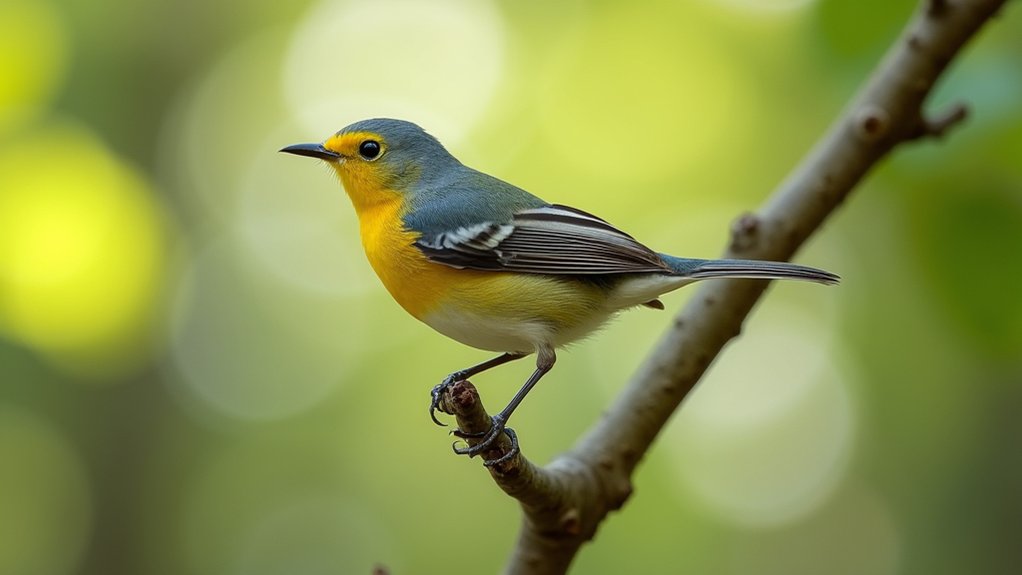
Since you’re familiar with the Northern Parula’s habitat and foraging habits, distinguishing it from similar warblers requires attention to specific physical and vocal traits.
The Northern Parula exhibits a blue-gray back and a yellow throat, accented by two distinct white wingbars.
In contrast, the Nashville Warbler lacks the chestnut breast band and blue-gray back, showing a more uniform olive-green coloration. The Pine Warbler is bulkier, with a yellow-green body and no pronounced white wingbars. The Canada Warbler’s bold necklace-like markings and overall yellow coloration differ markedly from the Northern Parula’s subtler pattern.
Pay close attention to vocalization: the Northern Parula’s rising buzzy trill ending in a sharp “zip” sets it apart from the more melodic songs of Nashville and Canada Warblers.
Seasonal Range and Migration Patterns
As you observe the Northern Parula’s movements throughout the year, you’ll notice it breeds extensively across the eastern United States. Southern populations return as early as March. This warbler’s seasonal range centers on the eastern half of the country, where breeding habitats vary from deciduous forests in the south to evergreen stands in the north.
During migration, they forage low in the understory, revealing their distinctive white belly more clearly than during canopy breeding.
Key points to note include:
- Southern breeders arrive early, often in March.
- Nesting materials shift geographically: Spanish moss in the South, Usnea lichens in the North.
- Migration leads to occasional western strays in spring and fall.
- Breeding habitats are patchy due to nesting material availability.
Understanding these factors sharpens your identification skills in the field.
Frequently Asked Question
What Time of Day Are Northern Parulas Most Active?
You’ll find Northern Parulas most active during early mornings around dawn when their singing peaks to establish territory and attract mates.
They also show heightened activity late in the afternoon, foraging for insects high in the canopy.
During migration, their frequent vocalizations make them easier to detect.
Focus your observations during these times for the best chance to witness their behavior and identify them accurately in the field.
How Long Do Northern Parulas Typically Live in the Wild?
Northern Parulas typically live between 2 to 4 years in the wild, though some can reach 7 years under ideal conditions.
When you’re observing these birds, keep in mind that survival depends heavily on factors like predation, habitat quality, and food availability during breeding and wintering seasons.
Juveniles often face higher mortality, so their lifespan tends to be shorter.
Conservation efforts focusing on habitat preservation can greatly improve their longevity and population stability.
What Predators Commonly Threaten Northern Parulas?
You might think the tiny Northern Parula lives a peaceful life, but predators constantly threaten it.
Cooper’s Hawks and Sharp-shinned Hawks hunt these birds amid the canopy.
Meanwhile, snakes lurk near nests, endangering eggs and chicks. Domestic cats, jays, and crows also prey on them, especially where habitat loss exposes nests.
These pressures create a constant survival challenge for Northern Parulas, demanding vigilance during foraging and breeding seasons.
Are Northern Parulas Affected by Climate Change?
Yes, Northern Parulas are affected by climate change.
You’ll notice shifts in their breeding and wintering ranges as temperatures rise.
You might also observe reduced availability of nesting materials like Spanish moss, impacting their reproduction.
Timing mismatches between insect availability and breeding seasons can occur, lowering success rates.
Furthermore, extreme weather events can destroy habitats, threatening populations.
You should prioritize conservation efforts to preserve their forest environments and mitigate these impacts.
What Is the Best Equipment for Photographing Northern Parulas?
Want to capture the Northern Parula’s vibrant colors perched high in the canopy?
You’ll need a telephoto lens of at least 200mm to get close without disturbing it. Pair that with a camera boasting fast autofocus to track its quick movements.
Use a tripod or monopod for stability, especially in low light, and shoot during early morning or late afternoon for natural light.
Don’t forget silent shutter mode to avoid startling your subject.
Conclusion
When you spot a Northern Parula, it’s like uncovering a tiny jewel flashing turquoise and gold amid the green chaos. Don’t just glance. Study its crisp breast bands, listen for its buzzy trill slicing through forest noise, and note its preference for mossy canopies where it forages with precision.
Mastering these details makes identifying this warbler feel less like chance and more like revealing nature’s secret code with scientific exactness.