
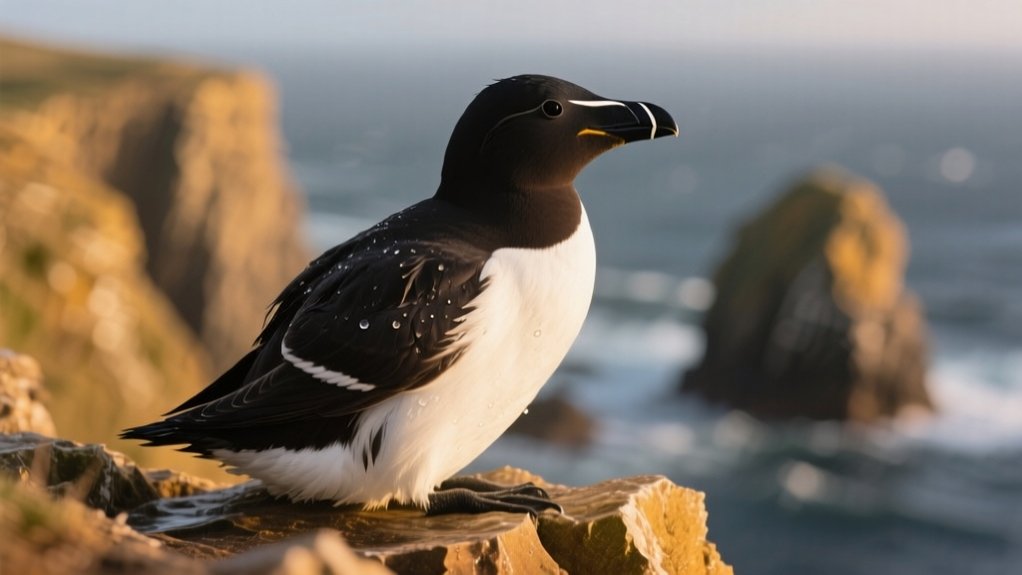
You’ll spot the Razorbill by its glossy black upperparts, white belly, and distinctive knife-edged black bill, which helps grip slippery fish. It breeds on rocky Atlantic cliffs from Maine through northern Europe, nesting in crevices or old puffin burrows.
Migrating offshore in winter, Razorbills plunge up to 120 meters using semi-folded wings for underwater flight. They form lifelong pairs and rear a single chick annually.
Investigate further to uncover its unique breeding cycle and conservation status.
Physical Characteristics of the Razorbill
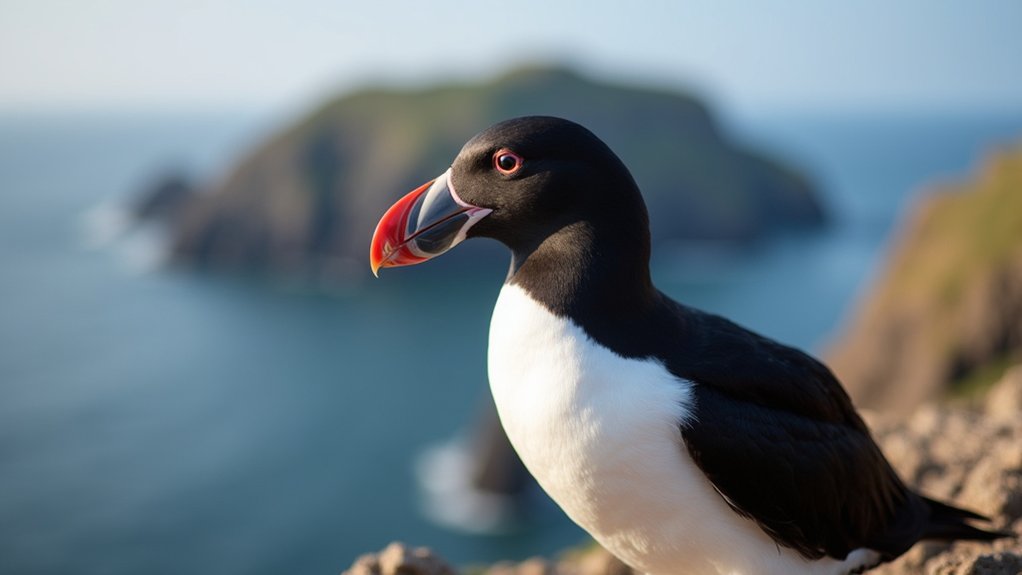
The Razorbill exhibits distinct seasonal plumage adaptations that facilitate identification and reflect its breeding status. During breeding, you’ll notice its glossy black head, neck, back, and feet contrast sharply with a white belly and underside. A thin white line runs from its eyes to the bill’s tip, accentuated in summer, alongside a dark chocolate brown throat. Males are generally larger than females, which can help in distinguishing individuals.
In non-breeding months, the throat and face behind the eyes turn white, and the facial white line fades, reducing contrast and causing confusion with similar species like the Thick-billed Murre.
Physically, the Razorbill measures 37-39 cm in length, with a wingspan of 60-69 cm. Its long, graduated tail is unique among alcids, held upright while swimming, complementing its streamlined body and powerful neck designed for efficient underwater propulsion.
Distinctive Bill Features
Beyond its striking plumage and streamlined body, the Razorbill’s bill stands out as a defining feature that plays an essential role in its survival and feeding efficiency.
You’ll notice its mainly black, glossy bill, thick and large relative to head size, with a deep lateral compression creating a knife-like, blunt-ended profile unique among similar species.
When viewed frontally, the triangular shape is evident. Vertical grooves near the curved tip increase in prominence as the bird matures, reinforcing structural integrity during forceful foraging.
Distinctive white markings, a band across both mandibles and a vertical line on the tip, develop by 15 months and fade outside breeding season.
The sharp hooked tip and hatchet-shaped edges enable you to grasp slippery fish securely. This facilitates plunges up to 330 feet while manipulating prey precisely underwater.
Razorbills are monogamous birds that share breeding sites with other auks, and their bill structure supports their ability to catch fish to feed their chicks during the breeding season monogamous, breeding behavior.
Sexual Dimorphism and Juvenile Plumage

Although males and females of the Razorbill species appear nearly identical to casual observers, subtle measurements reveal minimal sexual size dimorphism. Both sexes share nearly indistinguishable body proportions, coloration, and plumage patterns, which makes visual sex identification complicated.
However, you can use precise head and bill measurements, especially bill depth, to achieve roughly 80% accuracy in sexing. Juvenile Razorbills differ markedly, exhibiting mottled brown plumage, less distinct white markings, and shorter tail feathers that are still developing.
Razorbills typically measure between 15 to 18 inches in length, with a wingspan of 26 to 28 inches, which helps provide context to these size measurements physical size range.
| Characteristic | Male Range | Female Range |
|---|---|---|
| Weight (g) | 530–720 | 505–730 |
| Wing Length (mm) | 182–206 | 183–210 |
| Bill Depth (mm) | Slightly larger | Slightly smaller |
| Breeding Plumage | Black upperparts, white underparts | Identical to males |
| Juvenile Plumage | Mottled brown, less white markings | Same as males |
Preferred Nesting Habitats
When you observe Razorbill nesting habits, you’ll find they prefer sub-arctic and boreal Atlantic waters, breeding from Maine in eastern North America to northern France in western Europe.
They select windward slopes of rocky islands, steep cliffs, and boulder-strewn shores, often near brackish waters like the St. Lawrence estuary.
Nest sites are positioned at least 10 cm from cliff edges, favoring crevices or spaces under boulders, which offer protection from predators. Some pairs reuse abandoned Atlantic Puffin burrows, while others build minimal nests with pebbles, grass, feathers, or small bones.
Razorbills typically build nests consisting of a scrape lined with pebbles, vegetation, and feathers.
Narrow ledges measuring about 30 cm by 19 cm provide suitable platforms.
Males establish territories, and pairs maintain spacing several meters apart. This strategic nest placement in sheltered crevices greatly improves chick survival by reducing predation risks.
Breeding Colony Composition

Since Razorbill breeding colonies vary widely in size and distribution, understanding their composition requires examining key population centers and social structures.
Globally, about 165,000 pairs breed, with Látrabjarg, Iceland hosting roughly 40%, around 230,000 pairs based on mid-1990s data.
Other significant colonies include Stora Karlsö, Sweden (12,000 pairs), Runde, Norway (3,000 pairs), and the Farne Islands, UK (523 pairs in 2022). In the Svalbard region, the total breeding population is estimated at about 100 pairs, mostly concentrated on Bjørnøya.
Razorbills exhibit female-enforced monogamy, forming lifelong pairs through courtship behaviors like head-bobbing, bill-touching, and mutual preening.
Pairs reuse identical nest sites year after year. Breeding begins between ages 3 and 5, adding generational layers to colonies.
Seasonal occupancy follows winter migrations, with peak breeding from late spring to early summer, varying regionally by latitude and environmental factors.
Nesting Site Selection
Understanding the composition and social structure of Razorbill breeding colonies sets the stage for examining how these birds select their nesting sites. You’ll find that Razorbills prefer coastal cliffs, choosing enclosed or slightly exposed crevices on rocky islands and steep, windward slopes.
They avoid open cliff edges by at least 10 cm, prioritizing elevation and inaccessibility to ground predators to protect their young. Nest scrapes are minimal, often lined with pebbles, vegetation, or feathers, reflecting adaptation to cliff habitats.
You’ll notice pairs frequently reuse identical sites annually, maintaining established territories. Occasionally, Razorbills exploit abandoned Atlantic Puffin burrows or rabbit burrows, favoring protected, confined spaces.
Nests are spaced meters apart to reduce aggression, highlighting the species’ strategic site selection balancing predator avoidance and breeding success.
Geographic Distribution and Range
The Razorbill’s geographic distribution spans the North Atlantic. Its primary breeding range extends from about 73 degrees north latitude near Hudson Strait and west Greenland down to 43 degrees north along the Brittany coast and Baltic Sea in continental Europe.
You’ll find key breeding colonies on Iceland, Jan Mayen, Bjornoya, and scattered sites from Greenland to the Kola Peninsula. Their winter distribution shifts offshore, concentrating from Newfoundland to southern New England and southward to northwest Africa and the Mediterranean. Razorbills are known for their colonial behavior, nesting in large groups on rocky cliffs.
This species is strictly Atlantic, favoring boreal and sub-Arctic waters with rocky coasts for nesting and shallow offshore areas for feeding.
| Region | Breeding Sites | Wintering Range |
|---|---|---|
| Western Atlantic | Hudson Strait, West Greenland | Grand Banks, Southern New England |
| Northern Europe | Iceland, Jan Mayen, Bjornoya | Northern Europe coasts |
| Eastern Atlantic | Kola Peninsula, White Sea | Northwest Africa, Mediterranean |
| Continental Europe | Brittany, Baltic Sea | Rarely as far south as Florida |
| Canada | Atlantic Canada, Gulf of St. Lawrence | Offshore shoals less than 200 ft deep |
Migration and Seasonal Movements
Razorbills adapt their movements seasonally to enhance breeding success and foraging efficiency across the North Atlantic. You’ll notice fall migration begins mid-September in Maine, with birds dispersing southward and offshore after nesting. Migration patterns are influenced by oceanic conditions, which affect the timing and route of their journeys.
Northern Icelandic razorbills stay local during their flightless wing molt in August-September before moving toward the Faroes between October and January. North American populations travel from the Labrador Sea to New England, while Eurasian birds winter near the North Sea and western Mediterranean.
During winter, razorbills abandon land entirely, forming large offshore flocks that feed at depths up to 120 meters.
Their migration routes follow cold currents but can shift with ocean temperature changes, causing southern dispersal toward areas like Cape Cod. These movements guarantee they exploit prime habitats throughout the year.
Monogamous Pair Bonding
You’ll notice that razorbills tend to form lifelong monogamous bonds. They usually pick their mates early in their breeding years and come back to the same nesting spots every year. Mutual preening, especially around the head and neck, is a key behavior that helps strengthen pair bonds between partners. Both partners pitch in equally when it comes to incubating eggs and raising chicks. This teamwork really helps make sure their offspring have a good chance of surviving.
Plus, their strong pair bond, along with high survival rates, keeps their breeding patterns pretty stable from season to season.
Lifelong Mating Bonds
Although forming lifelong mating bonds requires time and selective behavior, individuals reach sexual maturity around 3 to 5 years old, with pair bonding typically initiating near four years.
You’ll observe younger females courting multiple males before final mate selection, driven by male courtship displays and competitive interactions.
Once paired, the male and female establish a bilateral commitment, maintained throughout their lifespan. Razorbills are known for their monogamous behavior, mating up to 80 times in a 30-day period.
You can identify bond formation by initial billing and mutual preening, behaviors that also reinforce the partnership annually.
These pairs return to the same nesting sites, performing synchronized courtship rituals like billing, preening, and coordinated displays to sustain their connection.
Lifespan averages 13 years, supporting extended bonds, with some pairs documented over four decades, illustrating the strength and endurance of these lifelong mating bonds.
Shared Parenting Roles
When raising their single annual chick, both parents share incubation duties fairly. They alternate shifts over a 32 to 39-day period to maintain ideal egg warmth and defense against predators. This equal time investment preserves egg viability and reinforces pair bonds during the nesting phase.
After hatching, you’ll see both adults bringing fish to the nestling. They coordinate foraging trips to guarantee continuous food delivery while minimizing nest exposure. They alternate hunting duties until the chick reaches 14-25 days old. Their diet consists mainly of small fish, crustaceans, and marine worms, which they catch underwater primarily 5-20 feet below the surface.
During fledging, the male accompanies the chick to the water’s edge and remains with it to guide initial foraging, providing critical protection.
This monogamous pair bonding and shared parenting strategy optimize offspring survival through precise division of labor and sustained cooperative care.
Egg Description and Incubation
Because razorbill eggs have an ovoid-pyramidal shape measuring about 75 by 48 millimeters and weighing roughly 90 grams, they’re distinctly adapted to prevent rolling off exposed cliff ledges where these seabirds nest.
Their coloration—cream to tan with variable dark brown spots and blotches concentrated at the larger end—provides effective camouflage against bare rock surfaces.
Females lay a single egg each breeding season, typically from early May to early June, later at higher latitudes.
Incubation starts about 48 hours post-laying and lasts 32–39 days, averaging 35 days.
Both parents alternate shifts, regularly turning the egg to guarantee proper embryo development and temperature regulation.
Key points include:
- Single egg per season laid on bare rock or minimal nest materials
- Biparental incubation with alternating shifts
- Consistent egg turning throughout incubation for embryo health
Chick Development and Fledging Behavior
You’ll notice that razorbill chicks spend their first few days mostly tucked safely under one parent’s wing. They really depend on the parents sticking to a strict feeding schedule, with multiple fish delivered at each meal.
Then, between about 17 and 23 days old, the chicks make a dramatic exit from the nest—they jump off cliffs at night!
The male parent stays close by, continuing to care for them out at sea. This is a key stage where the chicks go from being somewhat helpless nestlings to flightless fledglings, growing their wing feathers and getting ready to become independent.
Nestling Growth Stages
Although razorbill chicks hatch with their eyes open and covered in downy plumage, they remain semi-precocial and rely heavily on parental care during their initial growth stages.
At hatching, they weigh about 60 grams and can walk and swim within hours but spend most of their first 24–48 hours sheltered under a parent’s wing.
Over the next 9–10 days, they develop thermoregulation and experience rapid weight gain fueled by continuous feeding.
Key nestling growth stages include:
- Early brooding and temperature regulation development
- Primary feather emergence and change from down to defined plumage
- Pre-fledging size increase with still-developing wing feathers prior to colony departure
These stages prepare the chick for fledging at about 18 days but still flightless at that point.
Fledging and Parental Care
When razorbill chicks reach about 18 days old, they prepare to leave the nest despite remaining flightless and weighing only one-third of an adult’s mass. Fledging typically occurs during late evening, reducing predation risk, especially from gulls. Razorbills are a long-lived and highly social species that provide biparental care to chicks at the nest site.
Both parents share incubation and chick-feeding duties; post-fledging, males guide the young to sea and continue feeding them until independence.
| Stage | Timing (Days) | Parental Role |
|---|---|---|
| Nestling | 0–18 | Shared feeding and guarding |
| Fledging Departure | 18–23 | Male guides fledglings |
| Post-Fledging Support | 23+ | Continued feeding and care |
Synchronous fledging and crevice nests improve chick survival by lowering predation exposure during this vulnerable phase.
Diving and Feeding Techniques
The razorbill employs specialized plunging mechanics and anatomical adaptations to forage efficiently underwater. You’ll notice it plunges typically up to 35 meters, with maximum depths recorded at 43 meters, although it can reach 120 meters if needed. It propels itself using semi-folded wings, mimicking flight underwater for rapid pursuit of prey. Key plunging and feeding techniques include utilizing continuous V-shaped plunge patterns for efficient descent and ascent. It captures multiple small schooling fish per plunge, swallowing prey underwater to avoid kleptoparasitism. The razorbill forages exclusively underwater, often in large flocks, spending about half their day hunting small fish like capelin and herring. Spending almost half of their time foraging at sea in large flocks, these precise adaptations make the razorbill a highly effective marine predator.
Lifespan and Longevity
You’ll find that razorbills typically live around 13 years. This lifespan allows them to go through multiple breeding cycles, which helps strengthen their pair bonds.
Interestingly, some razorbills have been documented living beyond 40 years. These cases are verified through bird ringing programs. Such longevity records really highlight the species’ resilience and provide valuable data for understanding their population dynamics.
Razorbills have an average body weight of about 612.6 g, which supports their ability to thrive in coastal environments.
Average Lifespan
Razorbills typically live around 13 years from the time they begin breeding, a figure established through extensive bird ringing and population monitoring efforts.
You’ll find this average lifespan reflects a combination of adult annual survival rates ranging from 89% to 95% and juvenile survival variability.
Birds reach breeding maturity between 3 and 5 years, so their total lifespan often spans approximately 16 to 18 years. Additionally, the razorbill’s average weight ranges between 590 and 730 grams, which can influence its energy requirements and survival strategies.
Understanding this lifespan is essential for modeling population stability and predicting responses to environmental changes.
Key points to take into account include:
- Lifespan estimates derive primarily from long-term ringing and banding data.
- High adult survival supports population persistence despite variable juvenile survival.
- The 13-year breeding lifespan influences population dynamics and conservation planning.
Longevity Records
While average lifespan data provides valuable insight into breeding and survival trends, examining longevity records reveals the full extent of razorbill lifespan potential. The oldest documented razorbill reached 42 years in the wild, surpassing previous maximum records of 41 years. This species demonstrates remarkable survival capabilities under natural conditions, with longevity data maintained by multiple ornithological institutions. Historical banding records highlight individuals tracked over 30 years, confirming multi-decade survival and extensive migration. In comparison, several bird species like the Wood duck have documented lifespans of up to 22.5 years in captivity, illustrating the razorbill’s exceptional longevity. Lifespan variation is significant, with average wild lifespans near 7.3 years contrasting sharply with maximum records. Researchers use bird banding, GPS tracking, and colony surveys to monitor these patterns systematically. Such detailed documentation confirms the razorbill’s resilience and positions its maximum lifespan among the longest-lived auks, underscoring ongoing scientific efforts to understand population-level longevity dynamics.
Conservation Challenges and Monitoring Methods
Because of their Near Threatened status on the IUCN Red List and significant regional declines, conservation challenges for razorbills demand urgent attention.
You’ll need to address threats like oil spills, predation by large gulls, and climate-induced food scarcity. All of these impact population stability. Razorbills primarily come to shore to breed, making coastal colonies critical for their survival breeding colonies.
Monitoring these elusive sea birds requires advanced technology and rigorous methods. Key approaches include deploying GPS and satellite trackers to map migration and habitat use in real time.
Conducting systematic breeding colony counts paired with diet analyses from stomach and fecal samples also helps.
Plus, integrating acoustic sensors and field observations can gather behavioral data and ecosystem health indicators.
These combined methods give a clearer picture of what razorbills face and how to protect them.
Frequently Asked Question
How Do Razorbills Communicate With Each Other During Breeding Season?
During the breeding season, you’ll notice razorbills use guttural calls in paired duets to strengthen bonds. Males produce growling sounds with raised heads and upward-pointing bills, while braying vocalizations establish territories and social order.
Courtship involves “arrrh” and “kidda-kidda” calls, alongside bill tapping, head-bobbing, and bowing.
You’ll also see tactile interactions like billing and mutual preening, all essential for mate recognition and communication within colonies.
What Predators Commonly Threaten Razorbills and Their Chicks?
You’ll find that razorbills and their chicks face significant threats from several avian predators.
Black-backed gulls and great black-backed gulls pose serious predation risks, while herring gulls, with their expanding populations, also threaten nests.
Skuas contribute to natural predation pressures. These predators often target eggs, chicks, and even adult razorbills, impacting colony survival and recolonization efforts.
Understanding these predator dynamics is essential to conserving razorbill populations effectively.
Are Razorbills Affected by Oil Spills and Marine Pollution?
Yes, you’re right to worry. Razorbills suffer greatly from oil spills and marine pollution.
Oil disrupts their feather waterproofing, causing hypothermia and buoyancy loss. When they ingest toxic oil during preening, it damages essential organs like the liver and kidneys.
Oil spills have led to massive mortality, population declines, and breeding failures due to contaminated eggs and habitat loss. Their extended surface time makes them particularly vulnerable to these hazards.
How Do Razorbills Navigate During Long-Distance Migration?
You rely on multiple navigation methods during long-distance migration, including landmark navigation using coastlines and mountains.
For instance, razorbills can cover up to 4,130 km in dispersal events.
You also use an acute olfactory system to detect prey underwater and coordinate flock movements socially for efficient navigation.
Researchers track your precise routes with GPS technology, revealing your ability to fly about 300 miles daily while adjusting paths based on prey availability and sea ice conditions.
What Role Do Razorbills Play in Their Marine Ecosystem?
You’ll find razorbills act as key top predators in marine ecosystems, regulating small fish populations like herring and sand lance.
By hunting efficiently, often plunging over 100 feet, they maintain prey balance, preventing overpopulation that could disrupt aquatic systems.
Their feeding supports nutrient flow and species diversity, while also serving as prey for larger predators.
This links energy transfer across trophic levels and sustains overall marine ecosystem stability and biodiversity.
Conclusion
Now that you’ve examined the razorbill’s unique adaptations and complex behaviors, consider this: despite their impressive diving skills and resilient breeding strategies, these birds face mounting conservation challenges that could alter their future dramatically.
By understanding their physical traits, habitat needs, and life cycle intricacies, you’re better equipped to appreciate the delicate balance sustaining their populations and the urgent efforts required to guarantee they don’t vanish from our coastal ecosystems.
What’s next for the razorbill remains uncertain.