
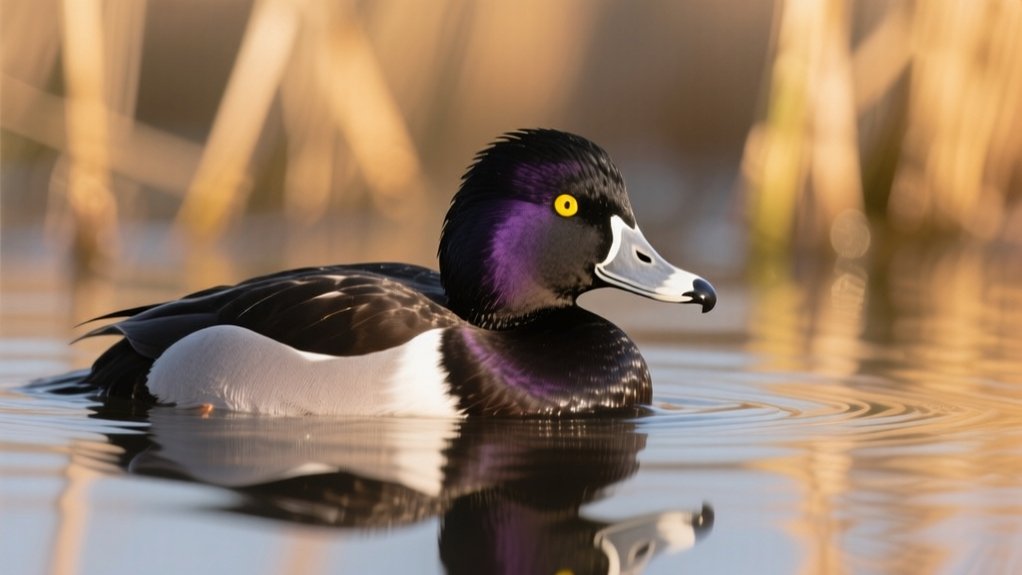
You’ll recognize the Ring-Necked Duck by its compact body, peaked head crest, and males’ distinct white bill rings against a dark head. They thrive in shallow freshwater wetlands with dense vegetation, breeding across boreal forests from Alaska to Canada.
They migrate seasonally to southern U.S. and Central America, feeding on aquatic insects in summer and plants in winter. Their swift flight and unique calls aid group cohesion. Investigate further to understand their nesting, migration, and conservation.
Physical Characteristics and Size
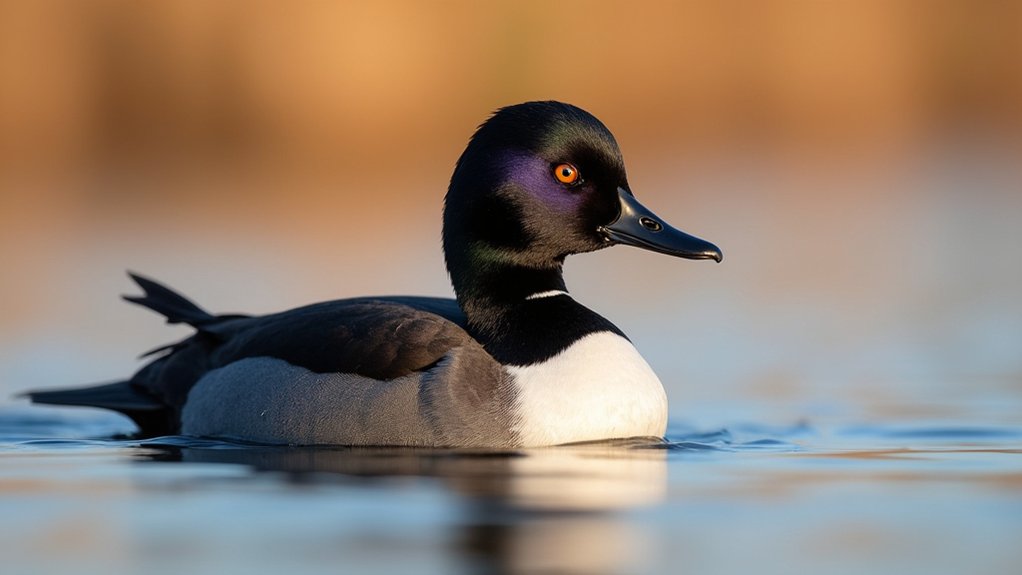
The Ring-Necked Duck is a small to medium-sized diving duck, comparable in size to the Lesser Scaup but smaller than the Mallard or Redhead. You’ll find its total length ranges from 14 to 18 inches (36–46 cm), with males typically larger than females.
Males weigh between 542 and 910 grams, while females range from 490 to 894 grams. Its compact body features a thin neck, large head, and short, rounded tail, especially noticeable in flight. Males have shiny black head and white rings on bill, while females are grayish brown with a dark bill.
Wingspan measures about 24.4 to 24.8 inches (62–63 cm), with pointed wings supporting fast, choppy flight. The bill is slate or bluish-gray with distinct white rings near the tip and a black tip, equipped with a toothlike fringe to strain food.
Legs set far back aid in efficient diving and swimming.
Male Plumage Details
Male Ring-Necked Ducks display striking plumage that aids identification, especially during the breeding season.
You’ll notice the adult male’s purplish-black to black head with iridescence and a distinctive peaked crown formed by a short crest.
The neck is uniformly black, smoothly merging with the breast, and shows a subtle cinnamon-brown ring near the lower neck, often visible only close-up.
Their solid black breast, back, and rump contrast sharply with whitish-gray flanks bearing fine silvery vermiculation and a white triangular wedge on the side.
The belly is lighter grayish-white, separated from the dark breast by a narrow white crescent.
The bill features a slate-blue base with prominent white bands near the base and tip, ending in a black tip.
Bright yellow irises stand out against the dark head, completing the male’s distinctive appearance.
Males typically weigh between 1.5-1.9 lbs, with a wingspan measuring about 8.1 inches.
Female Plumage Features
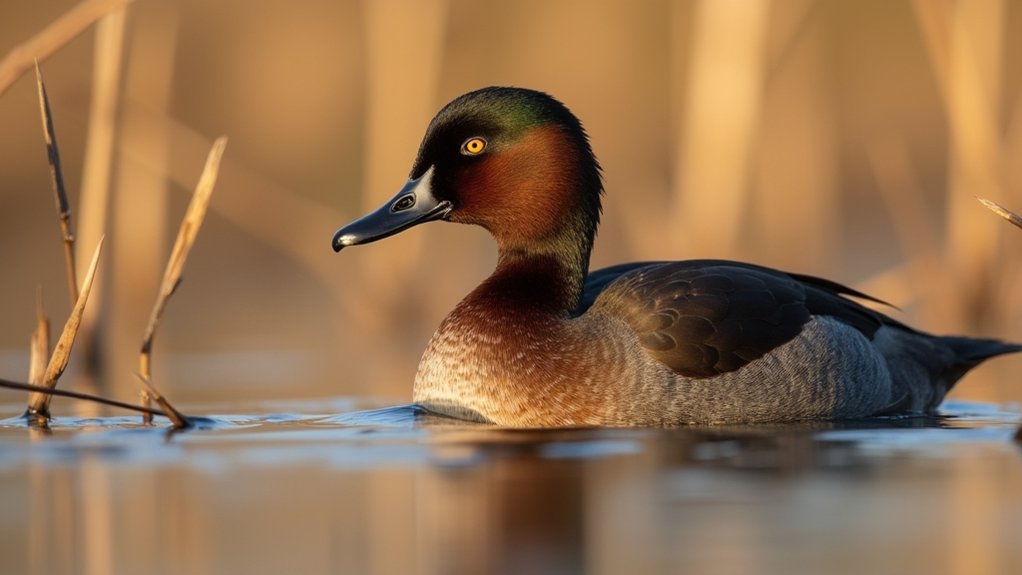
Although female Ring-Necked Ducks lack the striking contrasts seen in males, their rich brown to gray-brown plumage provides distinctive identification cues.
You’ll notice a darker brown back and scapulars, contrasting subtly with paler gray-brown face, cheeks, and underparts.
The angular, peaked crown and sloping forehead create a unique head profile.
Key field marks include a clear white eyering with a thin white line trailing toward the ear-coverts, surrounding brown eyes. The bill features a pale whitish crescent at its base and a gray to dark gray ground color with a black tip.
These traits distinguish females from scaups, which lack such crisp facial highlights.
Females show limited seasonal color variation and generally appear smaller and duller than males or eclipse males. Additionally, immature ducks resemble adults by sex but are duller in color, aiding in age identification through plumage differences immature ducks.
Typical Habitats and Nesting Sites
Recognizing female Ring-Necked Ducks is just one part of understanding their ecology; knowing where they choose to live and nest completes the picture.
You’ll find them primarily in shallow freshwater wetlands such as marshes, bogs, fens, and ponds, typically 1.5 m deep or less, with abundant organic substrates and dense aquatic vegetation.
They prefer acid to near-neutral marshes featuring emergent plants like sedges, cattails, and bulrushes.
Nest sites are usually well concealed within dense emergent vegetation, often directly over water or on floating mats, which limits terrestrial predator access.
Nests form shallow to medium bowls lined with down feathers.
During site selection, females inspect flooded vegetation edges while males guard nearby.
This preference for smaller, vegetated wetlands near open water supports higher nesting success compared to species breeding on larger lakes.
Ring-Necked Ducks are often found in association with dabbling ducks in these shallow waters, reflecting their shared habitat preferences.
Breeding Range and Seasonal Distribution
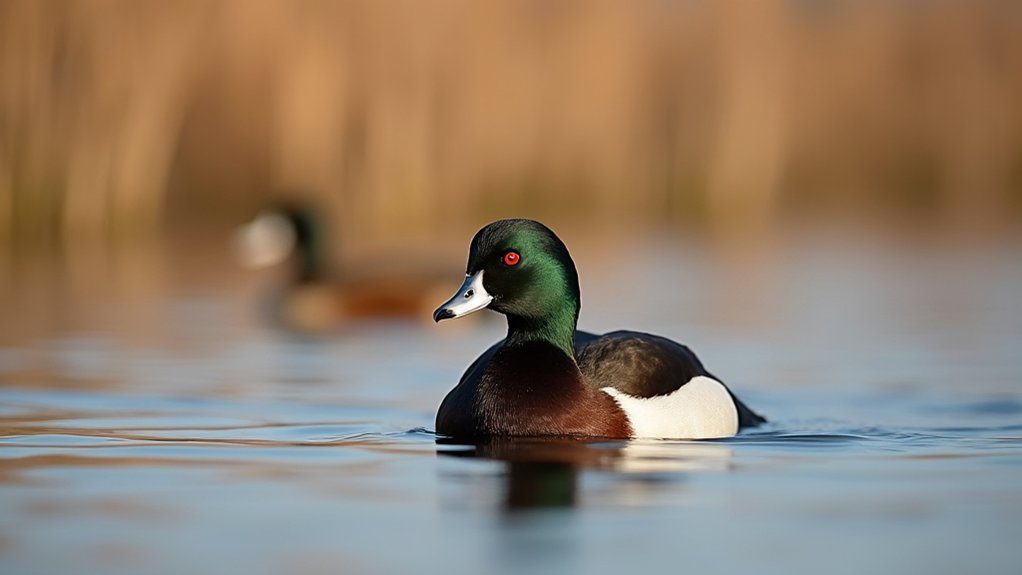
You’ll find Ring-Necked Ducks breeding primarily across the boreal forests from Alaska to eastern Canada.
The highest densities tend to be in central provinces like Alberta and Ontario.
When it’s time to migrate, they pass through mid-latitude staging areas.
They usually arrive on their breeding grounds by late April and stick around until December.
In winter, these ducks gather in southern and western parts of North America.
They even extend down into parts of Central America and the Caribbean.
Their breeding habitats consist mainly of freshwater wetlands such as fens, bogs, and marshes.
Northern Breeding Territories
When you examine the northern breeding territories of the Ring-Necked Duck, you’ll find they primarily occupy the boreal forest zone across far northern North America, including extensive areas of Canada and Alaska.
Their breeding range spans southeastern Alaska, central British Columbia, northern Saskatchewan, and Newfoundland. It also extends into northern US states like Minnesota and northern New England.
Key characteristics include preference for small to medium freshwater ponds and marshes with dense emergent vegetation. Nesting sites are typically on dry hummocks or mats near open water for concealment.
The breeding season runs late spring to mid-summer and is closely linked to ice-free wetlands. During this time, the ducks often face attacks from predators such as the Common Loon and Red-necked Grebe, which can impact nesting success predator attacks.
The population is stable at around 2 million, with range expansion noted since the 1930s.
This distribution reflects adaptation to boreal forest wetland ecosystems.
Migration and Wintering Areas
Although the Ring-Necked Duck breeds primarily in northern boreal forests, its migration leads it to a wide range of wintering areas concentrated mostly south of 35°N latitude. You’ll find them mainly along the Gulf Coast and southeastern U.S., inhabiting freshwater lakes, marshes, and reservoirs. These ducks are strong flyers capable of taking off directly from water without a running start, which aids their long migratory journeys.
Migration peaks from mid-November through February, with most traveling nocturnally in small flocks via Atlantic and Mississippi flyways.
| Region | Habitat Type | Seasonal Timing |
|---|---|---|
| Gulf Coast & SE US | Freshwater lakes, marshes | Nov–Feb (peak) |
| Central Mexico & Caribbean | Managed impoundments, brackish marshes | Nov–Mar |
| Pacific Flyway | California Central Valley | Late Oct–Apr |
This shift reflects their dietary and habitat preferences during winter’s colder months.
Migration Patterns and Wintering Areas
You’ll notice that Ring-Necked Ducks tend to migrate later in the fall and then head back earlier in the spring compared to many other species.
Interestingly, most of this migration happens at night.
When winter comes around, they settle into freshwater lakes, marshes, and swamps across the southern U.S. and even down into the Caribbean.
They really like spots that have plenty of submerged and emergent vegetation.
Ring-Necked Ducks typically form flocks in large groups during migration and winter, which helps them conserve energy and stay safe.
Getting a handle on these seasonal movements and where they choose to hang out during winter is super important if you want to understand their behavior and what they need for conservation.
Fall and Spring Movements
Because Ring-Necked Ducks migrate midseason, their fall departure occurs later than many dabbling ducks, typically spanning late September to early December.
You’ll notice peak migration activity in October and November, coinciding with molt and premigratory conditioning.
Spring migration happens from February through May, peaking in March and April, with birds arriving on breeding grounds mostly between mid-April and mid-May. The average spring migration initiation date is around 17 March, with completion by 16 May, lasting approximately 61 days. Migration timing
Consider these key points:
- Fall movements are mostly nocturnal, with juveniles showing multi-directional lake movements that shift southward late in the season.
- Spring departures average around mid-March, with arrival on breeding sites near mid-May.
- Migration follows primarily interior routes between boreal breeding wetlands and U.S. freshwater systems.
- Pair bonds form during spring migration, preceding nesting.
Winter Habitat Preferences
After completing their spring and fall migrations, Ring-Necked Ducks settle into specific winter habitats that support their survival and preparation for the next breeding season.
You’ll find about 92% of the North American population wintering in the eastern U.S., mainly along the Atlantic and Mississippi flyways, with large groups in Florida and Louisiana.
Western populations winter along the Pacific coast, especially California’s Central Valley.
These ducks prefer shallow freshwater marshes, floodplains, and managed impoundments with dense emergent vegetation such as cattails and bulrushes. They avoid saltwater bays and favor water depths under 1.5 meters. They are also strong and fast swimmers, which helps them navigate these aquatic environments efficiently.
Winter habitat selection depends on factors beyond food, including reduced human disturbance and predator protection.
Regional variations exist, with differing primary food sources like waterlily seeds or hydrilla influencing habitat use across their winter range.
Feeding Habits and Diet Composition
Although ring-necked ducks exhibit a diet that varies with season and region, their feeding habits consistently reflect adaptations to local resource availability and nutritional demands.
During breeding, they increase intake of protein-rich animal prey such as aquatic insects and gastropods. This is essential for egg production and chick growth. Additionally, their bill shape, which is adapted for efficient foraging, reflects their preference for both animal prey and plant matter.
In winter, their diet shifts towards plant-based foods like seeds, tubers, and vegetative parts of aquatic plants. You’ll observe regional differences in diet composition, influenced by habitat and plant availability.
Key points include:
- Breeding diet emphasizes insects and gastropods to meet protein needs.
- Winter diet dominated by hydrilla tubers, waterlily seeds, and regional plants.
- Frequent animal prey intake persists in winter, providing essential nutrients.
- Foraging occurs mainly by diving in shallow freshwater habitats with abundant submerged vegetation.
Flight and Locomotion Behavior
Understanding the ring-necked duck’s feeding strategies provides insight into its movement patterns on and above water. You’ll observe swift, direct flight characterized by fast, choppy wingbeats, typical of compact plunging ducks.
They form small, dense wedges or loose flocks, usually up to twenty birds, often showcasing acrobatic air plunges during displays or escapes, producing jet-like sounds.
Underwater, these ducks rely solely on foot propulsion, submerging up to 10 meters with rear-positioned legs optimizing efficiency despite high buoyancy. Their legs positioned toward the back are a distinctive physical adaptation that enhances their diving ability.
On land, their locomotion is awkward, limited mainly to walking or hopping near nesting sites due to leg placement.
During migration, they exhibit high motility, frequently flying between feeding and roosting sites, with flocks ranging from a few individuals to thousands.
Vocalizations and Communication
You’ll notice that male Ring-Necked Ducks produce soft purring or low croaking sounds. This mostly happens during courtship displays and helps them coordinate close interactions with females.
On the other hand, females emit low quack-like contact calls. These calls tend to be softer and are used to maintain group cohesion or lead broods.
Understanding these distinct vocal patterns really helps clarify how communication supports social and reproductive behaviors in this species.
Male Vocal Patterns
When male Ring-necked Ducks communicate, they primarily produce thin, low-pitched nasal whistles that serve essential roles during courtship and social interactions. These vocalizations are brief, consisting of single or short series of notes with a subdued, nasal quality shaped by a specialized syringeal bulla unique to males.
You’ll notice these calls aren’t continuous songs but discrete bouts synchronized with visual displays.
Key aspects include:
- Whistles function mainly during breeding season for attracting females and deterring rivals. Additionally, males produce a series of short, high, grating barks or grunts as part of their communication repertoire calls of Ring-necked Ducks.
- Low amplitude favors short-range communication in dense marshes or flocks.
- Call structure exhibits simple rhythmic patterns without complex trills, matching general duck vocal traits.
- Vocal morphology, including the left-sided bulla, improves tonal quality and resonance specific to male courtship signals.
Female Communication Sounds
Although female Ring-necked Ducks are often described as “usually silent,” they produce a distinct set of soft vocalizations including purring, trrr, and low quack-like notes that serve critical communication roles.
You’ll notice these calls are flat, simple, and low amplitude, suited for short-range communication in dense wetlands.
Females use them primarily within family groups for cohesion, spacing, and brood coordination, especially during movements through emergent vegetation. When guiding ducklings, these subdued calls reduce predator detection while maintaining contact.
You’ll also hear increased calling during local relocations or regrouping.
Females employ vocalizations in social contexts too, such as courtship and mate-guarding, supporting individual recognition and non-aggressive spacing. This delicate balance in communication reflects a broader need in nature to protect group integrity while minimizing disturbance, much like how Anubis protects servers by balancing security and accessibility.
Mating Rituals and Courtship Displays
Because Ring-Necked Ducks form pair bonds during spring migration, their mating rituals begin well before they reach breeding lakes. You’ll observe males performing intricate visual displays such as neck stretching, head throwing, and nod-swimming to signal vigor and species identity.
Mutual courtship includes synchronized neck stretches and bill-dipping to reinforce pair bonds. Vocalizations like the “kink-neck” call complement these displays, especially in low visibility.
Synchronized neck stretches, bill-dipping, and the “kink-neck” call strengthen pair bonds during courtship.
Key aspects of their mating rituals include:
- Seasonal monogamy with strong pair fidelity during May to early August.
- Sex ratio imbalance intensifies male competition.
- Visual displays maintain species recognition and reduce hybridization.
- Post-copulatory swimming side by side strengthens pair cohesion.
These behaviors guarantee effective mate attraction and coordination until nesting begins. It is important that mating occurs in water to prevent injuries, as clumsy mating on land can lead to leg injuries; therefore, a depth of at least one foot is recommended for safe mating safe mating practices.
Nesting, Egg Laying, and Duckling Development
Selecting an ideal nest site is essential for Ring-Necked Ducks to guarantee reproductive success. You’ll find them choosing small, shallow freshwater wetlands with dense emergent vegetation. They often nest on or near water in dry hummocks or floating mats.
The female constructs a shallow, bowl-shaped nest from bent vegetation, lining it with down feathers for insulation. She lays 8 to 10 eggs, one per day, usually after completing most nest construction. Incubation lasts 25 to 29 days and is performed solely by the female, while the male typically departs. The nest is commonly located in small wooded ponds within boreal forests and prairie regions, reflecting their preferred breeding habitat.
Upon hatching, precocial ducklings covered in down become mobile within hours. The female leads them to open water, where they use dense marsh vegetation for concealment and feed primarily on aquatic insects. This diet supports rapid growth during early development.
Conservation Status and Threats
Understanding the reproductive habits of Ring-Necked Ducks provides context for evaluating their long-term population viability. You’ll find that their global status is stable, classified as Least Concern by the IUCN, with a secure NatureServe rank (G5). However, localized trends vary, necessitating ongoing monitoring.
Key points include:
- Population estimates remain stable overall, but some regional declines signal habitat vulnerabilities.
- Female mortality rates are higher, potentially affecting population growth.
- Primary habitats like boreal forest lakes are healthy, yet wetland loss in prairie regions poses significant threats.
- Lead poisoning and pollutant exposure contribute to mortality, requiring targeted conservation efforts.
Frequently Asked Question
How Long Do Ring-Necked Ducks Live in the Wild?
You can expect ring-necked ducks to live up to about 20 years in the wild, with the oldest recorded individual reaching 20.4 years.
However, most don’t survive past 15 years due to predation, disease, and environmental challenges.
Males generally survive longer than females, partly because females face higher risks during nesting.
Early life mortality is high, so only a small percentage reach these maximum ages, making average lifespans closer to 5–10 years.
Can Ring-Necked Ducks Be Kept as Pets?
You can’t keep ring-necked ducks as pets legally or ethically.
Federal and state laws restrict possession to licensed rehabilitators or research facilities, not private owners.
These ducks need specialized care, including deep water for diving and extensive flight space, which you can’t provide in typical home settings.
Keeping them causes stress, behavioral issues, and welfare problems.
Instead, support their conservation or enjoy them through birdwatching and habitat protection efforts.
What Predators Commonly Threaten Ring-Necked Ducks?
If you thought ring-necked ducks had a peaceful life, think again. They’re practically hosting a “who’s who” of predators.
You’ll find raccoons raiding nests, red foxes snatching ducklings, and skunks prowling the marshes.
Raptors like hawks and owls hunt both young and adults. Aquatic predators such as snapping turtles add to the danger.
Even humans contribute by harvesting adults during hunting seasons, making survival a constant challenge for these ducks.
How Do Ring-Necked Ducks Avoid Harsh Winter Conditions?
You avoid harsh winter conditions by migrating south to milder regions with unfrozen wetlands, selecting habitats with abundant shallow freshwater or brackish areas.
You focus on conserving energy through increased feeding and resting, exploiting energy-dense foods, and using sheltered coves to reduce thermoregulation costs.
Furthermore, you prefer wetlands providing windbreaks and thermal cover, use protected refuges, and roost on ice-free waters to decrease predation risk and temperature fluctuations.
Are Ring-Necked Ducks Legally Protected From Hunting Year-Round?
Imagine a shield encircling the ring-necked duck, safeguarding it beyond select days.
Yes, you’re protected from hunting ring-necked ducks year-round except during federally authorized seasons, which are strictly limited in timing and duration.
Federal frameworks set closed seasons by default, allowing hunting only if population status supports it.
States can’t extend seasons beyond federal limits, so outside designated dates, hunting is illegal, ensuring continuous legal protection for these migratory game birds.
Conclusion
As you observe the ring-necked duck, you’ll see a master of adaptation, its plumage and behaviors finely tuned to thrive across diverse habitats. This species weaves a delicate balance between survival and reproduction, with intricate courtship dances and precise vocal cues.
Understanding its life cycle and threats helps you appreciate its role in wetland ecosystems. By safeguarding these environments, you guarantee the duck’s continued presence, a living thread in nature’s intricate tapestry.