
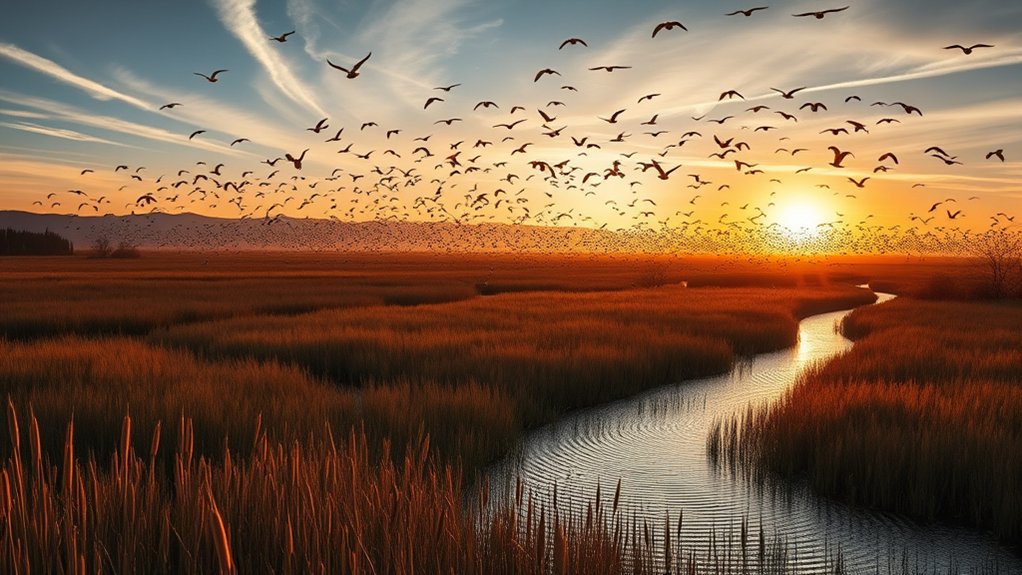
You’ll find that seasonal bird migration patterns are shaped mainly by climate, food availability, and safe stopover habitats. Birds migrate to reach rich feeding grounds and suitable breeding sites, responding to environmental cues like day length and temperature.
Climate change is making timing trickier, as insects emerge earlier and weather becomes unpredictable, impacting birds’ survival. Plus, physical adaptations and varied strategies help different species along the way. Keep exploring to see how these factors intertwine and influence migration success.
Why Do Birds Migrate Seasonally?
Although migration demands a great deal of energy, birds undertake seasonal journeys to reach areas rich in food and ideal nesting sites. These are crucial for their survival and breeding success.
You’ll notice that many birds time their migration to match the availability of blooming plants and insect populations, providing essential nutrition during breeding.
Environmental factors like day length and temperature changes signal when it’s time to start migrating. These cues guarantee birds arrive at locations that offer the right conditions for raising their young, such as the blue-gray gnatcatcher’s preferred habitats.
Despite the energy costs, migration allows birds to exploit resources that change seasonally. This gives them the best chance to thrive and reproduce in environments that can’t support them year-round.
How Climate Change Alters Bird Migration Timing
You’re noticing birds arriving at their nesting grounds earlier than before—like, their migration timing is shifting by days every decade.
This matters because it affects food availability; insects are hatching sooner too.
So, the whole timing of breeding seasons gets thrown off.
When you understand these shifts, it really helps you see how climate change is messing with the delicate balance that birds depend on.
Shifts In Migration Timing
As climate change accelerates, migrating birds are shifting their arrival times by 1 to 2 days earlier each decade. This means they now reach their nesting grounds up to 10 days sooner than birds did in the early 1970s. These shifts in migration timing reflect how climate change alters the cues birds rely on, such as temperature and daylight.
You’ll notice fall migration has also extended by about 17 days compared to 40 years ago, showing broader changes in migratory behavior.
Birds face physiological changes too. Studies reveal decreased body mass but increased wingspan, adaptations possibly linked to altered migration demands.
However, these timing shifts risk mismatches with food availability, since insects emerge earlier now.
Understanding these changes helps you grasp how climate-driven shifts affect bird survival and reproduction during migration.
Impact On Food Availability
When climate change speeds up insect emergence by up to 12 days, you’ll see a growing gap between the timing of bird migration and food availability. This shift considerably impacts the availability of food during their migratory journey.
You might notice birds arriving earlier, yet food resources remain out of sync. Extended fall migration seasons alter food supply dynamics. False springs damage insect populations critical for feeding. Later-breeding birds miss peak insect abundance. Reduced survival and reproductive success link to food scarcity.
These factors highlight the impact on food availability caused by climate change. As a result, birds face greater challenges securing the food resources essential for energy during migration. This affects their overall health and migration success.
Understanding this helps you grasp the delicate balance between climate and migratory patterns.
Altered Breeding Seasons
Although many bird species have shifted their arrival times earlier by up to 10 days since the 1970s, climate change continues to disrupt the delicate timing of their breeding seasons.
As a migratory species, you rely on precise timing of migration to reach breeding grounds when food sources, like insects, are abundant.
However, climate change causes insects to hatch 3-12 days earlier, creating a mismatch between your arrival and peak food availability. Long-distance migrants struggle more with adjusting their timing, risking reduced breeding success.
Unpredictable weather, such as false springs, can further damage food sources after you arrive early.
These altered breeding seasons challenge your ability to reproduce successfully, making it harder to adapt to rapidly changing environmental cues at your breeding grounds.
How Food Availability Drives Bird Migration
You’ll notice that many birds time their migration to follow insect populations.
This way, they make sure there’s enough food along the way. Seasonal plant blooming also plays a big role, especially for species like hummingbirds that rely on nectar.
When you understand these food availability patterns, it really helps explain why birds pick certain routes and timings for their journeys.
Insect Population Influence
Because insect populations provide vital food resources, many migratory birds time their movements to match insect availability. You’ll notice that during the breeding season, food availability becomes a driving force for migratory bird species.
When insects emerge at the right time, birds can feed their young adequately and thrive. However, shifts in insect populations, often caused by climate change, can disrupt this balance.
Here’s what you should know:
- Common yellowthroats migrate to coincide with peak insect abundance.
- Broad-winged hawks follow insect prey during migration.
- Earlier insect hatching risks mismatching bird arrival.
- Reduced insect availability harms breeding success.
- Food availability directly influences migration timing.
Understanding these links helps you appreciate how insect populations significantly shape bird migration patterns.
Seasonal Plant Blooming
When you track migratory birds, you’ll notice many times their journeys match the blooming of plants that supply vital food like nectar and insects.
Seasonal plant blooming directly influences migratory birds, guiding their timing to guarantee they arrive when food sources peak.
For example, ruby-throated hummingbirds migrate north in spring to feed on blooming flowers essential for energy and nesting.
Similarly, blue-gray gnatcatchers time their migration to exploit the abundance of insects linked to flowering plants.
However, climate change disrupts these blooming schedules, causing mismatches between bird arrivals and food availability.
This mismatch can reduce survival rates and reproductive success.
Understanding how seasonal plant blooming drives migration helps you appreciate the delicate balance migratory birds depend on to thrive during their long journeys.
Environmental Cues That Trigger Bird Migration
Although the changing seasons bring many shifts, you can count on environmental cues like increasing daylight and warming temperatures to trigger birds’ migration instincts. These cues prompt hormonal changes that prepare birds for their long journeys.
Increasing daylight and warming temperatures trigger hormonal changes that prepare birds for migration.
Key factors include:
- Photoperiod changes signaling the approach of spring or fall
- Rising temperatures influencing metabolic readiness
- Availability of food resources such as insects and flowering plants
- Synchronization with seasonal events like plant blooming and insect emergence
- Weather patterns, including favorable wind directions and storm avoidance
Physical Adaptations That Support Bird Migration
A bird’s body undergoes remarkable changes to tackle the challenges of migration. You’ll notice physical changes like lighter bones and increased wingspan, which reduce body weight and improve flight efficiency on long migratory routes. These adaptations help birds conserve energy during long-distance travel.
Many species develop specialized proteins that boost energy use, allowing you to store and utilize fat reserves effectively.
Moreover, migratory birds adjust sleep patterns, using unihemispheric slow-wave sleep to rest one brain hemisphere while staying alert.
Curiously, body mass has generally decreased over time, helping birds dissipate heat better amid rising temperatures.
These physical changes collectively equip birds to endure and excel at the demanding journeys that define seasonal migration.
What Hazards Do Birds Face During Migration?
Facing numerous hazards during migration, birds must navigate threats that can abruptly end their journeys.
As a migratory bird, you encounter various challenges that test your endurance and survival skills. Key hazards include:
Collisions with glass buildings, especially those under four stories tall, cause nearly a billion bird deaths annually in the U.S.
Light pollution disorients you and disrupts your navigation.
Severe weather like storms and fog can alter your route and increase mortality.
Predators such as snakes, raccoons, and humans target you when you’re fatigued.
Habitat loss forces you to search longer for safe resting spots, draining your energy.
Understanding these hazards helps you appreciate the risks migratory birds face every season.
Why Safe Stopover Habitats Matter for Migratory Birds
When you think about migratory birds, you realize they need safe places to rest and regain energy during their long trips.
These stopover habitats are like pit stops, providing essential food sources that help birds refuel and get ready for the next leg of their journey.
Without these resting areas, their chances of survival and successful migration drop quite a bit.
Importance of Resting Areas
Because migratory birds depend on safe stopover habitats, these areas play an important role in their long journeys by offering places to rest and refuel.
Without reliable resting areas, migratory birds face increased risks and energy depletion.
You can better appreciate why protecting these stopover habitats matters by considering their benefits:
- Provide safe refuges away from predators
- Offer shelter during harsh weather
- Support large numbers of migratory birds simultaneously
- Preserve crucial natural habitats like wetlands and forests
- Reduce mortality risks such as collisions with human-made structures
Protecting and conserving these resting areas guarantees migratory birds can complete their journeys successfully, maintaining healthy populations and vibrant ecosystems.
You can see how significant these habitats are for migration survival.
Role of Food Availability
Although migratory birds depend on safe stopover habitats to rest, their ability to find abundant food at these sites is what truly fuels their long journeys. You should know that food availability drives many species to migrate to warmer regions during the migration season.
These stopover habitats, often called staging areas, provide essential resources where birds can eat and refuel. Without sufficient food, birds must expend extra energy searching for nourishment, which jeopardizes their survival.
For example, ruby-throated hummingbirds time their migration to match plant blooming, ensuring they’ve enough food upon arrival. When natural habitats decline, food scarcity increases, making safe stopover sites even more crucial.
How Different Bird Species Vary in Migration Strategies
Understanding how different bird species vary in migration strategies reveals the incredible adaptability of these creatures to their environments.
When you explore how species migrate, you see a range of tactics shaped by food, weather events, and habitat.
Birds that migrate don’t all follow the same pattern.
Consider these examples:
Arctic Terns undertake the longest migrations, flying over 55,000 miles annually.
Canada Geese are complete migrants, traveling long distances seasonally.
Wood Storks show partial migration, moving only when food is scarce.
Black-throated Blue Warblers practice altitudinal migration, moving up and down mountains.
Common Redpolls exhibit nomadic migration, shifting locations based on seed abundance.
These diverse migration strategies help birds respond effectively to changing environments and resource availability.
How Scientists Track and Study Bird Migration
When you want to learn how birds navigate thousands of miles, scientists rely on various tracking methods like banding and GPS devices. These tools help gather precise data on migration routes and timing. Tracking devices reveal migration patterns, while citizen science projects like eBird engage birdwatchers in collecting data.
Acoustic monitoring and historical records also deepen our understanding of bird movements and adaptations.
| Method | Purpose |
|---|---|
| Banding | Identifies individual birds |
| GPS Tracking | Provides real-time location data |
| Citizen Science | Collects widespread sighting reports |
| Acoustic Monitoring | Detects species presence via calls |
| Museum Records | Shows long-term migration trends |
These tools combine to give a detailed picture of migratory behavior and environmental impacts.
How You Can Help Protect Migratory Birds
If you want to protect migratory birds, simple actions like reducing outdoor lighting during migration seasons can make a big difference.
When birds migrate, they often get disoriented by bright lights, increasing collision risks.
You can help by turning off or dimming outdoor lights during peak migration times.
Applying window decals can also prevent bird collisions with glass.
Using window decals is an easy way to stop birds from flying into glass surfaces.
Planting native plants is great because it helps birds find food and shelter.
You might also consider joining citizen science projects to track bird movements.
Supporting conservation initiatives, like purchasing Duck Stamps, is another way to make a positive impact.
Every little bit helps to keep migratory birds safe.
Frequently Asked Questions
How Do Migratory Birds Navigate During Cloudy or Stormy Weather?
When you think about how migratory birds navigate during cloudy or stormy weather, they rely on advanced navigation techniques and sensory cues.
Even under heavy cloud cover, they detect storm signals like changes in atmospheric pressure and humidity to adjust their routes.
They also use Earth’s magnetic field and polarized light patterns to maintain direction.
These cues help them stay on course, even when visual landmarks disappear in tough weather conditions.
What Role Do Magnetic Fields Play in Bird Migration?
Imagine you’re a navigator in the 18th century using a compass; birds rely on magnetic orientation mechanisms the same way.
These magnetic fields provide essential environmental cues, helping birds gauge magnetic field intensity to stay on course.
You’d see how avian navigation strategies blend these cues with celestial signals, enabling precise migration.
How Does Urbanization Impact Migratory Bird Routes?
Urban sprawl effects force you to navigate fragmented habitats, making your migratory routes longer and more exhausting.
Habitat fragmentation consequences reduce safe stopover spots, increasing risks.
Light pollution influence confuses your navigation, causing disorientation and collisions.
Moreover, urban heat islands alter food resource availability, shifting insect hatching times and making it harder for you to find nourishment during migration.
Are There Any Diseases Spread Through Bird Migration?
Yes, bird migration can spread diseases like bird flu, avian cholera, West Nile virus, and Newcastle disease.
When birds travel long distances, they can carry these pathogens to new areas, affecting both wild and domestic populations.
You should know that migratory birds act as carriers, making it important to monitor their movements closely.
This helps track outbreaks and protect both animal and human health from these serious diseases.
How Do Juvenile Birds Learn Migration Routes?
Imagine soaring through golden skies, guided by mentor birds.
You learn migration routes through social learning, following older, experienced birds who show you the way.
Your innate behavior nudges you to navigate, but it’s the environmental cues, like the sun’s glow, star patterns, and Earth’s magnetic whispers, that truly help you find your path.
This blend of instinct and guidance guarantees you’ll master the journey for seasons to come.
Conclusion
Now that you understand how climate, food, and safe stopovers shape bird migration, you can appreciate their incredible journeys even more. Take the Arctic Tern, for example. It travels over 25,000 miles annually, relying on precise environmental cues and rich feeding grounds.
By supporting conservation efforts and protecting habitats, you play a crucial role in helping these birds continue their seasonal migrations. Every small action you take makes a big difference for migratory birds worldwide.