
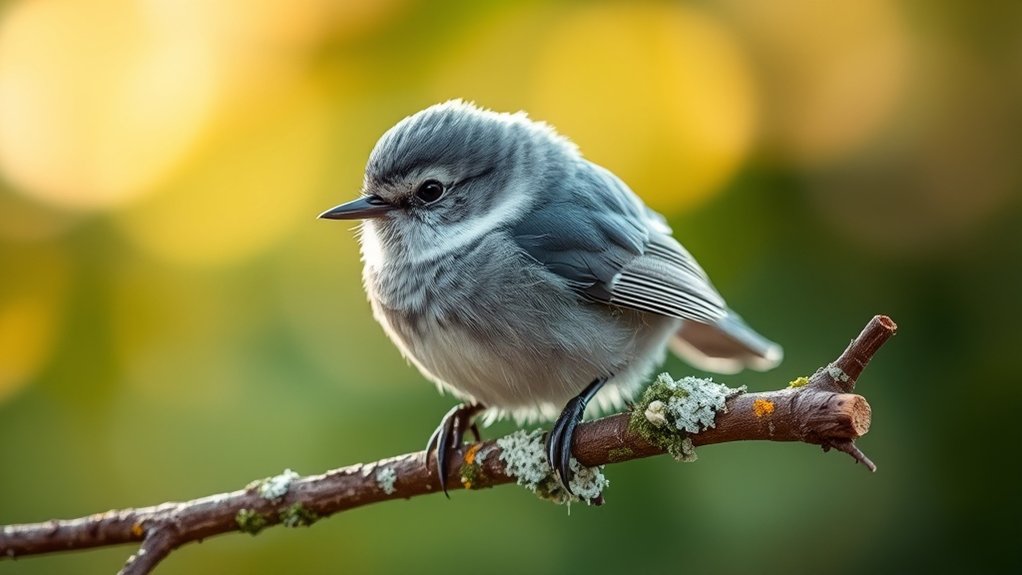
If you spot a small grey bird with a white belly, look closely at size, markings, and behavior to identify it. Dark-eyed Juncos show slate gray backs and are robust, while Gray Vireos have softer gray tones and a thin white eyering.
Watch how they move. Ground foraging or hopping in dense shrubs can help you tell them apart. Their calls and habitats also offer clues. Keep exploring, and you’ll uncover more about their fascinating habits and how to attract them nearby.
How To Recognize Small Grey Birds With White Bellies
When you spot a small grey bird with a white belly, look closely at its color patterns and behavior to identify it. The Dark-eyed Junco, for instance, shows a uniform dark gray upper body contrasting sharply with a clean white belly.
Spot a small grey bird with a white belly? Look for uniform dark gray upper parts—typical of the Dark-eyed Junco.
Both males and females lack streaks or stripes on their face, breast, or belly, which helps you distinguish them from other sparrows.
Notice how they often move in small groups foraging on the ground. That’s typical Junco behavior.
In contrast, other grey birds might’ve different markings or habits.
Common Species Of Small Grey Birds You’ll See
You’ll spot several small grey birds by looking for key identification features like their plumage patterns and unique markings.
Plus, knowing where they usually hang out—whether that’s in gardens or wooded areas—can really help narrow down which species you’re seeing.
Identification Features
Spotting small grey birds can be a delightful challenge, as many species share similar hues but reveal unique features up close. When identifying a gray bird with a white belly, focus on subtle markings and behaviors.
For example, the Dark-eyed Junco has a clean white belly and slate-gray body, while the Tufted Titmouse adds a tufted crest and rusty sides. The Gray Vireo is a small songbird with a thin white eyering and tail flicking, distinct from the Black-capped Chickadee’s black cap and bib.
Use this quick guide to pinpoint each bird’s traits:
| Species | Key Identification Features |
|---|---|
| Dark-eyed Junco | Slate gray, white belly, ground forager |
| Tufted Titmouse | Silvery gray, white belly, tufted crest |
| Gray Vireo | Plain gray, white belly, white eyering |
Typical Habitats
Although small grey birds may appear similar at first glance, their preferred habitats vary widely, offering you clues to their identification.
You’ll often find these birds in small groups, especially wintering birds that gather for warmth and protection. Many species share similar habitats, but each has unique preferences that help you spot them.
Dark-eyed Juncos frequent conifer forests, gardens, and urban areas across North America.
Gray Vireos prefer arid desert environments like mesquite and oak scrub at high elevations.
Tufted Titmice thrive in eastern forests and suburban gardens below 2,000 feet.
Chickadees, both Black-capped and Carolina, inhabit wooded areas and suburbs, often foraging in mixed flocks during winter.
Knowing these habitats helps you distinguish these small grey birds you’ll see.
How To Differentiate Similar Grey Bird Species
When distinguishing similar grey bird species, paying attention to subtle differences in color, behavior, and size can make all the difference.
For example, the Dark-eyed Junco displays a uniform slate gray back, wings, and head with a bright white belly, setting it apart from other gray birds.
In contrast, the Gray Vireo shows a softer gray tone with a pale belly and a thin white eyering.
Behavior also helps: you’ll notice the Junco foraging on the ground in social groups, while the Vireo hops through dense vegetation, flicking its tail consistently.
Size matters too. The Junco is generally larger and more robust than the Vireo.
Identifying Juvenile Vs Adult Grey Birds By Plumage
When you spot a small grey bird, taking a closer look at its plumage can really help you figure out if it’s an adult or a juvenile.
Adults usually have uniform grey feathers with paler bellies.
On the other hand, juveniles tend to show washed brown tones and more distinct wingbars.
Adult Plumage Features
Recognizing adult plumage features is key to distinguishing mature gray birds from their juvenile counterparts. When you spot gray birds like Dark-eyed Juncos, you’ll notice adults have a uniform slate gray back paired with a clean white belly.
These adult plumage features stand out clearly compared to the more muted, brownish tones of juveniles. For example, adult Gray Vireos show a plain gray body with subtle markings like a thin white eyering and a faint wingbar, which juveniles lack or display less distinctly.
To identify adults confidently, focus on:
- Consistent gray coloration without brownish wash
- Paler, clean white bellies
- Presence of subtle wingbars and eyering (e.g., Gray Vireo)
- Absence of pronounced juvenile markings or mottling
This helps you tell adult gray birds apart at a glance.
Juvenile Plumage Differences
Although juvenile gray birds share some features with adults, their plumage often shows distinct differences that help you tell them apart.
Juvenile plumage usually has a washed brown tone, contrasting with the adult’s plain gray appearance.
You’ll notice juveniles often have a more distinct wingbar, which adults lack or have less prominently.
Despite these differences, the white eyering is present in both age groups, giving you a reliable identification clue.
Juvenile feathers tend to be more variable and less uniform, sometimes with streaking, whereas adults maintain a consistent drab gray.
Behaviorally, juveniles may seem less active, which can aid you during field observations.
Understanding these plumage traits guarantees you accurately distinguish young birds from adults in the field.
Behavioral Traits Of Small Grey Birds With White Bellies
You’ll often find small grey birds with white bellies, like the Dark-eyed Junco and Gray Vireo, foraging on the ground or among dense shrubs to pick insects and seeds.
These small gray birds show distinct behavioral traits that help them thrive. They often move in small groups, especially in winter, enhancing their foraging efficiency and safety.
Their vocalizations, such as the Junco’s repetitive “tew-tew-tew-tew” call, serve as communication and territorial signals.
The Junco’s repetitive “tew-tew-tew-tew” call plays a key role in communication and marking territory.
When threatened, they quickly seek cover, displaying a shy nature that aids survival.
- Forage primarily on the ground or in dense vegetation
- Exhibit social behavior, moving in small groups
- Use distinctive calls for communication and territory
- Display quick cover-seeking when alarmed for protection
Typical Habitats For Small Grey Birds With White Bellies
When you explore woodlands, gardens, or conifer forests across North America, you’re likely to spot small grey birds with white bellies like the Dark-eyed Junco.
These birds often choose shrubby or dense vegetation for nesting, which offers protection and food access.
You’ll also find small gray birds adapting well to suburban parks, where feeders and natural food supplies attract them, especially in winter when they forage in flocks.
In more arid regions, species such as the Gray Vireo thrive in desert scrub environments, including mesquite and oak scrub.
Whether in urban settings or natural habitats, these birds demonstrate remarkable versatility.
Why Grey And White Coloring Helps These Birds Survive
Because small grey birds with white bellies often live in environments filled with shadows, bark, and dappled light, their coloring helps them blend in and avoid predators.
This camouflage is essential for their survival, especially when they exhibit ground-foraging behavior, picking through leaf litter and grasses.
The grey plumage conceals them against tree bark, while their white bellies reflect light from below, making them less visible from above.
Furthermore, their coloration plays a role in social signaling, allowing subtle visual communication during courtship and territorial displays.
- Camouflage reduces chances of predation.
- White belly reflects light, aiding disguise.
- Melanin pigmentation conserves energy.
- Enhances social signaling in low light.
This color pattern perfectly supports their survival strategies.
What Their Songs And Calls Reveal For Identification
Although small grey birds may look similar, their songs and calls offer clear clues that help you identify them in the wild.
For example, the delicately built songbird, the Dark-eyed Junco, repeats a simple “tew-tew-tew” call, making it easy to recognize.
The Gray Vireo, a songbird with a short, halting series of 2- and 3-note phrases, has a distinct burry quality that sets it apart.
The Gray Vireo’s unique 2- and 3-note burry phrases make it unmistakable among songbirds.
You’ll also hear the Gray Catbird’s varied, continuous mewing calls, often mimicking other birds.
Meanwhile, the Tufted Titmouse’s clear, whistling “peter-peter-peter” call helps you distinguish it from similar species.
Paying attention to these vocalizations lets you identify these birds confidently, especially during mating seasons when their songs become more pronounced.
Seasonal Patterns And Migration Of Small Grey Birds
You’ll notice small grey birds, like the Dark-eyed Junco, arriving as winter approaches.
They’re migrating from northern areas, which is pretty interesting to watch. Their timing can change, though, depending on things like temperature and how much food is around.
Winter Visitor Arrival
When temperatures drop and snow blankets the ground, you’ll start seeing many small gray birds with white bellies, like Dark-eyed Juncos and Gray Juncos, arriving from their northern breeding grounds.
These winter visitors prefer areas with abundant seeds and shelter, making your backyard feeders a hotspot.
The Dark-eyed Junco stands out with its slate gray back and white belly, often foraging in small flocks.
Watching these bird species during winter offers a unique chance to see their seasonal adaptations up close.
- Dark-eyed Juncos migrate south from Canada and northern U.S.
- They favor ground foraging near feeders
- Winter visitors appear as temperatures fall
- Their slate gray plumage contrasts with snowy landscapes
You’ll enjoy spotting these resilient birds throughout winter.
Migration Timing Patterns
As winter visitors like Dark-eyed Juncos settle into your backyard, their seasonal journeys are just beginning to reveal themselves.
The migration timing of small gray birds with white bellies, such as these juncos and Gray Vireos, depends on factors like food availability, temperature shifts, and daylight changes.
You’ll notice these birds start moving south as early as October, returning by March or April to breed in northern regions. Many travel in flocks, adapting routes based on environmental conditions.
Some populations stay year-round if the climate is mild, but most migrate to avoid harsh winters.
Understanding these migration timing patterns helps you appreciate the remarkable seasonal rhythms these small gray birds with white bellies follow to survive and thrive.
How To Attract And Support Small Grey Birds Locally
Anyone interested in attracting small grey birds like Dark-eyed Juncos can start by offering a variety of seeds, especially millet and sunflower seeds, in feeders placed near natural cover such as bushes or trees.
Providing a suitable habitat enhances their comfort and encourages frequent visits.
Creating a welcoming environment boosts their comfort and invites them to return often.
To attract and support these birds locally, consider the following:
Place feeders close to shrubs or trees for shelter and safety.
Plant native vegetation that yields seeds, berries, and insects.
Keep feeders clean to prevent mold and disease.
Include a shallow water source for drinking and bathing.
Frequently Asked Questions
What Do Small Grey Birds With White Bellies Eat?
You’ll find small grey birds with white bellies have varied feeding habits depending on the season.
Their dietary preferences usually include seeds from grasses and weeds, which serve as primary food sources.
During breeding, they switch to insects and invertebrates to feed their young.
In colder months, they adapt by eating berries and fruits.
You’ll often see them hopping on the ground or visiting feeders for seeds, nuts, and suet.
How Long Do These Birds Typically Live?
Imagine watching a small gray bird with a white belly flutter through your backyard.
These birds typically live 2 to 5 years. Their lifespan factors include predation and food availability.
Habitat influences how safe and nourishing their environment is.
Breeding habits also play a role, as the energy spent raising young and seasonal migrations can affect their longevity.
With ideal conditions, some even live beyond a decade, showcasing nature’s resilience.
Do Small Grey Birds With White Bellies Have Natural Predators?
Yes, small grey birds with white bellies do have natural predators like hawks, owls, snakes, and raccoons.
To survive, you’ll notice they use predator avoidance strategies like staying close to dense vegetation for cover.
They also adopt careful nesting behaviors, choosing hidden sites to protect their eggs and chicks.
Habitat protection measures, such as preserving shrubs and ground cover, are essential for their safety and overall survival.
Can These Birds Be Kept as Pets Legally?
Wondering if you can keep small gray birds with white bellies as pets? In most cases, pet ownership laws prohibit it unless you have special permits.
You’ll need to understand bird care tips and create suitable habitats that mimic their natural environment.
Before you decide, check local regulations carefully. Doing so guarantees you respect wildlife protections and provide proper care, avoiding legal troubles while keeping your feathered friends happy and healthy.
What Role Do These Birds Play in the Ecosystem?
You’ll find that small gray birds with white bellies play essential roles in the ecosystem by controlling insect populations and dispersing seeds.
Their breeding habits guarantee population growth, while their migratory patterns help spread plant diversity across regions.
Their habitat preferences, often in forests and urban areas, support biodiversity and food webs.
Conclusion
Now that you know how to spot small grey birds with white bellies, you’re ready to become a backyard bird detective. These subtle feathered friends might seem like a quiet whisper in nature’s chorus, but their unique markings and behaviors tell a vivid story.
Keep your eyes sharp and your ears open. Each sighting is a small treasure waiting to brighten your day and deepen your connection with the natural world around you.