
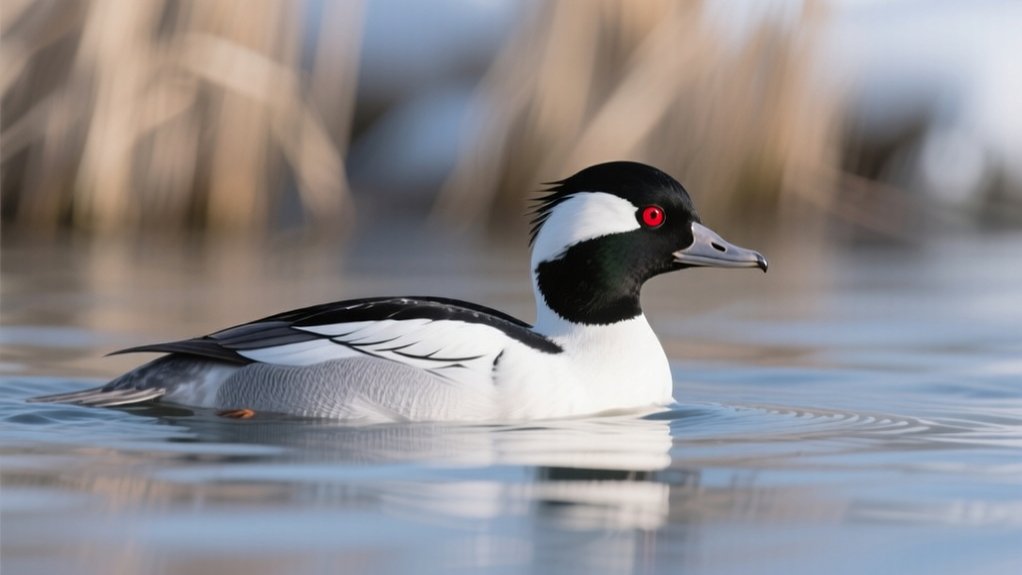
You can identify the male Smew duck by its striking white plumage with black “cracked ice” markings and steel-blue bill, while females have grey bodies with chestnut heads and red bills.
They breed across northern taiga forests and winter in sheltered lakes and coastal areas from Europe to East Asia. Specialized for diving, they mainly eat fish and aquatic insects.
Their seasonal plumage changes and migratory behaviors reveal fascinating adaptations you’ll uncover next.
Male Smew Duck Identification
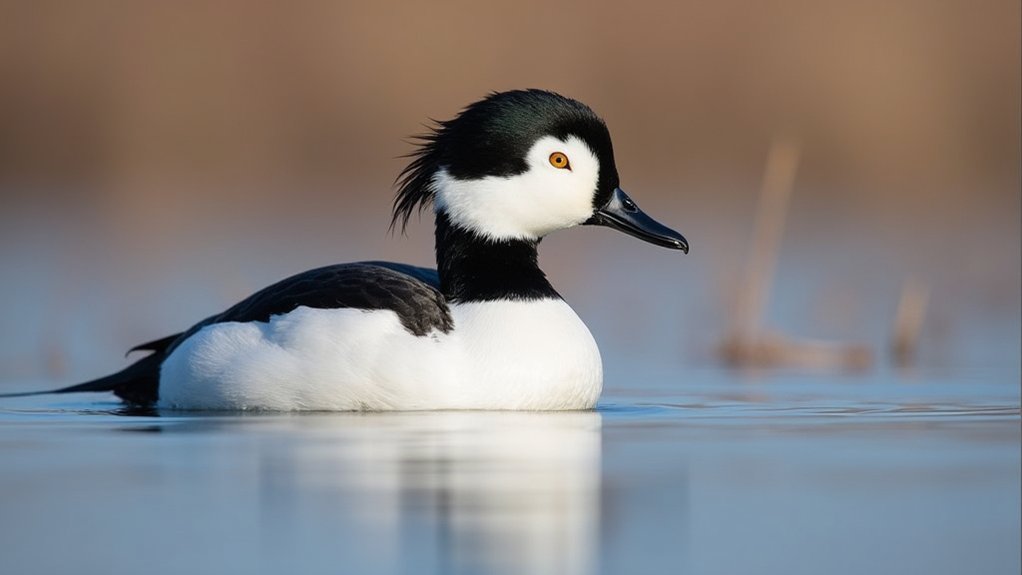
When identifying a male Smew duck, you’ll notice its mainly white plumage sharply contrasted by black markings that create a distinctive “cracked ice” pattern across its body.
Black areas concentrate on the head, back, and breast, including two narrow black stripes descending on each breast side. The black back and grey flanks clearly separate these from the white body.
The head features a drooping white crest lined with black, a black eye patch extending to the bill’s base, and black lores, producing a mask-like facial appearance. Its compact head complements the delicate body.
The short, steel-blue bill with a hooked tip and serrated edges supports aquatic prey capture. Smews are diving ducks with serrated bills for catching prey.
Wings and tail display light to dark grey, while long orange legs support its streamlined form.
Female Smew Duck Identification
You can spot female Smew ducks by their overall grey plumage with mottled breasts and flanks. This look really contrasts with the male’s bold markings, making it easier to tell them apart.
Also, check out the chestnut forehead and crown—they stand out nicely.
Then, there are the white patches below the eyes paired with black lores, which give the female a unique facial pattern.
These head markings, along with the lighter tones on the wings, are key clues.
Whether the female is resting or flying, these features help you identify her with confidence.
Female Smews typically have a brown cap and light grey body plumage, distinguishing them further from males.
Female Plumage Characteristics
Identifying a female Smew duck relies heavily on noting her distinctive plumage and coloration patterns.
You’ll observe a light grey body covering the torso and underparts, contrasted by a chestnut or reddish-brown head, which stands out against the pale neck.
Her throat, chin, and facial patches around the eyes are stark white, contributing to subtle facial differentiation.
The wing feathers show a brown and white pattern with oval white patches visible in flight, though less contrasting than males.
Grey wingtips and tail feathers complete the wing structure. Developing a flexible mindset and adaptability is crucial for understanding how these birds adjust to seasonal changes in their environment adaptability.
You’ll also notice a red bill with a hooked tip and serrated edges, adapted for catching fish, along with long orange legs.
Seasonal changes keep the brown head prominent during winter, while the body plumage remains consistent throughout the year.
Distinctive Head Markings
Although the female Smew’s overall plumage is subtle compared to the male’s, her head markings present distinct features critical for identification.
You’ll notice a chestnut-brown coloration dominating the uppermost head and extending to the rear neck, often appearing reddish in field conditions.
This sharply contrasts with the white lower head and throat, which extend well below eye level onto the cheeks, creating a clean vertical demarcation.
The prominent white cheek patches, continuous with the throat, form a high-contrast area that facilitates field separation from males, who display a black facial mask.
Unlike young males that develop mixed white head feathers mid-winter, females maintain this chestnut-and-white pattern consistently.
This makes head markings the primary, reliable gender identification feature throughout the winter visiting season.
Ducks typically have an elongated, broad body and relatively long necks, which also apply to Smew ducks, aiding in their distinctive silhouette and identification in the field (morphology).
Juvenile and Eclipse Plumage Characteristics
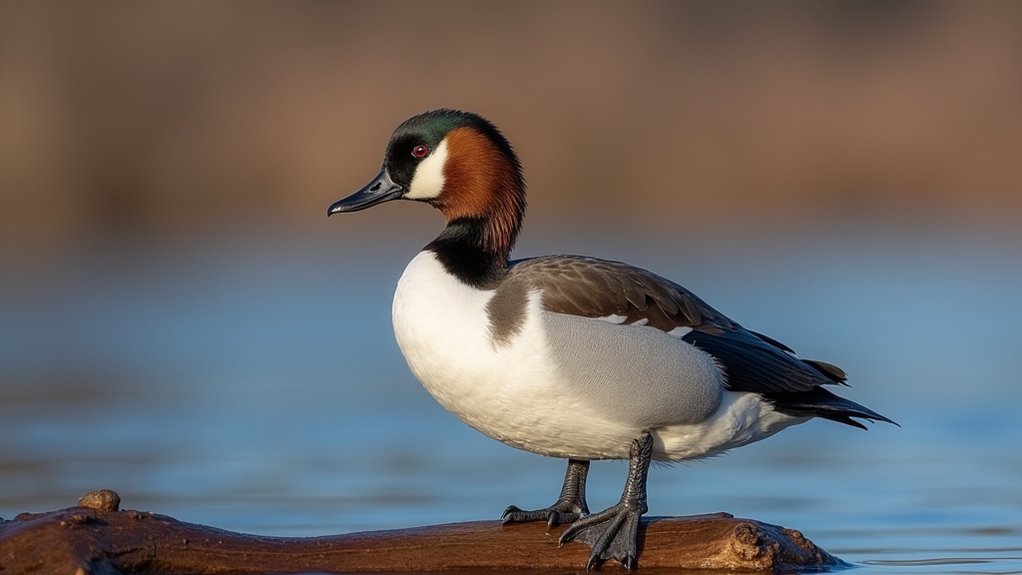
When observing smew ducks during their early life stages, you’ll notice juveniles exhibit a grey base coloration complemented by a chestnut-brown forehead and crown, along with white chin and cheeks.
Black lores mark the face, and crests are reduced compared to adults.
Eclipse plumage appears in late summer and autumn. During this time, males resemble females but retain key features like a black eye patch and white wing patches.
This phase coincides with molting and breeding cycles.
The bill of the smew has a hooked tip and serrated edges, which aids in catching fish while diving.
Key characteristics include:
- Juveniles’ plumage is indistinguishable from females, often called “redhead” smews.
- Eclipse males show darkened body plumage but maintain white heads and wing markings.
- Molt progression signals maturation, with young males gaining white head feathers by mid-winter.
These traits help you accurately identify smews during developmental stages.
Geographic Distribution of Smew Ducks
You can spot Smew ducks breeding all across the northern taiga, stretching from Scandinavia all the way to Chukotka. They like to nest in tree cavities close to waters that are rich in fish.
When winter rolls around, they head off to coastal and inland areas around the Baltic Sea, the Caspian Sea, and parts of East Asia. They tend to prefer spots that are sheltered and have milder temperatures. Smew migration patterns are also influenced by weather conditions, which can affect their migratory routes and timing.
If you look into their migration routes, you’ll notice that these paths shift depending on changes in temperature and how available their habitats are.
It’s pretty interesting to see how adaptable they are!
Breeding Range Overview
Because the Smew duck favors the taiga biome, its breeding range stretches across the northern regions of Eurasia, from the Scandinavian Peninsula in the west to Siberia’s Pacific coast in the east.
You’ll find breeding populations concentrated primarily in northern Scandinavia and extending through vast, sparsely populated taiga forests of Siberia.
Northern Finland, especially areas like Salla and Kuusamo, hosts a significant but scarce breeding population estimated at 1,000–2,000 pairs.
The Smew’s reliance on inland waters and lake systems within boreal forest-lake conversion zones confines its breeding distribution to these northern latitudes.
As a small diving duck, the Smew is well adapted to its environment with a short bill featuring teeth and a hook for catching slippery fish.
As you investigate their range, consider these defining aspects:
- Extensive coverage across multiple continents yet unevenly populated
- Strong association with taiga biome and freshwater habitats
- One of the largest breeding ranges among small diving ducks
Winter Habitat Locations
Smew ducks occupy a diverse range of winter habitats across Europe and Asia, with distinct geographic hotspots reflecting their ecological preferences.
In the UK, southeast England hosts the majority of wintering birds, primarily in gravel pit complexes, with occurrences also noted in Scotland, Wales, and scarce visits to the Isle of Man and Channel Islands.
Across continental Europe, key wintering zones include the Baltic and Black Seas, northern Germany, the Low Countries, Sweden, Bulgaria, and the Caspian Sea region.
In Asia, established winter grounds span eastern China, Korea, Japan, northern India, Iran, and southern Asia, with the Caspian Sea serving as a significant hub.
Smews favor sheltered lowland coasts, lakes, reservoirs, and fish-rich waters with adjacent tree coverage.
These provide essential roosting and exploring habitats during winter months. The smew’s diet primarily consists of fish, which influences its choice of wintering waters.
Migration Patterns and Routes
Understanding where Smew ducks spend their winter months provides a foundation for examining their migration behaviors. These ducks are migratory, with northern Poland serving as a notable wintering site.
Observations during spring and autumn migration periods indicate seasonal movement, yet detailed migration routes, timing, and stopover sites remain insufficiently documented.
As you investigate their migration, consider the following: The Smew’s reliance on fish and small crustaceans influences habitat selection during migration. Limited geographic data challenges precise mapping of their migration corridors.
Tracking their movement requires advanced telemetry studies for thorough insights. Additionally, knowledge of migratory flyways aids in predicting bird movements, which can be crucial for effective study and conservation efforts related to Smew ducks’ migration patterns (migration flyways).
You’ll find that current knowledge highlights general patterns but calls for further research to fully understand Smew ducks’ migratory geography and behavior.
Preferred Habitat Types
Preferred habitats for this species span a variety of aquatic environments that support its feeding, breeding, and seasonal survival needs.
You’ll find Smew ducks in fish-rich freshwater lakes, slow-moving rivers, and reservoirs, where water depth exceeds 18 inches, ensuring effective plunging and foraging. These water bodies often include marshes and wetlands that provide additional food and shelter resources.
Clean, clear water with abundant aquatic invertebrates and insects is essential for their diet.
Clear, clean waters rich in aquatic insects and invertebrates are vital for their nourishment.
During winter, they favor sheltered coastal areas, including protected bays and estuaries with moderate salinity, primarily around the Baltic Sea, Black Sea, and parts of northern Germany.
They also inhabit boreal and taiga zones across northern Eurasia, where cold climates and seasonal ice formation challenge survival.
These diverse habitats provide the necessary conditions for feeding efficiency, protection from extreme weather, and seasonal refuge.
Breeding Grounds and Conditions
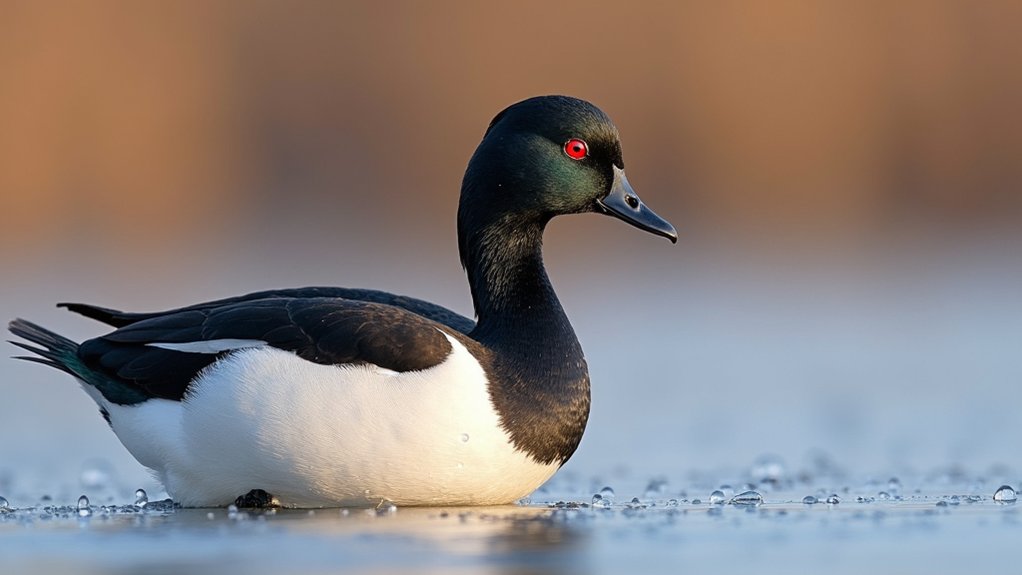
You’ll find Smew ducks primarily breeding in the northern taiga.
This area is full of dense coniferous forests and freshwater bodies, which create perfect conditions for them.
They’re well adapted to extreme cold, so they can survive and reproduce successfully even when temperatures drop harshly.
Knowing these habitat details really helps to understand their breeding ecology better.
Northern Taiga Habitat
Although the Smew duck breeds across a wide area of the northern taiga zone, from northern Scandinavia to eastern Siberia, you’ll find its populations concentrated in regions like northern Sweden, Finland, and European Russia.
This habitat features vast coniferous forests interspersed with wet bogs, marshes, and nutrient-rich freshwater bodies.
The Smew relies heavily on large conifers with woodpecker-excavated cavities for nesting, typically near fish-rich lakes or slow-moving water. It is a small diving duck adapted to catch fish underwater.
The precise balance of forest density, cavity availability, and aquatic prey supports their reproductive success.
You’ll appreciate the taiga’s demands on the Smew:
- Dependence on old woodpecker holes within dense coniferous forests
- Necessity of sheltered, productive lakes with abundant fish
- Requirement for proximity between nests and water for brood survival
Extreme Cold Adaptations
Surviving and breeding in the northern taiga’s harsh climate demands specialized adaptations from the Smew. You’ll notice their outer waterproof feathers prevent water penetration, while dense down traps warm air, creating a layered thermal barrier that maintains insulation year-round. Regular preening is essential to keep these feathers clean, dry, and flexible, ensuring maximum waterproofing efficiency.
Their legs and feet utilize a counter-current heat exchange system, transferring heat from arterial to venous blood, minimizing heat loss and allowing extremities to function in freezing water. Anatomically, their feet lack muscle tissue, reducing oxygen demand and resisting frostbite.
Behaviorally, you’ll see them lift legs into feather cover, tuck bills, roost in groups, and select sheltered sites to conserve heat.
Large fat reserves and metabolic adjustments provide sustained energy, enabling survival and successful breeding despite sub-zero temperatures and limited food availability.
Wintering Locations and Migration Patterns
When open, ice-free waters become scarce on the Continent, Smew ducks migrate primarily to the UK, especially its south-east regions. There, lakes, reservoirs, and coastal waters provide suitable wintering habitats.
Their autumn migration begins in October, with most arriving by December, forming stable populations. These movements respond directly to freezing conditions on their continental breeding grounds. Ducks navigate using the sun, stars, magnetic fields, and landmarks, relying on an innate sense of direction that guides them through migration.
You’ll notice that cold spells increase Smew numbers crossing the North Sea to the UK. Warmer winters shorten migration distances, keeping some closer to breeding areas.
Over recent decades, a northward shift into Scandinavia reflects climate-driven range changes. Understanding these precise migration and wintering patterns reveals how Smew ducks adapt dynamically to environmental pressures, balancing survival and reproduction across vast geographic ranges.
Feeding Habits and Diving Behavior
You’ll notice that Smews have some pretty specialized ways of diving underwater to catch their food. They mainly go after small fish and aquatic insects, which make up most of their diet. Their slender, hooked bill with serrated edges helps them grasp slippery prey effectively. Their bodies are built to help them dive easily and chase down their prey with a lot of accuracy, especially in freshwater areas.
When you look at how they feed, it really shows how their meat-eating habits meet their nutritional needs and fit into their role in the ecosystem.
Diving Techniques
Exploring the plunging techniques of the Smew duck reveals a specialized approach to foraging underwater, though specific details remain limited in current research.
As a species within the diving duck group, the Smew likely uses rapid, controlled submersion to access prey beneath the water surface. Efficient diving enables the bird to reach feeding areas without excessive energy loss, similar to how mastery prevents fatigue in other diving animals.
You can infer that its plunging behavior involves swift, agile movements to minimize energy expenditure during underwater foraging.
It probably has precise depth control to target specific aquatic prey habitats and makes efficient use of buoyancy adjustments to maintain position while searching.
Given the lack of direct studies on Smew plunging mechanics, these inferred techniques align with known behaviors in related diving ducks.
Further empirical research is necessary to elucidate the exact biomechanical and ecological strategies employed by the Smew during plunges.
Diet and Adaptations
Although the Smew’s diet shifts seasonally, its feeding habits consistently reflect adaptations to aquatic environments and prey availability.
During summer, you’ll find it primarily consuming aquatic insect larvae, especially water-beetles, dragonfly, and caddis larvae. Water-beetles may account for 60% of the Smew’s diet, highlighting their importance as a food source.
From September onward, it shifts to fish, favoring species between 3cm and 6cm like sticklebacks and minnows, corresponding with its move to open waters.
The Smew’s distinctive serrated bill edges, unlike related Goldeneyes, help you grip slippery fish efficiently underwater.
When foraging, you often engage in synchronized group plunges, herding fish into shallow areas for capture.
Your habitat preference for sheltered bays supports this feeding style, avoiding turbulent waters.
These behavioral and morphological adaptations optimize your aquatic hunting efficiency throughout the year.
Physical Adaptations for Hunting
When hunting underwater, the smew relies on a suite of specialized physical adaptations that augment its efficiency and success.
Its serrated bill edges and hooked tip provide a secure grip on slippery fish. The narrower bill profile allows precise capture of prey, including eels up to 29 cm long.
You’ll notice its muscular strength supports subduing various fish species despite its small size. The smew’s remarkable plunging capacity lets it remain submerged for 15-30 seconds, accessing prey beyond surface reach. It is also an agile swimmer and excellent diver, which aids in catching elusive aquatic prey.
Its hydrodynamic body and skilled swimming enable rapid acceleration and agile maneuvers during pursuit.
- Serrated, hooked bill improves prey capture precision
- Sustained underwater plunges increase hunting depth range
- Agile, powerful swimming supports swift prey pursuit
Size and Comparative Dimensions
You’ll find that the smew measures between 36 and 44 centimeters in body length, with males and females showing minimal size differences. Typically, both sexes range from 38 to 43 centimeters, reflecting negligible sexual dimorphism.
Its wingspan spans 56 to 69 centimeters, maintaining an approximate 1.5:1 wingspan-to-body-length ratio. Weighing between 450 and 800 grams, the smew remains lightweight and streamlined, supporting agile aquatic movement.
Classified as one of the smallest diving ducks within the sawbill subfamily, its compact build and delicate bill facilitate efficient hunting underwater. The smew’s specialized beak is ideal for sifting through water to catch small aquatic prey.
Ornithological measurements have been consistently documented across European and North American sources since the eighteenth century, confirming these dimensions.
This precise size profile aids in distinguishing the smew from larger diving duck species within its range.
Conservation Status and Legal Protection
While the smew is currently listed as Least Concern on the IUCN Red List, this status doesn’t fully capture the species’ ongoing population declines.
Populations are slowly decreasing across breeding and wintering ranges due to habitat loss, pollution, and disturbance.
Despite legal protections under the Agreement on the Conservation of African-Eurasian Migratory Waterbirds (AEWA), threats persist. Future projections indicate further decline without active measures.
You should be aware that smews face:
- Loss of nesting trees from forestry and land management
- Pollution impacting fish-rich freshwater breeding habitats
- Fragmentation of taiga breeding areas due to human development
Smews are generally rare winter visitors in many parts of their range, which makes monitoring and conserving their populations more challenging.
Conservation efforts focus on protecting breeding woodlands, preserving nesting sites, and maintaining clean wintering habitats.
Still, ongoing monitoring is critical to guarantee their survival.
Relationship to Other Duck Species
Although the smew shares many traits with other members of the duck family Anatidae, its classification as a merganser (Mergellus albellus) within the Mergini tribe distinctly sets it apart from dabbling and other diving ducks.
You’ll notice its serrated sawbill, a key adaptation for fish hunting, aligns it with mergansers, eiders, and scoters rather than seed-eating dabblers.
The smew’s cavity-nesting behavior overlaps with goldeneye and wood ducks, leading to competition and occasional hybridization, particularly with Bucephala species and hooded mergansers. This behavior is a common trait within several members of the Anatidae family, which often nest in tree cavities or similar sheltered locations.
This niche specialization influences reproductive isolation mechanisms, such as female imprinting on parental species to maintain genetic integrity.
Physically, the smew’s distinctive black-and-white male plumage and smaller size differentiate it from North American diving ducks, underscoring its unique evolutionary position within the Anatidae. Its relatively small size places it among the smaller ducks, similar to teal species and buffleheads, aiding in field identification based on size differences.
Duckling Appearance and Development
Smew ducklings undergo a rapid and specialized development process that prepares them for independent survival within approximately ten weeks.
While specific details on their early plumage and growth stages are limited, you can expect their development to align broadly with typical duckling ontogeny.
During this period, Smew ducklings shift from soft down to juvenile feathers, increasing their mobility and foraging efficiency.
Key aspects to contemplate include early dependence on parental care, which guarantees protection and guidance.
Maternal guidance is crucial as mothers demonstrate foraging techniques to ducklings, enhancing their survival skills.
Gradual acquisition of waterproof feathers supports aquatic adaptation.
Progressive motor skill development enables effective swimming and diving.
Though detailed morphological data on Smew ducklings remain scarce, understanding these general developmental milestones helps you appreciate their early life challenges and survival strategies.
Seasonal Appearance Changes
As Smew ducklings mature, their plumage undergoes significant seasonal modifications that reflect changes in behavior and breeding status.
Adult males exhibit a striking black and white “cracked ice” pattern in spring, featuring black patches around the eyes and a drooping crest.
By late summer, males enter eclipse plumage, which is duller and resembles females but retains more white on the wings.
During autumn, males shift back toward breeding colors as white head feathers increase.
Winter brings the brightest, most vivid black and white plumage after the second molt, enhancing courtship and pair formation.
Young males gradually change from mainly grey to adult white patterns through their first year, completing full adult plumage by the end of their first seasonal cycle.
These changes correspond with molting, breeding activity, and environmental cues.
Frequently Asked Question
What Is the Typical Lifespan of a Smew Duck in the Wild?
You’ll find that the typical lifespan of a smew duck in the wild ranges from 8 to 10 years.
While some individuals might live up to 10 years, most align with the average lifespan of many wild duck species, which is between 8 and 12 years.
Keep in mind, factors like predation, habitat quality, disease, and food availability influence how long a smew duck actually survives in natural conditions.
How Do Smew Ducks Communicate During Mating Season?
You know what they say: actions speak louder than words.
During mating season, smew ducks communicate through a mix of vocalizations and physical displays. Males produce soft, ascending rattling calls, while females emit harsh croaking patterns.
Both sexes use sharp alarm calls when disturbed. Their courtship also involves head-throwing, backward kicks, synchronized swimming, and posturing to signal fitness and strengthen pair bonds.
These behaviors intensify as breeding approaches.
What Predators Commonly Threaten Smew Ducks?
You’ll find that smew ducks face threats from various predators across their life stages.
Avian raptors like Merlins, Peregrine Falcons, and Hen Harriers actively hunt adults and juveniles.
Terrestrial mammals such as American Mink and foxes target nests and young.
Aquatic predators including pike and herons prey on ducklings. Eggs and molting adults are especially vulnerable.
Migration periods increase exposure to aerial predators across regions.
Are Smew Ducks Kept in Captivity or for Ornamental Purposes?
Yes, you’ll find smew ducks bred by several UK waterfowl breeders, with active stocks maintained primarily for ornamental purposes.
These ducks require specialized care, including clean water with a minimum depth of 18 inches to support natural diving behaviors.
You’ll need to provide raised nest boxes and a high-protein diet supplemented with live minnows and insects.
Captive breeding follows selective protocols to avoid hybridization, making them unsuitable for beginners.
How Do Smew Ducks Cope With Extreme Winter Temperatures?
You’ll find smew ducks cope with extreme winter temperatures through dense insulating feathers and a counter-current blood flow system that conserves heat.
They rely on fat reserves for sustained warmth, waterproof feathers to maintain insulation, and reduced muscle mass in their feet to minimize heat loss.
Behaviorally, they roost in small flocks for shared warmth, reduce activity to save energy, seek shelter, and adjust feeding times to optimize heat retention during cold periods.
Conclusion
You’ll find the Smew duck fascinating, especially knowing that males display striking white and black plumage. This makes them one of the most visually distinct diving ducks in Europe and Asia.
Their preference for boreal forests and freshwater lakes highlights their specialized habitat needs. Despite being classified as Least Concern, their sensitivity to habitat changes means monitoring remains essential.
Understanding these details enriches your appreciation of their unique ecological role and conservation importance.