
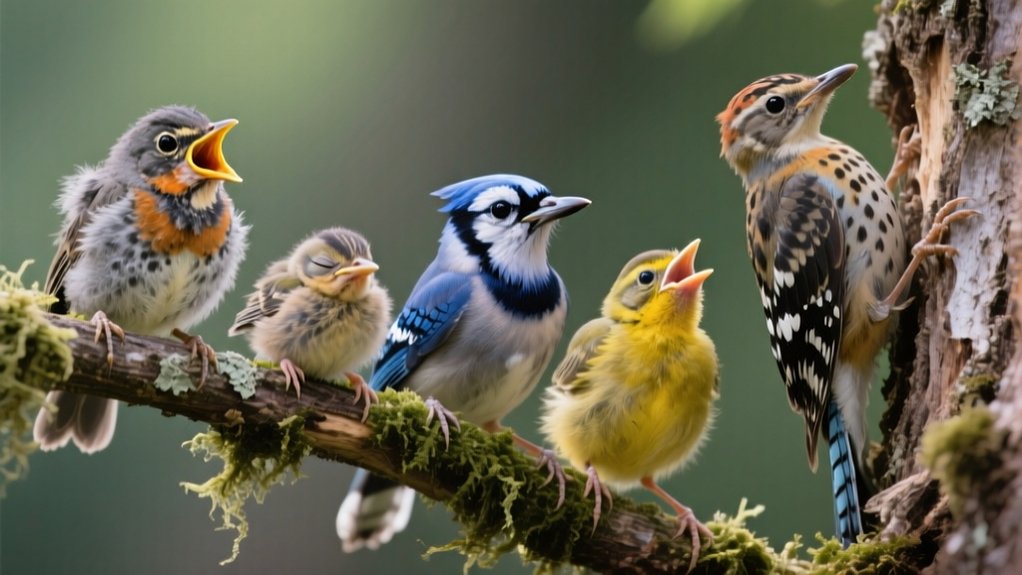
You’ll find baby birds start as hatchlings with closed eyes and minimal feathers, then grow into nestlings showing pin feathers and colorful gape flanges signaling hunger.
As fledglings, they sport juvenile plumage with shorter tail feathers and begin limited flight and self-feeding. Species like warblers or woodpeckers have unique features aiding identification.
Understanding these stages, physical traits, and behaviors helps you recognize various species and track their development. Exploring further reveals detailed distinctions among common North American baby birds.
Developmental Stages of Baby Birds
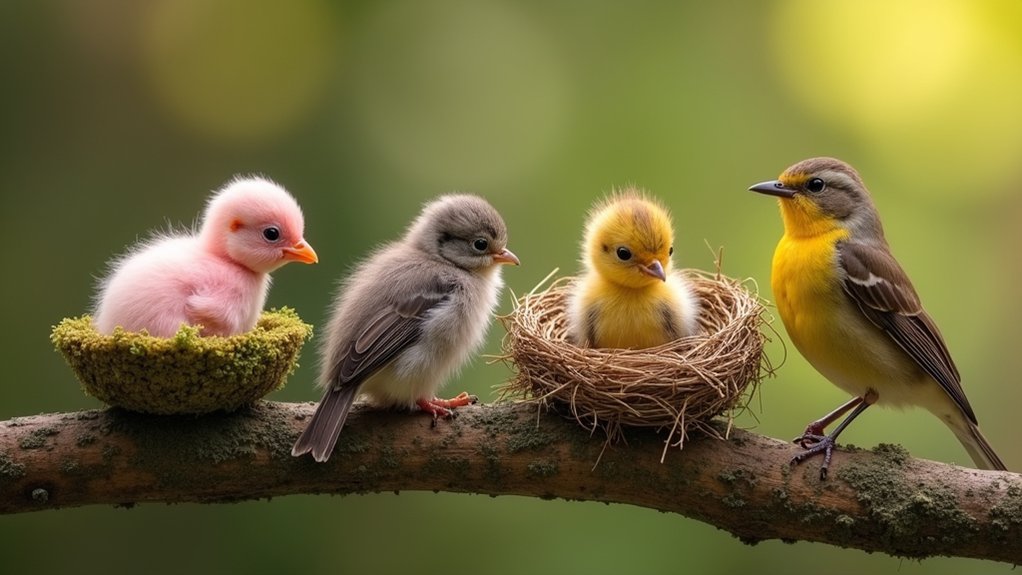
Although baby birds vary widely across species, their development typically follows distinct stages marked by rapid physiological and behavioral changes.
In the Hatchling Stage (0-3 days), you’ll notice their eyes closed or barely open, minimal feathering, and complete dependence on parents for warmth due to undeveloped temperature regulation.
By Early Nestling (4-9 days), rapid growth occurs; eyes fully open, primary feathers emerge, and temperature control begins. Nestlings experience two distinct growth stages, with rapid weight gain early on followed by slower growth.
Mid Nestling (10-13 days) brings complete feathering, more mobility, and grooming behaviors as fledging preparation intensifies.
Finally, the Fledgling Stage (14-22+ days) features awkward first flights and continued parental reliance.
Development varies by species, from precocial birds, mobile at hatching, to altricial species requiring full care.
These stages reflect intricate, species-specific growth timelines essential for survival.
Key Physical Characteristics of Baby Birds
You’ll notice that baby birds start out covered in soft down feathers. As they grow, these feathers gradually develop into juvenile plumage. This happens in distinct stages, including the appearance of pin feathers, which are tiny new feathers still wrapped in protective sheaths.
Their physical features are pretty interesting, too. For example, baby birds have gape flanges—the colorful edges of their open mouths—that help signal to their parents when they’re hungry. They also have shorter tail feathers compared to adults. Altricial chicks typically hatch naked and blind, relying entirely on their parents for food and warmth.
All these characteristics aren’t just random; they actually serve specific functions and help distinguish young birds from adults. Knowing these details can really help you tell how far along a baby bird is in its development and even identify what species it belongs to.
Feather Development Stages
When baby birds hatch, they start life almost entirely featherless, relying on their parents for warmth as their soft down begins to develop as the initial insulation.
During the early nestling stage (days 0-3), down thickens progressively, with pin feathers emerging through the skin by day 3. At this stage, the baby bird’s eyes are typically closed, and it is quite weak, requiring constant care from the parents.
By days 4-8, pin feathers break through, and primary flight feathers begin unsheathing, while ventral feather tracts first appear.
From days 7-10, primary feathers actively unsheath, though the belly often remains bare.
By days 9-15, juvenile plumage covers most apteria, and wing and tail feathers complete development, though downy feathers often persist on the head. At this point, many species have fledged or are preparing to leave the nest and begin the fledgling stage.
Distinct Juvenile Features
While juvenile birds may resemble adults at first glance, several distinct physical features clearly identify their immature status. You’ll notice gape flanges, soft, fleshy, often yellow or white tissue at the beak’s sides. These serve as visual cues to stimulate parental feeding.
Their tail feathers are shorter and stubby, indicating incomplete development which limits flight efficiency. Furthermore, fluffy down feathers protrude from their plumage, giving a ruffled appearance that differs from the sleek adult feathers.
Juvenile coloration tends to be duller with streaked or mottled patterns that aid camouflage, contrasting the vibrant adult plumage. This camouflage adaptation helps protect juveniles during their vulnerable stages. These features gradually shift through molting as they mature.
Recognizing these markers helps distinguish juveniles from adults during field observations and studies of avian development.
Identifying Plumage Patterns in Juvenile Birds
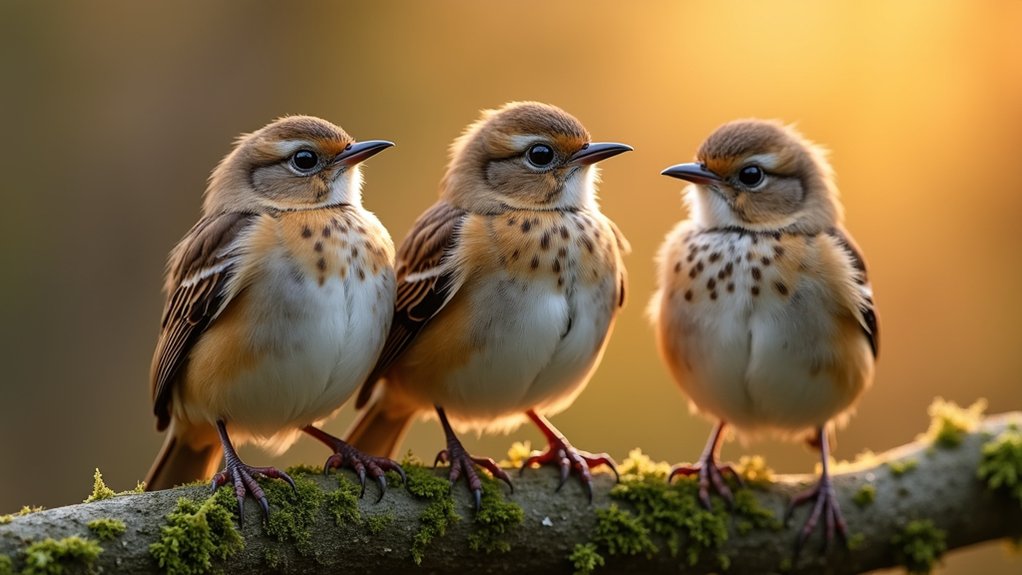
How can you accurately distinguish juvenile birds from adults based on their plumage?
Juvenile birds exhibit distinct plumage patterns that contrast with adult birds. Initially, their feathers are fine and fluffy with a bland appearance, lacking adult’s vivid colors. Over time, mottled, scaled, barred, spotted, or streaked patterns develop, primarily aiding camouflage.
Wing and tail feathers resemble adult structure but with broader, cleaner wing bars and grayish edges. Juvenile coloring often parallels adult females in dimorphic species, replacing bright adult markings with muted patterns.
Additional indicators include pale fringing on wing coverts and lighter beak or foot coloration.
- Mottled or barred plumage replaces bright adult colors for concealment
- Flight feathers show distinctive gray or brown edging
- Juvenile wing bars appear broader and less defined
- Pale fringes on upper-wing coverts help species identification
Behavioral Traits of Nestlings and Fledglings
You’ll notice that nestlings rely completely on instinctive begging behaviors to get their parents to feed them.
On the other hand, fledglings start practicing independent foraging, but they still receive some supplemental nutrition from their parents. During this stage, parental care continues after fledging and is vital as fledglings learn to recognize danger and adapt to their environment.
When it comes to flight development, it begins with limited wing and tail feather growth and gradually progresses to short, controlled flights as fledglings gain mobility. Good territories offer nest sites, food sources, and predator protection, which are crucial for fledglings as they develop these new skills. Good territories
Understanding these differences really highlights the important changes in feeding strategies and flight abilities during early bird development.
Feeding Behavior Differences
Because feeding behavior reflects a bird’s developmental stage, you’ll notice distinct differences between nestlings and fledglings.
Nestlings depend entirely on parental feeding, requiring nourishment every 30-60 minutes, signaling hunger by gaping and peeping. Parents carefully administer species-specific diets, ensuring proper positioning and pacing to prevent choking. Recognizing hunger cues in baby birds can help caregivers determine if intervention is needed, especially if excessive chirping indicates distress or abandonment. Understanding these growth stages is crucial for providing appropriate assistance and care requirements growth stages.
In contrast, fledglings start self-feeding while still receiving parental supplements, gradually reducing dependence within a week. Their hunger signals include cheeping and wing fluttering, showing excitement at feeding.
You’ll observe parents encouraging independence by sometimes ignoring fledglings’ frantic calls.
Nestlings require precise, frequent feedings with balanced formulas. Fledglings exhibit emerging self-feeding behaviors alongside parental care.
Hunger cues evolve from gaping to active fluttering and cheeping. Feeding intervals lengthen as fledglings develop autonomy.
Flight Development Stages
Feeding behavior changes mark the growing independence of young birds, but likewise significant are the physical and behavioral developments that prepare them for flight.
During the early nestling stage (days 4–9), rapid weight gain coincides with pin and primary flight feather emergence, alongside initial temperature regulation and leg use.
By days 9–10, juvenile plumage covers apteria, and wing feathers partly sheathed signal fledging readiness, though disturbance can provoke premature fledging.
Early fledglings exhibit limited flight, with feathers still developing and coordination imperfect, causing frequent crash landings. It is important to minimize handling to reduce stress and avoid disrupting parental care during this sensitive period.
As flight skills refine mid-fledgling, wings strengthen and aerial maneuverability improves, especially in cavity nesters.
Shifting to independence, fledglings practice insect catching and gradually reduce parental feeding, requiring up to four weeks of supervised skill improvement before mastering sustained flight.
Flight Capability During Early Bird Development
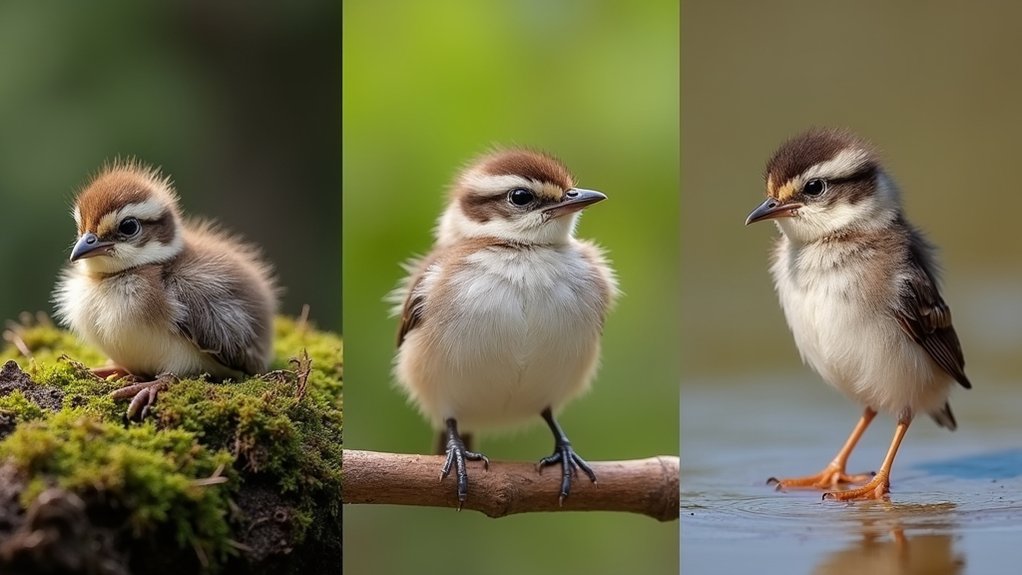
Although flight capability develops gradually, you can observe distinct stages in a young bird’s early life that mark its progress toward independent flight.
Initially, hatchlings lack feathers, muscle strength, and visual navigation, confining them to the nest.
By the nestling phase, pin feathers emerge, but these aren’t yet functional for flight.
As fledglings develop, they gain near-complete plumage and demonstrate limited wing movement such as hopping and fluttering. It is important to leave fledglings alone as their parents are likely nearby and continuing to care for them.
However, sustained flight remains beyond reach due to immature coordination and muscle strength.
Key developmental milestones include:
- Absence of wing muscle strength and visual capacity in hatchlings
- Emergence of pin and primary feathers during nestling stage
- Gradual foot grasp and leg strength development for mobility
- Early fledgling fluttering preceding full flight capability
Species Diversity: Common North American Baby Birds
Understanding the stages of flight development in young birds provides a foundation for recognizing the diversity of species you may encounter across North America. The continent hosts 231 passerine and 172 nonpasserine species, with many exhibiting altricial development. A systematic approach that includes anatomical and environmental characteristics is essential for accurate identification of baby birds. Knowing the terms for each stage, such as hatchling, nestling, and fledgling, is crucial when identifying young birds in the field and understanding their developmental needs.
Woodpeckers and kingfishers exemplify cavity-nesting species, each presenting unique identification challenges. Tracking morphological changes like plumage, bill shape, and gape coloration helps you distinguish species from nestling to fledgling stages.
| Family Group | Species Count | Key Identification Features |
|---|---|---|
| Passerines | 231 | Plumage, vocalization patterns |
| Woodpeckers | 9 | Bill shape, cavity nesting traits |
| Kingfishers | 1 | Bill color, gape flange |
| Ravens | Multiple | Morphological changes, vocalizations |
| Swallows | Multiple | Nestling coloration, growth stages |
Methods for Systematic Identification of Baby Birds
Accurate identification of baby birds relies on systematic methods that integrate developmental assessment, anatomical examination, and behavioral observation.
You’ll start by determining the developmental stage: hatchling, nestling, or fledgling. This helps narrow down the possible species based on morphology. Additionally, noting whether the bird is altricial or precocial can provide important clues about its species and care needs.
Next, examine anatomical features like gape flange coloration, beak shape, and feather tract patterns. These serve as critical taxonomic markers that give you clues about the bird’s identity.
Focus on gape flange color, beak shape, and feather patterns to uncover key identification markers.
Behavioral and environmental cues such as nest type, vocalizations, and geographic location further refine your identification. These details often help distinguish similar species.
Using comparison and elimination tools, including color-coded flow charts and species tables, helps you systematically exclude unlikely species. This structured approach makes identification more precise and manageable.
- Assess developmental stage to limit species range
- Analyze anatomical traits including mouth and feather patterns
- Observe environmental context and behavioral responses
- Use structured comparison tools for precise species elimination
Unique Features of Select Baby Warbler Species
Building on methods to systematically identify baby birds, focusing specifically on baby warbler species reveals unique features that aid in their recognition.
Juvenile warblers, such as the Yellow-rumped Warbler, typically exhibit brown and grayish plumages, differing considerably from adults’ brighter colors. These subdued tones help you distinguish young warblers during non-breeding seasons. However, detailed information on other juvenile warbler species remains limited, complicating precise identification.
You should note that juvenile warblers often lack the distinctive markings adults display, requiring careful observation of subtle traits like feather texture and patterning. Fall migration season is an exciting time for birdwatchers as it marks the arrival of many warbler species, providing opportunities to observe juveniles in diverse habitats fall migration.
To improve your identification accuracy, consulting specialized resources focused on juvenile morphology and developmental stages is essential. This approach guarantees a more scientific and accurate understanding of baby warbler characteristics despite current data gaps.
Frequently Asked Question
How Long Do Baby Birds Typically Stay in the Nest?
You’ll find that baby birds usually stay in the nest anywhere from 10 days to several months, depending on the species.
Small songbirds typically fledge within two weeks, while larger birds like raptors can take over a month.
Some species, like California condors, stay in nests for up to 180 days.
What Do Baby Birds Eat During Their First Week?
During their first week, baby birds primarily consume high-protein foods like finely chopped insects, including worms and mosquito larvae, to support rapid growth.
You’ll also feed them commercial hand-feeding formulas with balanced nutrients, maintaining a 70-75% liquid consistency for hatchlings.
You’ll feed them frequently, every 15-20 minutes initially, ensuring they receive calcium, vitamins, and minerals essential for skeletal and immune development.
Fresh water should be available in shallow dishes for hydration.
How Can You Safely Handle a Baby Bird if Found?
If you find a baby bird, don’t turn into a superhero. Handle it gently and precisely! Use your fingers to support its body firmly but softly, avoiding squeezing.
Check if it can grip your finger, which indicates fledgling status.
Always relocate it only a few feet to a safe spot near its original location so parents can still find it.
Never wash or feed it because improper care can cause harm.
Call professionals if it’s injured.
Do All Baby Birds Have the Same Types of Vocalizations?
No, not all baby birds have the same types of vocalizations. You’ll notice variation by species, with some fledglings producing loud, piercing cries while others emit shrill or thin calls.
Vocalizations often resemble adult sounds but differ in tone or complexity due to developmental stages and anatomical differences, like syringial muscle count.
When Do Baby Birds Start to Recognize Their Parents?
Imagine a newly hatched herring gull chick; within minutes, it starts imprinting on its parents. You’ll find that baby birds begin recognizing their parents immediately after hatching, during that critical imprinting window.
This early bond allows them to identify parents through vocal, visual, and behavioral cues.
Conclusion
By mastering the identification of baby birds, you’ll reveal a secret world where every downy feather and fledgling flutter unveils nature’s intricate blueprint. You won’t just see birds—you’ll decode evolutionary marvels in real time.
With precise observation of plumage, behavior, and flight stages, you become an essential participant in avian science. This turns ordinary encounters into extraordinary revelations that deepen our understanding of biodiversity and species survival like never before.