

If you spot a grey bird, you might be looking at species like the White-breasted Nuthatch with its blue-gray upperparts, or the Mourning Dove’s pale gray body and pointed tail. Eurasian Collared-Doves sport a black half-collar, while Dark-eyed Juncos show distinct gray hoods.
Tufted Titmice have tufted crests, and Blue-gray Gnatcatchers flaunt delicate blue-gray plumage. Western Scrub-Jays and Northern Shrikes stand out for behavior and habitat, offering fascinating identification clues you’ll find intriguing.
White-breasted Nuthatch
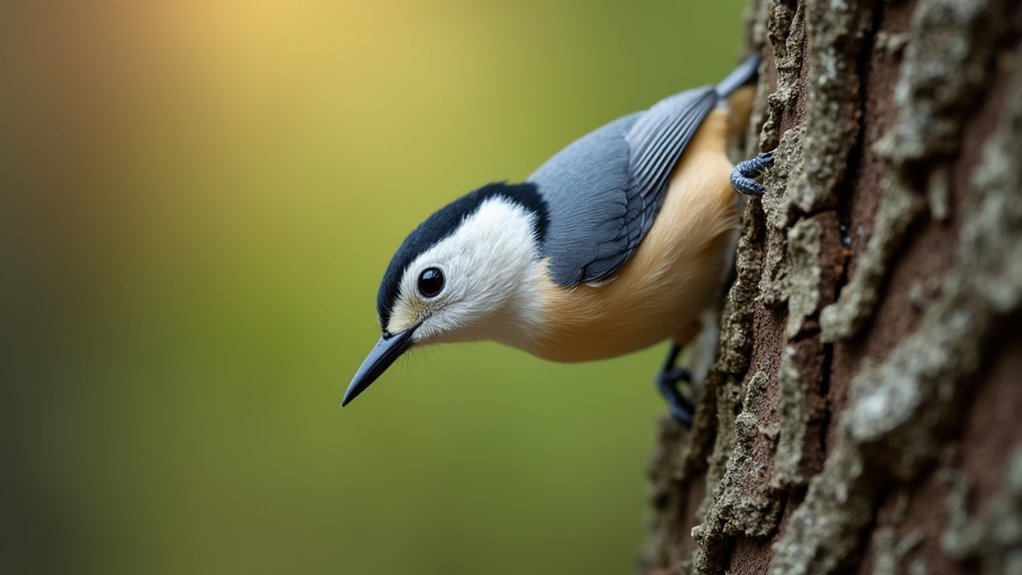
The White-breasted Nuthatch (*Sitta carolinensis*) is a small passerine bird notable for its stocky body, large head, and distinctive plumage featuring a white face and breast contrasted by blue-gray upperparts and a dark crown, which is black in males and often gray in females.
You’ll notice its length ranges from 13 to 15.5 cm, wingspan between 20 and 27 cm, and weight from 18 to 30 grams. These birds are commonly seen at quality bird feeders, where their agility and preference for sunflower seeds or suet make them frequent and delightful backyard visitors.
Its short tail and wings, coupled with a long, narrow bill and strong feet, support its unique foraging behavior. The bird’s black, gray, and white coloration, including an orange-brown wash on the lower belly, aids identification.
Belonging to the family Sittidae within Passeriformes, this species exhibits rounded wings and a square-tipped, rounded tail. They are often attracted to bird feeders for sunflower seeds or suet, making them a common visitor in backyard feeding stations.
Mourning Dove
While the White-breasted Nuthatch enchants with its agile foraging on tree trunks, you’ll find the Mourning Dove (*Zenaida macroura*) occupying more open and semi-open habitats. This bird features a light gray to brownish-gray plumage, pale pinkish-tan breast, and a long pointed tail with distinctive white edges.
You can spot it across much of North America, thriving in farms, grasslands, and suburban areas. Look for Mourning Doves on telephone wires and similar perches, where they often rest and observe their surroundings.
Key characteristics include:
- A fast, direct flight reaching speeds up to 55 mph, with wing whistles during takeoff.
- Ground foraging primarily on seeds, aided by a muscular crop for rapid feeding.
- Ability to drink brackish water, supporting survival in arid habitats.
- Loose feathers that detach to evade predators.
The Mourning Dove’s mournful coo adds a haunting soundtrack to its widespread presence.
Eurasian Collared-Dove
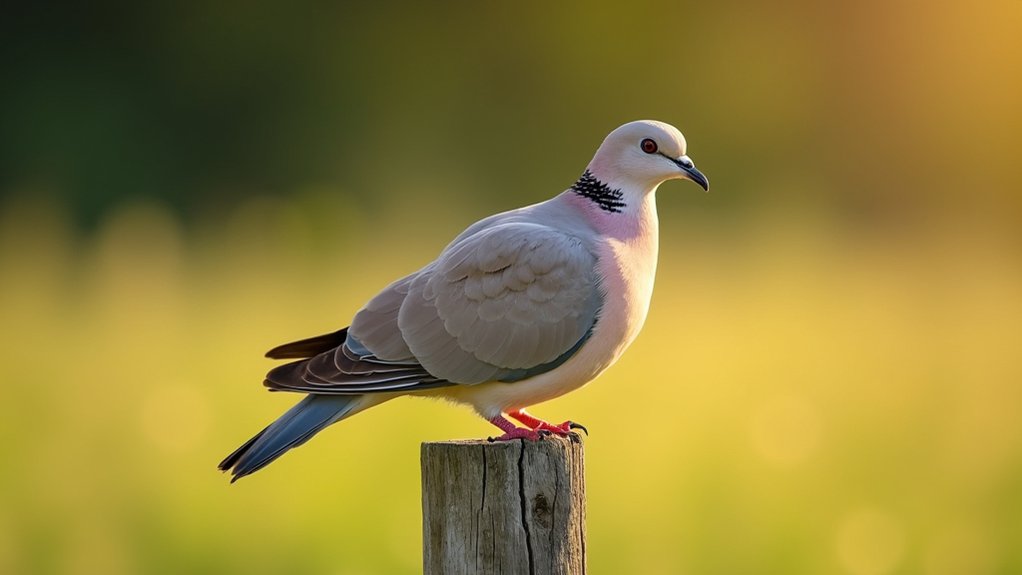
Although native to warm temperate and subtropical regions of Asia, Europe, and northern Africa, the Eurasian Collared-Dove (*Streptopelia decaocto*) has established a widespread presence across North America due to human-assisted introductions.
Native to Asia, Europe, and North Africa, the Eurasian Collared-Dove now thrives across North America.
You’ll identify this medium-sized dove by its grey-buff to pinkish-grey plumage, distinctive black half-collar edged in white on the nape, and long, broad tail with prominent white outer feathers.
Measuring about 32–33 cm in length with a wingspan of 48–56 cm, it exhibits a plump body, small head, and pinkish legs. The bird typically weighs between 4.5 to 8.4 ounces, reflecting its moderately light build and agile flight capabilities weight range.
This species thrives in suburban and agricultural landscapes, often perching on telephone poles or visiting bird feeders.
Significantly, it drinks water by suctioning “head down,” a rare adaptation. Its rhythmic three-part coo and ground displays like head-bobbing help you recognize its presence in loose flocks.
Dark-eyed Junco
You’ll recognize the Dark-eyed Junco by its medium size, gray hood, white belly, and those distinctive white outer tail feathers.
It’s pretty easy to spot once you know what to look for.
These birds breed across boreal and montane forests, stretching all the way from Alaska down to the Rockies. Subspecies interbreed extensively in areas where their ranges overlap.
When winter rolls around, they migrate southward, often heading to open woodlands and even urban areas.
When it comes to food, the Dark-eyed Junco mostly forages on seeds right on the ground.
But during the breeding season, they mix things up a bit by adding insects to their diet.
Pretty smart, right?
Appearance and Size
The Dark-eyed Junco exhibits a compact, slender body measuring between 5 and 6.5 inches in length. It has a rounded head and a relatively long tail that stands out during flight.
You’ll notice its dark gray head, neck, and breast, contrasting sharply with a striking white belly. Males appear darker and more conspicuous, while females and juveniles show muted brownish-gray tones and streaked breasts.
Key measurements include wingspan of 7.1 to 9.8 inches, tail length of 6.1 to 7.3 centimeters with distinctive white outer feathers, bill length of 0.9 to 1.3 centimeters that’s pale pinkish in color, and body mass ranging from 18 to 30 grams. Males are typically about 5% larger.
These traits make the Dark-eyed Junco easily identifiable among medium-sized sparrows. The average weight is 0.67 oz (19 g) with an average wingspan of 9.25 inches (23.5 cm), reflecting its small and slender body.
Habitat and Range
Understanding where the Dark-eyed Junco lives complements what you know about its physical traits. During breeding, this species occupies coniferous or mixed forests spanning from Alaska and central Yukon east to Newfoundland, with southern limits in California, Arizona, Texas, Minnesota, Michigan, and New England. It favors open forest edges, clearings, and brushy ground cover, nesting near the ground in banks or fallen logs. Elevation-wise, it ranges from sea level to timberline, including alpine zones. The species is mostly migratory, although some southwestern mountain populations are permanent residents.
In winter, its habitat broadens to include weedy fields, open woodlands, and urban areas across southern Canada, the U.S., and into Mexico. Migration varies: some populations remain permanent residents, while others shift southward or downslope by up to 2,100 meters, seeking shrub or tree cover alongside open foraging grounds.
Behavior and Diet
Although the Dark-eyed Junco displays varied foraging behaviors, it primarily feeds by hopping on the ground and pecking through leaf litter or snow to locate seeds and insects.
You’ll observe it using four main methods:
- Hopping with frequent pecking and scratching to uncover seeds and insects.
- Flitting through low underbrush to glean food from twigs and grass stems.
- “Riding” grass seed heads down to feed on fallen seeds.
- Occasional aerial sallies to capture insects mid-air or from tree trunks.
Its diet is omnivorous, dominated by seeds outside breeding season but shifting to a protein-rich insect diet during breeding. At bird feeders, providing shell-free seed blends can help reduce mess and waste while appealing to the junco’s natural feeding habits. It prefers millet over sunflower seeds at feeders, reflecting its natural seed preferences.
Nestlings rely heavily on insects, while adults prefer seeds and plant material overall.
This behavioral flexibility enables survival across seasons and habitats.
Tufted Titmouse
Tufted Titmice (*Baeolophus bicolor*) belong to the Paridae family and measure approximately 14 to 16 centimeters in length, with a wingspan ranging from 20 to 26 centimeters.
You’ll recognize them by their gray upperparts, white underparts, rust-colored flanks, black forehead patch, and distinctive gray tufted crest. Their large black eyes and white eye ring create a bright-eyed appearance.
Native to eastern North America, they’ve expanded northward into southern Canada. Usually non-migratory, they inhabit deciduous and mixed woodlands, parks, and suburban areas.
You’ll often see them forage acrobatically for seeds, insects, and caterpillars, frequently visiting feeders. They nest in tree cavities or nest boxes, lining nests with soft materials.
Pairs typically stay together year-round, and juveniles may assist in raising subsequent broods. Their distinctive calls are often described as “peter-peter-peter”.
Gray Catbird
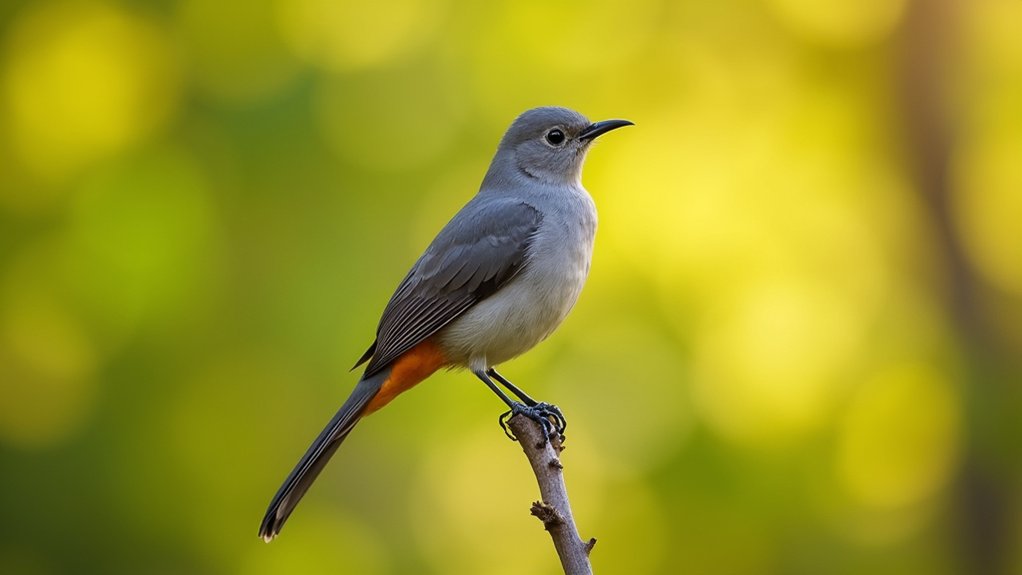
While the Tufted Titmouse thrives in woodlands and suburban areas, the Gray Catbird occupies a different ecological niche characterized by dense thickets and shrublands across much of temperate North America.
You’ll recognize this medium-sized songbird by its uniform slate-gray plumage, black cap, and distinctive chestnut undertail coverts. Eastern populations are generally darker than western populations, adding some regional variation to their appearance.
Here are key points about the Gray Catbird:
- It forages near ground level, favoring leaf litter and dense shrubs, feeding primarily on insects in warm months and berries in colder seasons.
- The species exhibits strong territoriality, with breeding pairs defending nesting sites in thick vegetation.
- Its vocalizations include varied mimicry and catlike mewing calls, used for communication and territory defense.
- Nesting involves low, bulky cup nests with 3–5 pale blue eggs, typically producing two broods annually.
This bird’s adaptation to dense cover contrasts with other grey species you might know.
Northern Mockingbird
You’ll recognize the Northern Mockingbird by its distinctive gray to brown upperparts and paler whitish underparts.
Plus, it has two white wingbars that you can see when it’s flying. Interestingly, some owl species such as the Barred Owl use mottled brown and white coloration for camouflage, which helps them blend into their forest habitats.
One of the coolest things about this bird is its amazing vocal mimicry. It can reproduce dozens of different song types and often sings all day and night during the breeding season. The Northern Mockingbird is also known for its light green-yellow iris, which adds to its distinctive appearance.
On top of that, you might notice some pretty aggressive territorial behavior. They actively defend against predators and will even harass human intruders who keep coming near their nests.
Distinctive Gray Plumage
Although the Northern Mockingbird’s plumage appears simple at first glance, its distinctive gray coloration reveals subtle complexity upon closer inspection.
You’ll notice how the upperparts range from gray to gray-brown, contrasting with a paler, whitish underside, creating a clean two-tone effect.
Four key plumage features help you identify this species accurately:
- Two prominent white wingbars and large white wing patches stand out against the gray wings, especially in flight.
- The long tail displays dark gray to blackish central feathers with white outer tail feathers, enhancing visual contrast.
- Facial markings include a subtle dark eye line and a thin white eye ring within pale gray cheeks.
- Juveniles show streaking on gray plumage and duller white wing elements, differing slightly from adults.
This precise gray-and-white patterning aids field recognition. The Northern Mockingbird is known for its exceptional mimicry of other birds’ songs and calls, which complements its bold and energetic behavior.
Vocal Mimicry Skills
The Northern Mockingbird’s distinctive gray-and-white plumage catches your eye, but its vocal abilities reveal an even more remarkable complexity.
You’ll find individual males boasting repertoires of 90 to 150 distinct song types, with some documented at 203. They imitate over 20, sometimes up to 200, bird species and numerous non-avian sounds like car alarms and whistles.
About half their song phrases are mimetic, integrating calls from frogs and mechanical noises. This vocal learner acquires new phrases throughout life, favoring sounds within its frequency range via a complex syrinx with seven muscle pairs, enabling rapid shifts between phrases. Their ability to mimic a wide array of sounds, including those of non-avian origin, showcases their vocal versatility.
Mimicry plays a critical role in mate attraction, with females preferring males with larger repertoires, signaling age, fitness, and territory quality.
Territorial Behavior Patterns
When defending their territories, Northern Mockingbirds establish ranges that can span several acres, strategically encompassing key resources such as nesting shrubs, insect-rich lawns, berry bushes, and reliable water sources like birdbaths. Late fall marks a transition period for mockingbirds, during which they often experience seasonal territorial shifts.
You’ll notice they combine open foraging grounds with dense cover for nests, maintaining territory year-round with peak aggression during breeding. They aggressively chase intruders, including crows, hawks, and humans, using aerial assaults and vocal warnings.
Territory size shrinks in winter, concentrating conflicts around scarce resources. Increased overlap in territories occurs around shared resources like birdbaths, especially in colder months. Displays like wing-flashing and aerial flights serve to assert dominance visually. Loud, repeated calls mark boundaries and escalate with threat proximity.
Understanding these patterns reveals their sophisticated, persistent defense strategy essential for survival and reproductive success.
Rock Pigeon
Rock pigeons, scientifically known as *Columba livia*, belong to the Columbidae family alongside doves and other pigeons.
You’ll recognize wild forms by their pale gray body, darker head, white rump, and two black wing bars, with glossy iridescence on the neck displaying green and purple hues. Like many perching birds, pigeons have a specialized foot structure that allows them to grip ledges and wires securely in urban habitats.
These birds measure about 32–37 cm in length and weigh around 9 oz. Originally native to Southern Europe, North Africa, and Western Asia, rock pigeons now thrive globally in urban environments. They have a population estimated at 140 million and are classified by the IUCN as Least Concern.
They forage primarily on seeds and grains, often scavenging human food waste.
Rock pigeons nest on ledges, producing 2 white eggs per clutch, with both parents incubating for 16–19 days.
Their capacity for multiple broods annually and adaptation to human habitats explain their vast populations worldwide.
Canada Jay
Canada jays, scientifically named *Perisoreus canadensis*, display a distinctive plumage pattern with pale grey underparts, darker grey upperparts, and a grey-white head accented by a darker grey nape that varies regionally.
Canada jays feature pale grey underparts and a striking grey-white head with a regionally darker nape.
You’ll notice juveniles start with dark charcoal gray feathers, lightening as they mature. Interestingly, just like cardinals, Canada jays play a key ecological role in their habitats by contributing to seed dispersal and maintaining healthy forest ecosystems.
These birds inhabit boreal and subalpine coniferous forests across North America, from Alaska to New Mexico. They often nest and raise young in late winter and early spring.
Key attributes include:
- Size ranging 25–33 cm in length, wingspan about 45 cm, and weight between 58–84 g.
- Monogamous pairs maintaining year-round territories, often with one juvenile offspring.
- Adaptations like a short bill and feather-covered nostrils aid survival in freezing climates.
- Food caching behavior with excellent spatial memory guarantees sustenance through harsh winters.
You’ll find them curious, often approaching humans and boldly foraging in campgrounds.
Clark’s Nutcracker
You’ll recognize Clark’s Nutcracker by its pale gray feathers that really stand out against its bold black wings, which have striking white patches. It has a long, pointed bill that’s perfect for getting at pine seeds. The bird itself is about 27 to 33 centimeters long.
Clark’s Nutcracker lives in high-elevation coniferous forests all across western North America. It mainly depends on pine trees like whitebark and pinyon pines for food and for building its nests. You can often hear their long, grating calls, which are a good indicator of their presence.
What’s really interesting is how important it’s to the forest ecosystem. This bird caches tens of thousands of pine seeds every year, which helps new trees grow and keeps the forest healthy and thriving.
Physical Characteristics
Although the Clark’s Nutcracker may resemble a jay in size, its chunky, compact body more closely mirrors that of a crow, measuring about 11 inches (27–30 cm) long with a wingspan near 24 inches (61 cm).
You’ll notice its powder-gray plumage envelops the head, back, and belly, contrasting sharply with glossy black wings and white-tipped secondary feathers.
Its bill is long, straight, and sharp-tipped, perfectly engineered to extract seeds from pinecones.
Here are key physical traits you should know:
- Weight ranges from 3.7 to 5.7 ounces (100-160 grams), with males larger than females.
- Rounded, crestless head with dark brown eyes.
- Black feet and legs with curved nails and four toes adapted for gripping.
- Tail feathers combine central black with white-bordered sides, visible in flight.
Clark’s Nutcrackers favor sub-alpine zones near the tree line during summer, inhabiting steep slopes and ridges with mixed stands of pine, fir, and spruce.
Habitat and Range
When exploring the range of the Clark’s Nutcracker, you’ll find it primarily inhabits mountainous regions across western North America, stretching from central British Columbia and western Alberta down through the Rockies, Cascades, and Sierra Nevada to Arizona and New Mexico.
You’ll notice it occupies elevations generally between 1,350 and 3,650 meters, favoring subalpine conifer forests dominated by whitebark and limber pines.
During winter, it migrates downslope to lower-elevation conifer forests, including ponderosa pine and pinyon juniper woodlands.
Its habitat typically consists of open to semi-open forest stands interspersed with meadows and rocky outcrops, often near key pine species that produce large seeds. The Clark’s Nutcracker has a close association with Whitebark Pine, which is vital to its survival.
Although largely a permanent resident, it may irrupt to unusual elevations or areas in years of poor cone production.
Ecological Importance
The Clark’s Nutcracker plays a keystone role in sustaining high-elevation conifer ecosystems by serving as the primary seed disperser for several pine species, including whitebark, limber, and pinyon pines.
Its caching behavior, involving tens of thousands of seeds each year, facilitates forest regeneration and expansion, especially after disturbances like fire or disease. The bird’s habit of relocating cached seeds miles apart enhances the spread and diversity of pine forests.
You can appreciate its ecological significance through these key functions:
- Disperses up to ~100,000 seeds annually, often far from parent trees, ensuring genetic diversity and forest patchiness.
- Enables whitebark pine regeneration by leaving unrecovered caches that grow into new seedlings.
- Supports food webs by providing high-energy seeds to over 20 vertebrate species, including grizzly bears.
- Stabilizes soils and moderates hydrology by promoting pine establishment on ridges and slopes.
This mutualism shapes conifer ecosystems’ resilience and structure across landscapes.
Loggerhead Shrike
Loggerhead Shrikes measure about 8 to 10 inches in length and display a distinctive gray and white plumage with bold black wings and tail markings. You’ll notice their broad black facial mask and a short, hooked bill with a tomial tooth, perfect for tearing prey.
These birds hunt from raised perches in semi-open habitats, often impaling prey on thorns or wire, which is a unique “butcherbird” behavior. They feed mainly on insects but also small vertebrates. Their diet includes large insects, small birds, and rodents, showcasing their role as a predatory songbird.
Loggerhead Shrikes breed in dense shrubs, building sturdy nests for 4–6 eggs.
| Trait | Emotion Evoked | Fact |
|---|---|---|
| Facial mask | Intrigue | Distinctive black mask across eyes |
| Hunting method | Fascination | Impales prey for later consumption |
| Habitat | Appreciation | Prefers open landscapes with perches |
| Vocal ability | Curiosity | Songbird with raptor-like habits |
Blue-gray Gnatcatcher
You’ll recognize the Blue-gray Gnatcatcher by its delicate size, measuring just 10 to 13 centimeters in length with a wingspan around 16 centimeters. Its striking blue-gray plumage above contrasts nicely with white underparts.
This active insectivore forages by hopping and sidling through foliage, flicking its long black tail edged with white to flush prey. Native to North America, it breeds in deciduous forests and riparian woodlands from southern Ontario to Mexico. It migrates south for winter. The species is known for its soft but insistent calls and constant motion. Young Blue-gray Gnatcatchers, like many other songbirds, do not typically return to the nest after fledging, as the nest serves as a temporary shelter for their growth and development.
Both sexes build small, camouflaged nests using spiderwebs and lichens, often reusing materials. Clutch size ranges from 4 to 5 eggs with an incubation period of 10 to 15 days.
Its vocalizations include soft buzzy calls and thin songs. Northern populations migrate longer distances than southern ones.
Gray Kingbird
Gray Kingbirds (*Tyrannus dominicensis*) belong to the tyrant flycatcher family and measure approximately 23 to 24 centimeters in length with a wingspan near 35 centimeters.
You’ll recognize them by their gray upperparts, brownish wings and tail, white underparts with a light gray chest, and a dusky eye mask. They have a heavy dark bill and a hidden yellow crown stripe.
These birds breed from southeastern USA, mainly Florida, through the West Indies to northern South America. You’ll find them in coastal areas, mangroves, and urban settings. Nesting habitat affected by development has led Gray Kingbirds to adapt well to urban and suburban areas.
They aggressively defend territory, often mobbing larger birds. Their diet mainly includes flying insects, supplemented by fruits and occasional small vertebrates.
They forage by sallying from high perches, catching prey midair with strong, direct flight.
Western Scrub-Jay
Although once considered a single species, the Western Scrub-Jay was split in 2016 into distinct California and Woodhouse’s scrub-jays, reflecting differences in range and behavior.
You’ll find these medium-sized jays (27–31 cm) with a blue head, wings, tail, grayish underparts, and a white “eyebrow” mainly in western North America. They are frequently found in oak woodlands, suburbs, parks, and roadsides at low elevations.
They inhabit scrub, oak woodlands, and suburban areas. Their omnivorous diet shifts seasonally, emphasizing insects during breeding and seeds later.
Key traits include:
- Non-migratory with sporadic seasonal movements.
- Highly social, foraging in pairs or groups.
- Advanced memory for caching acorns and pine nuts.
- Distinctive harsh, metallic vocalizations.
Understanding these features helps you identify and appreciate the Western Scrub-Jay’s ecological role and behavior.
Northern Shrike
When observing a Northern Shrike, you’ll notice its pale gray upperparts contrasted with white underparts and subtle barring on the lower body. This fairly large songbird, measuring 23-24 cm in length with a wingspan of 30-35 cm, features a bold black mask ending at its stout, hooked bill. This bill is typical of predatory birds.
You’ll find it breeding across the taiga and tundra from Labrador to Siberia, nesting in exposed deciduous shrubs before leaf-out. Its diet shifts seasonally: insects dominate in summer, while birds and rodents prevail in winter. The Northern Shrike is closely related to the Iberian grey shrike and steppe grey shrike, sharing similar predatory behaviors.
Watch as it perches silently, then swoops with precision to capture prey, often impaling carcasses on thorns. This behavior has earned it the nickname “butcher bird.”
This shrike caches food near nests, showcasing its role as a skilled provider.
Frequently Asked Question
How Can Gray Birds Benefit Local Ecosystems?
Gray birds benefit local ecosystems by dispersing seeds, which promotes plant regeneration and genetic diversity. They control insect populations naturally, reducing pest damage without chemicals.
By creating and using dense habitats, they improve biodiversity and vegetation complexity. Their presence indicates ecosystem health, helping you monitor environmental changes.
Furthermore, they support nutrient cycling and facilitate wildlife movement across fragmented landscapes. This ultimately strengthens ecosystem resilience and enhances habitat quality in urban and natural areas.
What Are the Migration Patterns of Gray Birds?
You’ll find that gray birds like the Gray Catbird migrate primarily at night, traveling about 113 km daily.
Western populations cross the Rockies via the Central Flyway, stopping in regions like Montana and Oklahoma, while eastern birds head through the southeastern U.S. to the Gulf Coast and Caribbean.
Migration spans April–May northbound and August–October southbound.
Some mid-Atlantic birds stay year-round, reducing their migratory distance considerably.
How Do Gray Birds Adapt to Urban Environments?
You might think gray birds struggle in cities, but they adapt remarkably well.
They use buildings and urban green spaces for nesting and foraging, showing tolerance to human disturbance.
You’ll notice they shift diets to generalist feeding, exploiting human food waste and urban insects.
Behaviorally, they reduce fear of humans, alter vocalizations to cut through noise, and cleverly use novel materials for nests.
These adaptations highlight their impressive urban resilience.
What Are the Breeding Habits of Gray Bird Species?
You’ll find that many gray bird species breed from spring through early summer, often raising two broods per season.
They build nests in dense shrubs or low trees, using twigs, grass, and occasionally human materials.
Females usually incubate eggs for about two weeks, while both parents feed the hatchlings.
The young remain dependent for several weeks post-fledging before becoming independent and capable of breeding themselves the following year.
How Can I Attract Gray Birds to My Backyard?
To lure gray birds to your backyard, plant native shrubs and trees that offer natural seeds and insects like a banquet set in a forest’s hold.
Install platform and ground feeders stocked with hulled sunflower and nyjer seeds.
Provide fresh water in shallow basins and shelter via dense evergreens or brush piles.
Maintain year-round habitat by avoiding pesticides, leaving seed heads intact, and minimizing disturbances during breeding seasons to support their natural behaviors.
Conclusion
So, next time you spot a grey bird, don’t just shrug and call it “that dull thing.” Each species, from the White-breasted Nuthatch to the Northern Shrike, sports its own evolutionary flair. It proves that grey isn’t just a boring shade but a masterclass in survival strategy.
You’ve now got the ornithological cheat sheet to impress friends or confuse birdwatchers. Who knew fifty shades of grey could be so scientifically fascinating?