
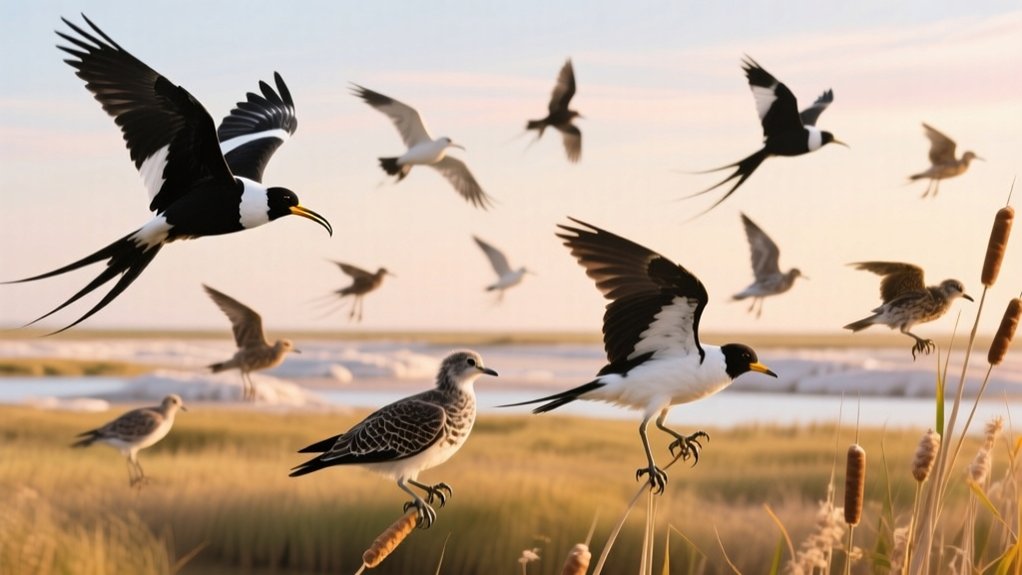
You’ll spot kite birds by their forked tails and graceful flight. The Red Kite shows reddish-brown plumage, while the Black Kite is a dark, adaptable scavenger.
The White-tailed and Black-winged Kites hunt rodents, using hovering techniques. Swallow-tailed and Mississippi Kites chase aerial insects.
Unique species like the Hook-billed Kite use specialized hunting strategies. Understanding these diverse kites across varying habitats reveals fascinating adaptations, and exploring each species’ traits uncovers even more intriguing details.
Red Kite
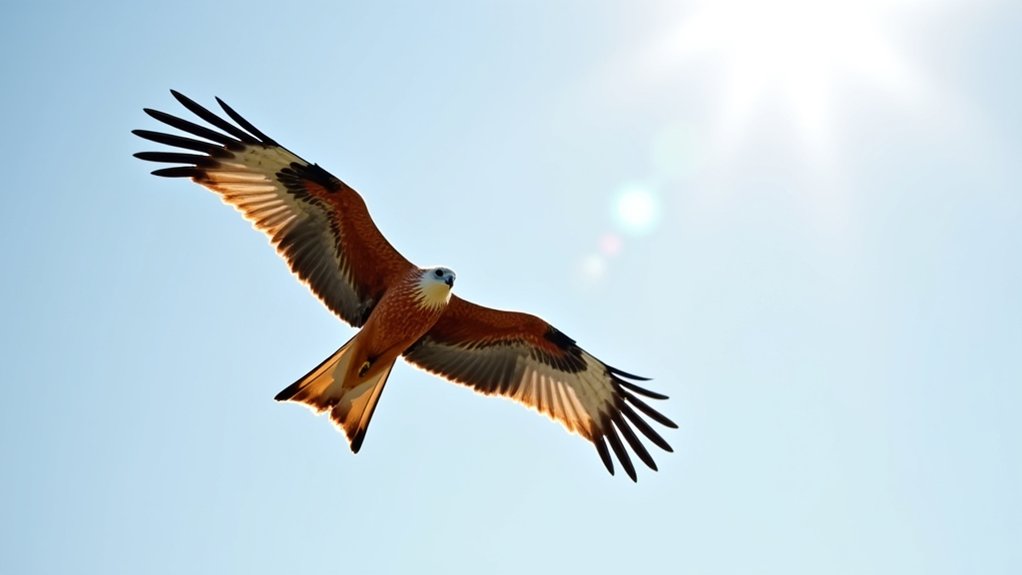
The Red Kite (*Milvus milvus*) is a medium-large raptor recognizable by its reddish-brown body, deeply forked tail, and long wings with distinctive white patches underneath. Measuring 58–66 cm in length, with a wingspan of 175–195 cm and weighing between 0.8 and 1.3 kg, this bird exhibits sexual dimorphism; females tend to be larger. Its pale grey, streaked head contrasts with bright yellow legs and feet. Native to the western Palearctic, it breeds mainly across Europe, favoring habitats such as broadleaf woodlands, farmland, and wetlands up to 1,600 m elevation. The Red Kite is protected under UK law and listed as Near Threatened globally due to population declines. Its distinctive flight features buoyant soaring and agile tail steering, which facilitates efficient scavenging and opportunistic predation. They are primarily scavengers feeding on carrion and road kill but also hunt small live prey.
Black Kite
While the Red Kite enchants with its reddish plumage and graceful flight, the Black Kite offers a contrasting presence marked by its dark brown feathers and remarkable adaptability.
You’ll notice its distinctive forked tail and light brown to rust-colored markings on the head and neck. It often soars above bush fires to catch small animals fleeing the flames, showcasing its opportunistic hunting behavior (aerial scavenger).
This medium-sized raptor thrives across Europe, Asia, Africa, and Australia, inhabiting diverse environments from wetlands to urban areas.
As an opportunistic hunter and scavenger, it plays a crucial ecological role by consuming live prey and carrion.
- Weighs about 560 grams; wingspan ranges 140–150 cm
- Migratory in temperate zones; resident in tropical regions
- Breeds March–August; nests in trees or cliffs 2–30 m high
- Adapts well to human environments; population stable globally
Black-winged Kite
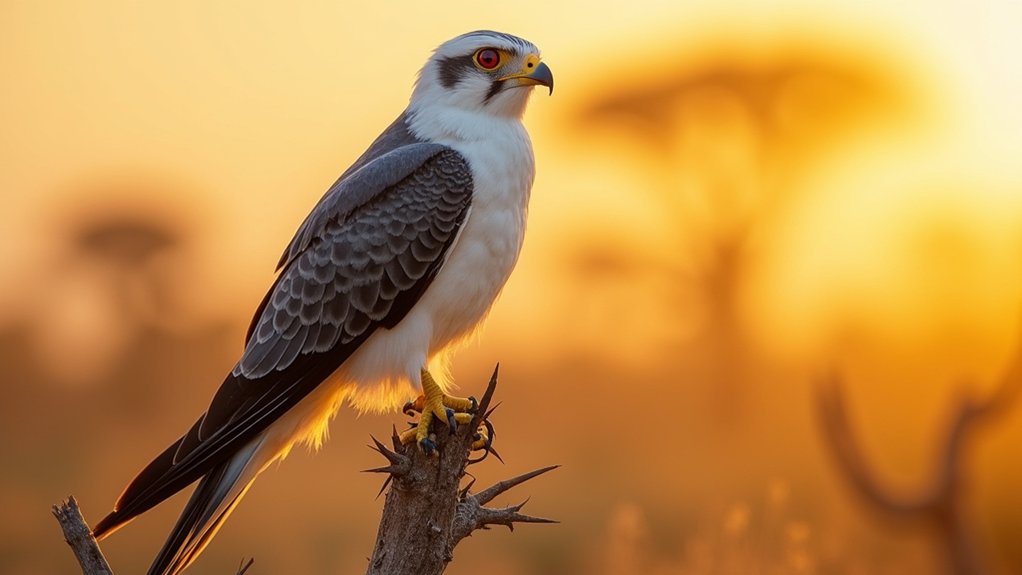
You’ll recognize the Black-winged Kite by its striking white and pale grey plumage. It’s got these cool black patches on its shoulders and wingtips that really stand out. Plus, those red eyes and a dark stripe across its face make it pretty distinctive.
What’s really interesting is how it hunts. It hovers in place, flapping its wings super fast, before swooping down to catch its prey. Mostly, it goes after small mammals like rodents, especially out in open areas.
You can find these birds all over the place—from sub-Saharan Africa to tropical Asia, and even parts of southwestern Europe. They seem to really like semi-deserts, savannas, and places where people farm.
Physical Characteristics
Measuring between 30 and 35 centimeters in body length with a wingspan of 70 to 85 centimeters, the Black-winged Kite exhibits sexual dimorphism in wing size and weight.
Males possess wings measuring 250 to 290 millimeters and weigh 205 to 285 grams, while females have slightly larger wings spanning 260 to 300 millimeters and weigh between 220 and 340 grams.
You’ll notice its mainly grey or white plumage with distinct black shoulder patches and wingtips. The bird’s large, red-irised eyes sit beneath a bony shelf, enhancing binocular vision.
Its long, falcon-like wings extend beyond a short, square tail, enabling efficient gliding and hovering. Females are larger than males in both size and weight.
Black eye stripe crosses the face, adding to its owl-like appearance. Velvety plumage texture resembles that of owls.
Zygodactyl feet and claw structure adapted for prey capture. Wings held in an upright V-shape during hovering.
Hunting Techniques
Because the Black-winged Kite relies heavily on aerial hunting, it primarily employs a hovering technique to locate prey. You’ll see it hover 10–12 m above ground, head into the wind, scanning systematically. After short hovers, it glides swiftly to new vantage points, spending about 82% of its search time in flight. It also uses its visual acuity to spot prey from a distance.
Alternatively, it perches on dead trees, scanning the ground for up to an hour, using a distinctive foot grip and tail flicks. When prey is spotted, it drops silently feet-first, seizing prey with sharp talons.
| Hunting Mode | Key Features |
|---|---|
| Hovering | Vertical body, wind-facing head |
| Aerial Search Time | 82% total search time |
| Perch Hunting | One foot above other, tail flicks |
| Attack Approach | Silent descent, sharp talon strike |
| Prey Types | Rodents, lizards, insects |
Geographic Distribution
While the Black-winged Kite primarily inhabits sub-Saharan Africa and tropical Asia, its geographic range extends into parts of southwest Europe, including Spain and Portugal. You’ll find it from the Nile Valley and North African coast through the Indian subcontinent to southern China and Southeast Asia, reaching islands like the Greater Sunda and New Guinea.
This species favors open habitats such as grasslands, savannas, and agricultural areas, avoiding dense forests and high mountains. It mostly stays resident or nomadic but can show seasonal movements linked to prey availability. The species is known for its distinctive large forward-facing eyes, which aid its hunting efficiency in these open environments.
Three main subspecies occupy distinct regions: caeruleus, vociferus, and hypoleucus. It has been recorded at elevations up to 3,650 m in India’s Sikkim region.
Breeding populations have expanded in southwestern Europe since the 1860s. Vagrants occasionally appear as far north as Switzerland and England.
White-tailed Kite
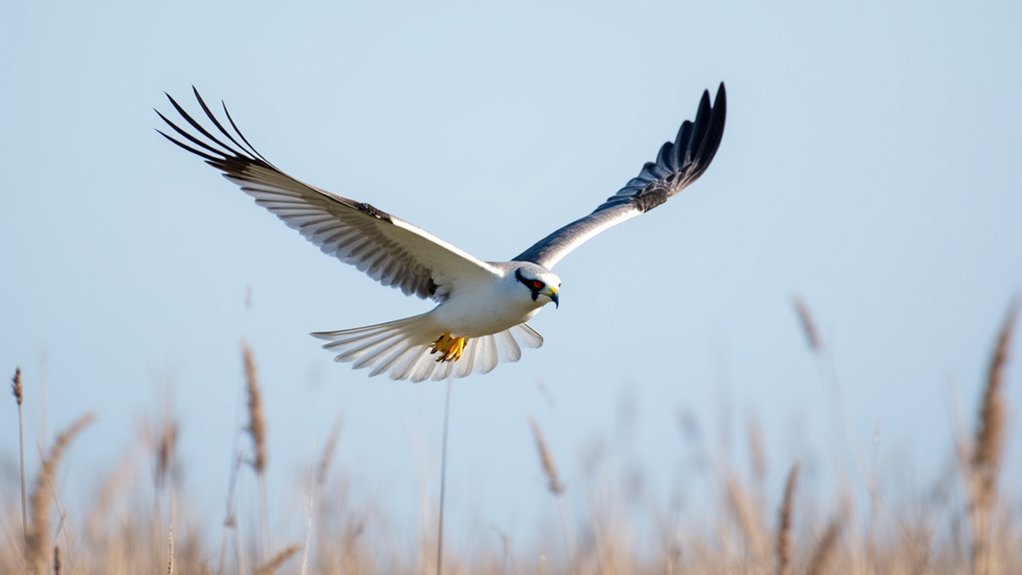
You’ll recognize the White-tailed Kite by its pale gray upperparts, bold black shoulders, and distinctive white tail with a narrow gray line. It’s pretty striking to see!
This raptor tends to hang out in low-elevation open areas like grasslands and agricultural fields, mostly across western North America and parts of Central and South America. They prefer habitats such as wetlands with grasses.
One of the coolest things about the White-tailed Kite is how it hunts. You might catch it hovering in the air, scanning the open ground below.
It mainly goes after small rodents, especially voles, and then swoops down to catch them. Watching this behavior really gives you a glimpse into how perfectly adapted this bird is to its environment.
Identification Features
The white-tailed kite stands out due to its mid-sized, slender build measuring 35–43 cm in length with a wingspan of 88–102 cm.
It has long, narrow wings and a small head that create a streamlined profile in flight and at rest.
You’ll notice its mainly white underparts and head, contrasted sharply by black “shoulders” on the upperwing coverts and black wingtips.
Its long, gleaming white tail and orange to deep red eyes further aid identification.
In flight, the kite displays a falcon-like silhouette with a shallow V-wing posture and buoyant glide.
- Slim body with small head and 3.6 cm tarsus for prey grasping
- Bold black shoulder patches and dark carpal spots on pale gray upperwings
- Juveniles show cinnamon wash and mottled brown scaling
- Characteristic hovering behavior with angled body and dangling legs, often seen in grasslands and open fields where it hunts for prey
Habitat and Range
Although the white-tailed kite‘s range extends broadly from western North America through Central America to parts of South America, its distribution within the United States is particularly patchy. You’ll find strongholds along the Pacific and Gulf Coasts, with isolated pockets in southern Florida and coastal Texas.
This species favors open habitats, like grasslands, savannas, pastures, and agricultural fields. They need scattered trees for essential perches and nesting sites. They prefer low elevations, generally below 200 meters, and occupy coastal and valley lowlands, especially in California’s Central Valley and Texas’s coastal plain. The white-tailed kite’s population has increased significantly in recent decades, reflecting its adaptability to diverse environments.
The white-tailed kite thrives in both arid and humid regions and often lives near human-modified landscapes. Year-round residents occur in western Washington, Oregon, California, southern Texas, and Florida.
Interior and northern records are mostly accidental or vagrant.
Feeding Behavior
When you observe a white-tailed kite hunting, you’ll notice its diet relies heavily on small rodents like voles and house mice. These make up most of its prey biomass. This raptor specializes in slow, hovering flight known as “kiting” to detect prey on the ground.
Its feeding behavior focuses on diurnal small mammals in open habitats. This distinguishes it from raptors that hunt nocturnally or catch insects midair. During breeding, males supply nearly all food, ensuring females can incubate and brood offspring efficiently. Sightings of white-tailed kites in Rocklin, CA, are rare and seasonal, mostly occurring from late October to November.
Key aspects of feeding behavior include:
- Dominance of small rodents in diet, supplemented by rabbits and occasional reptiles
- Use of stationary hovering at heights up to 80 feet to pinpoint prey
- Steep, talon-first plunges to capture prey after detection
- Communal roosting outside breeding season to exploit prey-rich sites efficiently
Swallow-tailed Kite
Swallow-tailed Kites (*Elanoides forficatus*) enthrall with their distinctive black-and-white plumage and remarkably agile flight. They glide and soar with minimal wingbeats, steering with their deeply forked tails.
Swallow-tailed Kites captivate with striking black-and-white feathers and graceful, effortless flight maneuvers.
You’ll recognize them by their 50–61 cm length, 1.3 m wingspan, and contrasting white head and underparts against black upperparts and tail. These Pernine raptors forage primarily on large aerial insects like dragonflies, capturing prey mid-flight by swooping low over vegetation.
During breeding season, they supplement their diet with small vertebrates such as frogs and nestling birds. Nesting high in tall trees near wetlands, they build twig platforms lined with Spanish moss. Summer is the optimal time to observe these birds before they leave after breeding season.
Found mainly across the southeastern U.S. and Central America, they migrate south to winter. Only a small fraction breed in the U.S. Their population, once sharply declined, now shows signs of stabilization.
Mississippi Kite
Moving from the strikingly agile Swallow-tailed Kite, the Mississippi Kite (*Ictinia mississippiensis*) offers another fascinating example of raptor adaptation to aerial insectivory.
This medium-sized raptor features a pearly gray body, paler head, and a black tail, with long, pointed wings forming a shallow “M” in flight. You’ll find them breeding across the southern U.S., favoring open woodlands and suburban areas, then migrating to South America for winter. They are known for migrating in flocks, sometimes in large concentrations, especially in Texas and Mexico, which makes their migration quite a spectacle. long-distance migrant
Key traits include:
- Length: 12–16 in; Wingspan: 31–44 in; Weight: 8–13 oz
- Diet mainly large flying insects; hunts on the wing
- Highly gregarious, often foraging and migrating in flocks
- Nests in tall trees; clutch size 1–3 eggs; young fledge at about 34 days
The Mississippi Kite’s graceful flight and social behavior make it a distinctive aerial predator.
Yellow-billed Kite
You’ll recognize the Yellow-billed Kite by its medium size, yellow bill, and deeply forked tail. These features really set it apart from other related species.
It’s quite adaptable, thriving across diverse African habitats—from open savannas to bustling urban parks.
Interestingly, there are two subspecies of the Yellow-billed Kite, each found in different regions. The subspecies aegyptius is largely resident, nesting between December and June, while parasitus migrates within Africa, mainly breeding in Southern Africa during the austral summer distinct subspecies.
When you learn about its opportunistic feeding habits and agile flight, you’ll see how this raptor easily adjusts its behavior to fit various environments.
It’s pretty fascinating how well it navigates such varied landscapes.
Identification and Appearance
The Yellow-billed Kite presents a medium-sized raptor profile, measuring approximately 40 to 60 centimeters in length with a wingspan ranging from 120 to 150 centimeters.
You’ll notice its sleek, slender body and long, slightly bowed wings ending in a pronounced “hand.” Its distinctly forked tail often appears slightly twisted during flight maneuvers.
Adults display an entirely yellow bill, a key field mark, contrasting with the darker bills of juveniles and Black Kites.
The plumage is mostly brown with a pale grey to buff head and neck, creating a subtle contrast. The dark eye is surrounded by a sometimes visible white orbital ring, giving a sharp expression.
Flight feathers are darker than the coverts, enhancing the kite’s typical silhouette.
Juveniles resemble Black Kites but lack the adult’s uniform brown tones and yellow bill.
The Yellow-billed Kite is frequently seen in wetlands, savannahs, and coastal regions, making it a familiar sight across various habitats.
Habitat and Distribution
Understanding the Yellow-billed Kite’s physical traits lays the groundwork for exploring where this raptor thrives. You’ll find it throughout most of sub-Saharan Africa and the Nile, Red Sea, Horn of Africa belt.
The subspecies M. a. parasitus occurs widely across sub-Saharan Africa, including Madagascar but avoids the Congo Basin. Meanwhile, M. a. aegyptius centers in Egypt, southwest Arabia, and the Horn of Africa, dispersing southward in the non-breeding season. Both subspecies show significant divergence according to molecular studies.
This species favors fairly open woodlands over dense forests or deserts, showing highest occurrence in East Coast Littoral, Okavango, and Mopane woodlands.
It also tolerates human-modified habitats like rubbish dumps and urban green spaces.
You’ll notice greater abundance in mesic savanna mosaics with ample soaring space, often near dense rural human habitation providing food subsidies.
Feeding and Behavior
Although often seen soaring gracefully on thermals, the Yellow-billed Kite utilizes a diverse range of feeding strategies that maximize its access to food. You’ll observe it as an opportunistic scavenger and hunter, exploiting carrion, insects, and human refuse alike.
Its behavior adapts fluidly across natural and urban landscapes, where it often pilfers food from other birds or patrols markets and dumps. The kite’s vibrant yellow beak is a distinctive feature that aids in its identification.
- Feeds on small vertebrates, large insects, fish, and carrion, integrating anthropogenic waste.
- Employs aerial foraging, swooping to snatch prey without landing.
- Engages in kleptoparasitism, stealing food from pelicans and smaller birds.
- Exhibits communal roosting and seasonal movements that track food availability.
This dynamic feeding ecology underscores its essential role as scavenger and pest controller.
Brahminy Kite
Recognizable by its striking plumage, the Brahminy Kite displays a deep chestnut brown body contrasted sharply with a white head and breast. Its wings and tail are marked by pristine white coloration and dark tips visible during flight.
This medium-sized raptor has a wingspan of 120–150 cm and features a sharp, hooked beak along with keen eyesight suited for predation. You’ll find it mainly in coastal and wetland environments across South and Southeast Asia, extending to northern Australia.
The Brahminy Kite scavenges dead fish and crabs but also hunts live prey by swooping from thermal updrafts. It is known for its remarkable adaptability in feeding habits, allowing it to thrive in diverse environments.
The Brahminy Kite scavenges and hunts, nesting monogamously in tall trees or mangroves with bowl-shaped nests.
It nests monogamously in tall trees or mangroves, building bowl-shaped nests from branches and driftwood.
Clutch incubation lasts about 26 days, and both parents feed the young until fledging around 52 days.
Papuan Kite
- Medium size: 44–66 cm length, 120–150 cm wingspan
- Distinct forked tail and long angled wings for soaring flight
- Opportunistic diet: insects, small vertebrates, carrion, and refuse
- Partial migrant, following food availability and seasonal cues. Similar to the Yellow-billed Kite, it is known for its opportunistic hunting behavior.
You’ll recognize it by its yellow cere, black bill, and efficient soaring behavior.
Grey-headed Kite
The Grey-headed Kite (*Leptodon cayanensis*) belongs to the family Accipitridae and shares its genus with the rare White-collared Kite (*Leptodon forbesi*). This medium-sized raptor measures 46–53 cm in length and weighs 410–605 g.
Adults display a grey head, black upperparts, white underparts, and a black tail with two to three white bars. Its call is a distinctive mewling “keow.” The bill of the Grey-headed Kite is characteristically blue, and its legs are grey, aiding in its identification.
You’ll find this species across humid lowland forests and woodland edges from eastern Mexico to northern Argentina. It hunts primarily reptiles, such as arboreal geckos and snakes, by still-hunting from high perches and swooping down.
Breeding involves constructing stick nests high in tall trees, where one or two spotted eggs are laid.
Juveniles exhibit three color morphs, mimicking various hawk-eagles, which helps with camouflage and predator avoidance. This sophisticated mimicry in juveniles resembles species like the Black-and-white hawk-eagle and Ornate hawk-eagle.
Square-tailed Kite
While the Grey-headed Kite thrives in humid forests from Mexico to Argentina, the Square-tailed Kite occupies a distinctly different niche. It’s endemic to mainland Australia. This medium-sized raptor measures 50–56 cm, with a square-shaped tail and a wingspan of 130–145 cm.
You’ll find it mainly near coasts in open eucalypt forests and well-vegetated urban areas. Its hunting strategy involves skimming above tree canopies, preying on passerines, insects, and reptiles. The Square-tailed Kite is monomorphic, showing no recorded geographic variations in appearance.
Its distinctive square tail has dark bands and shows no plumage variation. The Square-tailed Kite is a specialized canopy predator focusing on honeyeaters and small birds.
It breeds once annually with long incubation and nestling periods. Unfortunately, it’s threatened by habitat loss due to land clearing and altered fire regimes.
You’ll recognize it by its upswept wings during soaring flight.
Hook-billed Kite
Recognizable by its very large, deeply hooked bill, the Hook-billed Kite (*Chondrohierax uncinatus*) ranges from southern Texas through much of tropical America. It adapts morphologically to local snail prey. You’ll notice considerable variation in bill size and shape, correlating with the size of arboreal snails it preys on.
It inhabits lowland forests and wooded wetlands, tracking snail abundance seasonally. The species is generally solitary, hunting sluggishly from perches. Weight ranges from 215 to 397g, and length is 38–51cm, reflecting its mid-sized, slender raptor status with striped belly and banded tail.
| Aspect | Detail | Significance |
|---|---|---|
| Bill morphology | Deeply hooked, size varies regionally | Specialized for extracting snails |
| Habitat | Forests, swamps, mangroves | Linked to snail population |
| Breeding season | May–June (Texas); rainy season (tropics) | Timed to snail abundance peaks |
Understanding this kite’s adaptations reveals its specialized ecological niche.
Frequently Asked Question
How Do Kite Birds Build Their Nests?
You’ll find kite birds build their nests using small sticks and twigs, securing them with their beaks or feet.
They line the nest with grass, moss, wool, and fur, sometimes adding man-made items.
Nests form bowl shapes, 20-30 cm wide, 5-20 cm deep.
Females usually lead construction, which takes 7-28 days.
They place nests high in tall trees, ensuring safety and good vantage points for foraging.
What Are the Typical Mating Behaviors of Kite Birds?
You’ll find that kite birds display varied mating behaviors. Mississippi kites form monogamous pairs with minimal courtship displays, maintaining bonds through proximity and mate guarding.
In contrast, red kites perform conspicuous aerial courtship, including synchronized flights and talon-grappling cartwheels. These displays strengthen pair bonds and demonstrate agility.
These behaviors are precise adaptations ensuring reproductive success, reflecting their ecological niches and breeding strategies.
Can Kite Birds Be Trained for Falconry?
Yes, you can train kite birds for falconry, though they’re less common than falcons or hawks.
You’ll need to use standard falconry techniques like manning, creance work, and lure training while managing their weight carefully to maintain motivation.
Young wild-caught kites adapt better, and telemetry helps monitor flights.
Keep in mind, kites show less intense prey drive, so they’re often better for displays or education than fast hunting.
How Do Kite Birds Communicate With Each Other?
You might think kite birds rely only on sight, but they communicate mainly through loud whistles, screams, and mewing calls, especially where visibility is low.
You’ll notice distinct calls, like the Whistling Kite’s descending whistle or the Swallow-tailed Kite’s shrill “klee-klee-klee.”
They use varied vocal signals for alarm, social bonding, and breeding coordination.
Plus, their soaring patterns and tail displays send silent, visual messages to nearby kites.
What Threats Do Kite Birds Face From Climate Change?
You face multiple threats from climate change, including habitat loss as prey distributions shift due to altered rainfall and temperature.
Extreme weather events like storms and droughts increase mortality and reduce nesting success.
Range shifts and disrupted migration routes fragment populations, while increased diseases and contaminants from expanded vectors and pesticide use further endanger you.
These combined pressures reduce breeding productivity and survival, challenging your long-term viability across changing landscapes.
Conclusion
Now that you’ve examined these 12 fascinating kite species, you’re equipped to recognize their unique features and behaviors in the wild. Each kite, with its distinct silhouette and hunting style, paints a vivid stroke on nature’s canvas.
Keep your eyes sharp and your curiosity soaring. These birds aren’t just masters of flight; they’re living symbols of ecological balance.
Remember, understanding them deepens your connection to the natural world’s intricate web.