

You’ll often spot night birds like barn owls, which favor open lowlands and nests in cavities, or oilbirds, distinctive fruit-eating nocturnal flyers using echolocation.
Eastern and western screech-owls thrive in wooded habitats with distinct calls, while great horned owls dominate varied landscapes, hunting diverse prey.
Smaller species like northern saw-whet owls stay hidden in dense forests. Each adapts specifically for nighttime survival through specialized hunting, vocalizations, and nesting.
Exploring their traits reveals fascinating insights into nocturnal avian life.
Barn Owl
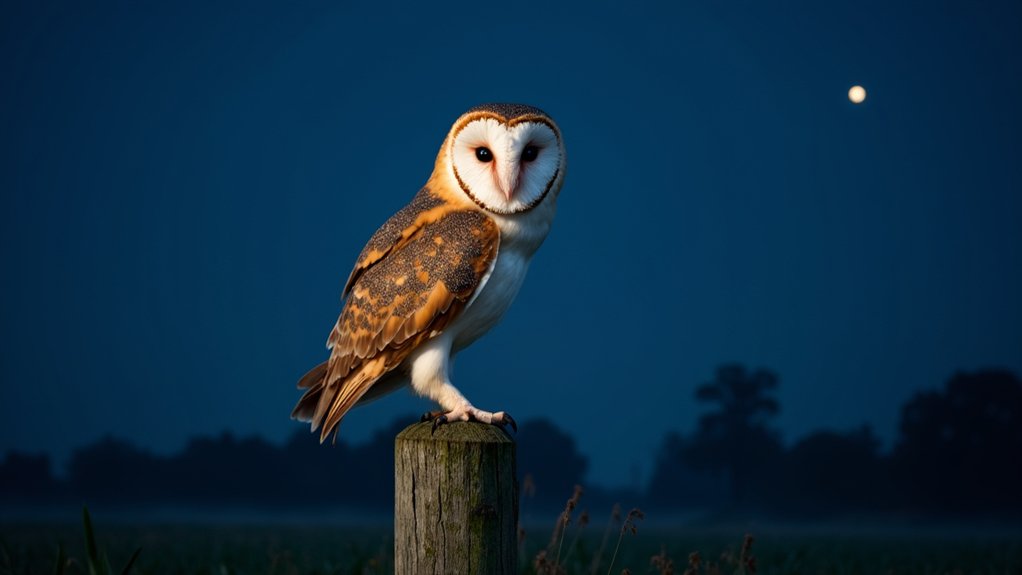
Barn owls inhabit nearly every continent except Antarctica, making them the most globally widespread owl species. You’ll find them across North America from British Columbia through Mexico and the Caribbean, throughout Europe from southern Spain to Russia, and across Africa, Asia, and Australia.
Their habitat includes open or semi-open lowlands such as grasslands, deserts, marshes, and farmland. You’ll notice they adapt well to urban and suburban areas, nesting in natural cavities like hollow trees or cliffs, and artificial structures including barns and abandoned buildings.
Barn owls require open foraging grounds near these nests. Their territory can span several square kilometers, showing significant overlap with other barn owls, as they don’t defend exclusive territories, favoring multiple roost sites within large home ranges. They are known for their distinctive ghostly appearance and often make rasping shrieks, especially when roosting in church belfries.
Eastern Screech-Owl
You’ll find Eastern Screech-Owls distributed across a broad territory east of the Rocky Mountains, ranging from the southern boreal forests of Canada down into Mexico. They adapt well to mixed deciduous and coniferous woodlands, especially where open clearings and meadows occur. Their habitat influences color morph variation, with gray morphs typically found in hardwoods and red morphs in pine trees.
You’ll see them nesting in large dead trees with natural cavities or artificial nest boxes, sometimes even in urban areas atop street lights. During breeding, they prefer tree cavities 7–20 cm wide, often using woodpecker-excavated holes. They lay three to four eggs incubated for about 26 days. The male provides most of the food while the female broods the young, reflecting a typical division of labor.
Nesting in tree cavities or urban spots, Eastern Screech-Owls lay 3-4 eggs incubated for 26 days.
These strictly nocturnal hunters use keen vision and hearing to capture diverse prey like insects, amphibians, small mammals, and introduced urban species. They consume about 25% of their body weight daily in winter, hunting primarily from perches and taking prey such as beetles, moths, shrews, and small birds.
They roost solitarily in dense foliage by day and vocalize with trills and wails, especially in spring. Their vocalizations include a tremolo call with a descending, whinny-like quality and a monotone purring trill, which differ from the solemn calls of western screech owls.
Great Horned Owl
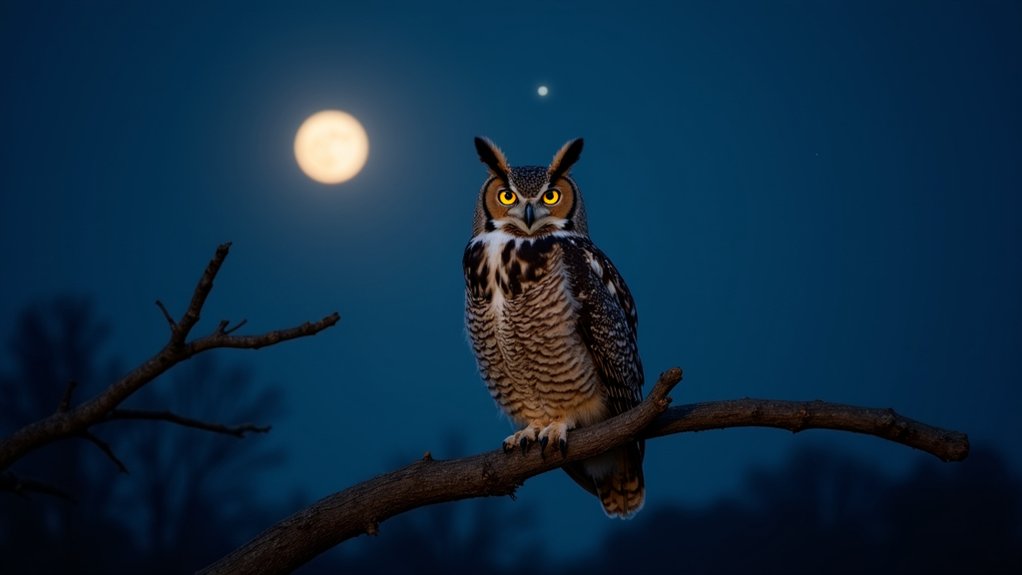
While Eastern Screech-Owls occupy woodland edges and urban niches, the Great Horned Owl commands a far broader range across the Americas. You’ll find it from northern Alaska through most of the U.S. and Central America, extending into upland Argentina and Peru.
This owl favors mixed habitats, including woodlands, grasslands, deserts, and even urban areas, typically at elevations up to 3,300 meters. You’ll recognize it by its large size, ear tufts, mottled gray-brown plumage, and bright yellow eyes. It is one of the earliest nesting birds in North America, beginning its breeding season well before many other raptors.
Its broad wings enable silent, powerful flight optimized for nocturnal hunting. Primarily active at night, it defends territories around 5.5 km², using deep hoots to communicate.
As a versatile predator, it hunts mammals, birds, and reptiles, relying on keen vision and talons to capture prey swiftly and efficiently. Its large, asymmetrical ear openings provide enhanced hearing abilities that help it locate prey even in complete darkness.
Northern Saw-whet Owl
You’ll notice the Northern Saw-whet Owl is a compact, robin-sized bird. It has this distinctive white “Y” marking right between its bright yellow eyes, and its warm mottled brown plumage really stands out.
It likes to hang out in coniferous and mixed forests all across much of North America. The owl is nocturnal and difficult to see during daylight hours.
This little owl prefers dense cover, which it uses for roosting during the day and hunting at night.
So, if you’re trying to spot one, understanding its size, where it likes to live, and its secretive behavior can really help.
Even though it’s pretty common, it’s also quite elusive, making it a special find in the forest.
Physical Characteristics
The Northern Saw-whet Owl exhibits a compact body measuring approximately 17 to 22 centimeters in length, with a wingspan ranging from 42 to 56 centimeters. This size places it roughly on par with the American Robin. You’ll notice its brown to reddish-brown upperparts adorned with white spots, contrasting with pale underparts streaked in brown.
Its large, round head lacks ear tufts, featuring bright yellow eyes and a hooked black bill. Females are significantly larger, averaging 100 g, while males weigh about 75 g, showing clear size dimorphism. Wings are broad and rounded for silent flight, and the short tail has a square tip. The owl’s black beak and feathered feet help it maintain stealth and grip during nocturnal hunting.
| Feature | Female | Male |
|---|---|---|
| Body Mass (g) | ~100 | ~75 |
| Length (cm) | 17–22 | 17–22 |
| Wingspan (cm) | 42–56 | 42–56 |
Habitat and Behavior
Although often elusive due to their nocturnal habits, Northern Saw-whet Owls occupy a broad breeding range across boreal and montane forests in North America. This stretches from southeastern Alaska and Newfoundland to central Mexico.
You’ll find them primarily in coniferous forests like pine, spruce-fir, and mixed stands. They also inhabit oak woodlands, riparian zones, swamps, and bogs. Their nighttime activity includes vocalizing for territorial defense and communication, which helps them establish their presence to other owls even in the quieter nighttime environment.
These owls roost in dense conifers or shrubs, usually 6–20 feet above ground. When it comes to nesting, they use abandoned woodpecker cavities or artificial boxes.
Their activity peaks at dusk and dawn, with males vocalizing persistently during the breeding season to establish territories. They hunt small rodents silently by relying on acute hearing and low-light vision. Their diet mainly consists of small rodents, including deer mice and voles.
- Breeds in boreal and montane coniferous forests
- Roosts in dense foliage 6–20 ft high
- Secondary cavity nester using woodpecker holes
- Nocturnal with peak vocal activity in late winter and early spring
Burrowing Owl
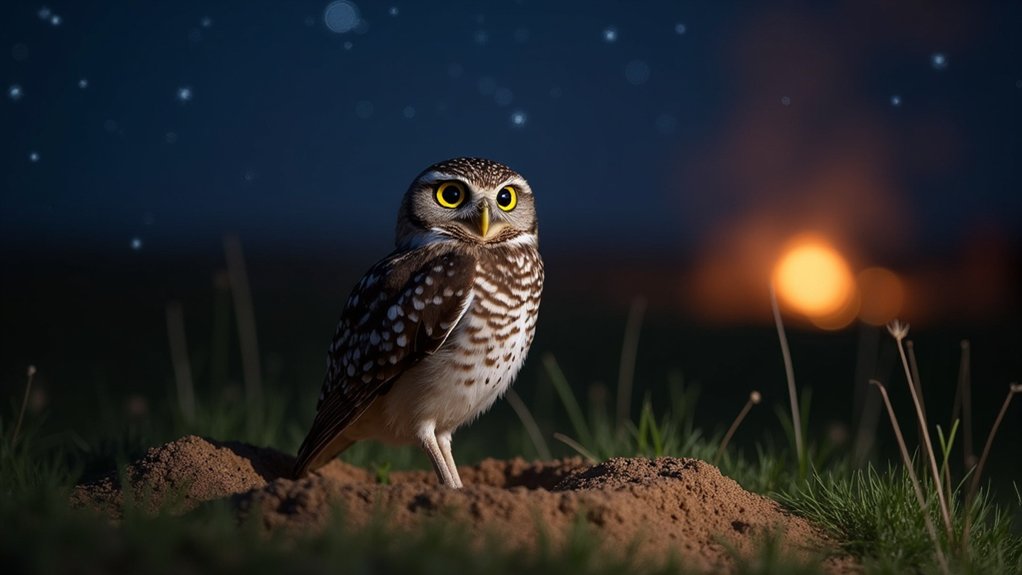
Burrowing Owls (*Athene cunicularia*) belong to the family Strigidae, comprising true owls, and exhibit a distinctive morphology adapted to a terrestrial lifestyle. You’ll note their long legs, sandy mottled brown plumage with white spots, bright yellow eyes, and absence of ear tufts.
Standing 19–25 cm tall with a wingspan of 50–61 cm, they weigh 125–185 g. Native to open landscapes across the Americas, they inhabit grasslands, deserts, and agricultural areas, nesting in underground tunnels often dug by mammals. In Florida, they are recognized as a state-designated Threatened species due to habitat loss and other environmental pressures. In aviary settings, it is crucial to consider species compatibility to ensure peaceful coexistence with other birds.
Primarily crepuscular and nocturnal, these owls actively forage on insects, small mammals, reptiles, and amphibians using diverse hunting strategies including hovering and ground pursuit.
You’ll find them decorating tunnel entrances with debris, possibly for communication or deterrence.
Their breeding season starts in spring, with clutch sizes up to 12 eggs commonly incubated by females.
Tawny Frogmouth
Tawny Frogmouths (Podargus strigoides) inhabit a wide range of wooded environments across mainland Australia and Tasmania, showcasing remarkable adaptability from urban parks to dense forests. You’ll notice their cryptic, mottled plumage, silver-grey to brownish-grey with streaks, that blends seamlessly with tree bark. These medium to large birds use a sit-and-wait hunting technique at night, preying primarily on insects and occasionally small vertebrates. They are part of the nightjar family, which distinguishes them from owls and frogs. Their unique daytime posture mimics dead branches to avoid detection. Tawny Frogmouths live in monogamous pairs, vocalize with deep grunts and duets, and thermoregulate by sunbathing or huddling in colder months.
- Wide distribution across mainland Australia and Tasmania
- Cryptic plumage and dead-branch camouflage
- Nocturnal sit-and-wait insectivores
- Monogamous pairs with distinctive vocalizations
Australian Owlet-nightjar
You’ll find the Australian Owlet-nightjar living in all sorts of environments across mainland Australia, Tasmania, and even down in southern New Guinea.
They really like woodlands and are often found roosting in tree hollows. They typically move between roost sites about 300 meters every nine days, using 2-6 cavities over 6 months (roost site rotation).
This little bird is quite small, about 21 to 25 cm long. It comes in different plumage colors, and one of its standout features is its big dark eyes—but interestingly, unlike many nocturnal birds, it doesn’t have that typical eyeshine at night.
The Australian Owlet-nightjar is mostly active around dawn and dusk, as well as during the night.
It cleverly adjusts its activity depending on the moon phases, which helps it catch prey more effectively while staying safe from predators.
Habitat and Distribution
The Australian Owlet-nightjar occupies a vast range across mainland Australia, Tasmania, and parts of southern to southeastern New Guinea, making it one of the most widespread nocturnal birds in the region.
You’ll find it in diverse habitats, primarily open forests and woodlands with abundant hollows for roosting. It avoids dense rainforests and highly urbanised areas lacking suitable cavities.
In Tasmania, a distinct subspecies resides, slightly smaller than mainland counterparts. The species also thrives in mallee scrub, mangrove swamps, and peri-urban parks with mature trees.
Its range includes all Australian states, Tasmania, and southern New Guinea. It prefers drier, open woodlands over closed-canopy forests.
The Australian Owlet-nightjar roosts and nests in tree hollows, rock crevices, and man-made structures. You’ll often find it using fragmented landscapes with remnant hollow-bearing trees for foraging and shelter. Notably, this bird is recognized by its large, dark eyes that do not reflect light in a torch beam.
Physical Characteristics
Measuring about 21 to 25 centimeters in length, the Australian Owlet-nightjar ranks as the smallest nocturnal bird in Australia. You’ll notice its compact body, large head with prominent dark eyes, and short neck. Its soft plumage varies from grey to rufous-orange, with distinct barred tails aiding flight control. The bird’s forward-facing eyes provide it with strong night vision, essential for its nocturnal lifestyle.
Facial features include a black eye stripe and long rictal bristles resembling whiskers. Wings are broad and rounded, enabling agile flight in dense habitats, while dainty pink feet support efficient ground foraging.
| Feature | Description |
|---|---|
| Size | 21–25 cm length, smallest in Australia |
| Plumage Morphs | Dark grey, pale grey, orange, grey-orange |
| Flight Adaptations | Rounded wings, barred tail for maneuverability |
Nocturnal Behavior
Although primarily active during the night, the Australian Owlet-nightjar exhibits crepuscular peaks in foraging and vocalization, especially around dusk and dawn.
You’ll observe that it mainly hunts arthropods using short, precise sally flights from perches. It relies on large eyes and acute hearing under low light. Its presence is often best detected by its distinctive series of soft churring notes heard at night.
This bird’s nocturnal activity adjusts with lunar phases. It prefers moonlit nights for better prey detection but reduces activity on full-moon nights to avoid predators.
During the day, it roosts in tree hollows or rock crevices. It rarely leaves these safe microhabitats even under thermal stress.
- Forages mainly at night with dusk/dawn peaks
- Hunts arthropods using sally-type strategy
- Adjusts activity based on lunar illumination
- Roosts in sheltered cavities with moderate fidelity
Kākāpō
Kākāpō, an extraordinary nocturnal parrot endemic to New Zealand, holds the distinction of being the world’s heaviest parrot and the only flightless species within its family. You’ll notice its moss-green mottled plumage camouflages it on forest floors, while its large, owl-like facial disc aids night vision. The species has been carefully relocated to predator-free islands to protect it from invasive mammals and support its survival.
This herbivore forages nocturnally, using wings for balance rather than flight. Unique among parrots, males perform lek displays to attract females, who alone incubate eggs.
| Trait | Description | Significance |
|---|---|---|
| Weight | Up to 4 kg | Heaviest parrot globally |
| Flight Ability | Flightless | Adapted for ground dwelling |
| Reproduction | Lek breeding, low fertility | Limits population growth |
| Conservation Status | Critically Endangered | Requires intensive management |
Stone-curlew
- Nocturnal or crepuscular, active at dusk and dawn
- Feed mainly on insects, small reptiles, and rodents
- Emit loud, haunting wailing or yelping calls at night
- Prefer dry open ground, stony fields, and semi-arid areas
These traits make stone-curlews unique among wader relatives. The bush stone-curlew is notable for its prominent yellow eyes that aid its nocturnal lifestyle.
North Island Brown Kiwi
The North Island brown kiwi (*Apteryx mantelli*) stands out as the only wild kiwi species native to New Zealand’s North Island. It measures 40–45 cm in length and weighs between 1.4 and 3.3 kg, with females generally larger than males.
The North Island brown kiwi is a uniquely native, medium-sized bird with females larger than males.
You’ll notice its dark brown plumage, streaked with reddish-brown and black, and spiky-feeling feather tips. Its long pale bill, about 10–12 cm, distinctively has nostrils at the tip, aiding its highly developed sense of smell.
This flightless bird inhabits diverse forests and plantations across the northern two-thirds of the island, preferring dense lowland forests. It is currently classified as vulnerable due to habitat loss and predation by introduced species. Strictly nocturnal, it probes soil and leaf litter for invertebrates using tactile bill receptors.
Its monogamous pairs defend territories with multiple burrows, nesting underground and contributing greatly to soil aeration and forest floor ecology.
Black-crowned Night Heron
You’ll find the black-crowned night heron hanging out in all sorts of wetlands. Whether it’s freshwater marshes or even urban ponds, this bird knows how to make the most of its surroundings.
It’s pretty adaptable, adjusting its behavior depending on whether it’s in a natural spot or a place shaped by humans. Artificial wetlands in some regions, particularly in the Middle East, provide important habitats for this species.
Now, when it comes to hunting, this heron is mostly active at night. It uses a really patient and still approach, waiting quietly by the water’s edge.
Then, with a quick strike, it grabs all kinds of prey—fish, amphibians, and more. Getting to know where it likes to live and how it hunts helps us understand how this cool species manages to thrive all over the world.
Habitat and Behavior
Across six continents, Black-crowned Night Herons inhabit diverse wetland environments ranging from freshwater marshes and tidal mudflats to mangroves and urban ponds.
You’ll find them active mainly at night and twilight, foraging along shallow, vegetated water edges.
During the day, they roost in dense foliage of trees or urban green spaces, prioritizing concealment over distance from humans. Their broad and fingered wing shape aids in their nocturnal flight and maneuvering.
These herons nest colonially in variable sites, on ground, reeds, or trees up to 50 meters high, often near or over water to reduce predation risk.
Their adaptability extends to human-altered habitats like fish ponds and sewage lagoons, reflecting high tolerance for non-aggressive human presence.
- Global wetland range including urban areas
- Nocturnal foraging, daytime roosting in dense cover
- Colonial nesting from ground to high trees
- Partial migration with nocturnal movements
Unique Hunting Techniques
Although Black-crowned Night Herons primarily rely on stealth, they employ a diverse array of hunting techniques that improve their foraging success in nocturnal and low-light conditions.
You’ll observe them using the bill-vibrating technique in shallow water, rapidly opening and closing their bill to create ripples that mimic prey movement, effectively luring fish and invertebrates within striking distance.
They also practice a “fly-fishing” method, manipulating insects on the water surface to attract cautious fish, demonstrating advanced behavioral flexibility.
Their stand-and-wait ambush posture allows you to see them motionless at pond edges, minimizing detection before a rapid strike. This patient, motionless stance exemplifies their patience and stealth in hunting.
Moreover, slow-walking through shallow water helps flush hidden prey.
This combination of strategies maximizes their efficiency across varying prey availability and habitat conditions.
Common Nightingale
The common nightingale (*Luscinia megarhynchos*), a member of the Old World flycatcher family Muscicapidae, measures about 15 to 16.5 cm in length with a wingspan of 23 to 26 cm and weighs between 17 and 24 grams.
You’ll find its plain brown plumage with a reddish tail and buff-to-white underparts across Europe and the western-central Palearctic during breeding. It migrates to Sub-Saharan Africa for winter.
Notable for a complex, melodious song exceeding 1,000 distinct sounds, males often sing at night early in the breeding season to establish territory and attract mates. The male’s song is described as one of the most beautiful sounds in nature male’s song. You can detect them more by their vocalizations than by sight due to their secretive nature.
Breeds in dense undergrowth and forest edges at low elevations.
Feeds mainly on insects and some fruit.
Nests close to the ground with 4–5 eggs per clutch.
Night singing aids in territory defense and mate attraction.
Common Nighthawk
You’ll recognize the Common Nighthawk by its mottled gray and brown plumage, long pointed wings with distinctive white bars, and erratic, buoyant flight pattern.
It’s pretty unique looking, isn’t it? This bird thrives in all sorts of open habitats, from forests to urban rooftops.
What’s really interesting is how it communicates. The males use sharp nasal calls and a mechanical “booming” sound during their courtship displays.
Identification and Behavior
When identifying a Common Nighthawk, you’ll notice its medium size, measuring about 21 to 25 cm in length with a wingspan between 51 and 61 cm.
It has a slender build characterized by long, pointed wings that extend beyond its slightly forked tail. Its cryptic plumage of dark gray, brown, and black mottling provides excellent camouflage.
In flight, look for the bold white wing patches and the male’s white subterminal tail bar.
Behaviorally, it exhibits erratic, buoyant flight with sharp turns. It actively forages above treetops and urban areas, especially near artificial lights.
- Large-headed profile with small bill tip visible
- Crepuscular and nocturnal foraging peak, also diurnal in summer
- Aerial insectivore capturing insects mid-flight
- Roosts horizontally on branches or ground, limited ground movement
Common Nighthawks are most often detected during the dusk period, making surveys one hour before and after dark particularly effective.
Habitat and Vocalizations
Observing a Common Nighthawk’s behavior naturally leads to examining where it thrives and how it communicates.
You’ll find these birds breeding in open areas with bare or sparsely vegetated ground, like sand dunes, prairies, logged or burned forests, and even urban gravel rooftops. They lay eggs directly on substrates such as bare rock or gravel, often using fire-maintained habitats or industrial sites with exposed gravel. The incubation period for their eggs is approximately 18 days, primarily by the female.
For feeding, they prefer open airspace over grasslands, lakeshores, and urban areas where insects gather, especially near artificial lights.
Geographically, they breed across northern and central North America and migrate through Central America to winter in southern South America.
Their primary vocalization is a sharp, nasal “peent,” used during flight to communicate territory and attract mates.
Western Screech-Owl
The Western Screech-Owl (*Megascops kennicottii*) is a small nocturnal raptor native to western North America. It’s recognized for its distinctive gray or brown plumage with heavily streaked underparts that provide effective camouflage. Several morphs exist, including brown and gray variations, all featuring brown or dark gray plumage with streaking that helps them blend into their environment (morph variations).
You’ll find it across diverse habitats, from riparian woodlands to urban parks. It hunts at night, relying on silent flight, acute hearing, and excellent night vision to capture small mammals, insects, and occasionally fish.
Its primary vocalization consists of a rapid series of high-pitched “toots,” used to defend territory and communicate with mates.
Length: 20–22 cm; wingspan: 50–55 cm
Habitat: woodlands, desert, urban areas with mature trees
Diet: small mammals, birds, insects, crayfish
Breeding: cavity nests, 2–7 eggs, incubation by female
You’ll appreciate its adaptability and territorial fidelity.
Oilbird
Unlike the Western Screech-Owl, which hunts small animals in woodland and urban environments, the Oilbird occupies a unique ecological niche as a nocturnal frugivore native to northern South America. Measuring 40–49 cm with a 95 cm wingspan, it feeds exclusively on lipid-rich fruits like oil palms. It is found in countries including Venezuela, Colombia, and Trinidad.
You’ll find it roosting in humid forests with caves or rock shelters, using echolocation, rapid 2 kHz clicks audible to humans, to navigate dark caves. Its eyes have the highest light-gathering capacity among birds, with layered rods enabling exceptional low-light vision but poor daylight sight.
Oilbirds nest in colonies where vocalizations create loud, continuous noise. Fossil evidence shows it separated over 50 million years ago, making it evolutionarily distinct. Its flattened hooked bill and long rictal bristles help it catch fruit mid-flight efficiently.
Frequently Asked Question
How Do Nocturnal Birds Navigate in Complete Darkness?
You navigate by integrating multiple cues: you use a geomagnetic compass detecting magnetic field polarity and inclination, even when visual cues vanish.
Your eyes sense dim blue-green light enabling magnetoreception.
You rely on internal circadian clocks to interpret these signals over time. When stars are visible, you switch to stellar navigation; under clouds, magnetic cues dominate.
You continuously recalibrate these systems, correcting drift and using mental maps to maintain your migratory course through total darkness.
What Adaptations Allow Silent Flight in Nightjars and Owls?
Imagine an owl swooping silently to catch a mouse.
Nightjars and owls achieve silent flight through specialized wing and feather structures: serrated leading edges break up airflow, soft velvet-like surfaces absorb noise, and flexible fringes diffuse turbulence.
Their broad wings enable slow, steady gliding, minimizing wingbeat noise.
These adaptations reduce turbulence and mechanical sound, allowing you to hear their approach only when it’s too late.
Are There Any Diurnal Birds That Become Nocturnal Occasionally?
Yes, you’ll find many diurnal birds exhibiting occasional nocturnal behavior, especially during migration.
They extend activity into night hours for vocalizing or flying to reduce predation and navigate using night calls.
This behavior isn’t a permanent shift but a temporal adaptation influenced by factors like artificial light or predation pressure.
How Do Urban Environments Affect Nocturnal Bird Behavior?
You might think urban lights simply brighten the night, but they actually disrupt nocturnal birds‘ navigation and behaviors.
Artificial light at night confuses their orientation, causing slower, erratic flights and increased vocalization.
This disorientation raises collision risks with buildings and depletes essential energy reserves.
Furthermore, urban noise and light shift community composition toward generalists, reducing biodiversity.
Yet, darker urban patches with greenery can support more sensitive nocturnal species, partially mitigating these effects.
What Role Do Nocturnal Birds Play in Controlling Insect Populations?
You play a key role in controlling insect populations by preying on nocturnal insects like moths, beetles, and mosquitoes.
Your nightly hunting reduces pest numbers, preventing outbreaks that harm crops and forests.
By feeding intensively near nesting sites, you create localized insect suppression zones.
Your predation shapes insect behavior and supports ecosystem balance.
But declines in insect availability and habitat disruption threaten your ability to regulate these populations effectively.
Conclusion
Now that you’ve examined these fascinating nocturnal birds, you see how night’s silent orchestra thrives in the dark. Each species, from the stealthy Barn Owl to the elusive Oilbird, plays an essential role in their ecosystems, adapting distinctly to the night’s challenges.
Like stars scattered across the sky, their presence might seem scattered but together, they illuminate the intricate balance of nocturnal life you rarely notice. Keep observing. The night holds many secrets still.