
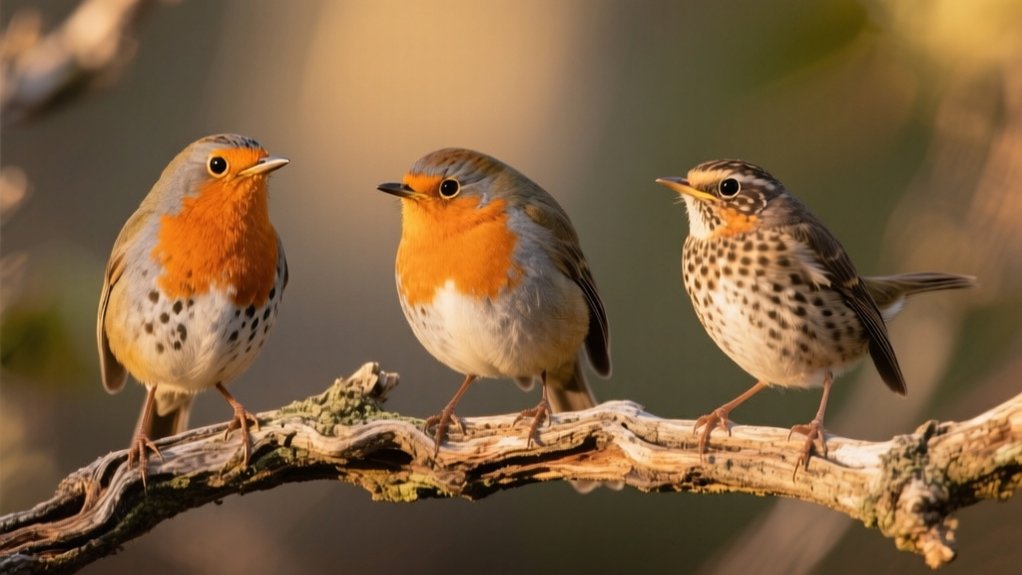
To identify types of robin birds, examine size, plumage, and behaviors carefully. Males typically have darker heads and vibrant orange breasts, while females are paler with muted hues.
Juveniles feature spotted backs and speckled underbellies. Regional differences affect color intensity, with western robins often lighter. Observe distinctive ground foraging and tail flicks.
Be wary of look-alikes like varied thrushes and towhees, which have unique markings and calls. Understanding these details reveals clearer distinctions you’ll want to investigate further.
American Robin Physical Characteristics
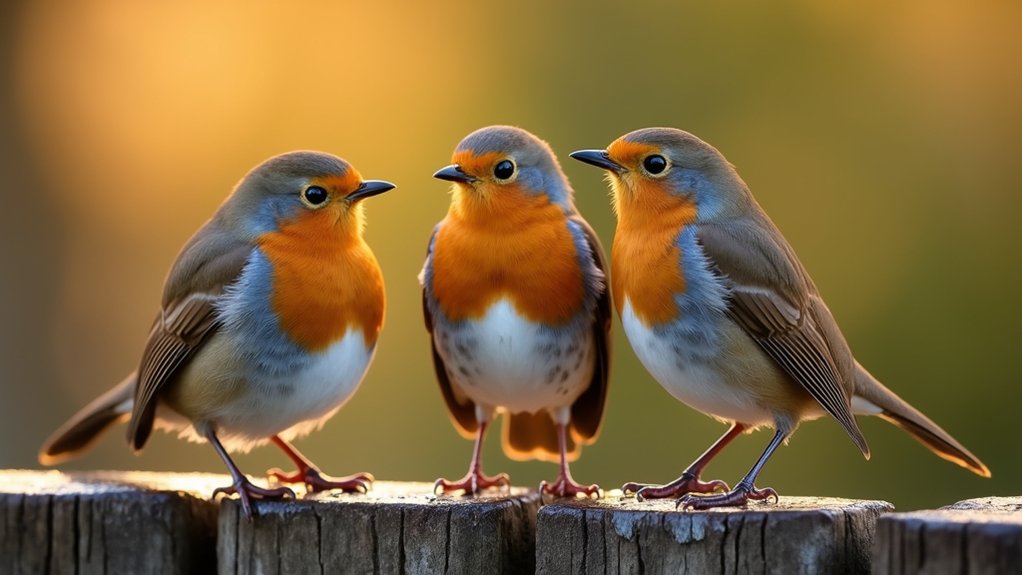
The American Robin displays distinct physical traits that help you identify it in the field. This bird measures between 7.9 to 11.0 inches in length, making it the largest North American thrush.
Measuring 7.9 to 11 inches, the American Robin is the largest thrush in North America.
You’ll notice the male’s dark head sharply contrasts with its bright yellow bill and rusty orange belly. Females appear paler, with more muted coloration, lacking the male’s intense hues.
Juvenile American Robins are easily distinguished by their spotting on the back and chest, a key feature absent in adults. Their wingspan ranges from 12.2 to 15.8 inches, supporting strong flight capabilities.
Observing their short, rapid ground steps reveals how they use powerful legs to extract earthworms, a behavior linked to their physical adaptations. These birds are known for their adaptability to urban environments, often thriving in city parks and suburban gardens across North America.
Male Vs Female American Robin Differences
When you’re watching American Robins, you’ll probably notice that the males have a darker black head and a really vibrant deep red breast.
On the other hand, the females tend to have a lighter-colored head and a softer, more muted orange breast. These color differences become especially clear during breeding season, making it easier to tell males and females apart.
Plus, there are some behavioral clues too. For example, males are usually the ones singing to defend their territory.
Color Variations
You’ll notice three key color distinctions that help differentiate male and female American Robins: head coloration, breast tone, and overall vibrancy.
Male American robins exhibit dark black heads, creating a strong contrast with their vibrant rusty red breasts and yellow bills.
In contrast, female American robins have paler heads that blend subtly with their grayish-brown backs, and their breasts show a more washed-out orange hue.
These color variations become especially pronounced during the breeding season, when males intensify their coloration to attract mates.
Juvenile robins, regardless of sex, differ markedly by displaying spotted patterns on their backs and chests, which sets them apart from adults.
Behavioral Differences
Although male and female American Robins share many similarities, their behavioral patterns during the breeding season display distinct roles and strategies. You’ll notice:
- Males have a dark black head and a vibrant deep red breast; their plumage is designed to attract mates and signal dominance.
- Female American Robins exhibit a lighter head and less vivid breast coloration, supporting camouflage during nesting behavior.
- Females primarily build the nest using grass, twigs, and mud, while males defend the territory aggressively to guarantee safety.
Understanding these behavioral differences helps you accurately identify each sex in the field.
The male’s vivid coloration and territorial defense contrast with the female’s lighter appearance and meticulous nest construction, reflecting their specialized roles in reproduction and survival.
Juvenile Robin Identification
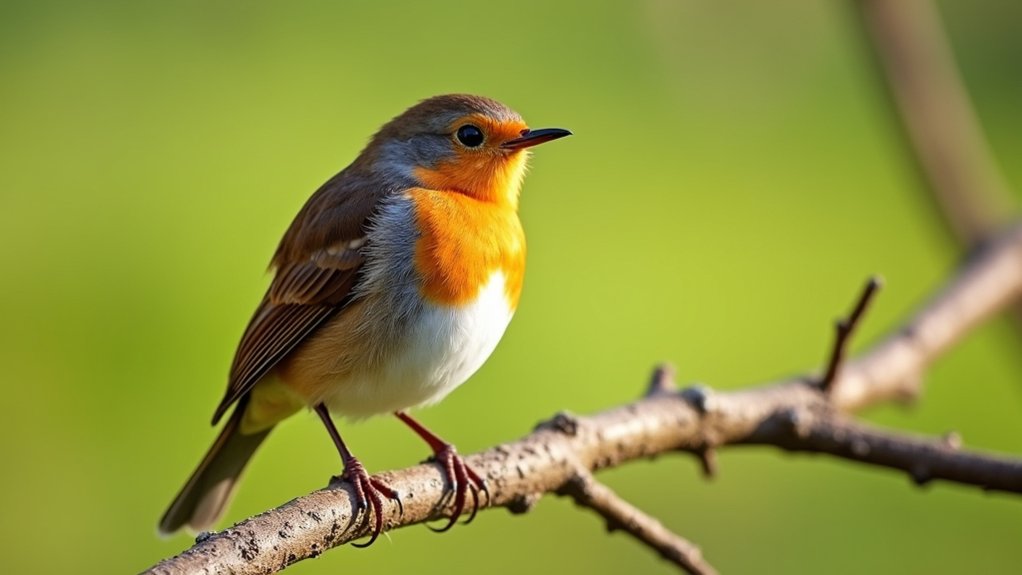
Juvenile American Robins display distinctive spotted patterns on their backs and chests that set them apart from adults. When identifying juvenile robins, note their brownish color combined with a less vivid orange breast, which contrasts the brighter hue of mature birds.
Their underbelly shows a light speckled pattern rather than the solid rusty coloration typical of adults.
Furthermore, juvenile robins have mottled heads that appear lighter and less defined compared to the darker heads of adults.
These features create a clear distinction between juveniles and fully matured robins. As juvenile robins develop, they gradually lose their spotted appearance and mottled heads while acquiring the adult coloration characterized by darker heads and more uniform, vivid underparts.
Recognizing these traits helps you accurately identify juvenile robins in the field.
American Robin Color Variations by Region
When examining American Robin populations across North America, you’ll notice distinct color variations influenced by geographic location and environmental conditions.
These variations help you differentiate regional populations with precision:
- The San Lucas American Robin stands out as remarkably paler than males from other regions, displaying a muted plumage that’s easy to identify.
- Western American Robins generally exhibit lighter coloration and have less white at the tail corners compared to their eastern counterparts, reflecting adaptation to different habitats.
- Breeding robins along the Canadian Atlantic coast feature richly colored plumage, making them more vibrant than robins in other areas.
Understanding these color variations allows you to accurately identify American Robins by region, appreciating how geographic location shapes their appearance.
Common Robin Behaviors to Note
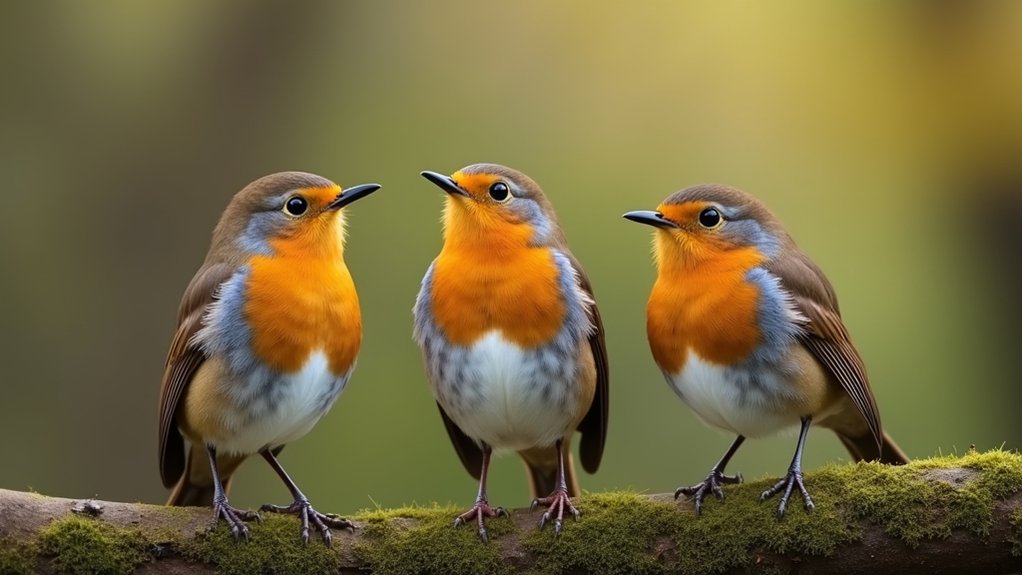
Because American Robins rely heavily on ground foraging, you’ll often observe their distinctive running behavior characterized by short, rapid steps as they scan for earthworms and other prey.
These birds flick their tails downward upon landing, a subtle but consistent identification marker. When scanning the ground, they stay alert, ready to emit alarm calls like sharp yeep or peek sounds that warn of nearby threats.
Their social behavior becomes prominent in fall and winter, forming large flocks for roosting and feeding on berries.
Nesting behavior is another key aspect; females construct nests meticulously from the inside out using grass, twigs, and mud.
Recognizing these behaviors will improve your ability to identify American Robins effectively in diverse environments.
Habitat Preferences of American Robins
Although American Robins display remarkable adaptability, they primarily favor open habitats like gardens, parks, woodlands, and grasslands where food sources are abundant.
To understand their habitat preferences, consider these key aspects:
- Foraging: American Robins prefer open areas such as fields and pastures. Here, they search primarily for earthworms and berries, optimizing their energy intake.
- Breeding season: They construct nests using grass, twigs, and mud in trees, shrubs, or human-made structures within these habitats. This ensures safety and accessibility.
- Flocks and regional variation: During fall and winter, they form large flocks to roost and feed on abundant fruiting plants.
Note that western populations, paler than their eastern counterparts, select slightly different habitats, indicating ecological divergence.
Robins’ Vocalizations and Calls
A diverse array of vocalizations enables American Robins to immerse effectively within their environment. You’ll notice robins’ vocalizations include a soft “cuck” or “tuk,” used for routine communication.
When alarmed, they emit sharp “yeep” or “peek” calls, signaling potential threats to nearby birds. Male robins engage in melodious singing, especially at dawn and dusk, vital for territory establishment and mate attraction during breeding.
These calls can vary between individual birds and show distinct differences between eastern and western populations. Understanding these vocal patterns helps you accurately identify robins and assess their behavioral context.
Similar Birds That Are Often Mistaken for Robins
You’ll notice the Varied Thrush looks a lot like the American Robin, but it really stands out because of its orange wingbars and a distinct black band across its breast.
Now, when you’re trying to spot a Towhee, keep an eye out for its black hood that extends down to the breast and those rusty-colored sides—pretty different from the robin’s overall coloring.
Then there’s the Black-Headed Grosbeak, which you can tell apart by its reddish neck band and white spots on the wings, plus it has black upperparts and a uniquely shaped beak.
All these little details help set them apart from robins.
Varied Thrush Differences
When comparing Varied Thrushes to American Robins, you’ll notice distinct visual markers that aid in accurate identification. Both belong to the thrush family, yet Varied Thrushes display unique features setting them apart from the charming American Robin.
To identify robins versus Varied Thrushes, focus on these three key differences:
- Adult males of Varied Thrushes showcase orange wingbars and a bold black breastband, absent in American Robins.
- Varied Thrushes have a distinctive orange eyebrow stripe, while robins lack this marking.
- Size and color differences matter: Varied Thrushes have a more robust build and are primarily found along the Pacific Coast, unlike the broader range of American Robins.
These markers help you precisely distinguish between the two species in the field.
Towhee Identification Tips
After distinguishing Varied Thrushes from American Robins through wingbars, eyebrow stripes, and size, attention shifts to another group of look-alikes: Towhees.
For accurate identification, note that Spotted Towhees are smaller with stouter bills than American Robins, aiding quick size comparison.
Eastern Towhees feature distinctive black heads extending to their breast, contrasting with the Robins’ uniform reddish belly. Towhees’ rusty coloration appears only on their sides, unlike the full belly of Robins. Unique markings such as red eyes further differentiate Towhees.
Observing foraging behavior also helps; Towhees scratch the ground with their feet, while American Robins run in quick bursts.
Macaulay’s extensive database supports these distinctions, emphasizing the importance of combining physical traits and behavior for precise identification.
Distinctive Grosbeak Features
Three key features help distinguish Black-Headed Grosbeaks from American Robins despite their superficial similarities. As a common North American bird, the grosbeak exhibits distinctive black upperparts and a dark head with black streaks, unlike the robin’s uniformly gray-brown body and red breast.
- Plumage: Grosbeaks have white on the belly and orange underwing coverts, contrasting with the robin’s solid red breast.
- Beak shape: The grosbeak’s broad, conical beak differs from the robin’s slender, pointed beak.
- Vocalization: Listen for the grosbeak’s sharp yeep or peek calls, distinct from the robin’s melodic song.
These precise traits help prevent confusing these similar species when birdwatching.
Distinguishing Features of the Varied Thrush
A key identifier of the Varied Thrush is its distinctive orange eyebrow and black breastband. These features clearly differentiate it from the American Robin, which lacks these specific markings.
When focusing on identification, note the Varied Thrush’s darker, more muted coloration compared to the American Robin’s brighter plumage. Size also matters: the Varied Thrush is slightly smaller and primarily inhabits the Pacific Coast, whereas the American Robin spans a broader North American range.
| Feature | Varied Thrush |
|---|---|
| Distinctive Markings | Orange eyebrow, black breastband |
| Coloration | Darker, muted |
| Size | Slightly smaller |
These detailed features assist precise identification in the field.
Comparing Robins With Other Look-Alikes
How can you accurately distinguish American Robins from similar-looking species in the field? Focus on precise visual markers and behavior:
Varied Thrush males display a prominent black breastband and orange wingbars, unlike American Robins’ solid reddish coloring and round bellies.
Hermit Thrushes, often confused with juvenile robins, lack reddish coloring and show distinctive spotted breasts, a key difference from the robin’s uniform breast.
Spotted Towhees and Black-Headed Grosbeaks have contrasting features: Towhees exhibit a black hood extending to the breast, while Grosbeaks have black upperparts with a reddish neck band, both differing from the robin’s white underparts and consistent reddish breast.
Tips for Observing Robins in the Wild
When observing American Robins in the wild, focus on their distinctive coloration and behavior to accurately identify them. Males display a dark head and vibrant orange-red breast, while females are generally paler with a washed-out breast.
Watch for their behavior: they move with rapid short steps, often pulling earthworms from soil using strong legs. Listen to their calls, including a cheerful dawn and dusk song and sharp alarm calls like “yeep” or “peek.”
Observe nesting habits; females construct nests inside out with grass, twigs, and mud, typically in trees or near human dwellings.
Note regional variations. San Lucas robins appear much paler than eastern counterparts.
Frequently Asked Question
What Is the Average Lifespan of a Robin in the Wild?
You can expect the average lifespan of an American Robin in the wild to be about 2 years.
However, with favorable conditions like abundant food and fewer predators, some robins live up to 5 years or more.
In safe environments, they might even reach 13 years, as banding studies reveal.
Keep in mind, factors like habitat, urban threats, and extreme weather greatly influence their survival and longevity.
How Do Robins Contribute to Their Ecosystem?
You’ll find robins considerably contribute to their ecosystem by controlling insect populations through predation on earthworms and beetles.
They aid seed dispersal by consuming fruits and berries, promoting plant diversity.
Their nests, made from grass and mud, provide microhabitats for insects and birds.
Furthermore, robins act as environmental health indicators, reflecting habitat quality and climate effects.
Their vocalizations also influence species behavior, enhancing biodiversity acoustically.
What Predators Commonly Threaten Robin Populations?
You’ll find that common predators threatening robin populations include domestic cats, which hunt aggressively in suburban areas.
Hawks like Cooper’s and Sharp-shinned target robins during foraging in open habitats.
Snakes, especially garter snakes, pose risks to nests near the ground.
Moreover, raccoons and opossums often raid nests for eggs or chicks.
Environmental changes worsen predation by disrupting nesting sites, making robins more vulnerable to these predators.
How Do Robins Build and Maintain Their Nests?
You gather grass, twigs, and mud; you layer materials meticulously; you build a sturdy nest from the inside out.
Female robins select secure locations in trees or shrubs, ensuring protection.
You shape the nest with precision, then incubate eggs for 12 to 14 days.
After hatching, both parents feed chicks insects and berries, maintaining the nest’s cleanliness and safety to promote healthy growth and development.
Are Robins Migratory Birds or Year-Round Residents?
Robins can be both migratory and year-round residents depending on where you observe them. If you’re in North America, most American Robins migrate south during winter, traveling to Central America or Mexico.
However, if you’re near milder coastal regions, you’ll find robins staying year-round, adapting to local food sources and conditions.
Migration distances also vary; western populations tend to travel shorter distances compared to eastern ones.
You’ll notice males return first in spring to establish territories.
Conclusion
Now that you’ve learned to spot the subtle differences in robin types, you’ll be able to distinguish them like the back of your hand. Paying close attention to physical traits, color variations, and behaviors will help you avoid confusion with similar species.
Remember, practice makes perfect. Getting familiar with these details in the field will sharpen your identification skills and make observing robins a truly rewarding experience every time.