
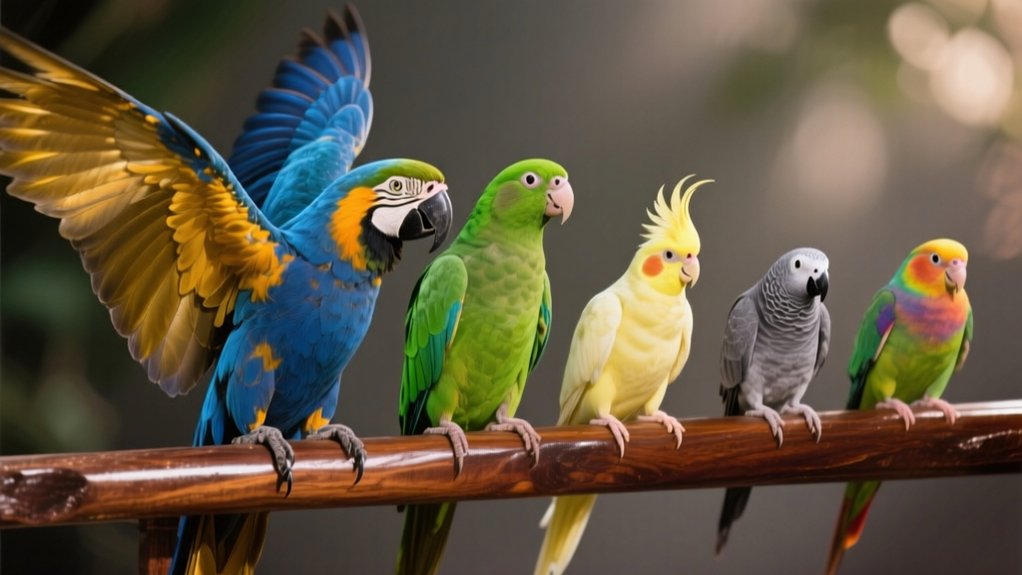
If you’re looking to teach birds human words, consider these top five: African Grey Parrots excel with vocabularies reaching thousands, showing genuine comprehension. Budgerigars mimic extensive words thanks to their unique brain areas.
Indian Ringneck Parakeets learn 100–250 words, repeating full sentences clearly. Yellow-naped Amazons develop vast, context-rich vocabularies and active play habits.
Hill Mynas rapidly acquire phrases and mimic sounds precisely, delivering exceptional speech clarity. Learning about their training and behaviors reveals fascinating ways these birds master human language.
African Grey Parrot
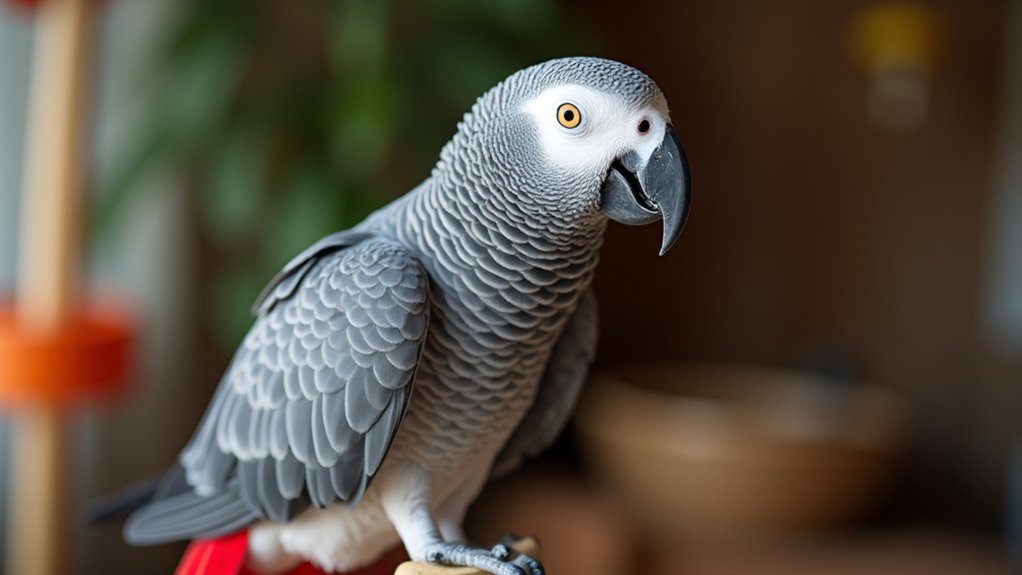
Although many birds can mimic sounds, African Grey Parrots stand out for their exceptional intelligence and cognitive abilities, which rival those of young children aged three to six. You’ll observe these parrots mastering counting, color identification, shape recognition, and even grasping the concept of zero.
Their problem-solving skills become evident as they complete puzzles and operate latches efficiently. Cognitive studies place their mental capacity alongside marine mammals and apes. The famous African Grey, Alex, demonstrated advanced analytical thinking across various domains, labeling over 80 distinct objects vocally. African Greys also show a strong capacity for social learning, which enhances their ability to use language contextually.
You’ll notice their vocabulary includes hundreds to thousands of words, with average productive usage around 20 utterances, ranging from single words to complex, creative phrases. Their speech reflects genuine comprehension, not mere mimicry, and is used purposefully in social contexts.
Budgerigar
While African Grey Parrots showcase remarkable intelligence and vocabulary, Budgerigars demonstrate unique vocal capabilities supported by specialized brain structures.
You’ll find that their anterior arcopallium (AAC) functions likewise to human speech-motor areas, enabling precise control over consonants, vowels, and pitch. Neural patterns closely match their chirps and warbles, highlighting advanced vocal organization. Their adaptations for flight also contribute to their energetic and agile social behaviors.
Native to Australia, these small, vividly colored parrots excel in social communication, using melodious songs within flocks. Recent studies have shown that budgerigars possess language-producing centers similar to those in humans, which helps explain their vocal mimicry abilities.
Budgerigars like Puck and Sparkie Williams set records with vocabularies exceeding 1,700 words, illustrating their impressive learning capacity.
If you train a budgie, repetition, social interaction, and positive reinforcement will boost its speech skills.
Despite their size, these birds hold complex linguistic abilities, making them a popular and scientifically fascinating choice for speech mimicry enthusiasts.
Indian Ringneck Parakeet
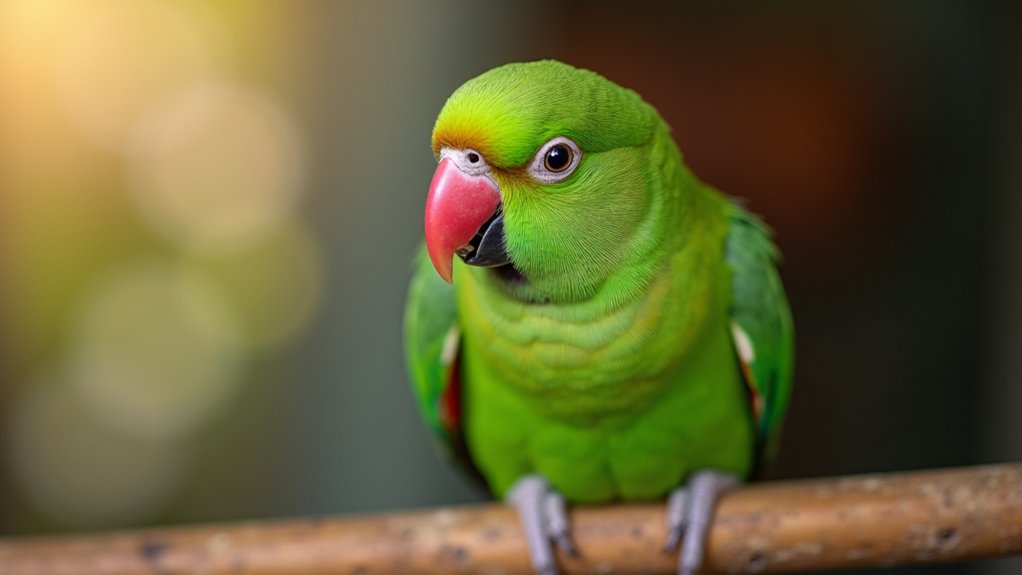
The Indian Ringneck Parakeet exhibits impressive speech capabilities, capable of learning between 100 and 250 words and phrases depending on the intensity of training.
You’ll notice these birds begin vocalizing around eight months old, repeating full sentences with remarkable accuracy. Their voice is high-pitched and distinct, often described as cartoon-like or robotic, yet their diction rivals that of African Greys and Amazon parrots.
When training your parakeet, keep in mind: consistent daily repetition is essential. They prefer learning longer phrases, which means they need more extensive training. Additionally, consistent training methods lead to better results in their vocabulary development.
Also, positive reinforcement and structured environments improve vocabulary retention. Plus, social interaction greatly boosts their speaking abilities.
Their vocal organ, the syrinx, enables this wide sound range, allowing you to associate words with contexts effectively.
Yellow-naped Amazon
Renowned for their exceptional vocal abilities, Yellow-naped Amazons stand out as the most accomplished talkers among Amazon parrot species. You’ll find they develop vast vocabularies, stringing sentences with context and tone.
Their bright yellow nape distinguishes them visually, while their playful yet intelligent nature makes interaction rewarding. However, males may become nippy as they mature. They are native to Central America, inhabiting tropical forests across Mexico, Honduras, Nicaragua, and Costa Rica.
| Attribute | Description | Note |
|---|---|---|
| Vocal Ability | Accurate imitation, understands context | Best Amazon talker |
| Physical Feature | Bright yellow patch on nape | Unique species marker |
| Behavior | Playful, curious, intelligent | Females often gentler |
Engage them daily with mental challenges and bird-safe toys to prevent stress-related behaviors like feather plucking.
Hill Myna

Hill Mynas fascinate researchers and bird enthusiasts alike with their extraordinary vocal abilities, capable of learning up to 100 human words and reproducing a wide range of sounds with remarkable clarity.
You’ll notice they mimic human voices, environmental noises, and bird calls with astonishing precision. Their learning is rapid; they pick up new phrases after just 3-5 repetitions, showing fast-mapping skills rare among birds.
Social interaction greatly boosts their vocal repertoire. Their ability to produce a wide variety of calls including whistles, wails, and screeches is learned when young, and individual birds have unique repertoires that vary geographically, which reflects their complex communication system (vocal repertoire diversity).
Engaging with others significantly enhances the variety and complexity of Hill Mynas’ vocalizations.
Consider these key points about Hill Mynas:
- They produce diverse loud calls: whistles, wails, screeches, and gurgles.
- Their speech clarity surpasses most parrots, rivaling grey parrots.
- They use words contextually, indicating cognitive understanding beyond mimicry.
- Wild populations decline, though captive demand remains high.
Frequently Asked Question
How Long Does It Take for Talking Birds to Start Mimicking Words?
You’ll typically see talking birds start mimicking words within weeks to a few months, depending on their species and age.
Budgerigars often begin around two months, while African Grey Parrots can start as early as six months.
Younger birds between six months and two years learn fastest.
Consistent practice, social interaction, and clear modeling speed up mimicry.
But remember, learning slows with age, and individual abilities vary widely across species.
Can Talking Birds Understand the Meaning of the Words They Say?
You might think talking birds truly grasp word meanings, but their understanding is mostly limited. They form associations between sounds and objects or actions, responding contextually rather than semantically.
While some species mimic phrases impressively, they often learn whole phrases as units without comprehending individual words. Their vocalizations rely on specialized brain circuits for sound production, not full language comprehension.
What Is the Best Age to Start Teaching a Bird to Talk?
You should start teaching a bird to talk as early as possible, ideally during the weaning stage when it’s still hand-fed.
Birds around 4 months old can handle basic training, but starting early lets their brains process sounds before they vocalize.
Consistent, short training sessions daily optimize learning.
Keep in mind species differences; some birds like budgerigars learn faster, while others, such as African Greys, take longer regardless of start age.
Do All Talking Birds Require Special Diets to Enhance Speech Ability?
Not all talking birds require special diets to improve speech ability; however, you’ll find that nutrition plays an important role in motivation and cognitive function.
While specific foods like sunflower seeds or cashews can act as effective reinforcers during training, it’s essential to avoid toxic items such as chocolate or caffeine.
Tailoring your bird’s diet with safe, varied treats helps maintain engagement and supports vocal learning, making dietary considerations important but not universally mandatory.
How Do Environmental Factors Affect a Bird’s Talking Skills?
Environmental factors greatly shape your bird’s talking skills. When you provide a stable, secure setting with consistent sounds, your bird feels safe, encouraging vocal practice and refinement.
The acoustic environment you create influences which frequencies your bird prioritizes, affecting sound modulation. Plus, regular social interaction motivates learning.
If conditions are unpredictable or noisy, your bird’s speech development can suffer.
Conclusion
As you investigate the fascinating world of talking birds, you’ll find these five species: African Grey Parrot, Budgerigar, Indian Ringneck Parakeet, Yellow-naped Amazon, and Hill Myna. They are linguistic marvels, each a living lexicon.
Their ability to mimic human speech isn’t just mimicry; it’s a complex symphony of neural precision and social interaction. Observing them, you witness evolution’s eloquence, where feathers become voices. Nature crafts its own articulate storytellers in vibrant plumage.