

You’ll spot the Tufted Titmouse in eastern woods, distinguished by its gray crest and rust flanks. Meanwhile, the Oak Titmouse prefers western oak woodlands with subtle gray-brown plumage.
The Juniper Titmouse thrives in southwestern habitats, specializing in piñon nuts. Across Europe and Asia, the Great Tit shows a black head and yellow underparts.
And the Eurasian Blue Tit flaunts vibrant blue and yellow feathers. Each species reveals unique behaviors and habitats worth exploring further.
Tufted Titmouse: The Familiar Eastern Visitor
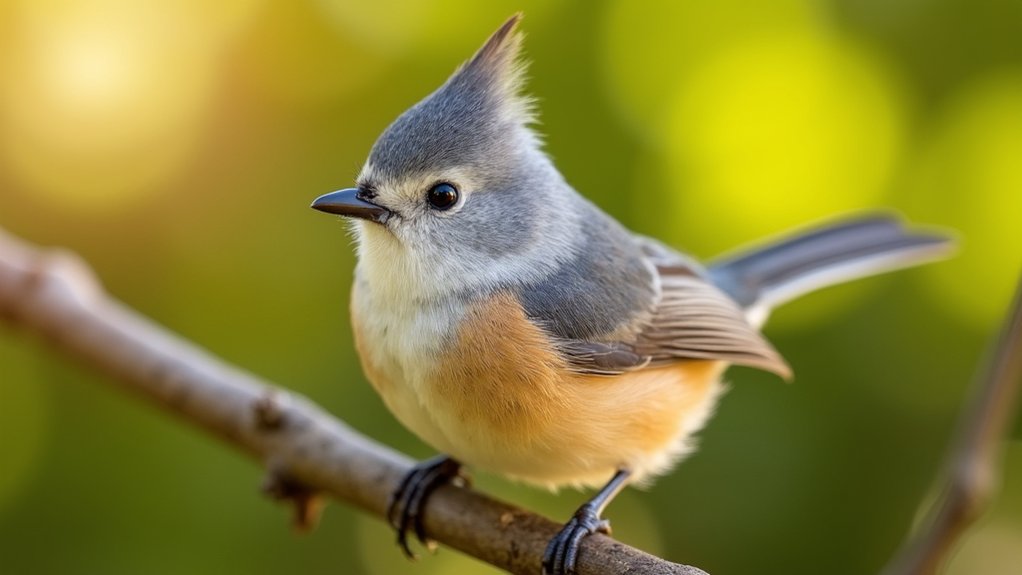
The Tufted Titmouse stands out among eastern North American birds with its distinctive gray upper body, white front, and rust-colored flanks. You’ll notice its black forehead and tufted gray crest, large black eyes, and small round bill, measuring about 6½ inches long with a 9¾-inch wingspan.
Males tend to be larger than females, while juveniles have a reduced black forehead, which can cause confusion with the oak titmouse. This species is known for social behavior, often joining mixed-species foraging flocks in autumn and winter to improve their chances of finding food and avoiding predators.
You’ll find this species native to deciduous and mixed woods, gardens, and parks throughout eastern North America, with a range extending north into Canada. They often forage from both the ground and tree branches, eating a diet that includes berries, nuts, seeds, and insects, especially caterpillars during summer, demonstrating their foraging versatility.
Since the 1940s, warming winters and increased mature woodland have allowed their range to expand considerably. They adapt well to suburban habitats, making them a common visitor to your backyard.
Oak Titmouse: The Western Oak Woodlands Resident
Although less conspicuous than its eastern counterpart, the Oak Titmouse exhibits subtle features such as a short crest and plain gray-brown plumage that distinguish it within western oak woodlands. Measuring about 5.5 inches, it shows a brownish back, lighter gray underside, stubby bill, and round black eyes. Its call is a distinctive harsh, fussy see-dee-dee or chick-a-dee-dee with a falling pattern that helps identify it in the field.
You’ll find this species year-round from southern Oregon through California to Baja California, favoring warm, dry oak and oak-pine woodlands, especially near coast live and valley oaks. Vocal pairs actively defend territories with a “weety, weety” song and husky calls.
Oak Titmice breed March to July, nesting in tree cavities or nest boxes with 3–9 eggs. Despite Least Concern status, habitat fragmentation threatens their oak woodland dependency, making them critical indicators of ecosystem health.
Juniper Titmouse: The Southwestern Habitat Specialist
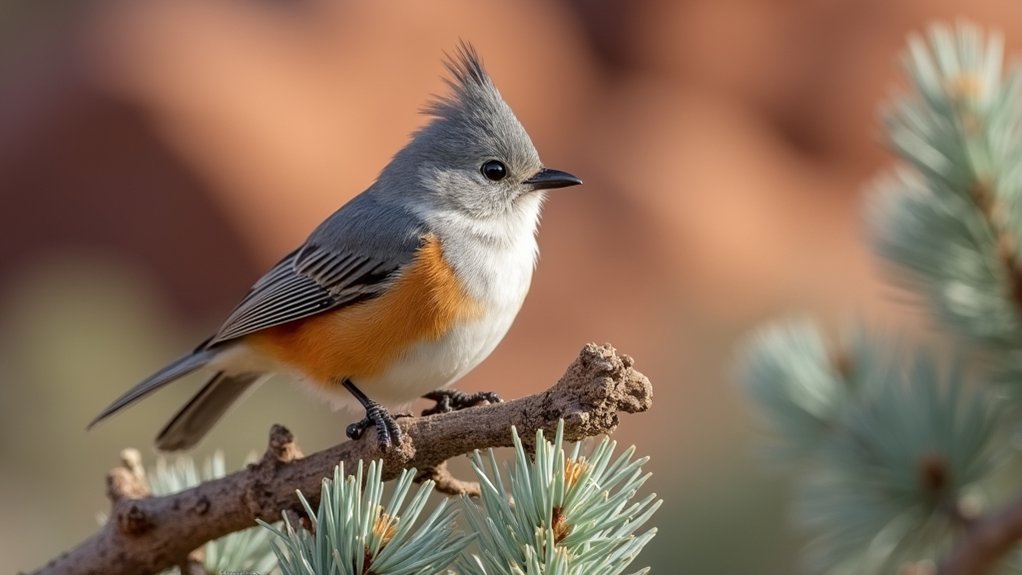
If you’ve observed Oak Titmice in western oak woodlands, you might notice a closely related species occupying distinct southwestern habitats: the Juniper Titmouse. Classified as Baeolophus ridgwayi, this monotypic species inhabits pinyon-juniper, juniper, and desert riparian woodlands primarily across the Great Basin and southwestern U.S., including southeastern Oregon, central Colorado, and extending into northeastern Sonora, Mexico.
Typically found at 2,250 to 8,000 feet elevation, it exhibits drab gray plumage with a small crest and a stout bill specialized for prying seeds. Their diet consists mainly of piñon nuts, seeds, and insects, which they forage acrobatically in the canopy. They forage acrobatically, clinging to twigs and branches to reach for seeds or insects.
Nesting occurs in natural cavities or nest boxes 3 to 12 feet above ground, with breeding peaking between April and May, laying 4 to 7 eggs per clutch.
Great Tit: The Widespread Eurasian Songbird
Recognizable by its striking black head and white cheeks, the Great Tit measures 11 to 14 centimeters, roughly the size of a sparrow. It displays olive-green upperparts contrasting with vivid yellow underparts marked by a distinct black breast stripe.
Males have a broader stripe extending to the tail, while females’ stripes are finer and stop at the abdomen. Juveniles appear duller, lacking the adult’s black bib. This highly adaptable bird is known for its remarkable problem-solving abilities, often figuring out how to access food in challenging situations.
Widely distributed across Europe, temperate Asia, and North Africa, this species thrives in forests, gardens, and urban areas. It often frequents bird feeders in winter. The Great Tit is currently classified as Least Concern by conservation organizations, indicating a stable population.
Its diet shifts seasonally from insects and caterpillars in summer to seeds and small prey in winter. Great Tits are monogamous, territorial breeders nesting in cavities.
Their distinctive two-syllable song signals territory and attracts mates.
Eurasian Blue Tit: The Colorful European Garden Guest
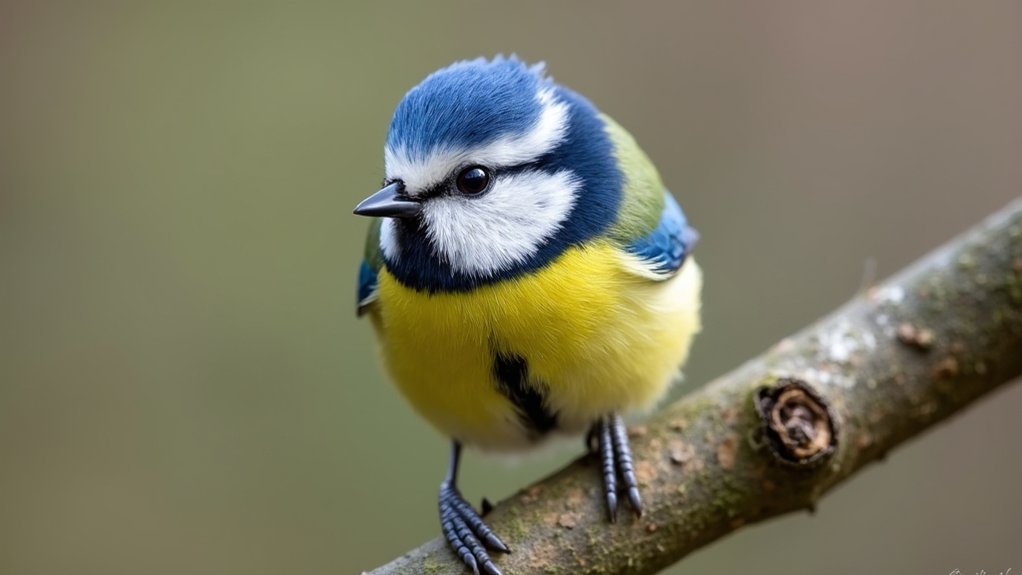
While the Great Tit stands out with its bold black and yellow patterning, the Eurasian Blue Tit enchants with a striking combination of blue and yellow plumage that signals its presence in European gardens.
Weighing about 11 grams and measuring 11-12 centimeters, this bird displays sulfur-yellow underparts with a dark abdominal line, reflecting carotenoid intake from its diet. A consistent food source availability in gardens—such as seeds, berries, and insects—greatly increases the likelihood of Eurasian Blue Tits frequenting backyard feeders.
At only 11 grams and 11-12 cm, its sulfur-yellow underparts reveal a diet rich in carotenoids.
You’ll find it across temperate Europe and western Asia, favoring deciduous woodlands rich in oaks, and readily visiting backyard feeders. The species is known to form mixed winter flocks with great tits, showcasing its social behavior and adaptability. mixed winter flocks
During breeding season, it nests in tree cavities or nest boxes with 26-27 mm entrance holes, laying 7-8 speckled eggs per clutch.
Its acrobatic foraging targets insects and larvae in summer, shifting to seeds and berries in winter.
This behavior helps maintain ecosystem health and signals individual fitness through vibrant plumage.
Frequently Asked Question
What Do Tit Birds Typically Eat Throughout the Year?
Tit birds typically eat insects like caterpillars, spiders, and beetles during spring and summer. This helps them meet the high protein demands for breeding.
In autumn, they shift to seeds, nuts, and berries. They often hoard food to prepare for winter.
During winter, they rely heavily on sunflower seeds, suet, peanuts, and cached reserves to survive cold conditions.
You’ll also find them enjoying live mealworms and fruit pieces in gardens, especially when natural food becomes scarce.
How Do Tit Birds’ Nesting Habits Differ Among Species?
You’ll notice tit species vary in nesting habits: Great Tits use diverse cavities and build moss-lined nests with hair and feathers, often producing two broods.
Blue Tits select specific moss species for cup-shaped nests in tree cavities, with females incubating alone.
Long-tailed Tits craft camouflaged domed nests in dense thickets early in the season.
Bushtits weave pendulous sock-like nests in colonies, emphasizing social structure.
Each adapts nest site and materials to optimize reproductive success.
Are Any Tit Birds Considered Endangered or Threatened?
Did you know some tit birds face serious conservation challenges?
Yes, the Willow Tit is red-listed in the UK due to sharp population declines. This is mainly from habitat loss and competition.
The White-fronted and Palawan Tits are near-threatened, mostly because of habitat destruction.
Meanwhile, the Ash-breasted tit-tyrant is officially endangered and protected federally in the US.
Understanding these statuses helps you appreciate the urgency of protecting these species.
Can Tit Birds Be Trained to Visit Backyard Feeders Regularly?
Yes, you can train tit birds to visit your backyard feeders regularly by providing high-energy seeds like black oil sunflower seeds and sunflower hearts.
Their natural affinity for feeders and social learning abilities help them quickly recognize and repeatedly use feeding sites.
Consistent food availability, rotating feeder positions, and maintaining fresh water encourage habituation.
Regular cleaning prevents disease, sustaining their health and repeat visitation, enabling you to observe their complex behaviors consistently.
What Predators Commonly Threaten Tit Birds in Urban Areas?
You might think urban tit birds face fewer predators, but that’s not true. In cities, you’ll find Eurasian sparrowhawks and great spotted woodpeckers targeting tits, especially during breeding.
Mammals like squirrels and weasels raid nests, while parasitic hen fleas infest them.
Urban pressures increase aggression and predation risks, with competition and climate shifts intensifying these threats.
Conclusion
As you investigate your backyard, these five tit species become vibrant brushstrokes on nature’s canvas. Each has distinct calls and colors that enrich your birdwatching palette. By recognizing the Tufted, Oak, Juniper, Great, and Eurasian Blue Tits, you’re not just observing birds. You’re decoding ecological stories written across continents and habitats. Welcome this avian symphony, and let your keen eye transform everyday moments into precise scientific revelations.