
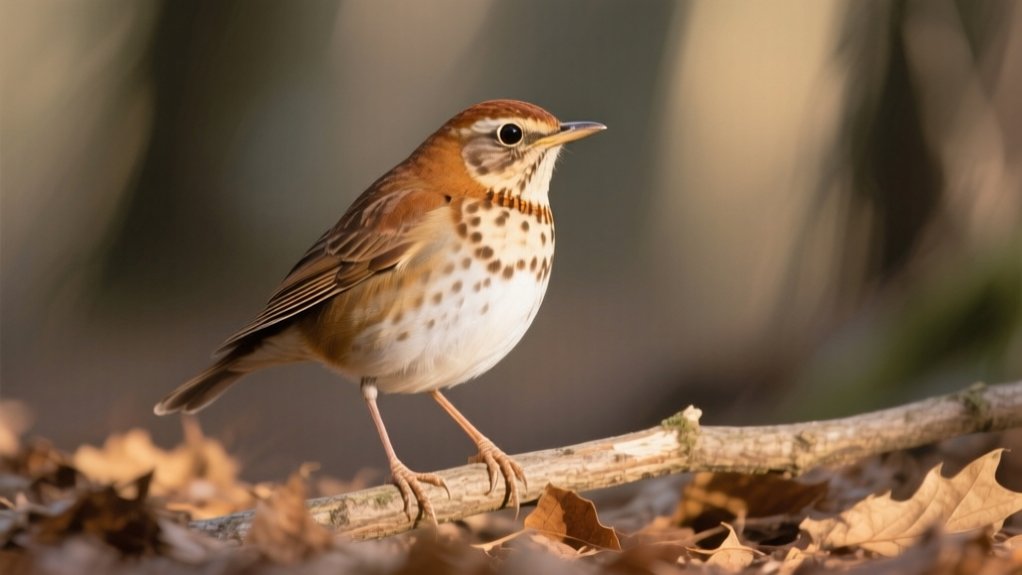
You can identify a Veery by its compact size, about 6.7 to 7.1 inches long with a wingspan near 11 inches. Its warm cinnamon-brown upperparts help it blend well in forests.
Look for pale underparts with a creamy, buffy-orange throat and a distinct brown malar stripe. Unlike similar thrushes, the Veery lacks bold spotting and has a rounded body.
Its size and subtle color patterns make it distinct. Understanding these traits lays the foundation for recognizing its unique vocal and behavioral features.
Physical Characteristics of the Veery
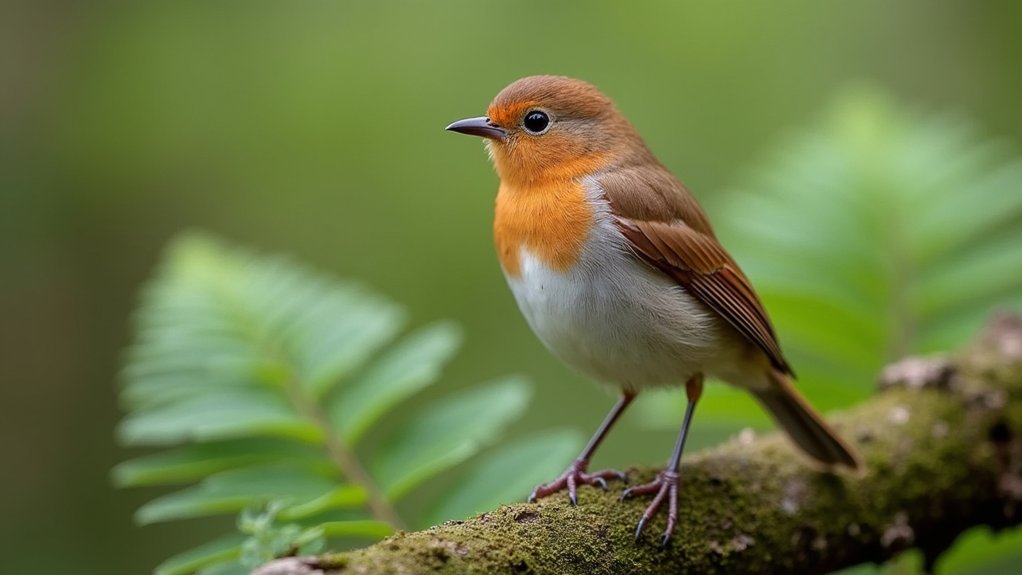
The Veery measures between 6.7 and 7.1 inches (17-18 cm) in length, placing it between the size of a Song Sparrow and an American Robin.
You’ll notice its plump body, which complements a wingspan measuring 11.0 to 11.4 inches (28-29 cm).
Its upperparts display a bright cinnamon-brown hue, while the underparts are pale and particularly lack distinct spotting, distinguishing it from Hermit and Wood Thrushes.
The creamy-colored throat with a buffy-orange cast and subtle brown mustache stripe provide additional subtle details.
With a small, thin bill and absence of bright colors, no red, blue, yellow, or green, the Veery’s warm tawny-brown coloration serves as effective camouflage within forest understory habitats.
This combination of precise physical traits defines the Veery’s characteristic profile.
Key Field Marks for Identification
You’ll notice the Veery’s head features a distinct brown malar stripe that contrasts sharply with its creamy, buffy-orange throat.
It’s a medium-sized bird—between 6.7 and 7.1 inches long—which makes it smaller than an American Robin but larger than a Song Sparrow. Plus, it has a compact, rounded body shape.
By focusing on these precise head and throat patterns along with its body size, you’ll be able to confidently identify this thrush in the field.
It really helps to zero in on those details when you’re out birdwatching.
Head and Throat Patterns
How can you distinguish a Veery by its head and throat patterns? Focus on the distinctive brown mustachial (malar) stripe that runs along the sides of its head. This stripe is a key field mark unique to the Veery among thrushes.
Its throat presents a creamy hue with a subtle buffy-orange cast, contrasting with the brighter or spotted throats of related species. Note the poorly defined eye-ring, which lacks the pronounced clarity seen in Hermit Thrushes.
Importantly, the Veery’s throat and breast lack the bold spotting common in similar thrush species. This is a critical identification point.
Body Size and Shape
Measuring between 6.7 to 7.1 inches in length and weighing 1.0 to 1.9 ounces, the Veery occupies a medium size niche among thrushes.
It’s smaller than an American Robin but larger than a Song Sparrow. Its plump body and round head create a distinctive silhouette, complemented by a small, thin bill.
The Veery’s wingspan ranges from 11.0 to 11.4 inches and is broad relative to its size, which helps with its characteristic flight.
You’ll notice its long legs and robust frame, adaptations that enable efficient foraging on the forest floor among leaf litter.
When identifying the Veery, focus on its body size and shape.
The combination of moderate length, substantial weight, and a plump body distinguishes it clearly from comparable-sized thrush species.
Size and Measurements Compared to Similar Species
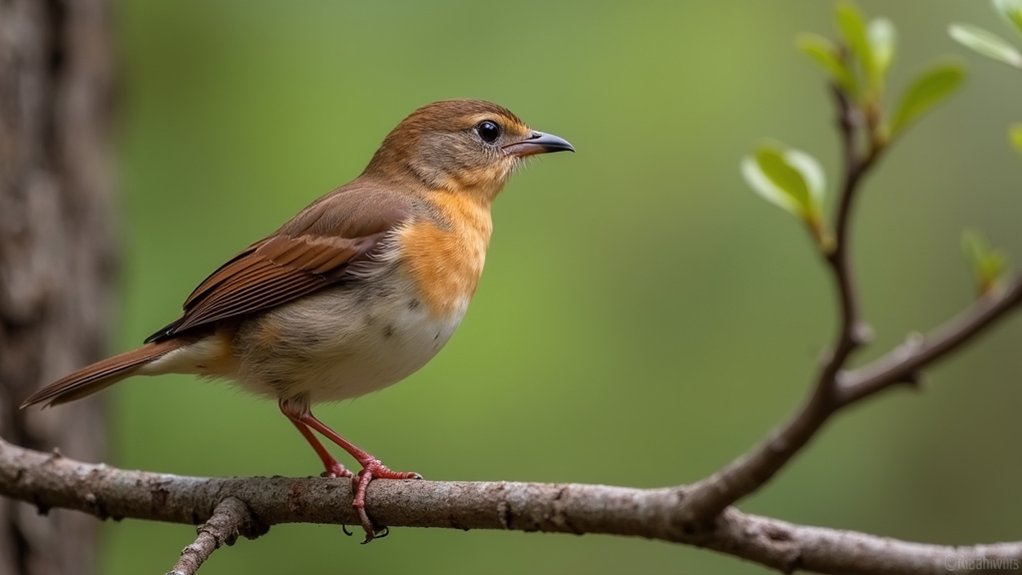
You’ll notice the Veery measures about 6.7 to 7.1 inches long, so it’s noticeably smaller than the American Robin, which usually runs around 9 to 11 inches.
In terms of weight, the Veery comes in between 1.0 to 1.9 ounces, putting it right in the middle size-wise for thrushes.
Knowing these differences can really help you tell the Veery apart from the larger Robin when you’re out in the field.
Veery vs. Robin
Size and proportions offer clear distinctions between the Veery and the American Robin.
The Veery measures 6.7-7.1 inches (17-18 cm) in length, noticeably smaller than the American Robin’s 9-11 inches (23-28 cm). The Veery weighs between 1.0-1.9 ounces (28-54 g), whereas the Robin is heavier at 2.7-3.2 ounces (77-91 g).
Wingspan further differentiates them: 11.0-11.4 inches (28-29 cm) for the Veery versus 12-15 inches (30-38 cm) for the Robin.
Morphologically, the Veery has a plump body, round head, and thin bill, contrasting with the Robin’s elongated body and thicker bill.
These size and proportion metrics, combined with structural differences, provide reliable criteria for distinguishing the Veery from the American Robin in the field.
Size Range Details
Three key measurements, length, weight, and wingspan, define the Veery’s physical profile and help differentiate it from similar thrush species. Understanding these size range details enables you to identify this bird accurately.
- Length: The Veery measures 6.7 to 7.1 inches (17–18 cm), smaller than an American Robin but larger than a Song Sparrow.
- Weight: It weighs between 1.0 to 1.9 ounces (28–54 g), making it relatively light among thrushes.
- Wingspan: Ranges from 11.0 to 11.4 inches (28–29 cm), featuring pointed or rounded wings.
- Comparison: Unlike the Hermit Thrush, the Veery lacks a reddish tail, and it doesn’t show bold spots like the Wood Thrush.
These precise size range details aid in distinguishing the Veery from similar species in its habitat.
Veery’s Coloration and Distinctive Patterns
Although the Veery’s uniformly bright cinnamon-brown upperparts offer effective camouflage within forest environments, its identification relies heavily on subtle coloration details.
The Veery’s coloration and distinctive patterns include pale underparts, with the throat exhibiting a creamy tone accented by a buffy-orange cast—features that differentiate it from similar thrushes.
Unlike the Hermit Thrush, the Veery lacks a reddish tail and doesn’t display spots along the front, resulting in a more streamlined appearance.
Moreover, the Wood Thrush shows bold, dark breast spots absent in the Veery’s plumage.
Note regional variation: northern Veery populations may show stronger chest spotting than southern ones, influencing identification accuracy depending on location.
Observing these precise coloration traits is essential for correct field identification.
Unique Songs and Calls of the Veery
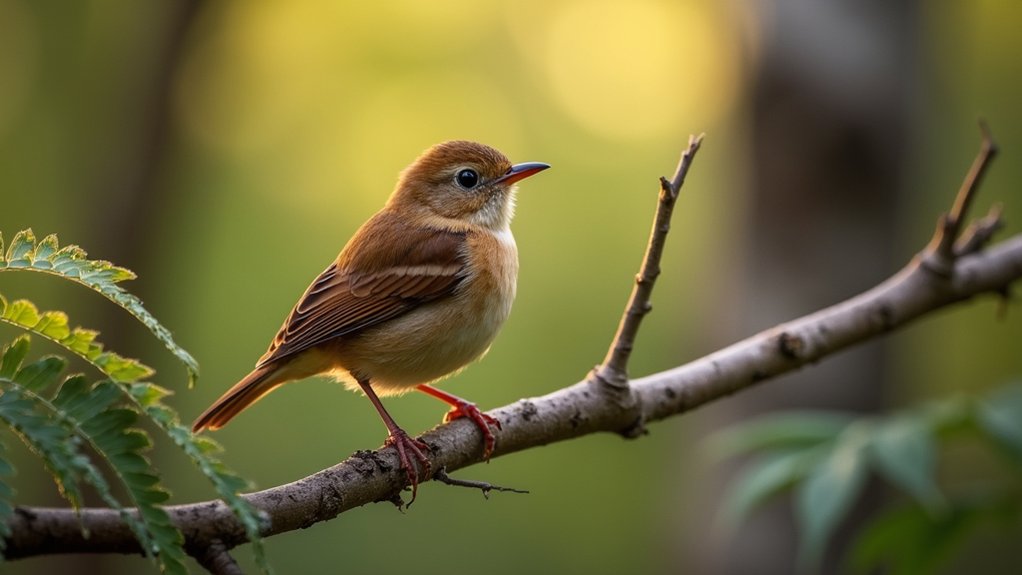
Veeries produce a distinct song characterized by a rich, ethereal quality that descends in pitch, creating a unique downward spiral effect.
To accurately identify the unique songs and calls of the Veery, focus on these key auditory features:
- The song exhibits a smooth, cascading rhythm that tapers downward in frequency.
- The call note is a singular, descending “whew,” serving as an immediate field identifier.
- Veeries sing primarily from the forest understory, making their calls spatially distinct.
- Their vocalizations are regarded as some of the most melodious among North American thrushes, enhancing recognition accuracy.
Habitat Preferences and Range
Understanding the Veery’s distinctive vocalizations provides insight into its behavior, but its presence in an area depends heavily on habitat conditions.
The Veery’s unique song reveals behavior, yet its presence hinges on suitable habitat conditions.
You’ll find Veeries primarily breeding in humid, deciduous forests across southern Canada and the northern United States. They favor sites with dense, well-developed understory vegetation.
This structural complexity supports essential nesting and foraging activities.
During migration, Veeries occupy various woodlots and densely vegetated habitats, optimizing cover and food availability. Their winter range shifts to tropical rainforests east of the Andes, where similar habitat features persist.
Nighttime migratory flights involve long distances, often with stopovers along the Gulf of Mexico and Caribbean coasts.
When identifying a Veery, consider these habitat preferences and range, as they critically influence where you’re likely to encounter this species in the wild.
Behavioral Traits Relevant to Identification
When you observe a bird hopping on the forest floor and flipping leaves to expose insects, you’re likely witnessing a distinctive foraging behavior characteristic of the Veery. This behavior aids precise identification alongside other key traits:
- Foraging involves systematic leaf flipping to uncover insect prey, especially during breeding season.
- The Veery’s song features a rich, ethereal quality with a descending pitch, serving as an auditory identifier.
- When startled, the bird emits a sharp scolding call, distinguishing it from sympatric thrush species.
- Seasonal diet shifts occur, with a change from insectivory to berry consumption in winter, reflecting adaptive foraging.
Recognizing these behavioral patterns, including the scolding call, improves your ability to identify the Veery in varied field conditions accurately.
Regional Variations Affecting Appearance
Although subtle, regional variations greatly influence the Veery’s plumage, with individuals in Newfoundland and western areas displaying darker brown tones and more pronounced chest spotting than those in eastern populations.
You’ll notice that western Veeries often have duller coloration overall, complicating differentiation from similar species like Swainson’s Thrush or Gray-cheeked Thrush.
Pay close attention to the lateral throat stripes, which tend to be darker in certain populations, adding a critical diagnostic feature.
Since habitat and geography affect these field marks, you must familiarize yourself with local Veery appearances for accurate identification.
Understanding these regional nuances helps prevent misidentification and improves your ability to distinguish Veeries reliably across their breeding range.
Frequently Asked Question
What Time of Year Is Best to Spot a Veery?
The best time to spot a Veery is during the summer months, from late May to early July, when they’re actively breeding in northern states and southern Canada.
You’ll also find them during migration periods in spring (April to May) and fall (September to October) as they travel.
Early mornings, especially around dawn, increase your chances since Veeries are more vocal and active then.
Focus on rich deciduous woodlands with well-developed understory for ideal observation.
Are Veeries Attracted to Backyard Bird Feeders?
Veeries aren’t drawn to backyard bird feeders; they symbolize the forest’s subtle rhythm, not the clatter of seeds.
You won’t find them at feeders because they specialize in foraging insects and berries on the forest floor, flipping leaves with precision.
If you want to attract them, focus on cultivating dense native shrubs and rich understory vegetation.
This replicates their natural habitat, providing the exact microenvironment they require to thrive and feed efficiently.
How Long Do Veeries Typically Live in the Wild?
Veeries typically live between 2 to 5 years in the wild, though some can reach up to 8 years under ideal conditions.
You should know their lifespan depends heavily on factors like predation, habitat quality, and food availability.
Young Veeries face higher mortality rates shortly after fledging.
Furthermore, environmental changes and climate shifts influence their survival and population dynamics, so their lifespan isn’t fixed but varies based on these conditions.
What Are Common Predators of the Veery?
Picture a Veery as a small target in a predator’s game of hide-and-seek. You’ll find hawks and owls swooping down, hunting them amid low vegetation.
Snakes and mammals like raccoons and domestic cats threaten their nests, especially during breeding. Blue Jays and crows raid eggs and nestlings, increasing vulnerability.
Habitat loss exposes Veeries to more danger, while migration brings unfamiliar predators, raising their risk considerably.
Can Veeries Be Kept as Pets Legally?
You can’t legally keep Veeries as pets without proper permits, as they’re protected under the Migratory Bird Treaty Act.
This federal law prohibits possession, capture, or sale of migratory birds without authorization. States often have additional regulations reinforcing this.
If you want to work with Veeries, you must obtain wildlife rehabilitation or educational permits.
Instead, focus on observing them in their natural habitats to support their conservation responsibly.
Conclusion
Now that you’ve honed your eye to spot the Veery’s subtle field marks and measured its size against lookalikes, you’re ready to distinguish this elusive thrush with precision. Like a seasoned detective piecing together clues, you’ll notice its warm, cinnamon hues and listen for its ethereal, downward-spiraling song.
With these detailed tools, you’ll confidently navigate habitats and regional shifts, making sure your identification is as exact as a well-calibrated instrument.