
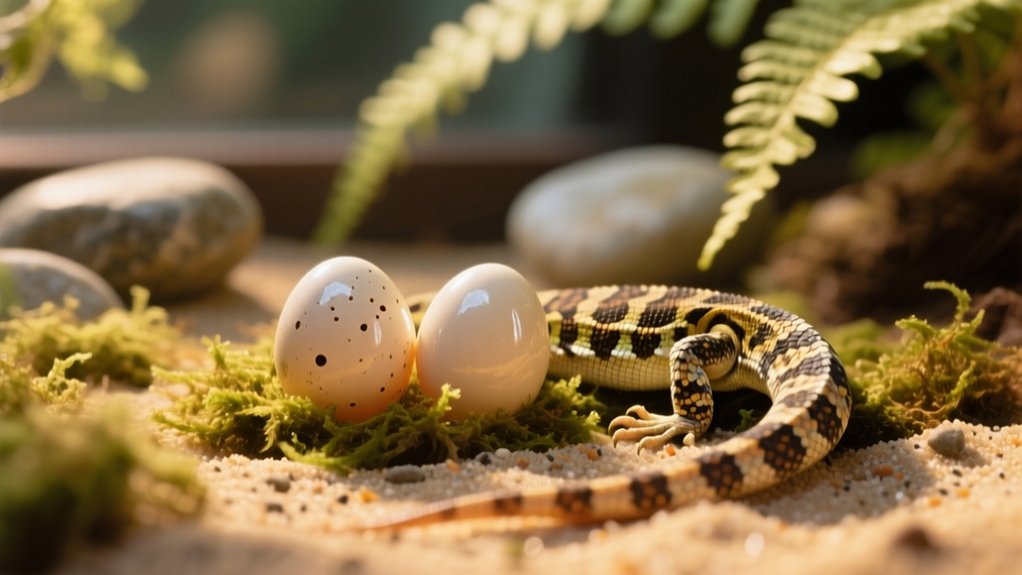
If you’re wondering what animals lay eggs but aren’t birds, reptiles like turtles and snakes do, along with amphibians such as frogs and salamanders. Fish lay eggs too, many in water, and insects have diverse egg-laying methods.
Unique among mammals, monotremes like the platypus lay leathery eggs. These eggs vary in structure and development based on their environments. Understanding these differences offers insight into how species have immersed their reproductive strategies across habitats and evolutionary lines.
Reptiles That Lay Eggs
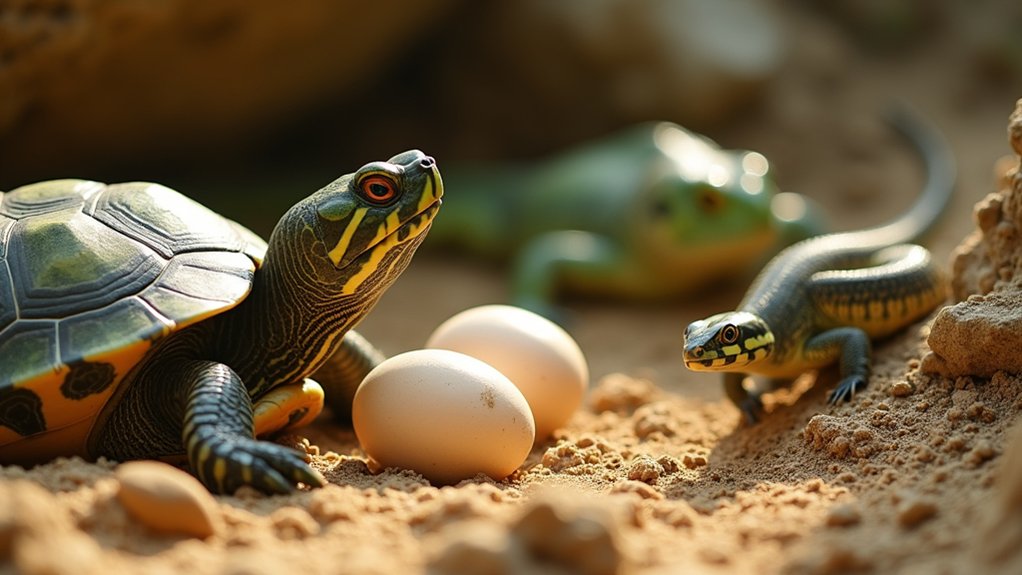
Egg-laying reptiles encompass a diverse group including snakes, turtles, lizards, and crocodilians, each utilizing oviparity as a primary reproductive strategy. You’ll find that snakes represent one of the largest oviparous groups, laying leathery eggs across various ecosystems.
Turtles produce hard-shelled eggs, providing strong protection. Lizards, including six-lined racerunners and slender glass lizards, primarily lay eggs, often with hard shells, especially geckos.
Crocodilians exclusively reproduce by laying hard-shelled eggs and actively guard their nests. Lepidosaurs, combining snakes and lizards, constitute the majority of egg-laying species.
Egg shell composition varies; leathery shells offer flexibility, while hard shells provide insulation and protection adapted to environmental conditions. These reptiles are cold-blooded vertebrates, relying on environmental heat sources to regulate their body temperature.
Understanding these reproductive adaptations reveals how egg-laying reptiles plunge into embryo development and survival across diverse habitats.
Amphibians and Their Egg-Laying Habits
Although amphibians share the trait of producing eggs, their reproductive strategies differ markedly from those of birds and reptiles. You’ll observe that amphibian eggs lack hard shells, instead encased in a gelatinous, jelly-like substance that keeps them moist, prevents desiccation, and offers protection from predators.
Fertilization varies: frogs and toads typically fertilize externally in water, while salamanders and caecilians use internal fertilization methods. You’ll find oviposition sites diverse; eggs may be laid in water, on vegetation, or even attached to a parent’s body. Some salamander species retain eggs inside their bodies, producing live young, showing an interesting variation in reproductive methods.
Fertilization methods and egg-laying sites vary widely among amphibians, showcasing their reproductive adaptability.
Amphibians produce large clutches, sometimes hundreds of eggs, compensating for low survival rates. Embryos develop aquatic larval stages, like tadpoles, adapting to water-based environments.
This flexible reproductive approach guarantees amphibians’ success across varied habitats.
Egg-Laying Fish Species
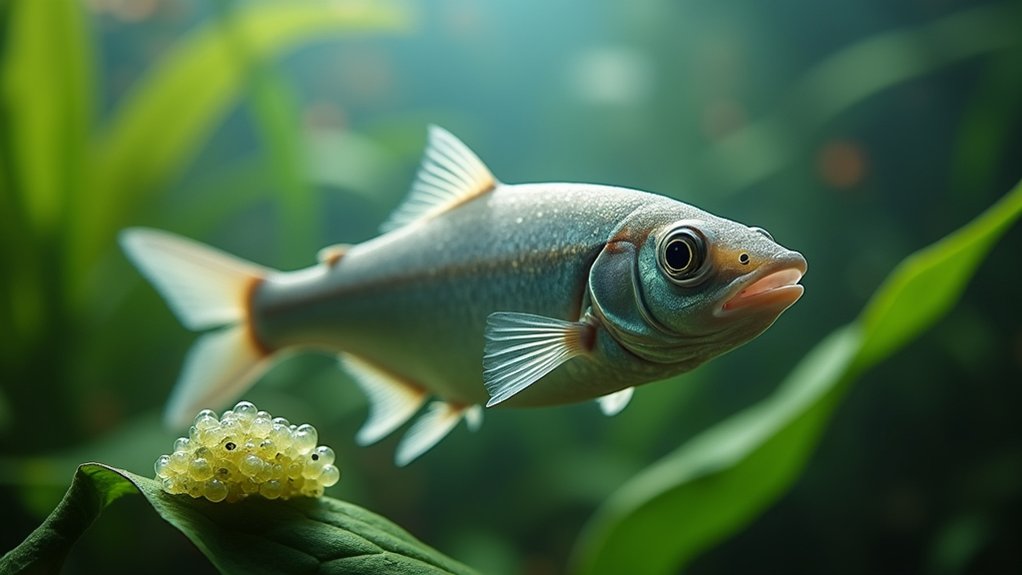
When you observe fish reproduction, you’ll notice diverse strategies for egg deposition, each adapted to specific environmental conditions and species behaviors.
Egg scatterers like cardinal tetras and goldfish release sticky or nonsticky eggs, which males fertilize externally without subsequent parental care.
Egg depositors such as rainbow fish and clownfish lay adhesive eggs on substrates, with fertilization occurring as males swim by. Success depends on water quality.
Nest builders, including bass and bettas, construct nests from materials or bubbles, providing male parental care post-spawning. Some livebearers, like guppies, bypass egg-laying entirely by giving birth to live young, requiring dense foliage and gentle filtration for breeding success livebearer breeding.
Cichlids exhibit biparental care or maternal mouthbrooding, enhancing offspring survival through protection and oxygenation.
Labyrinth fish, like kissing gouramis, broadcast floating eggs or maintain bubble nests, with males guarding eggs.
These reproductive adaptations reflect evolutionary responses to varying ecological niches and survival challenges.
Insects: Diverse Egg-Laying Strategies
Fish employ a range of reproductive strategies that maximize egg survival in aquatic environments, but insects have evolved an even broader array of egg-laying behaviors tailored to diverse terrestrial and aquatic habitats.
You’ll find insects placing eggs individually in soil crevices or gluing them to plant surfaces and rocks, sometimes piercing leaf tissue directly. They use chemical cues to select ideal substrates, enhancing offspring survival.
Insects also disperse eggs by dropping or throwing them to minimize clustering, reducing predation risk. Protective coatings, such as plant material or fecal pellets mixed with salivary secretions, shield eggs from environmental threats.
Specialized structures like capitula promote ant-mediated dispersal, while complex oothecae organize multiple eggs for development. The formation of these oothecae represents an important evolutionary shift from scattered eggs to concentrated egg deposition.
Behavioral adaptations include substrate selection based on nutrition and shelter, illustrating insects’ sophisticated reproductive strategies across varied environments.
Monotreme Mammals: Unique Egg Layers
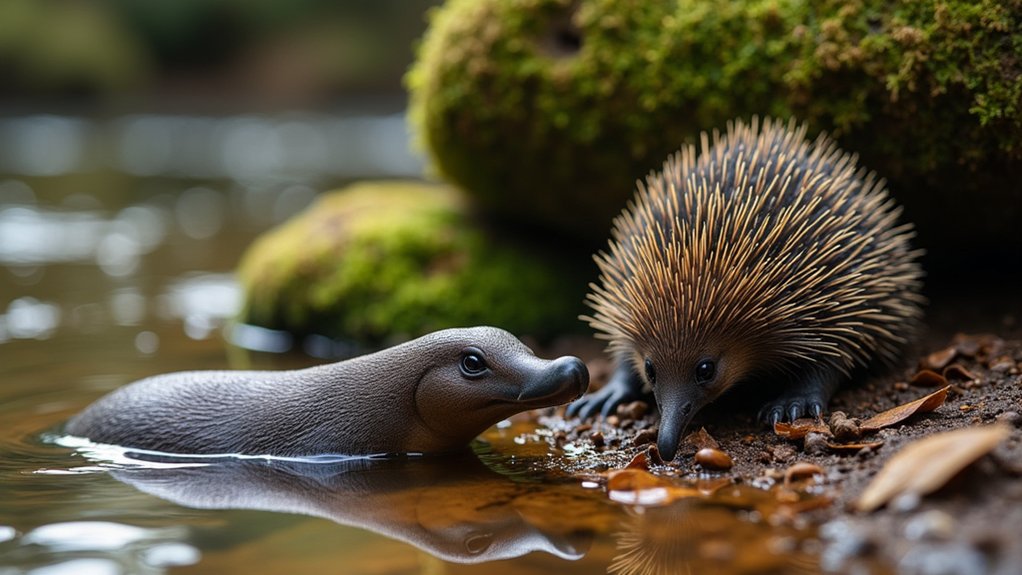
Because monotreme mammals lay eggs, they represent a rare and primitive branch of the mammalian lineage distinct from marsupials and placentals.
These mammals, including the platypus and echidnas, retain ancient reproductive traits reflecting their oviparous ancestry.
You’ll find monotremes possess:
- Eggs with flexible, leathery shells covered in albumen, similar to reptilian eggs
- Separate female oviducts opening into the cloaca for fertilization
- Electroreceptive snouts specialized for detecting prey
- Milk secreted through skin openings rather than teats for feeding hatchlings
- Prolonged parental care compensating for low reproductive rates
Monotremes also have a unique cloacal structure that serves both reproductive and excretory functions, a feature uncommon among mammals.
Their distribution is confined to Australia, Tasmania, and New Guinea, highlighting their unique evolutionary path as the only extant egg-laying mammals.
Crustaceans and Their Egg-Carrying Techniques
Egg-laying is not exclusive to mammals like monotremes; crustaceans also exhibit diverse and specialized reproductive strategies involving egg production and care. You’ll find vitellogenesis—a neuroendocrine-coordinated, energy-intensive process—critical for egg maturation. This process is influenced by environmental factors like temperature and salinity.
Crustacean eggs possess multi-layered vitelline membranes formed with follicular cell cooperation. These membranes provide osmotic protection to developing embryos. Many species store sperm internally for delayed fertilization, which optimizes reproductive timing.
This table summarizes key aspects:
| Aspect | Mechanism | Function |
|---|---|---|
| Vitellogenesis | XO/SG neuropeptides & environment | Egg maturation regulation |
| Egg Membrane | Vitelline & fertilization envelopes | Embryo protection & isolation |
| Fertilization | Internal or external post-molt | Guarantees sperm-egg interaction |
| Sperm Storage | Internal retention | Enables multiple paternity |
| Embryonic Osmoreg. | Embryo and maternal fluid control | Environmental stress buffering |
Differences Between Reptile and Amphibian Eggs
When you look at the texture and color of the eggs, you’ll notice that reptile eggs have leathery or sometimes brittle shells. On the other hand, amphibian eggs are soft and jelly-like. It’s pretty interesting how different they feel, right?
Also, reptiles usually lay their eggs on land, often in protected nests to keep them safe. Amphibians, however, tend to deposit their eggs in water. So, their eggs are more aquatic by nature. This difference reflects their distinct habitats and water needs.
Another cool difference is that reptile embryos develop inside amniotic membranes. When they hatch, they look like miniature versions of adults.
Amphibians are quite different—they hatch as larvae and then go through metamorphosis to become adults. It’s a fascinating process!
Egg Texture and Color
Although both reptiles and amphibians lay eggs, their egg textures and colors differ markedly due to distinct adaptations.
Reptile eggs typically have soft, leathery shells composed mainly of keratin, sometimes reinforced with calcium carbonate. This provides flexible protection.
Amphibian eggs lack rigid shells. Instead, they’re encased in gelatinous membranes that require moisture to maintain integrity. These membranes also make amphibian eggs more vulnerable to pollutants in their aquatic environment such as food coloring representing pollution.
Coloration varies widely. Amphibian egg masses may be transparent, opaque, or greenish due to symbiotic algae.
Reptile eggs often exhibit speckling or surface patterns but have limited transparency.
Reptile eggs possess leathery, protective casings.
Amphibian eggs have gelatinous, moisture-dependent membranes.
Amphibian egg color ranges from clear to opaque and greenish.
Reptile shells may be more rigid with calcium carbonate.
Transparency in amphibian eggs affects light exposure during development.
Nesting Environments
The textures and colors of eggs reflect adaptations to their nesting environments, which vary considerably between reptiles and amphibians. You’ll find amphibians depositing hundreds of jelly-like, shell-less eggs in water or damp areas, relying on external moisture to prevent desiccation. Their eggs require proximity to saturated soils or freshwater habitats to guarantee embryonic survival. Amphibian eggs are soft and lack hard coverings, which is why they need to be laid in moist environments.
In contrast, reptiles lay amniotic eggs with hard or leathery shells on land, even if they inhabit aquatic environments. These shells act as semi-permeable barriers, retaining water and nutrients, allowing reptiles to reduce dependency on water during development. Reptilian eggs also contain an amniotic membrane, which protects the embryo and facilitates gas exchange, a key adaptation for terrestrial life amniotic eggs.
Although some aquatic reptiles, like sea turtles, nest on beaches, reptiles generally choose protected terrestrial sites. These nesting strategies highlight distinct evolutionary adaptations.
Amphibians depend on moist or aquatic environments, while reptiles have evolved terrestrial reproductive independence through specialized egg structures.
Developmental Processes
Because reptile and amphibian eggs have evolved under distinct environmental pressures, their developmental processes exhibit fundamental differences.
You’ll notice reptiles lay eggs with leathery or hard shells that protect embryos via amniotic membranes, enabling terrestrial development.
Amphibian eggs lack protective shells and rely on aquatic or moist habitats for survival.
Key distinctions include:
- Reptile eggs retain water and allow gas exchange while restricting desiccation
- Amphibian eggs have gelatinous, permeable coverings requiring moist environments
- Reptile embryos develop directly into miniature adults without metamorphosis
- Amphibian embryos hatch as larvae (tadpoles) and undergo metamorphosis
- Reptile eggs can incubate on land; amphibian eggs depend on water for development
- The presence of extra-embryonic membranes such as the chorion, amnion, and allantois in reptile eggs facilitates respiration and waste storage, which amphibian eggs lack.
Understanding these differences clarifies how evolutionary adaptations shape embryonic growth in non-avian egg-laying animals.
How Fish Eggs Adapt to Aquatic Environments
When you examine fish eggs, you’ll find they possess specialized adaptations that guarantee survival in diverse aquatic environments. Modern teleosts, for example, fill pre-ovulated eggs with water to maintain osmotic balance, enabling survival in saline conditions.
The perivitelline space’s water content varies among species, influencing osmoregulation and allowing oceanic dispersal. Fish also produce eggs with specific gravities tailored for buoyancy, optimizing their vertical distribution according to ambient salinity and spawning habitat.
Furthermore, embryos exhibit thermal adaptation; temperature affects development and hatching timing through phenotypic plasticity. Fish eggs respond to environmental stressors like predation and oxygen depletion by modifying hatching behavior, enhancing survival.
Many fish species rely on external fertilization, where eggs are fertilized outside the female’s body, often in water, which is crucial for their reproductive success.
These intricate physiological and behavioral adjustments reflect evolutionary solutions to the challenges of aquatic life, ensuring successful embryonic development across a range of conditions.
The Role of Environment in Insect Egg-Laying
When insects choose where to lay their eggs, they pay close attention to environmental signals like carbon dioxide from plants and the temperature around them. These cues are really important because they’ve a direct impact on whether the eggs survive and how well the larvae develop. However, rising atmospheric CO₂ levels can disrupt these crucial chemical cues, threatening egg-laying behavior and insect survival.
Usually, insects lay their eggs in groups rather than just one at a time. They also often cover their eggs with protective layers. This helps keep the eggs safe from predators and tough environmental conditions.
Habitat Influence on Oviposition
Although environmental factors like temperature and photoperiod greatly influence insect oviposition, the habitat type and location play a crucial role in determining egg-laying behavior.
You’ll find that insects select oviposition sites based on microhabitat features that directly impact offspring survival.
For example, rural and urban habitats differ markedly in oviposition activity, and placement height of substrates affects egg deposition rates.
Key points to reflect on include:
- Rural vs. urban habitats strongly affect oviposition patterns
- Ground-level substrates yield higher egg deposition than raised ones
- Aquatic larval ecology guides female oviposition site choice
- Females may concentrate or disperse eggs depending on habitat structure
- Site selection influences offspring access to nutrients and survival chances
Many egg-laying animals, including insects, show diverse nesting behaviors that enhance egg protection and development, highlighting the importance of protective strategies.
Understanding these habitat influences is crucial for comprehending insect reproductive strategies.
Egg Cluster Adaptations
Since environmental conditions directly impact egg survival, insect species have evolved diverse egg cluster adaptations to enhance protection and developmental success. You’ll find protective structures like oothecae that shield eggs from desiccation, predators, and parasitoids. Grasshoppers, for example, embed eggs in soil within a hardening foamy matrix that adheres to surrounding particles, improving survival. These adaptations vary widely yet converge functionally across insect orders. Moreover, females select oviposition sites based on temperature and host plant quality, ensuring prime conditions for embryo development. Egg clusters also exhibit phenotypic plasticity, adjusting traits in response to environmental cues. Mothers of some species even move eggs after laying to optimize thermal exposure and increase hatching success, demonstrating active post-oviposition care egg movement. This dynamic interaction between eggs and environment, including microbial influences, not only safeguards embryos but also affects plant defenses and future oviposition behavior, demonstrating a complex, adaptive strategy to environmental challenges.
Parental Care Variations Among Egg-Laying Animals
How do egg-laying animals differ in their approaches to parental care? You’ll find that care strategies vary widely, influenced by species, fertilization mode, and environment.
Egg-laying animals exhibit diverse parental care strategies shaped by species, fertilization type, and habitat conditions.
For amphibians, parental care is relatively rare but diverse, including egg attendance and tadpole transport. Males often provide care in externally fertilizing species, whereas females tend to care in internal fertilization contexts. Larger eggs and terrestrial laying environments correlate with increased care intensity.
Consider these key variations:
- Egg attendance is the primary care mode among amphibians.
- Male care dominates in species with external fertilization.
- Parental care associates with larger egg size and smaller clutch size.
- Some fish mouthbrood eggs, providing protection until hatching.
- Male guardian frogs transport tadpoles to safer aquatic sites.
These strategies optimize offspring survival across diverse taxa.
Frequently Asked Question
How Do Egg-Laying Animals Protect Their Eggs From Predators?
You protect eggs from predators by using various strategies.
Many animals bury eggs deep underground or in concealed locations to reduce detection. Hard, leathery shells provide physical barriers against predators and environmental stress.
You might build nests with camouflage or structural defenses and choose raised or hidden sites.
Some species carry eggs on their bodies, ensuring constant protection and deterring threats.
These combined methods enhance egg survival rates greatly.
What Temperature Ranges Are Ideal for Incubating Eggs in Non-Bird Species?
You might think all eggs need the same warmth, but incubation temperatures vary widely among non-bird species.
Reptile eggs develop best between 25°C and 32°C, influenced by sun exposure and nest depth.
Amphibian eggs need stable aquatic temperatures around 20°C to 25°C.
Monotreme eggs incubate near maternal body heat, roughly 30°C to 33°C.
Precise temperature control is essential, as fluctuations can impact embryo survival and sex determination in reptiles.
How Long Does It Take for Eggs to Hatch in Different Animal Groups?
You’ll find that incubation periods vary widely: reptile eggs, like those of lizards, take about a month or more to hatch.
Amphibian eggs, laid in water, develop over days or weeks depending on species and environment.
Insects show diverse hatching times, from days to weeks, influenced by species and temperature.
Monotreme eggs, such as platypus, have less documented incubation durations but usually hatch within a few weeks, reflecting their unique physiology.
Are There Any Egg-Laying Animals That Also Give Live Birth Sometimes?
Though you might think of the Renaissance era as purely historical, nature’s complexity rivals any invention from that time.
Yes, some animals that typically lay eggs can give live birth occasionally.
Certain snakes and lizards exhibit ovoviviparity, where eggs hatch inside the mother’s body, and she then gives birth to live young.
This reproductive flexibility helps them adapt to varying environmental conditions, ensuring better offspring survival rates in specific habitats.
What Are the Nutritional Differences in Eggs Among Various Egg-Laying Animals?
You’ll find that nutritional content varies widely among eggs from different animals.
For example, reptile eggs generally contain more fat and fewer proteins than bird eggs.
Fish eggs, like caviar, are rich in omega-3 fatty acids.
Amphibian eggs often have lower caloric density and protein.
Monotreme eggs, such as those from the platypus, show unique lipid profiles.
To get precise data, you should consult specialized nutritional studies comparing these species directly.
Conclusion
You might find it surprising that over 1,000 species of reptiles lay eggs, far beyond just birds. This diversity shows how egg-laying spans multiple animal groups, from amphibians to monotreme mammals like the platypus.
Understanding these differences helps you appreciate the evolutionary adaptations each group has developed. By investigating their unique reproductive strategies, you gain insight into how environment and biology shape survival across the animal kingdom.