

You’ll find a wide variety of animals that eat birds, including mammals like domestic cats, raccoons, foxes, and mustelids. These animals attack nestlings and adults using stealth and ambush tactics.
Raptors such as hawks, eagles, owls, and falcons employ sharp talons and keen senses to hunt prey mid-flight or at night. Reptiles like snakes and crocodilians, plus aquatic predators including fish and marine mammals, also prey on birds.
Exploring these predator types reveals complex hunting strategies and avian survival adaptations.
Mammalian Predators of Birds
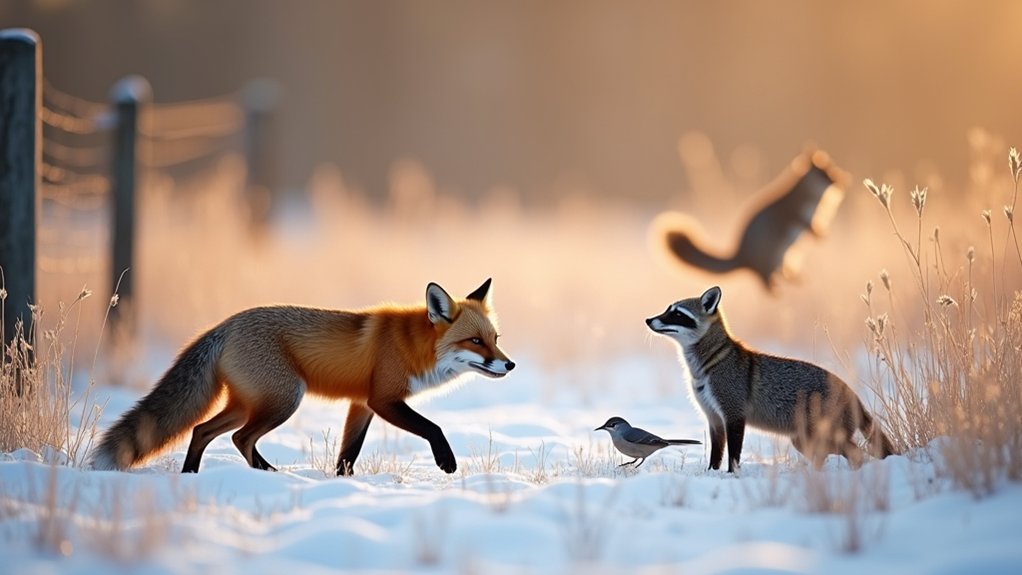
Although birds have evolved numerous adaptations to evade predation, mammalian predators continue to exert significant pressure on their populations.
You’ll find domestic cats responsible for millions of bird deaths annually, while wild felines like bobcats and lynxes use keen sight and stealth to ambush prey.
Cats, both domestic and feral, kill approximately 1.3 to 4 billion wild birds yearly, making them one of the most impactful predators.
Canine predators such as coyotes and foxes stalk birds like quail and wild turkey. Wolves opportunistically feed on birds when larger prey is scarce.
Mustelids including weasels and stoats enter burrows and breach birdhouses, targeting chickens and game birds.
Primates like baboons hunt birds from raised positions, caching kills for later. Chimpanzees use tools to capture birds.
Other mammals, including raccoons and squirrels, raid nests and feeders, while Australian marsupials and coastal otters prey opportunistically on birds.
Raccoons, being nocturnal mammals, often raid nests for baby birds and eggs, using their stealthy hunting style to catch sleeping birds at night.
Reptilian Predators Targeting Birds
You’ll notice that many snakes use ambush tactics. They often lunge at birds perched nearby or raid nests to constrict and swallow their prey whole.
Lizards, like monitors and tegus, don’t just wait around—they actively climb to reach eggs and nestlings, using their strength and persistence to get the job done.
Even crocodilians join in, opportunistically snatching birds near the water.
It really shows how diverse reptilian strategies are when it comes to targeting birds.
Snake Hunting Techniques
When snakes hunt birds, they use a range of specialized techniques that exploit the birds’ vulnerabilities. You’ll see constrictor species like boas and pythons use sudden lunging strikes on perched birds, capturing them when they’re unaware.
Then, they apply constriction to immobilize the prey before swallowing.
Snakes also show impressive climbing ability, which lets them access tree and shrub nests to prey on eggs and vulnerable chicks during early development.
Species such as the African Boomslang and Rat Snake specialize in nest raiding by moving through arboreal sites. Knowing the primary hunting locations—poultry farms, nest colonies, and perching areas—shows where birds face higher predation risk.
Understanding these strategies helps clarify how snake body size, strength, and habitat influence hunting success. In contrast, some bird predators like the Secretary Bird use incredibly fast and forceful kicks, striking with a force of 195 Newtons to hunt snakes effectively.
Meanwhile, birds use defensive behaviors to reduce these risks.
Lizard Bird Predation
Snakes aren’t the only reptiles preying on birds; monitor lizards and tegus also play notable roles as avian predators. Monitor lizards, highly carnivorous, actively consume birds, eggs, and small vertebrates. Juveniles favor invertebrates, while adults target a broader prey spectrum, influenced by species and habitat.
In Florida, Nile monitors, exceeding seven feet, hunt burrow-nesting birds like Burrowing Owls, using expert burrowing and swimming skills.
Tegus, omnivorous but powerful feeders, consume ground-nesting bird eggs such as quail and turkey. Their dense populations in Florida, nicknamed “Tegulandia,” escalate predation pressure.
Both species use stealth and strong jaws to access nests and capture prey efficiently.
This invasive lizard predation notably threatens native ground-dwelling bird populations, disrupting ecosystem balance and elevating extinction risks for vulnerable species.
Crocodile Bird Attacks
Although crocodiles are well-known apex predators in aquatic environments, their role as bird predators remains less documented and understood. Current research lacks specific data on crocodile attacks targeting birds, including the frequency, involved species, and geographic distribution of such predation events. Nile crocodiles and saltwater crocodiles are responsible for hundreds of fatal attacks on humans annually, highlighting their significant predatory capacity in certain regions (notorious for attacks). While crocodiles may opportunistically prey on birds near water bodies, detailed behavioral studies and empirical evidence are insufficient to characterize these interactions accurately.
To gain a thorough understanding of crocodile bird predation, researchers would need to conduct focused field observations and gather data on crocodilian hunting behavior concerning avian species. Until such information is available, crocodile predation on birds remains an area requiring further scientific investigation rather than a well-established predator-prey dynamic.
Avian Birds of Prey and Raptors
You’ll notice that Accipiters really depend on stealth and quick bursts of speed to catch their prey. They usually launch their attack from hidden spots and use their long tails to make sharp, agile turns.
Peregrine falcons, on the other hand, are famous for their incredible high-speed dives, sometimes going over 200 miles per hour to knock out their targets right in mid-air. Falcons and kestrels are medium-sized with long pointed wings and are swift flyers, which aids in their hunting success.
Then there are eagles, hawks, and owls, which have a whole variety of hunting techniques. They mix sharp senses with powerful talons to grab all kinds of vertebrate prey. For example, owls have acute hearing and nocturnal eyesight enabling silent flight during hunting.
It’s pretty fascinating how each bird has its own style!
Accipiters’ Stealth Hunting
When you observe accipiters hunting, you’ll notice their strategy relies heavily on stealth and surprise. These birds perch quietly, using dense cover to remain undetected before launching explosive speed attacks. A striking fact about accipiters is that about 20% of studied specimens have healed pelvic girdle fractures, highlighting their resilience despite risky high-speed chases through vegetation (healed pelvic fractures).
Their physical adaptations, like long rudder-like tails and short, rounded wings, enable agile, precise flight through woodlands. Females, larger than males, expand the prey size range.
Accipiters exploit cognitive skills, anticipating prey movements and using urban structures for cover during hunting.
| Aspect | Adaptation/Behavior | Function |
|---|---|---|
| Tail | Long, rudder-like | Precise cornering |
| Wings | Short, rounded | Rapid acceleration, maneuvering |
| Hunting method | Sit-and-wait, perch-to-perch | Stealth approach, surprise attack |
| Cognitive ability | Prey behavior prediction | Improved hunting success |
| Urban adaptation | Use buildings, cars as cover | Improved ambush in cities |
Peregrine Falcon Attacks
The peregrine falcon employs a remarkable hunting technique known as the stoop, a controlled high-speed plunge from great heights that can reach nearly 200 mph.
You’ll observe it folds its wings and tail to minimize drag, diving thousands of feet vertically. At the moment of attack, it strikes prey mid-air with a clenched foot, delivering a knockout blow.
Key aspects include:
- Folding wings and tail for aerodynamic speed during the stoop.
- Using a fist-like talon strike to stun or kill prey instantly.
- Employing acrobatic flight maneuvers to pursue missed targets.
Most hunting occurs at dawn and dusk, focusing on airborne prey, with occasional ground attacks on larger or disoriented targets. The falcon’s thick fluid production protects its eyes during high-speed flight, ensuring clear vision throughout the stoop.
This showcases precise adaptations for high-speed aerial predation.
Eagles, Hawks, Owls
Three primary groups of avian predators, eagles, hawks, and owls, show diverse adaptations that optimize their hunting efficiency across various environments and times of day.
Eagles are apex predators with powerful talons; they tackle prey larger than themselves, including mammals and birds. They often transport kills to nests or consume them on-site. The harpy eagle, known for being the heaviest and strongest of eagles, can weigh up to 9 kilograms.
Hawks are diurnal forest hunters. They use acute vision and quick maneuvers to ambush prey, leaving distinctive plucked feathers arranged in “fairy rings.”
Owls, being nocturnal and crepuscular, rely on exceptional hearing and silent flight to locate prey. They often carry prey away before consumption.
All possess sharp talons and hooked beaks for capture and dismemberment.
These raptors play significant roles in ecosystem balance by regulating prey populations. They demonstrate specialized hunting strategies and physical traits suited to their ecological niches.
Aquatic Predators That Hunt Birds
Although aquatic environments may seem inhospitable for avian predators, numerous marine and freshwater species have evolved effective hunting strategies that target birds.
You’ll find that these predators exploit birds’ dependence on water for feeding or resting, making them vulnerable.
Here are three notable aquatic predator groups:
- Marine Mammals: Orcas actively chase seabirds like murres and grebes, while sea otters prey on loons, gulls, and cormorants. River otters hunt storm-petrels and pelicans in coastal zones. In some regions, pinnipeds such as Cape fur seals have been documented significantly impacting fledgling seabird populations, illustrating their role as formidable bird predators.
- Crocodilians: American and estuarine crocodiles opportunistically capture cormorants, jaegers, and other waterfowl in brackish to saltwater environments.
- Fish and Sharks: Tigerfish leap to seize birds near the water surface; sharks prey on exhausted migrating birds, including swifts and warblers, especially during open-water crossings. Additionally, bony fish such as Pacific cod have been observed scavenging seabirds, showing that fish contribute to avian predation both actively and opportunistically.
Invertebrate Predators of Birds
When considering the range of predators that target birds, you might be surprised to learn that invertebrates also play a role, albeit less documented than vertebrate hunters.
Evidence suggests certain large predatory insects and arachnids, such as praying mantises and spiders, can occasionally prey on small birds or nestlings.
However, detailed scientific data on invertebrate predation of birds remain scarce. This scarcity limits thorough understanding of their ecological impact compared to vertebrate predators like mammals, reptiles, or birds of prey.
While invertebrates may opportunistically capture vulnerable juvenile birds, their role as significant avian predators isn’t well established.
Among vertebrate predators, some raptors like the Eurasian Eagle Owl are known to prey on small mammals and birds, highlighting the diversity of bird predators.
To fully grasp the extent of invertebrate predation on birds, further targeted research and observation are necessary.
At present, their contribution remains a minor and underexplored component of the broader predator-prey dynamics involving birds.
Amphibian Predators Feeding on Birds
If you’ve ever observed amphibians in their natural habitats, you mightn’t immediately regard them as predators of birds. Yet some species do occasionally prey on avian animals.
Amphibians, primarily frogs and toads, may capture small birds opportunistically, especially nestlings or fledglings near water bodies.
Scientific evidence on this behavior remains limited, but here are key points to reflect upon:
- Large amphibians such as bullfrogs can seize small birds if the opportunity arises.
- Predation mainly occurs during amphibians’ active hunting periods at night or dawn.
- Such events are rare and generally involve juvenile or vulnerable birds rather than adults.
Domestic and Feral Cat Impact on Bird Populations
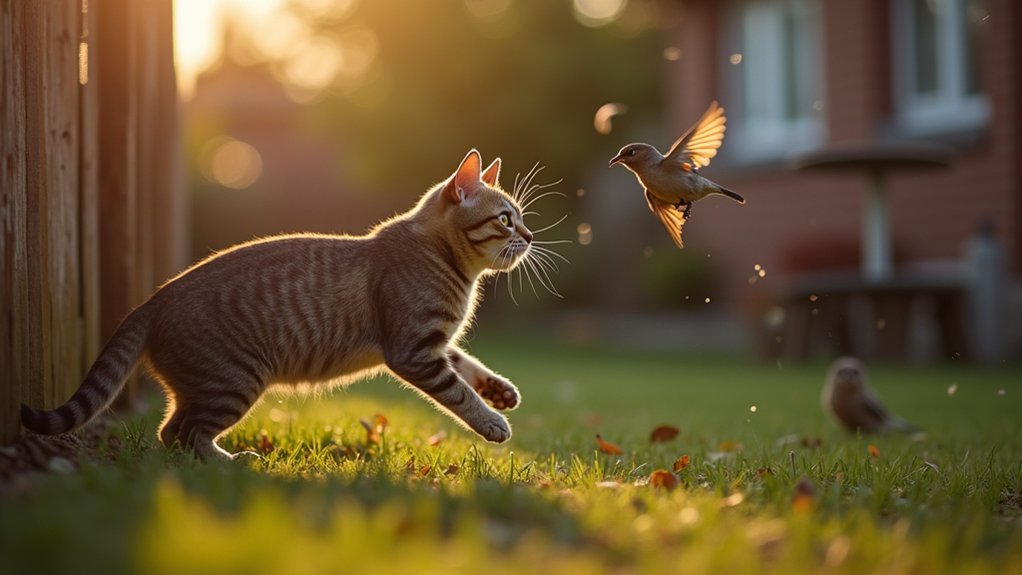
You see, domestic and feral cats show pretty different hunting habits that really impact local bird populations.
Interestingly, cats without owners tend to kill more birds each year compared to pet cats that are allowed outside. Because of this, these un-owned cats put a lot of pressure on bird communities. In some areas, the impact of scavengers is reduced due to cats quickly removing bird carcasses, which can affect how nutrients are recycled in the ecosystem.
This kind of predation can actually cause noticeable drops in how many birds survive and reproduce in these areas. Studies estimate that free-ranging domestic cats kill between 1.3 and 4.0 billion birds annually in the United States alone, highlighting their role as a significant source of bird mortality.
Predation Behavior Patterns
Although domestic and feral cats receive supplemental feeding, they continue to exhibit strong predation behaviors that greatly impact bird populations. Their hunting technique involves stalking prey with crouched movement, followed by a rapid sprint and precise paw strikes.
You should know these key behavioral patterns:
- Cats kill 10–20 prey daily to meet energy needs, regardless of feeding. This is because cats are obligate carnivores requiring meat for survival and nutrition.
- Urban cats kill roughly three times more birds than rural cats, influenced by environment and prey availability.
- Owners often underestimate kills; many prey are consumed or left undiscovered, skewing impact assessments.
This predation persists year-round but intensifies during spring and summer when cats spend more time outdoors.
Despite supplemental feeding, cats remain obligate hunters, posing significant threats to native and non-native bird species alike.
Population Decline Effects
The persistent predation behaviors of domestic and feral cats directly contribute to significant declines in bird populations across the United States.
Cats kill an estimated 1.3 to 4 billion birds annually, with unowned cats responsible for approximately 69% of this mortality.
This intense predation reduces bird population productivity by about 12%, with cats taking 10–15% of individual bird populations each year.
They cause 33% of egg fatalities, 20% of nestling deaths, and 10% of fledgling losses, impacting one-third of native species facing decline.
Outdoor cats represent the leading source of human-related bird mortality, surpassing all other anthropogenic causes combined.
Maintaining bird feeders at least 10 to 12 feet away from hiding spots for cats can help reduce predation risks.
You should recognize that managing feral and unowned cat populations is critical to mitigating these population-level effects and preserving native bird biodiversity.
Nocturnal Mammals and Their Bird Predation
When nocturnal mammals hunt for birds, they utilize the darkness to target vulnerable prey during resting periods. You’ll notice this behavior in raccoons, foxes, and coyotes. Each uses unique adaptations to capture birds efficiently.
- Raccoons use their masked vision and climbing skills to raid tree nests. They prey on nestlings in forested and urban areas. Raccoons are also known to consume adult birds when the opportunity arises due to their opportunistic feeding habits raiding nests.
- Foxes stealthily stalk small birds like sparrows and finches. They rely on sharp claws and pouncing techniques during nocturnal hours.
- Coyotes focus on ground-dwelling birds such as quail and wild turkey. They employ stalking behaviors in mountain and forest habitats.
These mammals capitalize on nocturnal activity patterns and specialized hunting methods to access birds during their most defenseless states.
Predatory Fish Species Attacking Birds
Predators of birds extend beyond terrestrial mammals into aquatic environments, where several fish species actively hunt avian prey. The Wels Catfish, Europe’s second largest freshwater fish, uses its massive size to capture pigeons and waterfowl.
In the Indo-Pacific, Giant Trevally coordinate attacks on surface terns, targeting fledglings with limited flight skills.
African Goliath Tiger Fish time their strikes to coincide with bird migrations, preying on low-flying species like barn swallows.
Monkfish, primarily nocturnal, opportunistically consume little auks during migrations, though bird predation is incidental.
Tiger Sharks exhibit surface-stalking techniques to ambush sea birds, launching explosive assaults from below.
These fish demonstrate diverse hunting strategies, emphasizing the aquatic dimension of avian predation and highlighting the complex predator-prey dynamics between birds and fish.
Human Influence on Bird Predation and Population Decline
Although human activities rarely involve direct predation, they greatly influence bird mortality and population declines through various mechanisms. You should consider these key factors:
Human activities indirectly impact bird populations, driving mortality and declines through various environmental pressures.
- Direct Mortality: Outdoor and feral cats cause the largest human-related bird deaths, alongside collisions with buildings, vehicles, and power lines. Estimates suggest that domestic cats kill an estimated 2.4 billion birds annually, making them the most significant human-associated cause of bird mortality in North America. The presence of avian flu outbreaks can also increase bird deaths, especially when human feeding practices inadvertently contribute to the spread of disease.
- Behavioral Changes: Birds habituate to human presence, reducing their flight initiation distance and increasing vulnerability to predators.
- Nesting Disturbance: Repeated human disturbance forces parents to abandon nests, raising predation risk on eggs and chicks and reducing reproductive success.
These impacts collectively alter local population structures and threaten species survival.
Understanding these human influences is essential for developing effective conservation strategies aimed at mitigating indirect predation pressures and preserving avian biodiversity.
Strategies Birds Use to Evade Predators
Human activities have increased the challenges birds face, intensifying the pressure to develop effective survival tactics.
You’ll notice birds employ sharp turns, rapid directional changes, and zigzagging flight to disrupt predator pursuit paths, especially from fast raptors like peregrine falcons. Birds also rely on flocking behavior to confuse predators and increase their chances of escaping an attack.
Many small species utilize rapid vertical climbs, exploiting their superior climb-to-weight ratios to reach altitudes inaccessible to larger predators.
Speed is vital; quick takeoffs reduce predator reaction times, while sustained horizontal flight exhausts pursuers.
Concealment also plays a role. Camouflage and immobility in dense vegetation reduce detection. Some birds even use disruptive coloration to blend with their surroundings and avoid being spotted by predators.
Finally, flocking behavior improves vigilance and dilutes individual risk, allowing coordinated escape responses.
These strategies collectively boost evasion probability, balancing energy expenditure with survival needs in predator-rich environments.
Frequently Asked Question
How Do Migratory Birds Avoid Predators During Long Flights?
You avoid predators during long migratory flights by relying on rapid takeoffs and agile flight maneuvers, such as sharp turns and sudden ascents, to escape aerial threats.
You also travel in flocks, using collective vigilance and alarm calls for early predator detection.
Choosing dense vegetation and wetlands for resting offers camouflage, while mimicry and distraction displays deter attackers.
These strategies, combined with your ability to plunge underwater briefly, improve survival against predators.
What Role Do Insects Play in the Diet of Bird Predators?
You might be surprised how essential insects are for bird predators. They don’t just snack casually; many rely heavily on insects like caterpillars, bees, and spiders for high nutrition, especially during breeding.
This dietary focus supports energy-intensive activities like hunting and nesting.
Birds like orioles and flycatchers have evolved specialized techniques to safely capture stinging insects mid-air, maximizing nutrient intake while minimizing risk. It’s a fascinating balance of survival and adaptation.
Can Urban Environments Increase Bird Predation Risks?
Yes, urban environments can increase bird predation risks. You’ll find that noise pollution and artificial lighting impair prey detection, making birds more vulnerable.
Concentrated food sources like bird feeders attract predators such as hawks, intensifying predation pressure.
Plus, urban green spaces create habitats for recovering predators.
Human tolerance often reduces prey vigilance, further raising risk.
Altogether, urbanization reshapes predator-prey dynamics, often favoring heightened predation on birds.
How Do Bird Predators Impact Ecosystem Balance?
You’ll find bird predators essential in maintaining ecosystem balance by regulating prey populations, preventing overabundance and resource depletion.
Their presence influences trophic interactions, controlling rodents that affect ground-nesting birds.
When predator numbers decline, you risk disrupted food webs and destabilized community dynamics.
Consequently, keeping predator populations stable supports biodiversity, energy flow, and ecosystem resilience, especially in harsh environments where species interactions critically shape population stability.
Are There Any Birds That Prey on Other Bird Predators?
Some cunning corvids, like crows and ravens, sometimes strike at smaller predatory birds, effectively preying on other bird predators.
You’ll find that raptors, especially larger hawks and eagles, also hunt smaller predatory birds, maintaining ecological equilibrium.
This predation among predators helps regulate populations and sustains biodiversity.
Conclusion
Just as Aesop’s fables reveal nature’s delicate balance, you see how birds navigate a world full of diverse predators. These range from stealthy mammals and soaring raptors to lurking reptiles and even aquatic hunters.
Understanding this complex web helps you appreciate the survival strategies birds employ daily. By recognizing human impacts, you can contribute to preserving these intricate predator-prey dynamics. This ensures birds continue to plunge amid constant challenges in their ecosystems.