
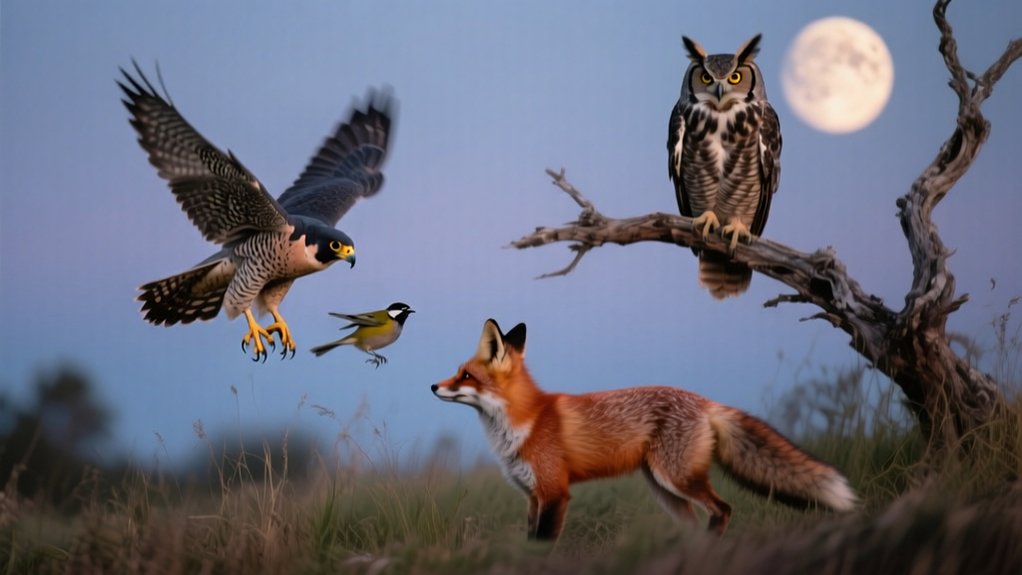
You’ll find many predators hunting birds in the wild, from mammalian hunters like cats, dogs, squirrels, and raccoons to avian predators such as hawks, falcons, and owls. Aquatic predators like northern pike also prey on waterfowl, while insects such as praying mantises can capture small birds.
These predators impact bird survival and reproduction in diverse ways. Understanding their roles and effects reveals deeper insights into bird ecology and conservation challenges.
Mammalian Predators of Birds
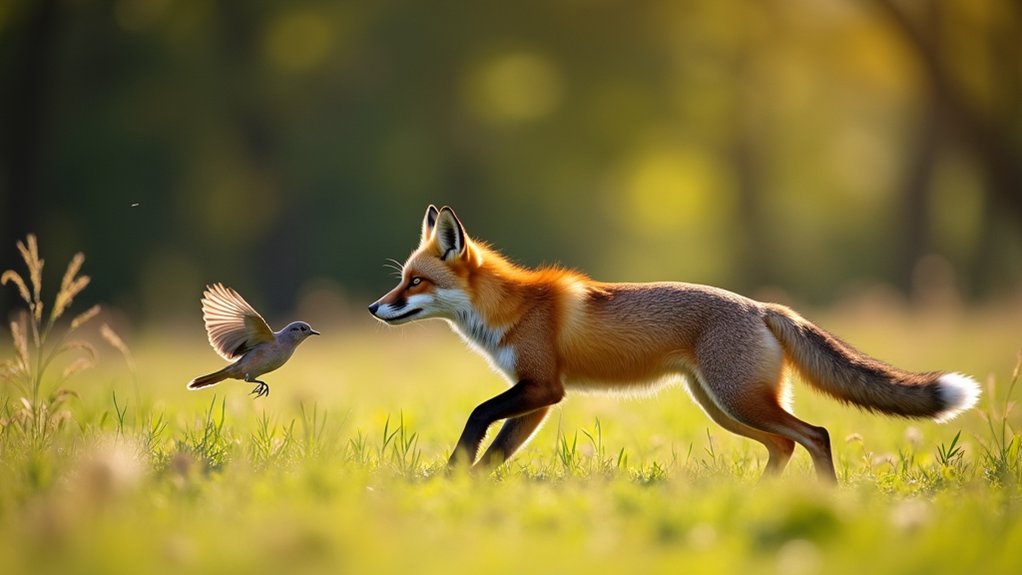
Although birds face numerous threats, mammalian predators considerably affect their populations through direct predation. Mammalian predators such as domestic cats and feral cats are significant contributors, killing an estimated 1.3 to 4 billion wild birds annually in the U.S.
These predators frequently target bird nests, consuming eggs and young birds, which disrupts reproductive success. Other mammals like squirrels and raccoons also impact local bird populations by raiding nests for eggs and nestlings.
Mammalian predators disrupt bird reproduction by raiding nests and consuming eggs and young birds.
Squirrels opportunistically feed on bird nests during the day, while nocturnal raccoons exploit nighttime hours to hunt young birds.
You should recognize that these varied mammalian predators collectively influence bird population dynamics, shaping ecosystem balance through their predation behaviors on vulnerable bird stages such as nests and fledglings.
Cats as Bird Hunters
Mammalian predators such as squirrels and raccoons impact bird populations by targeting nests, but cats stand out due to their exceptional hunting skills and significant predation rates.
Cats are natural predators that hunt and eat small birds with remarkable efficiency. Their keen instincts respond to erratic flight patterns, enabling them to stalk and ambush prey silently.
Both domestic and feral cats contribute to the annual death of 1.3 to 4 billion wild birds in the U.S. Cats often patrol areas near bird feeders, increasing their chances to catch birds that feed on insects.
To reduce this impact, managing cats’ access to dens and using repellents near feeders can help protect vulnerable bird populations from these skilled mammalian predators.
Dogs and Their Role in Bird Predation
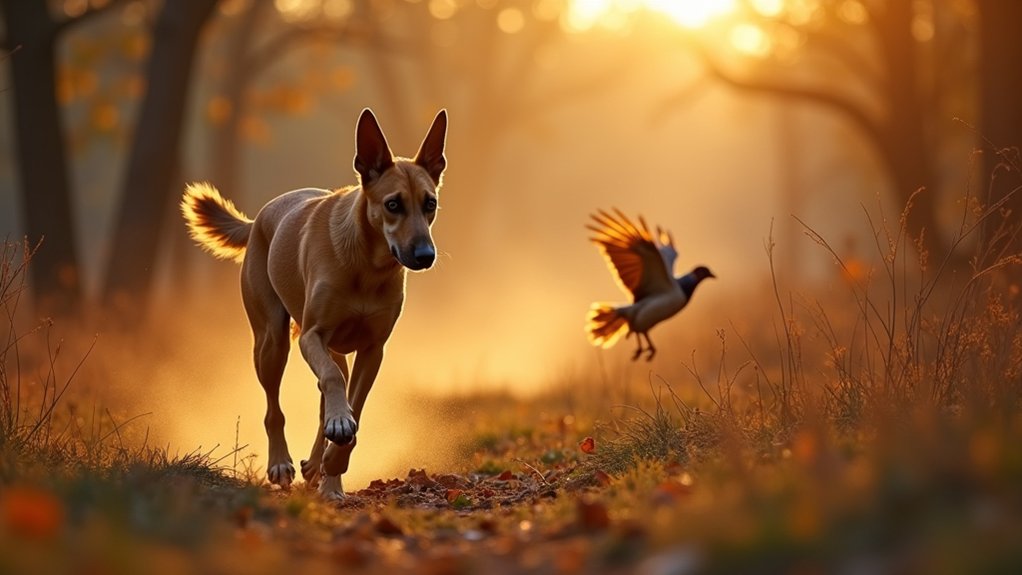
When dogs, especially breeds like retrievers and spaniels, engage in hunting activities, they use their instincts to flush out and retrieve birds efficiently.
You should recognize dogs’ predation on bird species is often intentional during structured hunting rather than random.
However, untrained or unsupervised dogs may chase and harm smaller birds, causing a significant impact on local populations.
Unsupervised dogs can chase and harm smaller birds, significantly impacting local wildlife populations.
Responsible pet ownership is essential to mitigate these effects.
Key points to take into account:
- Dogs retain natural hunting instincts that target birds.
- Predation risk increases when dogs roam freely without supervision.
- Hunting breeds are trained specifically to minimize unintended harm.
- Keeping dogs leashed or confined helps protect wild bird species.
Understanding these factors helps balance dogs’ roles in hunting with conservation efforts.
Squirrels Raiding Bird Nests
Beyond dogs, other mammals like squirrels also impact bird populations by raiding nests. Squirrels, being opportunistic feeders, frequently raid bird nests to consume eggs and chicks. This poses a significant threat to avian offspring.
Their agile climbing abilities allow them to access nests located high in trees or on ledges with ease. In addition to preying on eggs and chicks, squirrels may scavenge injured or weakened adult birds found on the ground.
Their attraction to bird feeders often increases the risk of nest raiding, as these feeders draw both squirrels and birds into close proximity.
To mitigate this, you can install squirrel-proof bird feeders and use baffles. These help deter squirrels from accessing bird nests and feeding sites effectively.
Regular engine bay inspections can also help detect and remove nests early, reducing the chances of squirrels or other predators finding and preying on bird nests near vehicles or nearby structures.
Raccoons’ Nocturnal Bird Predation

Although raccoons primarily hunt at night, their stealthy approach allows them to catch sleeping birds off guard with remarkable efficiency.
As nocturnal predators, raccoons exploit low light conditions aided by their distinctive black mask, enhancing their vision.
They frequently raid nests, consuming eggs and nestlings, which greatly impacts local bird populations. Their opportunistic diet also includes adult birds when available, showing versatile predatory behavior.
Key aspects of raccoons’ nocturnal bird predation include:
- Utilizing night vision to locate vulnerable birds
- Raiding nests to consume eggs and chicks
- Hunting adult birds opportunistically
- Reducing survival rates of breeding bird species
Understanding raccoons’ impact helps clarify their role as considerable nocturnal predators in avian ecosystems.
Snakes Targeting Bird Eggs and Chicks
Because snakes can unhinge their jaws, they efficiently consume bird eggs and chicks by swallowing them whole. As predators, snakes such as constrictors and colubrids climb trees to access nests. They are camouflaged to ambush unsuspecting birds in nesting habitats.
This predation can reduce bird populations, especially where snake and bird habitats overlap. To protect eggs and chicks, mounting bird boxes on metal poles and adding squirrel baffles helps deter snakes.
| Snake Species | Target | Hunting Method |
|---|---|---|
| Constrictors | Eggs | Tree climbing, ambush |
| Colubrids | Chicks | Camouflage, infiltration |
| Rat snakes | Eggs | Nest invasion |
| Tree snakes | Chicks | Stealthy approach |
Fish That Prey on Birds
You might notice that some aquatic predators, like Northern pike and African tigerfish, actually go after birds near the water’s surface.
It’s pretty interesting because these fish don’t just stick to smaller prey—they can target birds too.
Young waterfowl, like ducklings, are especially at risk, mainly when they’re in shallow areas where these fish can easily launch an attack.
Aquatic Ambush Predators
Several species of predatory fish, including Northern pike and largemouth bass, actively hunt birds that come near the water’s surface.
These fish use ambush tactics, relying on stealth and sudden bursts of speed to capture unsuspecting birds.
Their feeding behavior intensifies during peak feeding times, increasing predation risks for birds resting or foraging in shallow waters.
You should recognize that fish can leap from the water to seize birds mid-air or at the surface.
Baby ducks are especially vulnerable due to their proximity to shallow hunting zones.
Predators exploit shallow water habitats where birds nest or feed.
Aggression in fish rises during feeding, enhancing their efficiency as ambush predators.
Understanding these dynamics highlights how aquatic environments shape predator-prey interactions between fish and birds.
Vulnerable Bird Species
Any bird that forages or rests near water surfaces faces increased risk from predatory fish such as Northern pike, largemouth bass, and African tigerfish.
These vulnerable bird species often become prey when they approach shallow waters, where predatory fish use ambush tactics.
Fish like the African tigerfish demonstrate remarkable speed and sharp teeth, enabling sudden attacks, sometimes even leaping out of the water to capture birds.
Young birds, including ducklings, are particularly susceptible due to their limited escape abilities.
These predatory behaviors illustrate the complex interactions within aquatic ecosystems, where both avian and aquatic species compete and evade threats.
Understanding these dynamics is essential for studying ecosystem balance and the survival strategies of vulnerable bird species living in and around water habitats.
Insect Predators of Birds
You’ll find that praying mantises use precise ambush techniques to capture birds.
They often target smaller species like hummingbirds. Their rapid strikes allow them to seize prey quickly.
Sometimes, they even overpower birds larger than themselves.
Understanding these behaviors reveals how insect predators influence bird populations through complex hunting strategies.
Praying Mantis Hunting
Although praying mantises are primarily known as insect predators, they can also pose a significant threat to small bird species such as hummingbirds.
As ambush predators, praying mantises rely on stealth and rapid movement to capture their prey. They use their powerful forelegs to seize birds, often during vulnerable feeding times near bird feeders.
Their predatory efficiency is notable, as they can consume small birds alive, making them one of the more dangerous insect predators in avian ecosystems.
Key points include:
- Praying mantises target small birds, especially hummingbirds.
- They employ ambush tactics to maximize capture success.
- Feeding times increase small birds’ vulnerability.
- Their size and predatory efficiency enable them to overpower avian prey swiftly.
Insect Ambush Techniques
When insects like praying mantises rely on ambush techniques, they exploit camouflage and rapid strikes to capture birds unaware.
These predators blend seamlessly into vegetation, using their coloration and posture as effective camouflage to avoid detection by small birds.
You’ll notice mantises remain motionless, patiently waiting for prey such as hummingbirds to approach. Their strike speed, up to 50 times faster than a blink, guarantees the prey has little chance to evade.
This ambush method relies on precision and timing, enabling mantises to overpower birds despite their size disparity.
As insect predators, mantises demonstrate remarkable efficiency in hunting small birds, consuming them alive.
Understanding these ambush techniques highlights the sophisticated predatory adaptations insects employ in their ecological niches.
Sea Anemones and Unexpected Bird Predation
While sea anemones don’t actively hunt, they position themselves strategically in tidal zones where injured or weak birds may inadvertently come into contact with their stinging tentacles.
These marine predators rely on such unexpected interactions within marine ecosystems to capture vulnerable prey, including injured birds or baby birds fallen near tidal rocks.
Once stung, the bird becomes paralyzed, allowing the anemone to digest it efficiently.
Although birds of prey primarily dominate avian predation, sea anemones represent a rare, non-avian predator contributing to bird mortality.
Keep in mind these key points:
- Sea anemones attach to hard substrates in tidal zones
- Predation targets mainly injured or weak birds
- Stinging tentacles immobilize prey for digestion
- This phenomenon illustrates unique predator-prey dynamics beyond typical bird predation
This highlights an unusual but significant example of predation in marine ecosystems.
Avian Predators: Birds That Hunt Birds
Because they rely on keen eyesight and specialized hunting techniques, avian predators like eagles, hawks, falcons, and owls efficiently target smaller birds as prey.
Birds of prey, or raptors, such as the red-tailed hawk and golden eagle, soar high to scan vast areas before swooping down to hunt small birds.
The Peregrine Falcon exemplifies avian predators’ prowess, plunging at speeds over 320 km/h to capture birds mid-flight.
Smaller raptors like the merlin use agility and speed to pursue prey in open habitats.
Owls, including the great horned owl, exploit their exceptional night vision and silent flight to hunt nocturnally.
These raptors’ keen eyesight and diverse hunting strategies make them formidable predators within bird communities, maintaining ecological balance by controlling populations of smaller avian species.
Although both avian predators and bats have evolved adaptations for flight, they are not closely related, with birds belonging to class Aves and bats to class Mammalia.
Human Impact on Bird Populations
Although birds have adapted to diverse environments, human activities have drastically immersed their habitats, resulting in significant population declines.
Habitat destruction from urban development and agriculture reduces nesting sites, while climate change disrupts migration and breeding cycles.
You should be aware that feral cats kill billions of wild birds annually, posing a major threat.
Pesticide use contaminates food sources, lowering reproductive success.
Key human impacts include:
- Habitat destruction through land conversion
- Predation by introduced feral cats
- Pesticide use harming bird health and survival
- Climate change altering habitats and food availability
These factors collectively contribute to ongoing population declines, highlighting the profound influence of human activities on avian species in the wild. Additionally, environmental stressors caused by human-induced changes can trigger panic flights and collisions, further increasing bird mortality rates.
Protecting Birds From Predators
When you aim to protect birds from predators, implementing targeted measures can markedly reduce risks posed by domestic cats, snakes, squirrels, and raptors.
To protect birds effectively, restrict cat shelters near feeding areas and apply cat repellents, given cats’ high predation rates.
Install bird boxes on metal poles and add squirrel baffles to prevent snakes from accessing nests. Use squirrel-resistant feeders and maintain baffles around pole-mounted houses to deter squirrels that raid feeders and prey on eggs.
Clean birdhouses annually to minimize insect predation on small birds like hummingbirds. Provide adequate habitat cover and shelter near feeders to shield birds from raptors such as hawks and eagles.
Preventing predator access through habitat management and feeder modifications consequently plays an essential role in safeguarding local bird populations. For additional protection, consider reinforcing vulnerable areas with physical barriers to reduce both predator and bird-related damage around nesting and feeding sites.
Ecological Importance of Predation in Bird Populations
Understanding the ecological importance of predation reveals how it actively immerses bird populations by removing weak, sick, and old individuals. This process promotes genetic diversity and overall species resilience.
Predators in the food web, especially raptor species considered birds of prey, help keep their numbers balanced. This prevents overpopulation and habitat degradation.
Small to medium-sized predators, including mammals and reptiles, also influence bird reproductive success. This dynamic interaction sustains ecological balance by shaping bird behavior and population structure.
- Raptors regulate bird populations by targeting vulnerable individuals
- Predators influence nesting and foraging adaptations in prey birds
- Small to medium-sized predators raid nests, affecting reproductive strategies
- Predation prevents resource depletion, maintaining ecological balance across ecosystems
Frequently Asked Question
How Do Predators Locate Bird Nests in Dense Habitats?
You locate bird nests in dense habitats by using a combination of sensory cues and physical abilities.
Predators like squirrels and raccoons rely on their keen eyesight and strong sense of smell to detect nests hidden within thick vegetation.
Snakes climb adeptly through branches to reach concealed nests.
Cats approach silently, detecting subtle bird movements.
Birds of prey use exceptional vision from high altitudes, while some insects utilize camouflage and ambush tactics to find nests effectively.
What Adaptations Help Birds Avoid Being Hunted?
You wouldn’t expect a bird to outsmart a predator like a knight jousting in armor, yet they do.
Birds use cryptic coloration to blend into their surroundings, making you overlook them. Their keen vision spots threats early, letting you fly away swiftly.
Agile flight maneuvers confuse predators, while alarm calls warn your flock.
Nesting in inaccessible spots or making false nests protects your young from mammalian hunters, increasing your survival odds.
Do Migratory Birds Face Different Predators Than Resident Birds?
Yes, migratory birds face different predators than resident birds because their seasonal movements expose them to diverse habitats and predator species.
While resident birds often deal with terrestrial predators like cats and raccoons, you’ll find migratory birds more vulnerable to aerial predators such as peregrine falcons and hawks during their journey.
They also encounter fish-eating birds like ospreys at stopover sites, requiring heightened vigilance and adaptive behaviors to survive.
How Do Environmental Changes Affect Predator-Prey Dynamics in Birds?
Imagine feral cats invading a forest, increasing predation on native birds.
Environmental changes like habitat loss and climate shifts can disrupt predator-prey dynamics by altering food and shelter availability.
This forces predators to expand hunting areas or target different prey, intensifying pressure on bird populations.
You’ll see that such changes destabilize established relationships, often leading to decreased bird survival and biodiversity loss, highlighting the intricate balance in ecosystems.
Are There Any Symbiotic Relationships Between Birds and Their Predators?
Yes, you can observe symbiotic relationships between birds and their predators, often involving mutual benefits or indirect advantages.
For example, some birds like oxpeckers feed on parasites found on large mammals, simultaneously alerting them to aerial predators.
Raptors control pest populations, indirectly aiding smaller birds.
Furthermore, species such as the red-billed quelea use flocking strategies to reduce individual risk, benefiting from predator presence by diluting predation pressure.
Conclusion
You should understand that predators play an essential role in maintaining bird population balance. For instance, studies show domestic cats alone kill an estimated 1.3 to 4 billion birds annually in North America.
This statistic highlights the significant impact mammalian predators have on avian species. By recognizing these threats and implementing protective measures, you can contribute to conserving bird populations and preserving ecological dynamics shaped by natural predation processes.